Olivier Audino
Webinar
Tail Spend: The Overlooked Lever to Free Up Your Buyers' Time
Tuesday March 31 at 2:00 PM

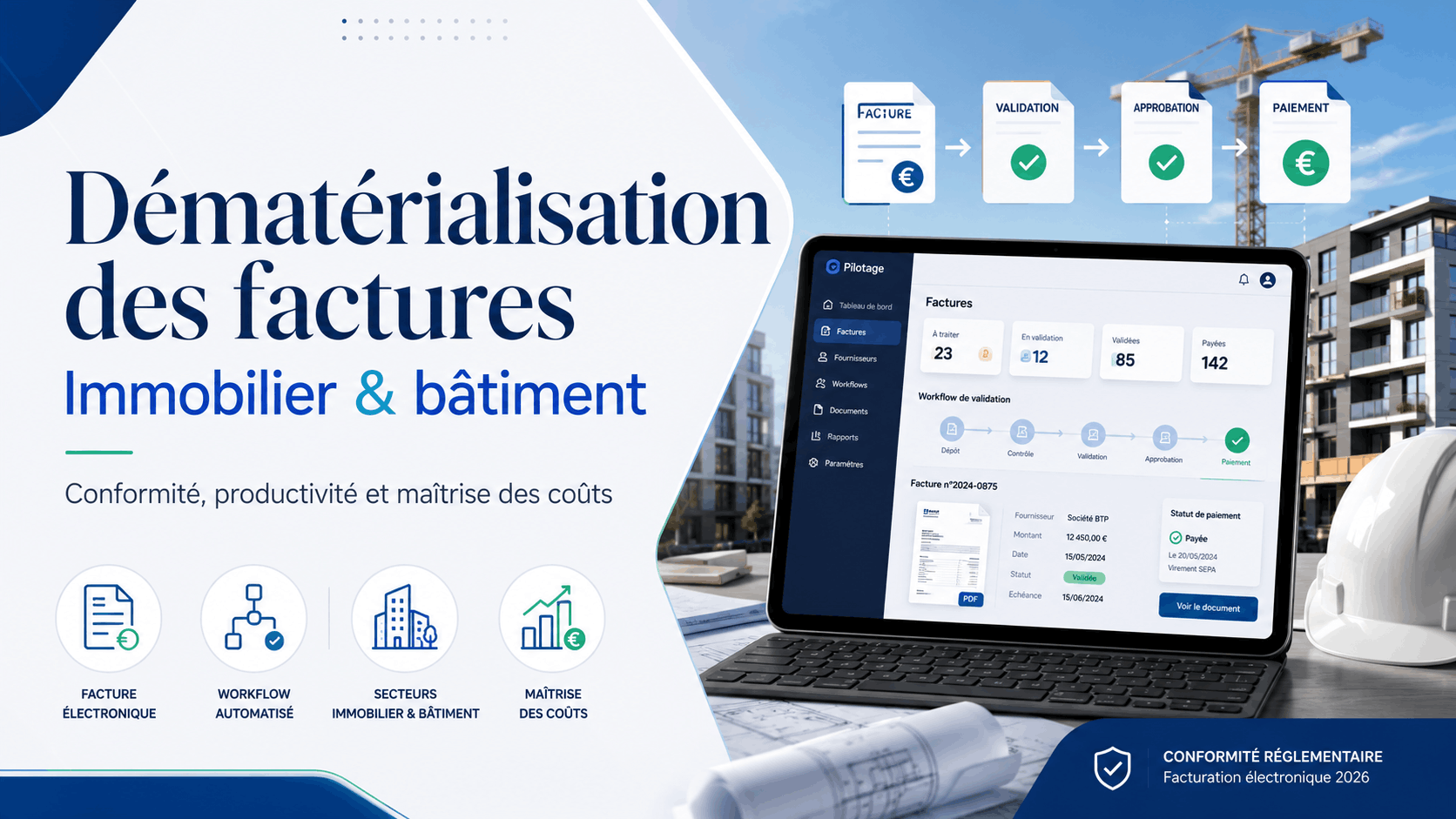

Invoice dematerialization is no longer just an administrative project. For companies in real estate, construction, property management, development or project ownership, it is becoming a structural issue. Document volumes are high, validation circuits are often complex, and errors can have significant financial consequences.
Supplier invoices, works progress statements, calls for funds, deposits, retention guarantees, purchase orders, contracts, supporting documents: every operation generates a documentary chain that must be tracked, controlled, validated and archived.
With the progressive rollout of electronic invoicing in France, companies now need to plan ahead for their organization. According to the AIFE, all companies will need to be able to receive electronic invoices starting September 1, 2026, while the obligation to issue them will apply progressively depending on company size: large companies and mid-sized companies (ETI) from September 1, 2026, followed by SMEs and micro-businesses from September 1, 2027.
Key takeaway: in real estate and construction, invoice dematerialization should not be seen solely as a regulatory obligation. It is also a tool for financial steering, reducing disputes and improving supplier relationships.
Traditional invoice management still too often relies on email exchanges, scattered attachments, Excel files, manual validations and internal follow-ups. This approach may work for a small organization with few flows, but it quickly shows its limits as volumes increase.
In real estate and construction, the difficulty is compounded by the diversity of stakeholders involved: general contractors, subcontractors, engineering firms, property managers, developers, asset managers, project owners, materials suppliers, operators or maintenance providers.
The French electronic invoicing reform will change companies' habits. Invoices will no longer simply be sent by email in PDF format. They will need to pass through accredited platforms or solutions compatible with the future regulatory framework.
In practice, companies will need to be able to:
Official information published by the tax administration recalls that electronic invoicing aims in particular to simplify life for businesses, strengthen competitiveness, secure exchanges and improve knowledge of economic activity.
In this context, companies in the real estate and construction sector have an interest in preparing early. Their environment is rarely linear: a construction site can involve several lots, several progress statements, several technical validations and several levels of budget control.
Compliance matters, but it is not enough on its own to justify a dematerialization project. The real gain lies in day-to-day efficiency.
An invoice that is poorly transmitted, lost in an inbox, or validated too late can cause:
Dematerialization makes it possible to centralize flows, automate controls, and track every invoice from receipt through to payment. For companies that want to structure their financial management, invoice dematerialization in real estate and construction with freedz.io can thus become a concrete lever for organization and process reliability.
The invoice of a standard service provider is often simple to control: an order, a service, an invoice, a payment. In construction and real estate, the reality is more nuanced. Financial flows are part of projects that are long, fragmented and heavily documented.
A construction site can last several months, or even several years. Invoices sometimes need to be reconciled with quotes, contracts, purchase orders, works progress statements, riders/amendments, official reports, technical validations or reservations.
The works progress statement is a central document in the life of a construction site. It allows progressive invoicing of the actual progress of the work. But it requires precise control: does what is invoiced actually match what has been completed? Are the progress percentages consistent? Are retention guarantees correctly applied? Have the amendments been validated?
| Process Step | Common Risk | Benefit of Dematerialization |
|---|---|---|
| Invoice Receipt | Document sent to the wrong contact | Centralization of incoming flows |
| Matching with the purchase order | Mismatch between order, quote and invoice | Automatic or semi-automatic control |
| Operational Validation | Delay by the site manager or property manager | Traceable approval workflow |
| Accounting Control | VAT, legal details or incomplete data | Structured information verification |
| Payment | Delay or duplicate | Status tracking and history |
| Archiving | Loss of supporting document | Organized digital retention |
This table highlights an essential point: dematerialization is not simply about eliminating paper. Above all, it helps to secure the entire invoice processing cycle.
For procurement and finance departments, this supports a broader objective: better structuring spend categories, suppliers and approval workflows. On this topic, see this Buy Made Easy article on procurement mapping, which helps identify volumes, risks and optimization opportunities.
Real estate professionals do not manage supplier invoices alone. They must also track calls for funds, charges, provisions, re-invoicing, management fees, maintenance services and asset-related expenses.
In this context, traceability becomes critical. Each amount must be justified and linked to the correct property, unit, project, contract or supplier.
Dematerialized management notably makes it possible to:
Key consideration: Dematerialization should not reproduce a paper process in digital form. It should be an opportunity to simplify, clarify and automate decision workflows.
A successful dematerialization project does not begin with choosing a tool. It starts with a clear understanding of existing flows. How many invoices are received each month? Through which channels? Who approves them? What are the main causes of blockage? Which suppliers generate the most disputes? Which documents need to be matched?
Without this preliminary analysis, the company risks digitizing a poorly designed process. The benefits will then be limited.
Before deploying a solution, it is advisable to create a simple map of document and financial flows.
The key questions to ask are:
This step helps build a realistic target process. The objective is not to add complexity, but to create a smoother, more reliable and more measurable workflow.
Not all invoices should follow the same workflow. A recurring maintenance invoice, a major progress billing invoice and a call for funds do not carry the same level of risk.
It is therefore preferable to implement differentiated workflows.
| Flow Type | Recommended Approval | Objective |
|---|---|---|
| Standard supplier invoice | Accounting + operational manager | Verify the service and amount |
| Progress billing | Operations + financial control | Confirm progress and retentions |
| Call for funds | Property manager + finance | Allocate the amount to the correct asset |
| Invoice with discrepancy | Enhanced approval | Resolve the discrepancy before payment |
| Compliant recurring invoice | Simplified workflow | Speed up processing |
This table highlights an essential point: dematerialization is not just about eliminating paper. Above all, it secures the entire invoice processing cycle.
For purchasing and finance departments, this ties into a broader issue: better structuring spend categories, suppliers and validation circuits. On this topic, you can consult the Buy Made Easy article on purchasing mapping, useful for identifying volumes, risks and optimization opportunities.
Real estate players do not manage only supplier invoices. They also need to track calls for funds, charges, provisions, rebilling, management fees, maintenance services or asset-related expenses.
In this context, traceability becomes decisive. Every amount must be able to be justified and linked to the right building, the right lot, the right construction site, the right contract or the right supplier.
Dematerialized management makes it possible in particular to:
Point of caution: dematerialization should not simply reproduce a paper process in digital form. It should be an opportunity to simplify, clarify and automate decision-making circuits.
A successful dematerialization project does not start with choosing a tool. It starts with a good understanding of existing flows. How many invoices are received each month? Through which channels? Who validates them? What are the main causes of blockage? Which suppliers generate the most disputes? Which documents need to be reconciled?
Without this preliminary analysis, the company risks digitizing a poorly designed process. The gain would then be limited.
Before deploying a solution, it is recommended to carry out a simple mapping of documentary and financial flows.
The key questions to ask are the following:
What types of documents do we handle?Invoices, works progress statements, calls for funds, credit notes, purchase orders, contracts, quotes, amendments.
Who is involved in the process?Accounting, finance department, purchasing, property managers, program managers, site supervisors, suppliers, service providers.
What controls are needed?Amount, VAT, mandatory information, budget commitment, site progress, acceptance of service, contractual compliance.
What are the friction points?Validation delays, incomplete documents, lack of visibility, duplicates, supplier disputes, allocation errors.
What indicators should be tracked?Average validation time, rate of blocked invoices, volume per supplier, pending invoices, disputes, payment deadlines.
This step makes it possible to build a realistic target process. The goal is not to add complexity, but to create a smoother, more reliable and more measurable circuit.
Not all invoices should follow the same circuit. A recurring maintenance invoice, a large works progress statement and a call for funds do not carry the same level of risk.
It is therefore preferable to implement differentiated workflows.
This approach makes it possible to focus human controls on sensitive flows, while automating simple cases. It is particularly useful in multi-site organizations, real estate groups or construction companies managing several operations in parallel.
The success of the project also relies on user support. Teams need to understand why the process is changing, how to use the tool and what benefits they can expect from it. A good dematerialization project is not only technical: it is also organizational.
Invoice dematerialization is often presented as a regulatory constraint. For players in real estate and construction, however, it can become a genuine operational advantage.
By centralizing flows, automating controls, structuring validations and improving traceability, companies can reduce administrative costs, limit disputes, make payments more reliable and better steer their operations.
The benefits are particularly strong when the project is designed area by area: works progress statements, calls for funds, supplier management, budget tracking, archiving, operational validation and financial control.
In a sector where margins can be under pressure and where every processing delay can affect cash flow, dematerialization becomes a performance lever. The question is therefore no longer whether to move forward, but how to build a system that is robust, compliant and genuinely useful to teams.
What is invoice dematerialization?Invoice dematerialization involves replacing paper-based or manual processing with structured digital flows, enabling the receipt, control, validation, payment and archiving of invoices.
Why is dematerialization important in construction?In construction, invoices are often linked to works progress statements, amendments, retention guarantees and technical validations. Dematerialization improves control, traceability and payment tracking.
What are the benefits for real estate players?Real estate players can better track calls for funds, charges, rebilling, suppliers and expenses by asset. This saves time and reduces allocation errors.
How can a company prepare for electronic invoicing?It is necessary to map flows, identify validation circuits, verify supplier data, choose a suitable solution and train teams ahead of regulatory deadlines.
Note: sponsored article