Olivier Audino
Webinar
Tail Spend: The Overlooked Lever to Free Up Your Buyers' Time
Tuesday March 31 at 2:00 PM



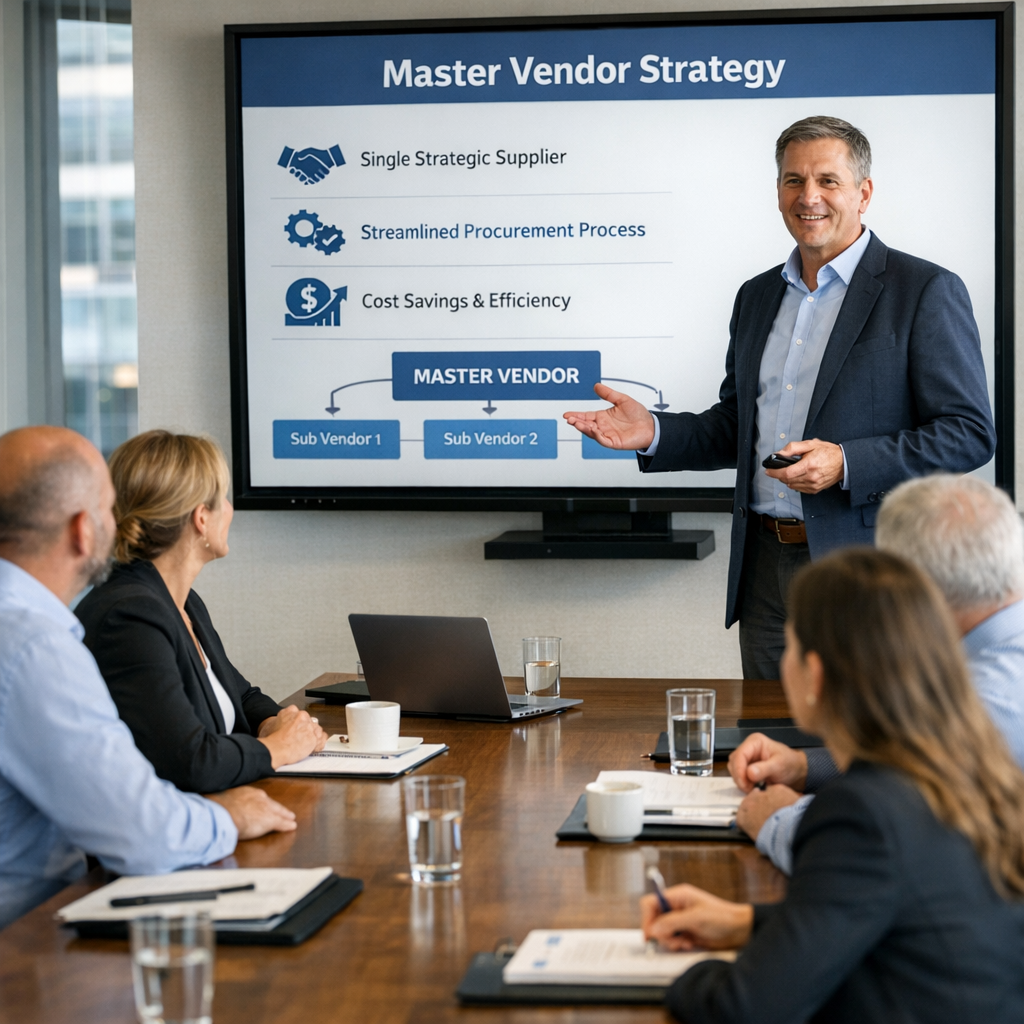
A master vendor is an organizational model in which a single actor becomes the main entry point for managing a defined scope of needs and suppliers. The objective is not to add an extra intermediary, but to structure dispersed flows through clear rules, defined governance, and reliable operational control.
In organizations where procurement structuring remains partial, this type of framework helps quickly restore visibility on commitments and execution quality. Rather than multiplying controls after the fact, the master vendor integrates coordination directly into the process.
In practice, the master vendor centralizes orchestration: needs qualification, sourcing, selection, service delivery, performance monitoring, and data consolidation. While it may rely on a panel of partners, it retains full responsibility for coordination and compliance.
This logic aligns closely with supplier management approaches supported by SRM , where the real challenge is not the number of suppliers, but the ability to reduce exceptions and limit the administrative burden placed on internal teams.
The model is particularly relevant when performance depends on execution continuity, traceability, and compliance with shared rules. Internal control frameworks such as COSO emphasize that robustness comes from controls embedded within processes, not from an accumulation of late-stage checks. This is precisely what a properly governed master vendor enables.
The master vendor model responds to a very concrete operational reality: in certain categories, companies neither have the interest nor the capacity to directly manage a large number of suppliers, contracts, and exceptions. The hidden cost is rarely driven by unit price. It is driven by coordination, compliance, and the ability to absorb volume without friction.
This challenge is particularly visible in environments where tail spend management represents a significant share of total administrative workload. As volumes grow, dispersion and exception handling quickly become structural inefficiencies.
By stabilizing rules and consolidating data, the master vendor also helps realign procurement, operations, and finance around a shared view of commitments and execution. This coherence makes it easier to control spend, measure performance, and reduce deviations, without multiplying manual checks or corrective workflows.
To properly assess the relevance of a master vendor model, it is essential to clarify what it is not. Misunderstandings often lead to inappropriate deployments or unrealistic expectations.
These distinctions help explain why the master vendor model delivers value only when it is positioned as a structuring mechanism, not as a generic outsourcing solution.

Comparing a master vendor with a traditional supplier panel helps clarify the real operational impact of each model. In a supplier panel setup, the company maintains direct relationships with multiple suppliers and coordinates contracts, flows, and controls internally.
This approach can work on limited scopes, but it quickly becomes complex as volumes increase and the number of actors grows— especially in environments where supplier management practices remain heterogeneous.
The master vendor model shifts the logic. Instead of managing a multitude of operational relationships, the company pilots a single, structured setup. Coordination, compliance, and reporting are handled by one accountable actor, reducing friction points and stabilizing execution.
In a supplier panel, each supplier becomes an operational entry point. Teams must manage multiple contracts, conditions, and validation circuits, which naturally multiplies exceptions.
With a master vendor, the entry point is unique. Rules are centralized and applied consistently, making spend control easier and limiting downstream deviations. This centralization is particularly effective in multi-site environments, where local practices tend to diverge over time.
Cost differences are not driven solely by negotiated prices, but by the overall cost of coordination. Poorly structured supplier panels lead to variable lead times, frequent follow-ups, and partial visibility on commitments.
By consolidating flows and data, the master vendor improves predictability and strengthens steering capability— a key driver of procurement performance .
These differences explain why the master vendor model is often preferred on complex or high-volume scopes. The next section focuses on the concrete benefits for procurement leadership teams.
Using a master vendor is not a tactical shortcut. It is a structural lever for procurement teams facing complex, dispersed, or hard-to-control flows. The value of the model goes beyond operational simplification: it enables procurement to regain control over scopes that consume significant effort for limited strategic return.
In organizations where procurement teams constantly arbitrate between strategic priorities and day-to-day exception handling, the master vendor helps refocus efforts on value creation. This logic naturally aligns with a procurement performance approach, where reducing administrative burden does not come at the expense of execution quality.
One of the first tangible benefits is a significant reduction in administrative tasks. By standardizing rules and centralizing coordination, the master vendor limits the number of interfaces, manual validations, and after-the-fact corrections.
This approach is particularly effective on recurring, low-unit-value flows, close to C-class purchasing logic, where repetition amplifies administrative workload. Fewer exceptions also mean fewer frictions between procurement, operations, and finance.
In this context, the invoice becomes a confirmation step rather than a blocking point, which helps fluidify the procure-to-pay process and improves overall flow reliability.
By consolidating data from multiple suppliers and sites, the master vendor provides a unified view of volumes, lead times, and service levels. This visibility makes steering easier and supports fact-based decision-making, especially when identifying deviations or prioritizing corrective actions.
Procurement teams gain analytical capacity without multiplying tools or parallel reporting, a key enabler of effective procurement dashboards .
The master vendor also acts as a compliance filter. It enforces rules, verifies contractual commitments, and monitors service quality. This role is critical in environments exposed to operational or regulatory risk, where multiplying actors mechanically increases exposure.
These benefits explain why master vendor setups are often chosen for complex or sensitive scopes. The next section explores the contexts in which the model is truly relevant— and those where it is not.
The master vendor model is not designed to cover all purchasing categories. Its relevance depends on the level of complexity, dispersion, and criticality of the flows involved. When a scope combines high volumes, multiple actors, and strong operational constraints, the model helps restore coherence where direct management becomes costly and unstable.
This is often the case in organizations where procurement structuring has not kept pace with business growth or with the diversification of needs. In such contexts, the master vendor acts as a targeted lever, not a universal solution applied indiscriminately.
Multi-site environments are a natural use case for the master vendor. Each site develops its own practices, suppliers, and habits, which quickly leads to heterogeneity that is difficult to control at group level.
By centralizing rules while preserving operational flexibility, the master vendor absorbs complexity without constraining local teams. This balance is particularly effective when procurement must reconcile local autonomy with global control and visibility.
The model is also highly relevant for recurring, low-unit-value flows, where repetition creates disproportionate administrative workload. These flows are close to C-class purchasing logic, where volume amplifies inefficiencies.
By standardizing common cases, the master vendor drastically reduces exceptions and improves the fluidity of the procure-to-pay process . This, in turn, strengthens long-term procurement–finance steering.
Understanding these contexts helps avoid inappropriate deployments. The next section looks at how the master vendor actually impacts procurement performance beyond organizational design.
The impact of a master vendor on procurement performance goes far beyond organizational simplification. It primarily translates into improved predictability, execution reliability, and the ability to steer purchasing flows over time.
When rules are stabilized and applied consistently, procurement teams can finally focus on analysis and decision-making instead of constantly managing emergencies and exceptions. In this sense, the master vendor acts as a maturity accelerator, especially on scopes that have historically been difficult to structure.
By consolidating data from multiple suppliers and sites, the master vendor significantly improves the reliability of key indicators: volumes, lead times, service levels, deviations, and incidents.
This consolidation makes it possible to build truly actionable dashboards, as opposed to fragmented data sets that are hard to compare or exploit. It reflects the fundamentals of a procurement dashboard built on consistent, shared information.
Procurement performance does not stop at contracting. It extends to execution and to the ability to translate commitments into operational results.
By reducing exceptions and stabilizing coordination, the master vendor secures the procure-to-pay process and contributes to shorter lead times and lower hidden costs.
This consistency also strengthens collaboration with finance. Data becomes more reliable, forecasts more accurate, and arbitration faster. Performance turns into a shared topic, not a procurement-only metric.
These effects explain why the master vendor is often selected as a performance lever on complex purchasing scopes. The next section addresses the limits and points of vigilance required to secure the model over time.
While a master vendor can deliver strong benefits on the right scopes, it is not without risks. Like any delegation model, it must be precisely framed to avoid unintended side effects.
The main point of vigilance lies in governance. Without clear rules and active steering, the setup can quickly lose transparency and drift away from procurement objectives. A master vendor should be embedded in a structured procurement steering framework , not operated as a standalone solution.
Delegating coordination to a single actor mechanically creates a dependency risk. Without strong contractual safeguards, the company may gradually lose control over data, practices, and negotiation levers.
This risk increases when contracts lack clear reversibility clauses or when performance indicators are not shared transparently. Best practices in supplier contract management stress the importance of addressing these points upfront.
To mitigate this dependency, procurement must retain internal analytical capacity: understanding flows, reading indicators, and challenging the master vendor on performance and outcomes. The model should strengthen governance, not replace it.
An effective master vendor relies on clear governance and shared indicators. Without reliable reporting, the setup becomes a “black box” that is difficult to steer.
Procurement teams must be able to track volumes, service levels, deviations, and incidents through coherent dashboards, such as a procurement dashboard . Transparency is also essential to maintain credibility with internal stakeholders.
When these vigilance points are anticipated, the master vendor becomes a powerful lever for a clearer and more robust procurement organization. The next section synthesizes when the model truly creates value— and when it should be avoided.
The master vendor is neither a universal solution nor a purely organizational choice. It becomes a genuine performance lever when its scope is clearly defined and aligned with the company’s operational challenges.
In contexts where supplier dispersion, multi-site operations, and high transaction volumes generate excessive administrative workload, the model helps restore visibility and control. This is often the case in environments where procurement must evolve to support business growth or increasing operational complexity.
Conversely, deploying a master vendor without a prior diagnostic can produce the opposite effect: rigidity, excessive dependency, and loss of proximity with key suppliers. The model only makes sense when it absorbs unnecessary complexity— not when it interferes with high-value decisions.
Properly positioned, the master vendor acts as a procurement maturity accelerator. It stabilizes execution, consolidates data, and strengthens steering— particularly on flows close to C-class purchasing, where repetition amplifies inefficiencies.
In these configurations, procurement teams gain time, visibility, and greater capacity to pilot performance objectively.
On strategic purchases with low volumes or high value-added, direct supplier management remains the most effective option. Introducing a master vendor in such cases can add an unnecessary layer and reduce agility.
The key therefore lies in arbitration: identifying where the master vendor creates measurable value, and where alternative approaches remain more relevant. This framing step is essential to avoid default choices and ensure long-term performance.
The master vendor model is neither a shortcut nor a universal answer. When properly positioned, it becomes a powerful lever to restore control over complex, dispersed, and administratively intensive purchasing scopes. Its value lies less in structural change than in its ability to simplify execution while strengthening governance.
By centralizing coordination, standardizing rules, and consolidating data, the master vendor helps procurement teams move away from constant exception handling and refocus on steering, analysis, and value creation. This is particularly true for recurring, high-volume flows close to C-class purchasing, where operational inefficiencies quickly erode performance.
However, the model only delivers results when its scope is clearly defined, governance is actively managed, and transparency is built into the setup. Without these conditions, the master vendor can create rigidity rather than clarity.
The real challenge is therefore not whether to adopt a master vendor, but where, why, and under which governance conditions it makes sense for your organization.
Wondering if a master vendor model is relevant for your purchasing flows?
Assess the relevance of a master vendor setup with a Buy Made Easy expert and identify the scopes where structured delegation can create measurable procurement performance gains.
A master vendor is a single actor responsible for coordinating a defined scope of suppliers and services on behalf of a company. It acts as a centralized entry point, applies shared rules, and consolidates data to simplify operations and reduce administrative complexity.
In a supplier panel model, the company manages multiple suppliers directly, including contracts, coordination, and controls. With a master vendor, this coordination is centralized and carried by one accountable actor, which reduces interfaces, exceptions, and operational dispersion.
The model is particularly relevant for complex environments: multi-site organizations, high-volume recurring flows, and categories with a high number of suppliers. It is often used on scopes close to C-class purchasing, where administrative workload is disproportionate compared to the strategic value of transactions.
No. A master vendor does not replace procurement strategy or governance. It operates within a framework defined by the company, under clear rules, objectives, and performance indicators. The role of procurement remains to steer, control, and challenge the setup.
The main risks include excessive dependency, loss of transparency, and insufficient governance. Without clear KPIs, reporting, and reversibility clauses, the company may gradually lose control of the model. These risks can be mitigated through strong contractual framing and active procurement steering.
The main value is rarely limited to unit price reductions. The real gains come from lowering hidden costs: fewer exceptions, less manual coordination, improved visibility, and more predictable execution. These elements have a direct impact on overall procurement performance.
Success relies on three key factors: a clearly defined and limited scope, a structured contract covering responsibilities, KPIs and reversibility, and an internal capability to analyze and challenge performance. The master vendor should strengthen procurement governance, not replace it.



.svg)