Accounting & Taxation

AI Procurement 2024: Evolution and Optimal Strategies

Published By
Olivier Audino
Tags
Sourcing
In 2024, artificial intelligence is radically revolutionizing purchasing strategies across modern enterprise organizations.

As AI technologies become increasingly sophisticated, they enable procurement leaders not only to optimize cost structures and boost operational efficiency, but also to forecast market shifts with remarkable precision.

1. Cost Optimization & Predictive Market Intelligence

Integrating advanced AI algorithms into everyday purchasing workflows transforms standard procurement functions into proactive value engines.

By evaluating large datasets in real time, AI tools uncover hidden cost-saving opportunities and equip buyers with predictive market intelligence—allowing teams to anticipate price fluctuations and secure optimal commercial terms.

Key Advantages of AI Integration in Purchasing

  • Precision Cost Optimization: Pinpoint spend inefficiencies and streamline acquisition costs.
  • Predictive Market Forecasting: Anticipate supply fluctuations and price trends with remarkable precision.
  • Enhanced Operational Efficiency: Automate routine purchasing tasks to accelerate cycle times.
  • Strategic Decision-Making: Leverage data-backed insights to guide enterprise-level sourcing strategies.

2. Influencing Strategic Decisions & Transforming Industries

The integration of AI into purchasing processes goes far beyond basic task automation—it directly influences high-level strategic decisions and reshapes competitive dynamics across entire industries.

Discovering best practices and anticipating key technological developments is essential for procurement leaders seeking to maintain agility and market leadership in an ever-changing economic environment.

Conclusion: Stay Competitive in an Evolving Market

Shape the Future of Your Sourcing Strategy

Adopting AI-driven tools, adopting best practices, and anticipating technological shifts allows your business to optimize operations and maintain a lasting competitive edge.

Transform your purchasing processes, predict market trends, and drive strategic growth today.

General Introduction to AI Trends in Procurement

Innovations in artificial intelligence (AI) are accelerating rapidly, fundamentally reshaping enterprise procurement and sourcing strategies.

From real-time strategic decision-making to predictive analytics and sustainable purchasing, AI systems are moving from supportive tools to essential operational drivers.

1. Major Technological Trends: Focus on Autonomous AI

Autonomous Systems & Real-Time Strategy: Recent developments are advancing toward systems that operate with greater autonomy, capable of making strategic decisions in real time.

These technological advances promise to radically transform traditional purchasing methodologies—delivering superior operational efficiency and an enhanced capacity to adapt dynamically to volatile market conditions.

2. Why AI Represents a Key Tipping Point in Procurement

Data Management, Sustainability & CSR Goals: The widespread adoption of AI solutions is driving fundamental shifts in how organizations process purchasing data and communicate with internal teams and external suppliers.

AI enables accurate predictive analytics—vital for optimizing purchasing strategies and reducing total acquisition costs. Furthermore, it fosters sustainable and responsible procurement practices aligned with regulatory mandates and corporate social responsibility (CSR) objectives.

Pillars of AI Transformation in Purchasing

  • Real-Time Autonomous Decision-Making: Transition from manual processing to intelligent, self-optimizing procurement workflows.
  • Predictive Analytics & Cost Savings: Forecast market fluctuations accurately to secure advantageous commercial terms.
  • Streamlined Communication: Enhance transparency across internal stakeholders and supplier networks.
  • Sustainable Procurement Alignment: Integrate environmental and CSR compliance directly into sourcing criteria.

3. Visualizing the Impact of AI on Purchasing Strategy

Interactive Dashboards & Data-Driven Insights: The concrete impact of AI on purchasing is evident through interactive dashboards and AI-enhanced management platforms.

Providing procurement leaders with real-time insights enables highly responsive, accurate decision-making. Integrating AI into existing infrastructure consistently boosts market competitiveness while driving down operational costs.

Conclusion: Harness the Power of AI Sourcing Today

Elevate Your Procurement Operations with Modern AI

Integrating autonomous AI capabilities, real-time spend visualization, and predictive analytics ensures maximum operational efficiency and cost discipline.

Transform your purchasing strategies, predict market trends, and secure a lasting competitive advantage today.

Evolution of AI in the Purchasing Department

Over the past few years, the procurement landscape has undergone a significant transformation driven by the gradual integration of artificial intelligence.

Predictive analytics tools and process automation have optimized workflows, improved risk management, and reduced operational costs. Adopting these next-generation technologies refines procurement strategies and strengthens collaboration across supply chain stakeholders.

1. Revolutionary AI Tools Transforming Procurement

Emerging AI tools are fundamentally redefining traditional purchasing practices:

Natural Language Processing (NLP): Parses and analyzes thousands of complex purchase contracts in seconds to highlight key risks and obligations.
Autonomous Buying Robots: Leverage advanced algorithms to negotiate commercial terms and execute transactions automatically.

These tools deliver unprecedented operational speed, high precision, and personalized sourcing journeys.

Core AI Innovations in Procurement

  • AI-Based Supplier Management: Elevate vendor selection, evaluation, and continuous compliance monitoring.
  • Predictive Risk Management: Forecast supply chain bottlenecks and vendor failures before they happen.
  • Automated Autonomous Negotiation: Deploy intelligent buying bots using algorithms to secure optimal pricing and terms.
  • Strategic Talent Reallocation: Automate low-value tasks to free human talent for high-stakes decision-making.

2. How AI Strengthens Purchasing Competitiveness

Integrating AI into enterprise purchasing strategies generates a distinct competitive edge.

Artificial intelligence increases agility in response to market volatility and accurately forecasts consumer demand through advanced data analytics. By automating repetitive administrative tasks, procurement teams focus on high-value strategic initiatives that directly boost enterprise profitability and long-term expansion.

3. Technological Advances: Shift from 2023 to 2024

Technology Domain State of Impact in 2023 State of Impact in 2024
Predictive Spend Analytics Modern / Emerging Highly Advanced
Autonomous Negotiation Robots Initial Introduction Common Usage
NLP for Contract Analysis Experimental Widespread Adoption

Conclusion: Harness Next-Gen AI in Your Sourcing Strategy

Transform Your Procurement Operations with Modern AI

From automated contract analysis and predictive risk modeling to autonomous negotiation bots, integrating artificial intelligence secures supply chain resilience and drives sustainable cost optimization.

Empower your procurement team, eliminate manual friction, and lead the market with AI-driven purchasing today.
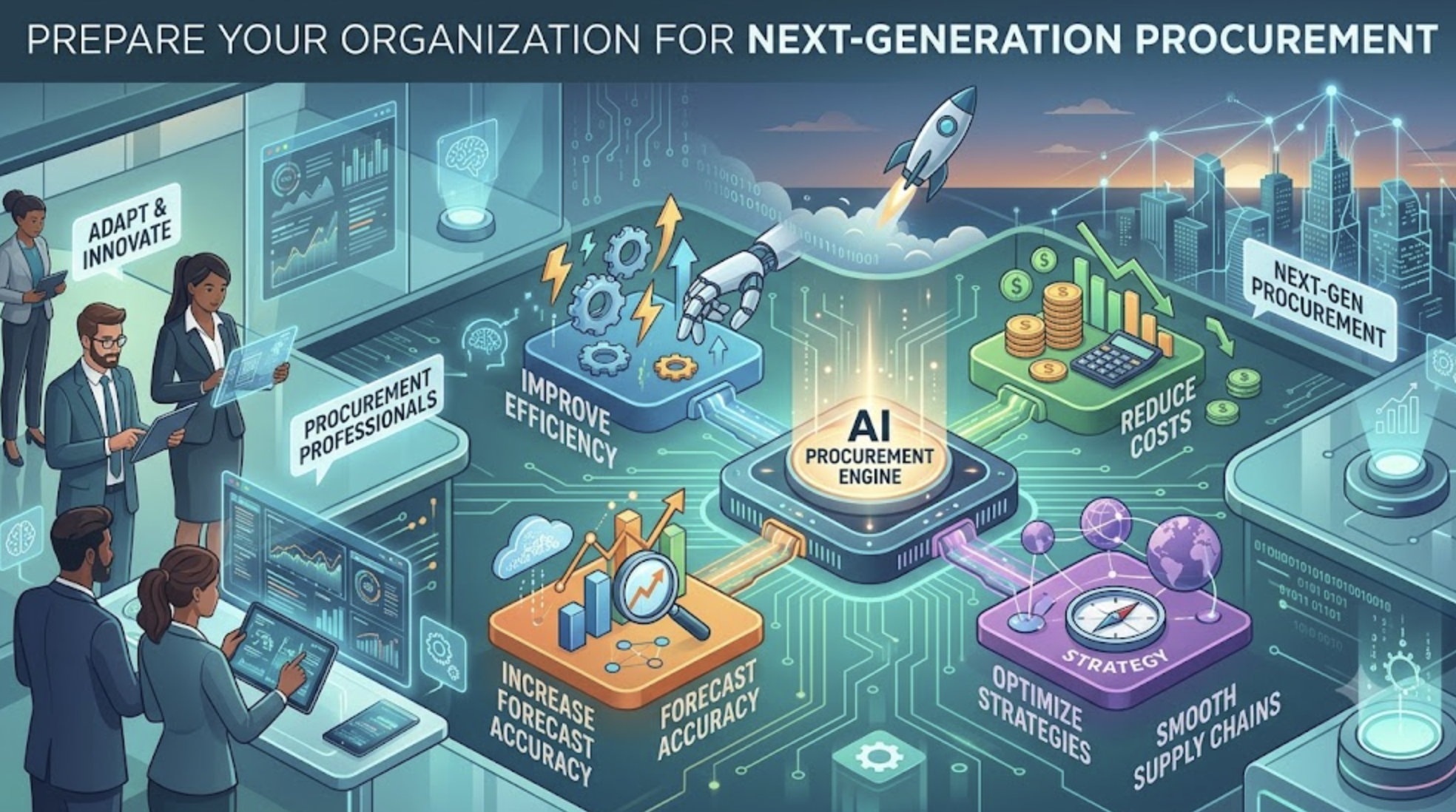
A detailed infographic illustration titled "PREPARE YOUR ORGANIZATION FOR NEXT-GENERATION PROCUREMENT." A central glowing "AI PROCUREMENT ENGINE" core is surrounded by specialized zones, with a diverse team of "PROCUREMENT PROFESSIONALS" using advanced tablets to manage the data. Connected sections with icons and labels show how AI helps: "IMPROVE EFFICIENCY" (gears and lightning), "REDUCE COSTS" (money bags and calculator), "INCREASE FORECAST ACCURACY" (charts and magnifying glass), and "OPTIMIZE STRATEGIES" (compass and globes). In the background, a digital city and a rocket labeled "NEXT-GEN PROCUREMENT" indicate the futuristic horizon.

AI Opportunities for Procurement

The integration of artificial intelligence into procurement represents a true revolution for the purchasing function.

By analyzing consumption patterns and supplier performance data in depth, AI enables businesses to create more accurate, personalized purchasing strategies while driving down operational costs.

1. Key Opportunities to Optimize the Procurement Function

Process Automation & Predictive Insights: Automating order cycles and optimizing inventory management using artificial intelligence significantly reduces overhead while boosting operational efficiency.

Predictive technologies allow businesses to anticipate market fluctuations and dynamically adjust purchasing schedules, delivering a distinct competitive edge.

2. AI as an Essential Performance Lever in Purchasing

Supplier Performance & Risk Mitigation: AI acts as a primary performance driver by utilizing advanced algorithms to rapidly identify top-performing suppliers and uncover the best price opportunities.

In addition, continuous evaluation of vendor reliability reduces supply chain risks, allowing procurement leadership to proactively adjust sourcing strategies before disruptions occur.

Key Benefits of AI in Procurement

  • Cost Optimization & Efficiency: Streamline order automation and minimize operational spend.
  • Proactive Supplier Risk Management: Continuously evaluate supplier reliability to prevent supply bottlenecks.
  • Agile Response to Market Needs: Leverage real-time predictive analytics to match fluctuating customer demand.
  • Embedded Sustainability Criteria: Integrate ethical and ESG metrics directly into purchasing processes to elevate brand reputation.

3. New AI-Powered Purchasing Strategies

Autonomous Real-Time Sourcing: Modern AI introduces innovative, disruptive strategies—including autonomous purchasing systems that execute orders in real time based on predictive algorithms.

This approach accelerates buying cycles, guarantees product availability at the exact time of demand, and seamlessly aligns procurement workflows with corporate social responsibility (CSR) goals.

4. Summary of Core AI Capabilities and Operational Impacts

Core AI Functionality Operational Impact
Predictive Analytics Optimization of procurement processes and proactive demand forecasting
Order Process Automation Significant operational cost reduction and increased throughput efficiency
Continuous Supplier Evaluation Risk reduction, proactive mitigation, and enhanced decision-making accuracy

Conclusion: Maximize Procurement Value with Modern AI

Transform Your Procurement Strategy Today

Leveraging predictive analytics, real-time order automation, continuous risk tracking, and embedded sustainability standards ensures a resilient, future-proof procurement ecosystem.

Supercharge your purchasing operations, eliminate supply risks, and drive strategic growth today.

Practical Cases and Achievements in Procurement AI

Concrete implementation cases illustrate the revolutionary impact of artificial intelligence in the purchasing sector.

Enterprise organizations deploying procurement AI solutions are achieving measurable cost reductions, accelerating sourcing lead times, and significantly elevating vendor quality.

1. Case Study: Enterprise Sourcing & Predictive Cost Optimization

A prominent multinational enterprise deployed an end-to-end procurement AI system to overhaul its strategic sourcing workflows.

Measured Results: The implementation reduced overall purchasing costs by 15% while simultaneously elevating the quality of acquired components. Furthermore, predictive market trend algorithms enabled the leadership team to anticipate price volatility and negotiate superior commercial terms with suppliers.

Significant Innovations in Procurement AI

  • AI-Driven Tender Automation: Streamline call-for-tender processes, proposal scoring, and bid evaluations automatically.
  • Predictive Supplier Risk Algorithms: Deploy machine learning models to assess and score vendor failure probability early.
  • Automated Dynamic Contract Management: Update contract terms in real time based on active supplier performance and shifting market conditions.

2. Summary of Key AI Achievements

AI Technology Domain Operational Description Measured Business Impact
Predictive AI Analyzes real-time market data to anticipate price shifts Improved supplier negotiations and substantial cost reduction
AI Contract Management Automates contract execution and real-time term adjustments Increased operational efficiency and legal compliance
Strategic AI Sourcing Optimizes procurement processes and vendor selection models Enhanced product quality and reduced lead times

Widespread Adoption: Performance & Efficiency Gains

The adoption of procurement AI has accelerated rapidly across industries, delivering substantial efficiency gains and bottom-line savings.

Integrating AI into purchasing processes is no longer optional—it is a competitive necessity. AI-powered procurement management systems have revolutionized how businesses evaluate, select, and manage vendors, leading to optimized buying cycles and higher customer satisfaction.

3. Measured Impacts of AI on Purchasing Processes

30% Reduction in Purchasing Cycles: Drastically accelerates reaction times to sudden market demands and supply fluctuations.

Enhanced Supplier Evaluation Accuracy: Reduces partnership risks through continuous, objective vendor monitoring.

Heightened Strategic Alignment: Increases organizational compliance and aligns procurement spend with macro enterprise objectives.

4. Key Benefits & Impact Summary

Performance Aspect Strategic Benefit Measured Operational Impact
Operational Efficiency Optimization of end-to-end procurement procedures Significantly reduced time-to-market and lower administrative costs
Strategic Decision-Making Data-rich insights for executive procurement choices Fewer judgment errors and superior negotiation leverage
Risk Management Accurate, continuous supplier risk scoring Safer, more reliable, and more profitable partnerships

Conclusion: Transform Procurement with AI Today

Lead the Market with Modern Procurement Intelligence

From tender automation and predictive risk scoring to 30% faster purchasing cycles, AI adoption transforms procurement into a primary driver of enterprise growth.

Safeguard your supply chain, eliminate administrative friction, and maximize enterprise profitability today.

Challenges and Issues for AI Adoption in Procurement

Integrating Artificial Intelligence into purchasing processes offers immense transformative value, but it is not without operational and cultural hurdles.

Navigating team resistance, closing skill gaps, and establishing rigorous cybersecurity protocols are essential steps for organizations seeking a seamless, secure, and effective AI transition.

1. The Challenges of Adopting AI in Procurement

Cultural Resistance to Change: Purchasing professionals often express reluctance toward adopting new technologies, fearing that automation might marginalize their professional roles or negatively impact decision quality.

AI Skill Shortages & Training Investment: A baseline lack of specialized AI competencies within procurement teams requires extensive, ongoing training programs and significant capital investments in human capital development to ensure smooth adoption.

2. How to Overcome Obstacles to AI Integration

Overcoming integration barriers demands a structured strategic roadmap:

Continuing Education & Awareness: Roll out targeted learning programs and workshops that explicitly demonstrate the practical benefits of AI.
Strategic Technology Partnerships: Collaborate with proven technology vendors to implement customized, scalable AI solutions that integrate smoothly into legacy ERP ecosystems.
Transparent Communication: Reassure teams by highlighting how AI automates repetitive administrative tasks, elevating human buyers to focus on high-value strategic decision-making.

Data Security Priorities for Procurement AI

  • Strengthen Encryption Protocols: Enforce robust end-to-end encryption for data both in transit and at rest.
  • Regular Cybersecurity Audits: Conduct periodic independent system vulnerability assessments and penetration tests.
  • Continuous Employee Training: Upskill purchasing personnel routinely on cybersecurity best practices and threat detection.

3. AI and Data Security in Purchasing

Beyond operational shifts, data security represents a paramount challenge. As AI adoption scales, the volume of sensitive commercial and vendor data processed expands rapidly, raising privacy and exposure concerns.

Deploying robust cybersecurity measures safeguards critical information against cyberattacks, guarantees compliance with evolving global regulations, and reinforces trust with suppliers and commercial partners.

4. Problem vs. Solution Framework for AI Integration

Integration Challenge / Problem Strategic Solution & Implementation Strategy
Resistance to Change Structured awareness programs, change management workshops, and continuous skill development
Lack of AI Skills Partnerships with educational institutions, specialized training modules, and targeted recruitment
Data Security Risks Enhanced cybersecurity infrastructure, end-to-end encryption, and continuous system audits

Conclusion: Build a Secure & Future-Proof Sourcing Strategy

Master AI Adoption with Confidence

By proactively addressing team resistance, investing in upskilling, and enforcing enterprise-grade data security, your organization turns AI adoption obstacles into a powerful competitive advantage.

Empower your team, protect sensitive procurement data, and lead the future of procurement today.

AI in Responsible and Sustainable Purchasing

Integrating artificial intelligence into responsible purchasing practices promises to revolutionize the sector.

By analyzing vast amounts of product and vendor sustainability data, AI empowers businesses to make informed, ethical choices. Advanced algorithms verify which suppliers actively apply sustainable development principles, turning AI into an indispensable tool for achieving social and environmental goals alongside economic efficiency.

1. How AI Drives Corporate Social Responsibility (CSR)

In the realm of Corporate Social Responsibility (CSR), AI offers unprecedented opportunities to maximize positive impacts across sourcing decisions.

Predictive analytics evaluate environmental and social outcomes before contracts are signed, ensuring complete alignment with corporate CSR goals. Furthermore, process automation eliminates human error, guarantees strict policy compliance, and strengthens stakeholder trust.

Key Benefits of AI for Sustainable Procurement

  • Ethical Supplier Selection: Optimize vendor choices based on verified ethical and sustainability metrics.
  • Supply Chain Transparency: Enhance end-to-end traceability across complex global supply networks.
  • Strengthened Stakeholder Trust: Elevate communication and reporting on corporate responsible practices.

2. Comparative Impact of AI on CSR Criteria

CSR Evaluation Criterion Impact Before AI Integration Impact After AI Integration
Supply Chain Transparency Low / Opaque High / Real-Time
Operational Efficiency Medium Very High
CSR Policy Compliance Variable / Fragmented Consistent / Automated

Future Prospects: The Horizon Beyond 2024

Looking toward the coming years, businesses can expect radical technological leaps in procurement AI.

Innovations will focus on autonomous purchasing agents capable of negotiating independently, highly refined predictive market models, and deep integration with IoT ecosystems to revolutionize ordering, delivery, and inventory management in real time.

3. Emerging Technologies and Strategic Impacts

Next-Generation Sourcing Technologies

  • Robotics & Autonomous AI: Execute repetitive tasks and autonomous negotiations to reduce operational overhead.
  • Self-Learning Algorithmic Systems: Continuously refine buying preferences and predict organizational behavior.
  • Blockchain Integration: Merge decentralized ledgers with AI for cryptographically secure transactions and fraud prevention.

4. Summary of Planned Innovations & Expected Impact

Emerging Technology Expected Strategic & Operational Impact
Robotics and AI Agents Substantial reduction in operational costs and massive efficiency gains
Self-Learning AI Systems Enhanced purchasing personalization, accuracy, and user satisfaction
Blockchain Fusion Maximum transaction security, auditability, and total anti-fraud transparency

Conclusion: Build a Sustainable, Future-Proof Procurement Engine

Lead the Future of Responsible Sourcing

Combining CSR predictive modeling, autonomous agent capabilities, and transparent blockchain architecture turns procurement into a primary driver of sustainable business expansion.

Empower your team, enforce sustainable purchasing standards, and master next-generation procurement today.
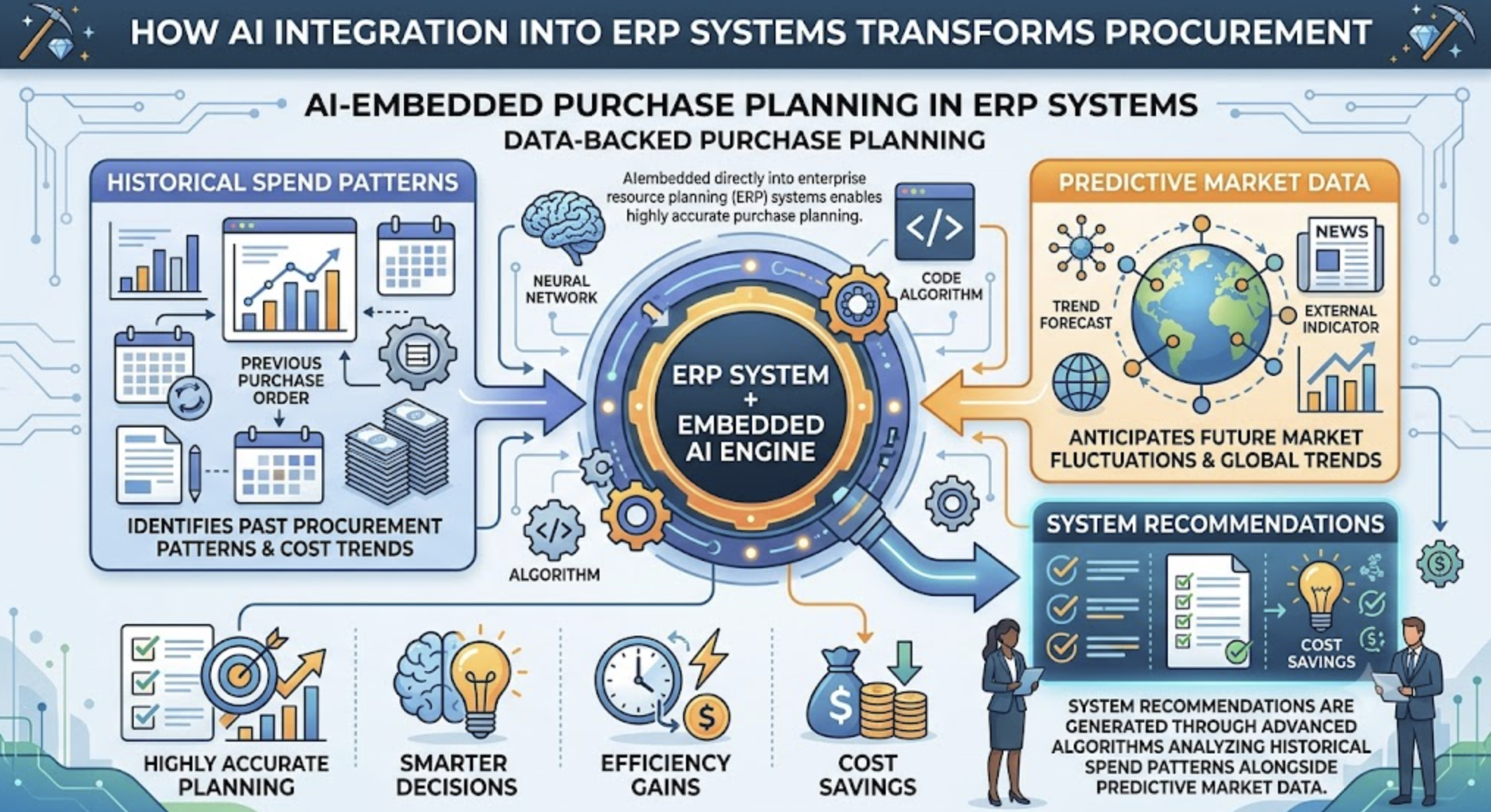
`A detailed infographic illustration in a layered vector landscape style about how AI integration into ERP systems transforms procurement. It features two data plates—'Historical Spend Patterns' and 'Predictive Market Data'—converging into a central 'ERP System + Embedded AI Engine'. Output is shown in two parts: 'System Recommendations' with a control console used by a woman and man, and four large pillars detailing benefits like 'Highly Accurate Planning', 'Smarter Decisions', 'Efficiency Gains', and 'Cost Savings'. The overall header is 'HOW AI INTEGRATION INTO ERP SYSTEMS TRANSFORMS PROCUREMENT'. The founding foundational bedrock has circuit patterns, and pickaxes are integrated in the corners.

Comparison with Trends from Previous Years

The evolution of AI procurement from 2023 to 2024 marks a major leap in technical precision and strategic value.

Algorithms have become significantly more sophisticated, enabling accurate spend analysis, proactive inventory calibration, reduced overstocking overhead, and the virtual elimination of costly stockouts across complex supply chains.

1. Comparison of AI Technologies: Shift to Prescriptive Systems

From Predictive Analytics to Prescriptive Action: The primary technological shift lies in the transition from basic predictive tools to fully prescriptive systems that generate actionable purchasing strategies.

Modern procurement AI incorporates self-learning capabilities that continuously refine buying recommendations over time. Natural Language Processing (NLP) and Machine Learning (ML) have become standard baseline tools, offering nuanced analyses of supplier behaviors and global market trends.

Technological & Operational Milestones: 2023 vs. 2024

  • Prescriptive System Transition: Evolved from standard forecasting to automated strategic decision support.
  • Self-Learning Recommendation Engines: Algorithms continuously optimize purchasing suggestions using live data feeds.
  • Enhanced Efficiency Gains: Measured 15% increase in overall procurement process efficiency.
  • Human Error Cost Reduction: Achieved a 20% cost reduction by eliminating manual operational errors.

2. Evolution of Performance & Operational Results

Adopting next-generation AI systems has yielded a 15% increase in procurement process efficiency and a 20% reduction in costs associated with human errors compared to previous years.

By deploying adaptive AI infrastructure, organizations respond dynamically to market volatility, optimizing sourcing schedules and protecting operating margins.

3. Testimonies & User Feedback

Feedback from procurement leaders emphasizes high satisfaction with the upgraded real-time data capabilities of modern AI tools.

Purchasing managers highlight that integrating real-time insights facilitates rapid, highly informed decision-making—proving that continuous AI adoption is indispensable for maintaining market competitiveness.

Conclusion: Stay Ahead of the AI Procurement Curve

Master Next-Generation Procurement Intelligence

Evolving from simple predictive tools to self-learning prescriptive AI systems equips your procurement team with unmatched operational agility, precision inventory control, and reduced risk exposure.

Upgrade your purchasing workflows, eliminate costly operational errors, and lead the market with modern procurement AI today.

FAQ - Frequently Asked Questions about AI in Procurement

Artificial intelligence is reshaping the procurement function by unlocking unprecedented opportunities for cost optimization, proactive risk management, and sustainable sourcing.

Below are expert answers to common questions regarding the impact of AI technologies on cost reduction, vendor monitoring, ERP integrations, and green supply chains.

1. What are the impacts of AI on reducing costs?

Optimal Supplier Sourcing & Predictive Analytics: The increased use of AI in procurement helps identify the highest-performing suppliers.

Predictive analytics tools analyze price trends and market cycles in real time, enabling procurement teams to reduce overall acquisition expenses significantly.

2. How does AI improve supplier risk management?

Real-Time Performance & Reliability Tracking: AI algorithms evaluate supplier performance and operational reliability continuously.

This real-time visibility empowers businesses to anticipate potential stockouts or non-compliance issues before they disrupt production cycles.

Pillars of AI Procurement Strategy

  • Predictive Cost Optimization: Analyze market pricing trends to secure maximum savings.
  • Proactive Risk Mitigation: Track supplier reliability in real time to avoid stockouts.
  • Autonomous Negotiations: Utilize virtual assistants and bots for automated contract agreements.
  • ERP-Driven Planning: Empower ERP platforms with intelligent, data-backed purchase recommendations.
  • Green Supply Chain Audit: Automatically evaluate vendor sustainability and product environmental footprints.

3. What technological innovations in AI are being considered to optimize purchasing processes?

Virtual Assistants & Integrated Platforms: Key innovations include virtual AI assistants designed for automatic contract negotiations and fully integrated management platforms that provide end-to-end inventory visibility.

4. How does integrating AI into ERP systems transform procurement?

Data-Backed Purchase Planning: AI embedded directly into enterprise resource planning (ERP) systems enables highly accurate purchase planning.

System recommendations are generated through advanced algorithms analyzing historical spend patterns alongside predictive market data.

5. How does AI contribute to sustainability in procurement?

Eco-Responsible Sourcing & Carbon Auditing: AI helps identify eco-responsible suppliers and assesses the environmental footprint of purchased products, accelerating the transition toward greener supply chains.

Conclusion: Shape the Future of Your Sourcing Strategy

Prepare Your Organization for Next-Generation Procurement

In considering AI Procurement, it is crucial to recognize the transformative role of emerging technologies in optimizing procurement strategies. Advances in artificial intelligence offer unprecedented opportunities to improve efficiency, reduce costs, and increase forecast accuracy.

As we move towards an ever more digitized horizon, procurement professionals must continue to adapt and innovate. By adopting these technologies, businesses can not only remain competitive but also prepare the ground for a future where AI is at the heart of modern business practices.

Line
Featured Post

Popular posts