Purchasing performance

Optimizing Purchasing: Automating Purchase Requests

Published By
Olivier Audino
Tags
Sourcing
Optimizing purchasing through the automation of purchase requests is radically transforming the modern business landscape.

In today's digital age, the speed and efficiency of internal procurement processes often determine the success or failure of organizations. Adopting automated workflows not only eliminates costly human errors but also frees up valuable personnel resources for high-impact strategic tasks.

Key Benefits of Automating Purchase Requests

  • Process Speed & Efficiency: Accelerate approval workflows to ensure seamless internal operations.
  • Human Error Reduction: Standardize request forms to eliminate data entry mistakes and miscommunications.
  • Resource Reallocation: Free up internal teams from repetitive manual tasks so they can focus on core strategic priorities.
  • Agile Resource & Budget Management: Promote optimized budget allocation and ensure swift responsiveness to changing market demands.

Drive Agility and Fiscal Control

Automating purchase requests establishes a clear bridge between operational requirements and strategic financial management.

By streamlining requisition workflows, organizations gain precise visibility over planned expenditure, enabling agile budget management and faster response times across all supply chain channels.

Transform Your Purchase Requisition Process

Lead your organization into a more economical, agile future with real-time automated purchase request solutions.

Discover how purchase request automation can revolutionize your procurement workflows and elevate operational efficiency today.

Introduction to Automating Purchase Requests

Purchase request automation refers to integrating advanced digital technologies to simplify and optimize an organization's procurement management processes.

By converting manual, paper-based operations into digital workflows, businesses eliminate processing delays, minimize human errors, and ensure strict procedural compliance across every requisition stage—including request creation, manager approval, and order tracking.

1. Importance of Automation for Modern Businesses

In an increasingly competitive market, automating purchase requests has become an essential strategy for maintaining a sharp operational edge.

Accelerating the buying cycle significantly reduces operational overhead while boosting productivity—allowing organizations to respond rapidly to internal demand and improve stakeholder satisfaction.

Core Technical Dimensions of Requisition Automation

  • ERP System Integration: Connecting software platforms with Enterprise Resource Planning systems for unified spend and inventory management.
  • AI-Powered Forecasting: Leveraging artificial intelligence to predict supply requirements and optimize stock levels.
  • Automated Approval Workflows: Digitally routing purchase requests through pre-set approval hierarchies for fast, secure sign-offs.
  • Data Visibility & Spend Control: Making every procurement stage traceable and less prone to human error to improve financial analysis.

Streamline Procurement and Gain Spend Control

Build a Faster, More Reliable Purchase Requisition Process

Transitioning from manual requisitions to automated digital workflows equips your organization with speed, security, and absolute budget transparency.

Empower your team with real-time spend tracking, automated approval routing, and intelligent procurement tools to drive long-term business efficiency.

Benefits of Automating Purchase Requests

Automating purchase requests shifts procurement operations from slow, manual routines to streamlined, high-speed digital workflows.

By eliminating manual bottlenecks, organizations significantly reduce operational overhead, accelerate procurement cycles, and ensure full regulatory compliance across every transaction.

1. Reduced Operational Costs

One of the primary advantages of automating purchase requests is a substantial decrease in operational expenses.

Minimizing manual data entry drastically cuts human errors—reducing the costs associated with correcting and re-routing erroneous orders. Furthermore, standardized purchasing procedures enable better inventory management and stronger price negotiations with suppliers based on accurate spend volumes.

2. Accelerating the Buying Cycle

Automated systems process and approve purchase requests in a fraction of the time required by manual channels.

In fast-paced markets, reducing requisition lead times enhances organizational agility—allowing teams to seize commercial opportunities quickly and maintain a sharp competitive edge.

Key Benefits of Requisition Automation

  • Resource & Cost Optimization: Lower operational spend by minimizing manual intervention and rework.
  • Shorter Decision Cycles: Accelerate approval routing to prevent operational delays and bottlenecks.
  • Superior Data Accuracy: Eliminate data entry mistakes to improve reporting and spend tracking.
  • Strict Regulatory Compliance: Standardize purchasing policies to guarantee complete auditability.
  • Higher Employee Satisfaction: Free internal teams from tedious administrative tasks to focus on strategic work.

3. Improving Compliance and Traceability

Automating purchase requests guarantees strict adherence to corporate spending policies and compliance benchmarks.

Every request, approval, and order adjustment is logged in detail, creating an immutable audit trail. This operational rigor minimizes legal risk, simplifies financial audits, and reinforces corporate credibility with partners and regulators.

4. Summary of Strategic Advantages

Strategic Advantage Impact on the Company
Reduction in Operational Costs Decrease in human errors, improved inventory management, and lower administrative spend
Procurement Cycle Acceleration Increased operational responsiveness, faster decision-making, and better competitive positioning
Compliance & Traceability Improvement Minimization of legal risks, simplified financial audits, and full transaction transparency

Conclusion: Maximize Procurement Speed & Compliance

Unlock Strategic Savings with Request Automation

Automating purchase requests transforms slow administrative workflows into a fast, accurate, and fully compliant engine.

Empower your procurement teams with automated approval routing, real-time spend visibility, and error-free requisition tracking.
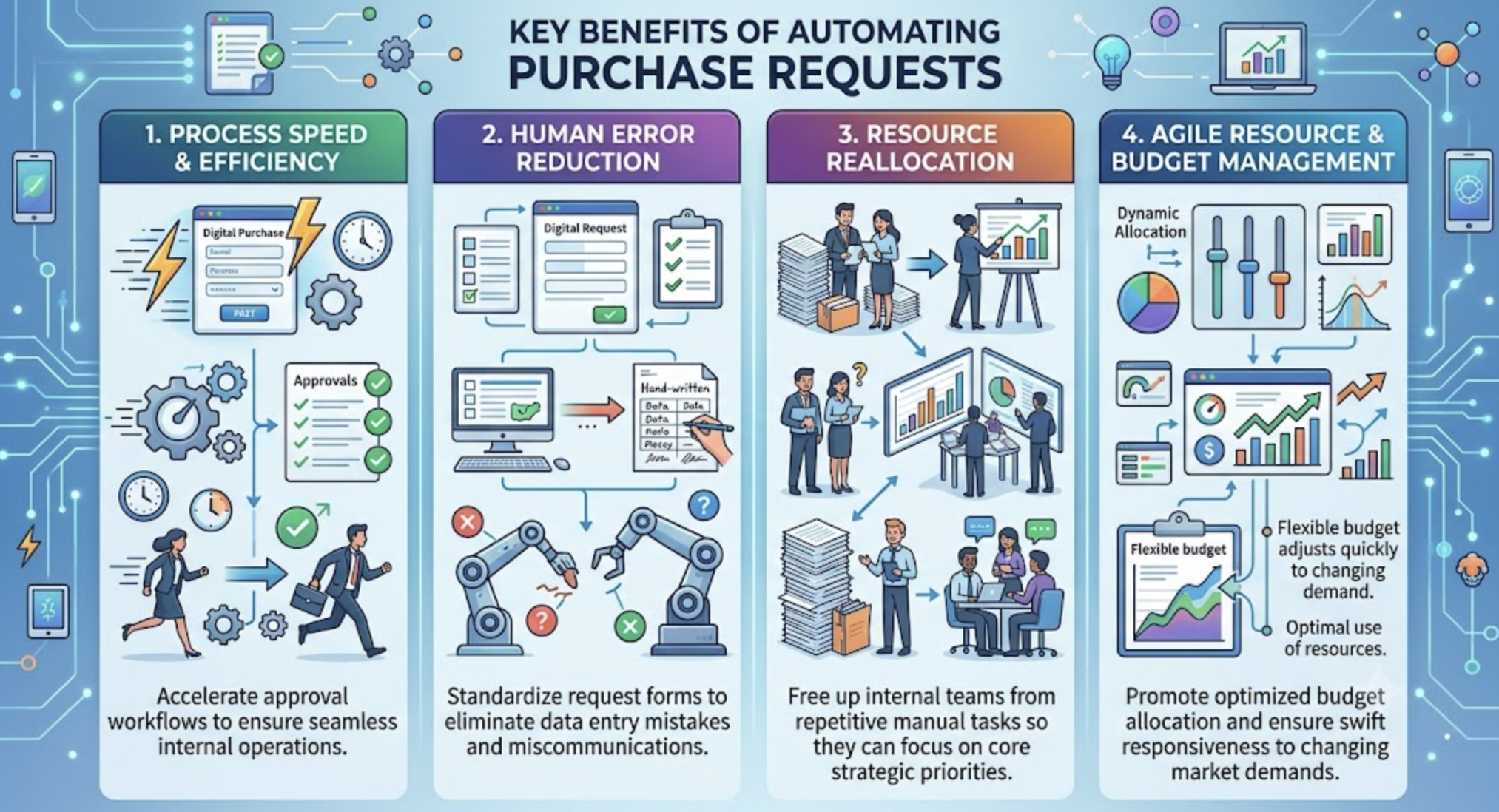
A detailed digital infographic titled 'KEY BENEFITS OF AUTOMATING PURCHASE REQUESTS' with four distinct columns. The first column (Blue) illustrates 'Process Speed & Efficiency' with fast digital forms, accelerated gears, and business professionals running for faster approvals. The second column (Green) shows 'Human Error Reduction' with standardized digital forms, filters, and a visual comparison of messy handwriting to clean digital data. The third column (Purple) depicts 'Resource Reallocation', where staff move from repetitive data entry with massive paper piles to high-level strategic collaboration and planning. The fourth column (Orange) displays 'Agile Resource & Budget Management' with dynamic scales, flexible sliders, and real-time dashboards for optimizing budgets and responding to market demands. The overall scene is set in a clean, modern digital environment with connected nodes and glowing data streams against a circuit background, featuring diverse professionals.

Implementation of Purchasing Automation

Successfully deploying purchase request automation requires a structured strategic roadmap that connects operational requirements with modern technological solutions.

From initial process audits and software customization to team onboarding and continuous technical support, a well-planned implementation strategy guarantees seamless organizational adoption and long-term efficiency gains.

1. Needs Assessment & Strategic Planning

The implementation process begins with an accurate assessment of your business's current procurement workflows.

Identifying bottlenecks and setting clear objectives—such as accelerating processing lead times or enhancing spend visibility—allows leaders to manage organizational changes and workflow adjustments effectively.

2. Selection & Customization of Technological Solutions

Once strategic needs are established, selecting the right software solution is crucial.

Automation platforms range from specialized request management tools to integrated enterprise suites. Tailoring these applications to mirror your company's specific approval hierarchies and procurement workflows ensures a seamless operational fit.

3. Team Training & Change Support

Successful automation relies heavily on staff buy-in and user adaptability.

Structured training sessions familiarize employees with new tools, while ongoing helpdesk and technical support ensure rapid issue resolution throughout the transition phase.

Implementation Strategy Checklist

  • Comprehensive Audit: Conduct an in-depth evaluation of existing purchasing processes and pain points.
  • Objective Goal Setting: Define clear targets for lead time reduction and spending transparency.
  • Technology Selection: Choose a tech solution tailored to your operational complexity and budget.
  • Workflow Customization: Configure software settings to align with internal approval hierarchies.
  • User Onboarding: Schedule structured team training to drive high software adoption.
  • Transition Support: Establish dedicated technical support for continuous issue resolution.

4. Expected Strategic Benefits Matrix

Strategic Objective Expected Operational Benefit
Lead Time Reduction Acceleration of end-to-end procurement cycles
Improved Transparency Increased control and visibility over enterprise spending
Resource Optimization Significant reduction of repetitive administrative workload

Conclusion: Drive Long-Term Competitive Edge

Ensure a Seamless Transition to Automation

A comprehensive implementation strategy ensures a smooth organizational transition while maximizing operational efficiency and cost savings.

Empower your team with structured planning, tailored technology, and continuous support to optimize long-term competitiveness.

Case Studies: Industry Success Stories in Request Automation

Real-world implementations across diverse enterprise sectors highlight the high return on investment driven by purchase request automation.

Whether in fast-paced retail, heavy manufacturing, or highly regulated healthcare environments, automated workflows deliver major processing speed gains, substantial inventory savings, and bulletproof compliance.

1. Cross-Sector Automation Impact Matrix

Company Industry Sector Measurable Impact of Automation
GlobalTech Retail 70% reduction in processing times and a significant decrease in order errors.
EcoMaterials Construction Materials 30% reduction in stock costs and improved production-purchasing synchronization.
HealthPharma Pharmaceutical Improved traceability and compliance, alongside reduced response times to critical requests.

Sector-Specific Key Takeaways

  • Retail Speed (GlobalTech): Slashing request approval cycles by 70% keeps stores supplied and eliminates order entry mistakes.
  • Inventory Optimization (EcoMaterials): Synchronizing raw material purchasing with live production schedules cuts stock holding costs by 30%.
  • Regulatory Control (HealthPharma): Complete auditability guarantees compliance with medical benchmarks while accelerating urgent requisition pipelines.

2. Strategic Insights Across Industries

Retail Efficiency: Eliminating paper sign-offs allows retail networks to adapt quickly to inventory fluctuations and avoid stockouts during demand spikes.

Manufacturing Alignment: Direct integration between ERP production planning and automated requisitions prevents cash lockup in excess raw materials.

Healthcare Compliance: Detailed digital tracking simplifies complex regulatory audits and ensures emergency supply requisitions bypass administrative friction.

Conclusion: Replicate Industry Success Today

Transform Your Procurement Operations

From retail agility and stock optimization to pharmaceutical compliance, automating purchase requests delivers proven, repeatable enterprise value.

Empower your team with automated approval routing, real-time inventory synchronization, and error-free procurement operations.

Case Studies on Successfully Automating Purchase Requisitions

Examining real-world enterprise deployments demonstrates how purchase requisition automation transforms operational speed, reduces overhead, and enforces rigorous compliance across diverse industries.

Below are three detailed case studies highlighting how technology leaders, sustainable manufacturers, and pharmaceutical distributors achieved high-impact procurement transformation.

1. Optimizing High-Volume Retail Operations at GlobalTech

Industry: Technology Retail

GlobalTech needed a solution to handle high transaction volumes where every requisition previously required manual processing—leading to administrative bottlenecks and costly entry errors.

Strategic Impact: Achieved a 70% reduction in processing times and a dramatic decrease in order errors.
Operational Outcome: Enabled real-time, high-precision inventory tracking and automated request routing to optimize end-to-end supply chain responsiveness.

2. Improving Logistics & Production Alignment at EcoMaterials

Industry: Sustainable Building Materials

EcoMaterials integrated purchase request automation to refine internal logistics and eliminate disconnects between procurement and manufacturing schedules.

Strategic Impact: Reduced purchase requisition cycle times by 30% and significantly decreased excess stock holding costs.
Operational Outcome: Synchronized raw material purchases directly with production timelines, ensuring faster, highly predictable customer deliveries.

Cross-Industry Automation Success Factors

  • Drastic Lead-Time Cuts: Slashing request approval times by up to 70% keeps supply channels moving smoothly.
  • Production-Purchase Alignment: Synchronizing procurement with live operations eliminates holding costs and overstocking.
  • Strict Regulatory Compliance: Immutable digital trails ensure absolute audit readiness in compliance-heavy sectors.
  • Accelerated Critical Response: Fast-tracking urgent requisitions safeguards customer satisfaction and operational continuity.

3. Innovation & Regulatory Compliance at HealthPharma

Industry: Pharmaceutical Distribution

Operating in a tightly regulated domain, HealthPharma automated purchase requisitions to satisfy strict compliance standards while accelerating critical supply pipelines.

Strategic Impact: Delivered comprehensive end-to-end order traceability and seamless adherence to industry regulations.
Operational Outcome: Reduced response times for urgent medical requests while safeguarding safety benchmarks and patient security.

Conclusion: Transform Your Requisition Workflow

Replicate Industry-Leading Procurement Gains

From high-volume retail to precision manufacturing and pharmaceutical compliance, automating purchase requisitions yields measurable efficiency and cost control.

Empower your organization with automated approval routing, real-time stock tracking, and complete spend visibility today.

Automation Challenges and Resolution Approaches

While automating purchase requests unlocks significant efficiency and cost savings, organizations often face operational, technical, and cultural obstacles during implementation.

Proactively addressing employee resistance, system integration hurdles, and data quality concerns ensures a smooth, risk-free transition to modern digital procurement.

1. Overcoming Resistance to Change Within the Organization

The Challenge: Reluctance among staff often stems from fear of the unknown or concern over job displacement.

Resolution Approach:
Transparent Communication: Reassure teams that automation serves as an empowering productivity tool rather than a replacement for human expertise.
Departmental Change Champions: Designate internal champions within each team to build project trust, drive peer engagement, and accelerate tool adoption.
Comprehensive Training: Provide hands-on training sessions combined with continuous support to boost user confidence and software proficiency.

2. System Integration & Legacy Infrastructure Compatibility

The Challenge: Legacy ERPs and existing IT systems are rarely immediately compatible with modern purchase automation platforms.

Resolution Approach:
Flexible Software Selection: Choose adaptable automation platforms engineered to connect seamlessly with diverse IT ecosystems.
Expert Integration Consulting: Partner with specialized system integration consultants to bridge architectural gaps.
Rigorous Pre-Deployment Testing: Plan integration timelines carefully and execute thorough testing phases before full live deployment.

Strategic Resolution Framework At a Glance

  • Change Management: Deploy internal change champions and transparent training to eliminate employee hesitation.
  • Technical Flexibility: Rely on open-architecture software and integration specialists to bridge legacy ERP gaps.
  • Data Governance: Establish strict validation controls and user training to safeguard system accuracy and prevent costly entry errors.

3. Ensuring High Data Quality & System Integrity

The Challenge: Purchase request automation relies heavily on input accuracy—incorrect or incomplete data leads to system bottlenecks and costly procurement errors.

Resolution Approach:
Pre-Integration Quality Controls: Establish automated data verification rules and pre-entry validation workflows.
User Accuracy Training: Educate employees on the operational importance of precise data entry and correct software navigation to maintain continuous system integrity.

Conclusion: De-Risk Your Automation Roadmap

Master the Transition to Automated Procurement

Navigating organizational change, legacy software integration, and data validation requires a structured, strategic implementation plan.

Empower your organization with flexible automation technology, expert guidance, and robust change management to achieve lasting operational success.

Impact of Automation on the Quality of Purchases

Automating purchase requests drives a fundamental improvement in procurement quality across the entire enterprise.

By replacing manual processing with automated verification rules, organizations eliminate order errors, accelerate validation timelines, and enforce strict quality standards across all supplier relationships.

1. Improving Control & Order Accuracy

The automation of purchase requests leads to a significant increase in overall order accuracy.

Human errors—such as duplicate requests or incorrect data entries—are drastically reduced. Automated systems enforce predefined protocols that verify and validate data before an order is placed. For example, every product reference number is checked for exact correspondence before confirming the purchase, ensuring strict compliance with required specifications.

2. Accelerating Validation Processes

Automated systems process and approve purchase requests in minutes, compared to the hours or days required by manual paper-based approval channels.

This swift execution enables teams to respond rapidly to internal department needs while strengthening supplier relationships through shorter payment terms and predictable order schedules.

Core Quality Enhancements At a Glance

  • Zero-Defect Data Accuracy: Predefined validation rules check product codes and specifications prior to order release.
  • Rapid Approval Cycles: Process request approvals in minutes to eliminate operational delays.
  • Strict Quality Standards: Built-in selection criteria prevent the receipt of non-compliant goods.
  • Supplier Performance Analytics: Advanced reporting tools monitor supplier performance for continuous quality optimization.

3. Strengthening Quality Control & Supplier Performance

Automation reinforces overall quality control by incorporating strict selection criteria to ensure all purchased products and services satisfy specific organizational standards.

Preventing non-compliant goods avoids costly return logistics and production delays. Furthermore, integrated analytics tools track supplier performance metrics over time, driving continuous improvement across the supply chain.

4. Quality Impact Summary

Quality Aspect Impact of Automation
Order Accuracy Significant improvement driven by reduced manual errors and automated validation protocols
Validation Time Notable reduction (minutes vs. days), ensuring rapid response to internal operational needs
Quality Control Strengthened through rigorous selection criteria and advanced supplier reporting analytics

Conclusion: Elevate Procurement Standards

Achieve Superior Purchase Quality & Precision

Automating purchase requests guarantees high data accuracy, rapid approval routing, and strict vendor quality management.

Empower your enterprise with real-time validation, error-free order processing, and comprehensive supplier analytics.
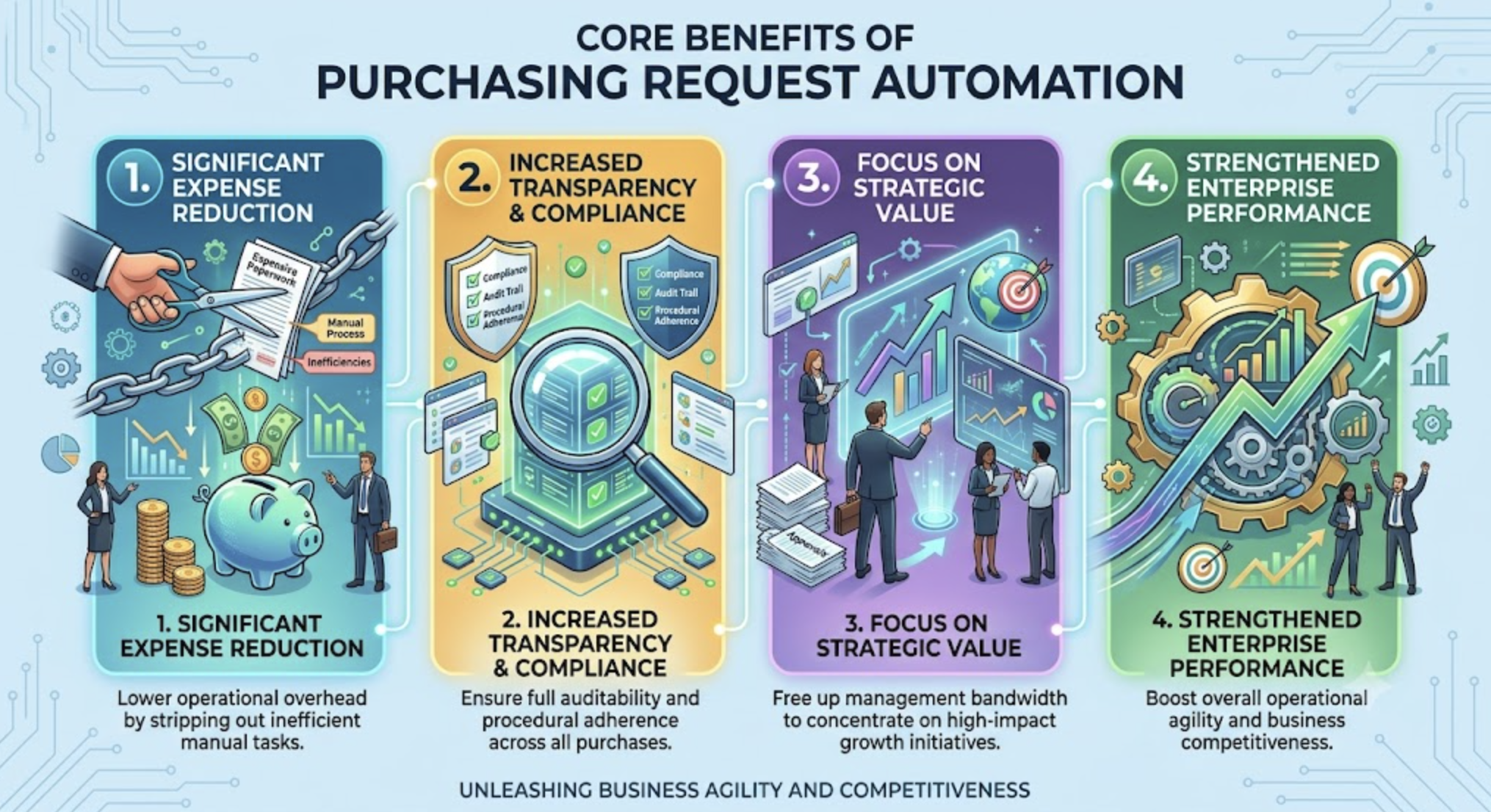
A detailed modern infographic titled 'CORE BENEFITS OF PURCHASING REQUEST AUTOMATION' with four numbered columns. The first column (Blue/Green) illustrates 'SIGNIFICANT EXPENSE REDUCTION' with a hand cutting chains of costly paperwork into a piggy bank. The second column (Yellow) shows 'INCREASED TRANSPARENCY & COMPLIANCE' with a magnifying glass over data servers and compliance checklists. The third column (Purple) depicts 'FOCUS ON STRATEGIC VALUE' with business people using growth chart holograms to bypass approval stacks. The fourth column (Green) displays 'STRENGTHENED ENTERPRISE PERFORMANCE' with integrated gears, arrows, and celebrating professionals. A bottom banner reads 'UNLEASHING BUSINESS AGILITY AND COMPETITIVENESS', set against a circuit board pattern background.

Role of Artificial Intelligence in the Evolution of Purchase Request Automation

The integration of Artificial Intelligence (AI) into purchase request automation represents a major evolutionary leap for modern procurement management.

By deploying advanced algorithms and machine learning models, businesses can analyze complex market trends, tailor procurement experiences, and automate vendor interactions—unlocking unprecedented operational efficiency.

1. Improving the Accuracy and Speed of Purchasing Processes

AI significantly enhances both precision and execution speed by processing massive data volumes in real time to identify high-value buying opportunities while curbing human error.

For example, predictive AI algorithms forecast raw material price fluctuations and pinpoint optimal order timing—ensuring highly economical resource management.

2. Personalizing Shopping Experiences for Businesses

Through machine learning, AI adapts procurement workflows to match specific organizational habits, historical spend patterns, and internal preferences.

By providing tailored recommendations for every purchase request, AI optimizes the buying process, ensuring users select the most relevant, compliant, and cost-effective items available.

Core Benefits of AI in Requisition Automation

  • Increased Decision Accuracy: Leverage predictive data analysis to choose optimal order timings and quantities.
  • Accelerated Cycle Times: Slash processing delays and approval timelines across all request channels.
  • Tailored Process Personalization: Adapt recommendations and approval paths to specific organizational needs.
  • Automated Supplier Negotiations: Streamline vendor interactions and parameter-based bargaining to secure ideal terms.

3. Automating Interactions and Negotiations with Suppliers

AI plays a pivotal role in streamlining supplier communication and parameter-driven commercial negotiations.

Automated systems can independently negotiate pricing and terms based on predefined rules, accelerating deal execution while guaranteeing favorable commercial conditions and freeing up human talent for strategic initiatives.

4. Impact Matrix of AI Capabilities

AI Functionality Impact on Purchasing Automation
Advanced Data Analysis Accurate spend predictions, market trend forecasting, and reduced lead times
Machine Learning Customization Improved user satisfaction, tailored recommendations, and cost optimization
Automated Vendor Negotiations Fast, efficient transaction execution ensuring optimal pricing and terms

Conclusion: Lead the Future of AI-Driven Sourcing

Harness Next-Generation Purchasing Intelligence

Combining predictive analytics, personalized buying recommendations, and automated supplier negotiations turns purchase request automation into a strategic asset.

Empower your enterprise with AI-driven procurement tools to maximize financial savings and secure a lasting competitive edge.

Strategies for the Future Adoption of Automation in Procurement

Successfully adopting purchase request automation requires careful strategic planning to align new technology platforms with long-term enterprise goals.

The initial phase centers on building a solid business case that justifies startup investments by illustrating quantifiable cost savings, reduced lead times, and operational efficiency gains while preparing internal staff for streamlined workflows.

1. Progressive Adoption & Pilot Testing

Rolling out purchase request automation in phased stages prevents operational friction and facilitates gradual system refinement.

Launching pilot projects within target departments allows organizations to identify and resolve process flaws prior to enterprise-wide expansion—providing concrete performance data to validate ROI before committing further capital.

Key Steps for a Successful Pilot Test

  • Department Selection: Identify an ideal purchasing unit to host the initial pilot.
  • Goal Setting: Establish precise, measurable performance objectives and timelines.
  • Deployment & Training: Configure system workflows and train affected personnel.
  • Data Benchmarking: Collect performance metrics to compare directly against pre-automation baselines.
  • Process Refinement: Adjust system settings and approval rules based on user feedback.

2. Communication & Change Management Strategy

Open communication is vital to drive software acceptance across every organizational tier.

Involving team members early in the project lifecycle and collecting continuous feedback builds project trust, mitigates resistance, and ensures full operational engagement with automated procurement tools.

3. Change Management Framework

Implementation Step Strategic Action Expected Outcome
Initiation Engage key stakeholders and department leaders Alignment on project goals, scope, and expectations
Planning Define core messaging and select communication channels Increased organizational understanding and project support
Execution Roll out structured communication and team training plans Gradual, effective adoption of automated processes
Feedback Gather ongoing user feedback and performance data Continuous workflow adjustments and system improvements

Conclusion: Drive Future-Proof Sourcing Agility

Master Your Procurement Automation Strategy

Integrating purchase request automation through structured planning, phased pilot testing, and strong change management guarantees maximum operational impact.

Empower your enterprise to boost market competitiveness, eliminate bottlenecks, and secure lasting efficiency today.

Conclusion: Assessment and Prospects of Automating Purchase Requests

Implementing purchase request automation consistently transforms internal procurement workflows across modern enterprises.

By significantly curbing data entry errors, slashing operating costs, and elevating cycle speed, automation has firmly established its strategic necessity. Beyond direct financial gains, it boosts employee morale by eliminating tedious paperwork and reallocating focus to high-value strategic initiatives.

1. Challenges Encountered & Resolution Strategies

While integrating purchase request automation delivers high returns, organizations must navigate operational obstacles such as staff hesitation and legacy software constraints.

Overcoming these barriers requires targeted employee training, intuitive software selections tailored to specific business requirements, and a gradual, inclusive rollout strategy that builds internal confidence at every stage.

Strategic Overview of Purchase Request Automation

  • Core Operational Gains: Reduced errors, optimized spend control, and higher employee satisfaction.
  • Smooth Risk Mitigation: Phased implementation combined with intuitive tools overcomes change resistance.
  • AI & ML Integration: Advanced machine learning unlocks predictive insights and real-time decision-making.
  • Future Market Leadership: Scaling automated procurement tools ensures long-term commercial competitiveness.

2. Future Perspectives of Automation in Procurement

Looking forward, purchase request automation will be deeply driven by Artificial Intelligence and Machine Learning.

These next-generation technologies will perform predictive spend analyses, forecast market trends, and execute faster, high-precision decision-making—making automated procurement platforms an indispensable pillar for agile, innovative enterprises.

Conclusion: Future-Proof Your Procurement Operations

Build a High-Performance Sourcing Ecosystem

Combining automated approval routing, tailored change management, and AI-driven analytics equips your enterprise to dominate an increasingly competitive market.

Transform your purchase request workflows today to maximize operational efficiency, cut administrative spend, and secure long-term growth.

FAQ - Questions About Automating Purchase Requests

Automating purchase requests is a pivotal step toward modernizing enterprise procurement and eliminating operational inefficiencies.

Below are clear, actionable answers to key questions regarding the benefits, process transparency, system integration, software selection criteria, and impact on employee satisfaction.

1. What are the main benefits of automating purchase requests?

Efficiency Gains & Cost Reduction: Automating purchase requests drastically slashes processing lead times and minimizes human errors—boosting operational efficiency and lowering overhead costs.

Industry Example: A manufacturing company can reduce order processing times by up to 30% through automated request routing and real-time spend tracking.

2. How does automation influence the transparency of purchasing processes?

Complete Traceability & Audit Readiness: Automation provides real-time visibility and an immutable digital record of every action, approval, and validation step.

Industry Example: An automotive parts distributor implemented an automated system to track each procurement stage, ensuring seamless adherence to strict industry compliance and audit standards.

3. Can purchase request automation be integrated with other systems?

Unified System Ecosystem: Yes, modern platforms integrate smoothly with ERPs, CRMs, and financial software to create a connected, real-time data ecosystem.

Industry Example: A technology firm synchronized its purchase requests directly with its accounting software to streamline budget control and financial reporting.

Key Insights on Requisition Automation

  • Core Selection Criteria: Prioritize ERP compatibility, intuitive design, scalability, and responsive vendor support.
  • Employee Engagement: Lower administrative friction to boost workplace morale and reduce staff stress.
  • Financial Precision: Real-time software synchronization eliminates billing discrepancies and duplicate orders.

4. What criteria should you consider when choosing an automation solution?

Strategic Fit & Scalability: Crucial factors include compatibility with legacy software, user-friendly interface design, platform scalability, and reliable technical support.

Industry Example: An agri-food enterprise selects scalable software that easily adapts to surging seasonal order volumes without compromising system performance.

5. What impact does automation have on employee satisfaction?

Workload Reduction & Morale Boost: Replacing repetitive manual paperwork with automated digital workflows significantly reduces employee stress and administrative fatigue.

Industry Example: A professional services firm automated its purchasing channels, allowing team members to redirect their time to high-value strategic tasks and increasing job satisfaction.

Conclusion: Transform Your Requisition Workflow

Unlock Enterprise Procurement Speed & Precision

From complete audit traceability and seamless ERP integration to elevated employee morale, purchase request automation yields measurable organizational value.

Empower your team with intuitive tools, automated approval routing, and real-time spend visibility today.

Optimizing Purchasing Through Request Automation

Optimizing purchasing through the automation of requests is crucial for effective modern management.

This strategic approach allows not only a significant reduction in operational expenses, but also a major increase in transparency and procedural compliance within purchasing processes.

Core Benefits of Purchasing Request Automation

  • Significant Expense Reduction: Lower operational overhead by stripping out inefficient manual tasks.
  • Increased Transparency & Compliance: Ensure full auditability and procedural adherence across all purchases.
  • Focus on Strategic Value: Free up management bandwidth to concentrate on high-impact growth initiatives.
  • Strengthened Enterprise Performance: Boost overall operational agility and business competitiveness.

Empower Management with Strategic Focus

By automating purchasing requests, managers can shift their day-to-day focus from routine administrative execution to strategic decision-making.

This reallocation of valuable internal resources directly strengthens the overall performance and operational efficiency of the organization.

Integrate Automated Procurement Today

To find out how to effectively integrate these solutions into your organization, continue to explore the potentials and benefits of purchasing automation.

Transform your purchasing operations today to maximize operational efficiency, transparency, and sustainable cost savings.

Line
Featured Post

Popular posts