
Purchasing performance

Optimal CSR Purchasing Strategies: A Complete Guide

Published By
Olivier Audino
Tags
E-Procurement solution
Exploring optimal corporate social responsibility (CSR) procurement strategies is crucial for organizations committed to managing their environmental and social footprint.

This comprehensive guide outlines how to effectively integrate CSR principles into core purchasing processes—enabling your enterprise to align sourcing practices with ethical values while saving money and strengthening brand reputation.

1. Integrating CSR Principles into Sourcing Workflows

Modern procurement strategy must extend beyond transaction costs.

Embedding social responsibility into supplier selection, vendor evaluation, and contract management ensures every purchasing decision actively supports long-term corporate governance, carbon reduction, and social equity.

Core Pillars of Sustainable Procurement Strategy

  • Ethical Value Alignment: Synchronize daily procurement decisions with core organizational ESG commitments.
  • Cost Optimization & Efficiency: Uncover hidden cost-saving opportunities through total lifecycle costing and reduced waste.
  • Brand Reputation Enhancement: Differentiate your business in competitive markets by establishing verifiable sustainable supply chains.
  • Strategic End-to-End Roadmap: Journey from theoretical ESG foundations to practical execution and real-world case studies.

2. Aligning Profitability with Corporate Responsibility

Sustainable procurement strategies demonstrate that ethical practices and financial performance are mutually reinforcing.

By mitigating supply chain risks, reducing resource consumption, and attracting eco-conscious customers, companies transform procurement into a powerful driver of long-term commercial value and market leadership.

Conclusion: Transform Your Procurement Approach Today

Build a Resilient, Purpose-Driven Supply Chain

Taking control of your CSR procurement strategy allows your enterprise to combine cost efficiency with positive social and environmental impact.

Transform your purchasing practices today to drive sustainable growth, insulate your business against risks, and lead your industry into a responsible future.

Definition and Importance of CSR Purchasing in the Industrial Sector

Corporate Social Responsibility (CSR) procurement involves systematically embedding social and environmental principles into industrial purchasing workflows.

Beyond reducing costs and optimizing operational efficiency, sustainable sourcing fosters a positive influence across society and the environment by selecting suppliers who strictly adhere to high ethical, ecological, and social standards.

1. The Strategic Importance of CSR Purchasing in Industry

In an industrial context, responsible procurement is vital for building competitiveness while ensuring long-term sustainability.

It enables industrial enterprises to comply with evolving regulations, protect brand equity, and generate a distinct market advantage by satisfying the expectations of eco-conscious consumers and commercial partners.

2. Enterprise Value & Long-Term Profitability

The impact of CSR purchasing extends far beyond basic regulatory compliance:

Stakeholder Benefits: Strengthened partner relationships, reduced supply risks, accelerated supply chain innovation, and expanded access to new markets.
Value Chain Influence: Positively transforms supplier and subcontractor practices across all tiers.
Bottom-Line Impact: Drives long-term profitability through proactive risk mitigation, optimized production processes, and heightened customer loyalty.

Common CSR Procurement Practices

  • Supplier Environmental Assessments: Systematic auditing of vendor ecological footprints and compliance.
  • Contracts with Sustainability Clauses: Legally binding agreements enforcing ESG and ethical standards.
  • Regular CSR Team Training: Continuous skill development for procurement professionals on ESG frameworks.
  • CSR Vendor KPIs: Integrating environmental and social metrics directly into supplier scorecards.

3. Key Benefits Summary Matrix

Strategic Benefit Operational Impact & Value Delivered
Regulatory Compliance Meets legal mandates and significantly reduces the risk of compliance penalties
Reputation Enhancement Strengthens customer loyalty and attracts new clients sensitive to CSR performance
Innovation & Competitiveness Drives internal process innovation and elevates overall market competitiveness

Conclusion: Elevate Industrial Sourcing Today

Transform Procurement into a Strategic Advantage

Integrating CSR principles into industrial purchasing aligns operational profitability with sustainable economic development.

Empower your enterprise with modern, responsible sourcing strategies to secure compliance, protect your brand, and lead your industry into a sustainable future.
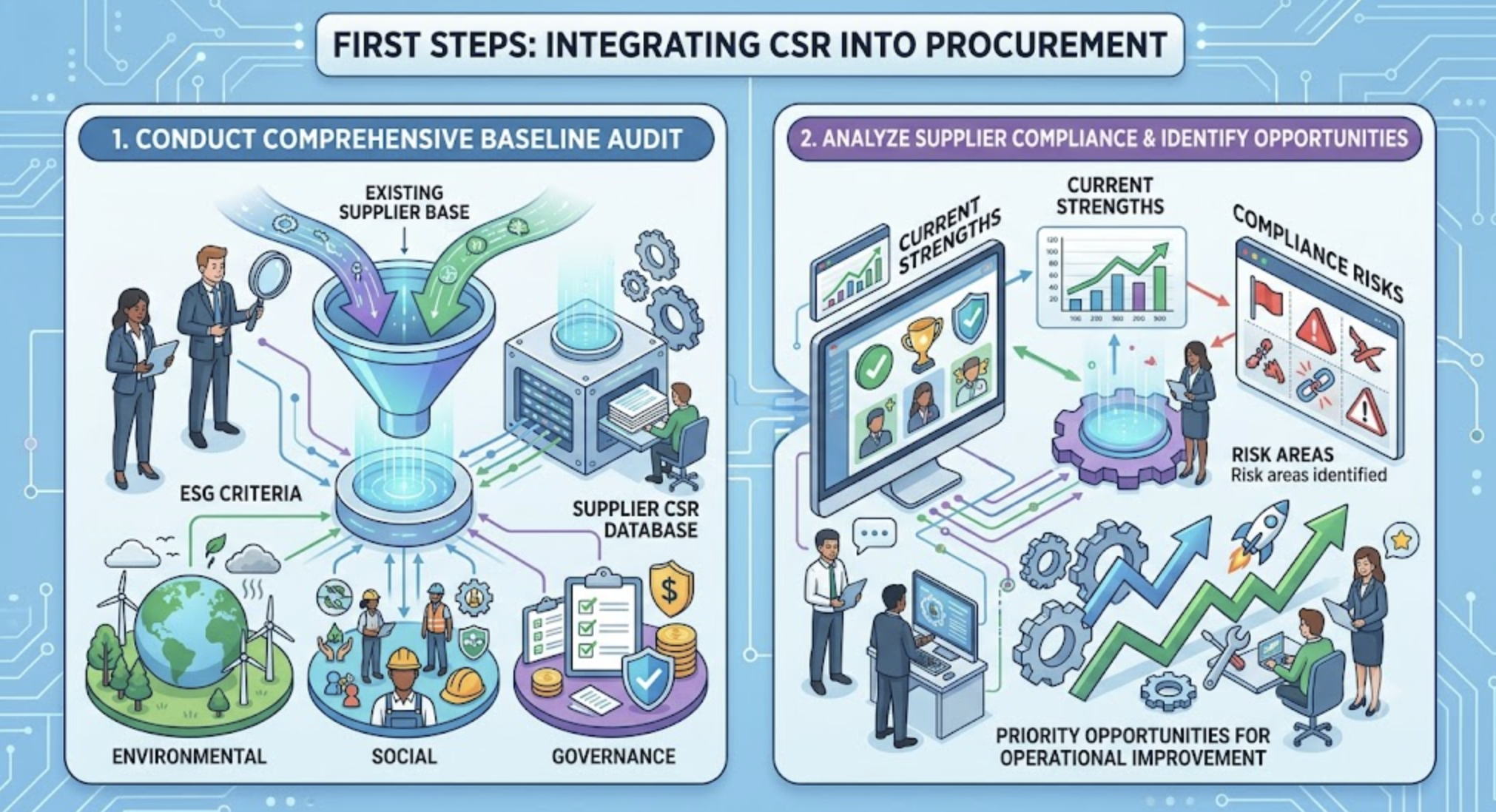
A detailed digital infographic titled "FIRST STEPS: INTEGRATING CSR INTO PROCUREMENT". The image is divided into two main panels against a light blue technological circuit background. The left panel, "1. CONDUCT COMPREHENSIVE BASELINE AUDIT," shows business professionals examining an "EXISTING SUPPLIER BASE" that flows through a digital funnel. The funnel integrates "ESG CRITERIA" represented by three distinct islands: "ENVIRONMENTAL" (a globe with wind turbines), "SOCIAL" (a diverse group of workers), and "GOVERNANCE" (a checklist, shield, and coins), which then feeds into a "SUPPLIER CSR DATABASE". The right panel, "2. ANALYZE SUPPLIER COMPLIANCE & IDENTIFY OPPORTUNITIES," displays digital dashboards highlighting "CURRENT STRENGTHS" with upward charts and trophies, and a red alert window showing "COMPLIANCE RISKS" with warning signs and broken chains. At the bottom, a collaborative team of employees works with interconnected gears and rising growth arrows, symbolizing "PRIORITY OPPORTUNITIES FOR OPERATIONAL IMPROVEMENT."

Key Principles and CSR Purchasing Criteria

Establishing structured Corporate Social Responsibility (CSR) criteria is fundamental to building a modern, sustainable procurement strategy.

Integrating environmental protection, social equity, and rigorous financial governance enables organizations to transform routine buying into a powerful lever for long-term corporate value and risk reduction.

1. Environmental Stewardship & Resource Conservation

Carbon Footprint Reduction: Selecting suppliers utilizing clean technologies, low-carbon manufacturing processes, optimized logistics, and ecological transport modes.
Choice of Eco-Responsible Suppliers: Prioritizing partners holding recognized environmental certifications, structured waste management protocols, and clear commitments to recycled or renewable inputs.
Natural Resources Management: Monitoring resource consumption, maximizing energy efficiency, and expanding circular economy recycling initiatives.

2. Social Responsibility, Human Rights & Inclusion

Core Social Criteria Checklist

  • Human Rights Enforcement: Strict prohibition of forced or child labor, ensuring safe, fair working conditions verified through periodic social audits.
  • Social Inclusion & Diversity: Active promotion of supplier diversity, including gender equality initiatives, minority inclusion, and local business support.
  • Contribution to Local Development: Empowering regional communities through skills training, local startup support, and economic capacity building.

3. Economic Governance, Transparency & Profitability

Cost Optimization: Maximizing purchasing efficiency by evaluating the full total cost of ownership (TCO) and cost-benefit ratios of sustainable practices.
Transparency in Purchasing: Maintaining full disclosure regarding product origin, working conditions, and verified ESG standard compliance.
Impact on Long-Term Profitability: Driving brand loyalty, mitigating regulatory exposure, and capturing a distinct competitive market advantage.

4. Summary Matrix of CSR Sourcing Criteria

Pillar Criterion Core Sourcing Focus Strategic Enterprise Benefit
Environmental Protection Carbon reduction, clean tech, resource conservation, and certified eco-suppliers Drastic carbon reduction and regulatory future-proofing
Social Equity & Inclusion Human rights audits, supplier diversity, fair labor, and local community support Enhanced social license to operate and supply chain resilience
Economic & Governance Transparent sourcing disclosure, TCO optimization, and ethical compliance Higher long-term profitability and strengthened brand reputation

Conclusion: Drive Sustainable Transformation

Build a Future-Proof Procurement Framework

Applying rigorous CSR purchasing criteria aligns daily procurement operations with environmental accountability and social progress.

Empower your enterprise today to optimize costs, strengthen partner trust, and secure a lasting market leadership position.

Best Practices for Optimizing CSR Purchasing

Optimizing Corporate Social Responsibility (CSR) procurement requires a deliberate operational framework built on rigorous vendor selection, target-driven contracting, and collaborative innovation.

Implementing these best practices enables procurement teams to align corporate spending with ethical values, minimize supply chain risks, and drive sustainable growth across the enterprise value chain.

1. Rigorous Selection & Evaluation of Suppliers

Selecting the right business partners is the foundation of effective CSR procurement.

Deploying structured evaluation scorecards enables procurement managers to objectively audit vendor practices—analyzing key criteria such as waste management, energy efficiency, carbon intensity, and labor rights. Choosing partners with verified commitments to sustainability ensures seamless alignment with internal corporate values.

2. CSR Performance-Based Contracting & Governance

Once suitable suppliers are identified, embedding enforceable CSR clauses directly into purchasing contracts establishes clear operational standards.

Contractual measures—such as carbon footprint reduction milestones, required eco-friendly certifications, and mandatory periodic audits—encourage vendors to maintain high ESG standards while driving continuous process improvement over the contract lifecycle.

3. Supplier Collaboration & Joint Innovation

Fostering joint innovation with key suppliers unlocks long-term value and competitive differentiation.

Investing in joint research and development (R&D), co-creating sustainable product designs, and organizing vendor workshops creates synergies across the supply chain—enabling shared risk management, capacity building, and rapid adoption of green technologies.

Key Approaches Checklist

  • Detailed Supplier Sustainability Assessment: Utilize objective scorecard frameworks to evaluate environmental and social performance.
  • Integration of Sustainability Goals in Contracts: Legally bind vendors to actionable CSR milestones, certifications, and compliance audits.
  • Collaboration on Innovation Projects: Co-develop eco-designed products and circular processes through vendor partnerships.

4. Strategic Summary of Optimization Benefits

Strategic Aspect Direct Enterprise & Value Chain Benefit
Supplier Relationships Strengthens mutual environmental and social commitments while building trust
Contractual Performance Drives continuous operational improvement through specific, enforceable CSR clauses
Innovation & Growth Accelerates the development of sustainable, market-leading solutions and processes

Conclusion: Elevating Supplier Partnerships for Sustainable Growth

Transform Vendor Workflows into Strategic Value Engines

Applying best practices in CSR purchasing transforms vendor relationships from simple commercial transactions into strategic, value-generating partnerships.

Empower your procurement function today to enforce high ESG standards, foster sustainable innovation, and secure a lasting competitive advantage.

CSR Purchasing Regulations and Certification

Corporate Social Responsibility (CSR) procurement operates at the intersection of voluntary standards and binding legal obligations.

Navigating international certifications and regulatory mandates is essential for ensuring ethical supply chain compliance, avoiding severe legal liabilities, and turning corporate governance into a strategic market advantage.

1. CSR Purchasing Standards and Certifications

International standards provide a structured framework to guarantee ethical and ecological compliance across purchasing workflows:

ISO 20400 Guidelines: The leading international standard delivering actionable guidelines for integrating sustainability across environmental, social, and economic procurement dimensions.
Market Labels (e.g., European Ecolabel): Earning recognized eco-labels verifies fair purchasing practices, enhances market distinction, and builds enduring consumer trust.

2. Legal Compliance & Mandatory Sourcing Frameworks

Beyond voluntary standards, businesses face stringent legal requirements that mandate strict supply chain oversight.

Evolving international legislation enforces supply chain transparency, human rights protections, and environmental risk controls. Non-compliance risks severe legal penalties, financial sanctions, and reputational damage—making regulatory compliance an urgent top priority.

Key Pillars of Regulatory Governance

  • Supply Chain Transparency: Mandatory reporting on vendor origin, working conditions, and sub-tier practices.
  • Human Rights Due Diligence: Legal enforcement preventing forced labor, child labor, and workplace abuses.
  • Environmental Impact Control: Binding compliance directives covering carbon emissions, waste disposal, and resource extraction.

3. Strategic Impact of Regulations on Procurement

While regulations compel companies to adopt sustainable practices, forward-thinking organizations treat compliance as a catalyst for positive transformation.

Integrating strict standards into purchasing strategies enhances corporate brand image, stimulates joint innovation among suppliers, and elevates product and process quality—proving that regulatory adherence is a powerful strategic asset.

4. Standards & Regulations Overview Matrix

Framework / Directive Type of Mechanism Core Objective & Business Value
ISO 20400 Voluntary Standard Provides global guidelines to align procurement with ESG and economic sustainability
European Ecolabel Market Certification Validates ecological excellence to boost consumer confidence and brand value
Supply Chain Due Diligence Laws Mandatory Legislation Enforces human rights protections, environmental tracking, and penalizes non-compliance

Conclusion: Leverage Compliance as a Strategic Driver

Master Sourcing Regulations & Secure Your Market Position

Navigating CSR regulations and securing recognized certifications protects your enterprise against legal liabilities while establishing industry leadership.

Align your procurement framework with international standards today to drive supply chain innovation, ensure full compliance, and foster sustainable growth.

Integrating CSR Purchasing into the Global Corporate Strategy

Integrating Corporate Social Responsibility (CSR) procurement into an enterprise's overarching strategy requires tight alignment between CSR objectives and core business targets.

Clearly defining how responsible sourcing drives operational efficiency, cost optimization, and brand reputation enables decision-makers to calculate the long-term impact of CSR commitments on business viability—maximizing savings through optimized resource management and resilient supply chains.

1. Strategic Alignment of CSR and Business Goals

Embedding sustainability into corporate strategy converts environmental and social responsibility into a powerful value engine.

Executive leadership must evaluate the long-term ROI of ethical purchasing, factoring in direct savings from reduced energy consumption, material waste elimination, and risk-mitigated supplier networks.

Core Aligned Objectives

  • Energy Efficiency & Cost Reduction: Lower operational expenditure through resource optimization and low-carbon sourcing.
  • Supply Chain Optimization: Build resilient, high-performing procurement networks through partnerships with ethical vendors.
  • Elevated Customer Satisfaction: Boost brand loyalty and client trust through full transparency in purchasing practices.

2. Enterprise Value Creation Matrix

Strategic Benefit Operational Impact & Business Description
Financial Stability Proactive risk mitigation and supply chain resilience achieved through ethical and sustainable sourcing protocols
Market Innovation Continuous incorporation of innovative products, eco-designed materials, and services from the circular economy
Brand Recognition Significant enhancement of corporate brand equity and trust among consumers, investors, and commercial partners

Conclusion: Drive Long-Term Enterprise Growth

Transform CSR Sourcing into a Corporate Asset

Unifying CSR goals with global corporate strategy ensures your procurement function delivers measurable financial returns while fulfilling social and environmental responsibilities.

Align your procurement framework today to build a resilient, innovative, and highly competitive business for the future.

Integrating CSR Practices into Purchasing Processes

Embedding Corporate Social Responsibility (CSR) into procurement requires a systematic restructuring of traditional purchasing workflows.

Transitioning to sustainable procurement involves evaluating vendor networks against strict ethical and ecological criteria, embedding mandatory CSR clauses in purchase agreements, and instituting ongoing training for procurement teams to ensure seamless daily execution.

1. Roadmap for Reviewing Purchasing Processes

Core Workflow Transformation Steps

  • Supplier Sustainability Auditing: Rigorously assess prospective and existing vendors against environmental, social, and ethical benchmarks.
  • Contractual CSR Integration: Embed enforceable compliance, carbon reduction, and labor standard clauses into all purchasing contracts.
  • Continuous Team Upskilling: Execute ongoing training programs to empower buyers with up-to-date responsible procurement methodologies.

2. Process Integration Matrix

Procurement Process CSR Integration Method
Supplier Selection Deploy strict environmental and ethical scorecards to evaluate vendor suitability
Contract Management Include mandatory CSR compliance and sustainability clauses in all vendor agreements
Internal Upskilling Establish regular CSR awareness sessions and operational training for purchasing teams

Measuring and Monitoring CSR Performance

Ensuring long-term success requires robust performance monitoring frameworks.

Establishing key performance indicators (KPIs) spanning economic, environmental, and social dimensions—supported by regular third-party audits and transparent evaluations—enables procurement leaders to measure concrete progress and target priority areas for continuous optimization.

1. Key Performance Indicators & Benchmark Results

Key Performance Indicator (KPI) Value Achieved & Target Impact
Carbon Footprint Reduction 15% reduction achieved compared to the previous year
Certified Green Suppliers 40% of suppliers hold recognized eco-friendly certifications
Stakeholder Satisfaction Rate 85% satisfaction rate reported across internal and external partners

Conclusion: Build a Transparent, High-Performing Supply Chain

Systematize Responsible Sourcing Across Your Enterprise

Integrating CSR practices directly into daily purchasing workflows ensures long-term operational resilience, compliance safety, and measurable environmental impact.

Empower your team with structured processes, enforce contractual standards, and monitor progress to lead the transition toward sustainable procurement.

Innovative Technologies and Tools for CSR Purchasing

Digital transformation is revolutionizing Corporate Social Responsibility (CSR) procurement—enabling enterprise buyers to automate auditing, gain real-time visibility across global supply networks, and make data-backed sustainable sourcing decisions.

Leveraging digital platforms, big data analytics, carbon accounting software, and artificial intelligence (AI) elevates procurement from reactive compliance monitoring into a strategic, value-generating capability.

1. Centralized Digital Supplier Management Platforms

Digital Supplier Relationship Management (SRM) platforms play a vital role in streamlining CSR procurement workflows.

These tools centralize vendor documentation, enable real-time performance tracking, and incorporate supplier self-assessment modules where partners upload environmental certifications and labor audit disclosures—allowing buyers to form transparent, high-integrity partnerships.

2. Advanced Analytics & Big Data Sourcing Insights

Big data analytics unlock unprecedented visibility across multi-tiered supply chains.

By analyzing vast volumes of operational data, enterprise buyers uncover hidden supply chain trends, evaluate supplier environmental impacts, and identify emerging ESG risks or cost-saving opportunities well before they impact operations.

Core CSR Technology Ecosystem

  • Digital Supplier Platforms: Centralize vendor data and facilitate real-time ESG self-assessment reporting.
  • Advanced Big Data Analytics: Map multi-tiered supply chains and identify systemic ESG risks and efficiency opportunities.
  • Carbon Footprint Tracking Software: Calculate purchasing emissions and simulate low-carbon purchasing scenarios.
  • AI-Driven Supplier Vetting: Automate compliance scoring, analyze ESG metrics objectively, and detect operational anomalies.

3. Carbon Footprint Tracking & Scenario Simulation

Controlling purchasing emissions requires specialized carbon tracking software.

These tools accurately quantify the carbon impact of goods and services across Scope 1, 2, and 3 emissions. Advanced simulation capabilities allow procurement managers to model how prospective purchasing decisions affect the organization's overall carbon footprint—enabling conscious, sustainable planning.

4. AI-Powered Supplier Assessment & Risk Detection

Integrating Artificial Intelligence (AI) into supplier evaluations accelerates data processing while removing human bias.

AI algorithms analyze complex datasets—from environmental compliance records to workplace ethics—providing objective scorecards and real-time anomaly detection that flags direct and indirect supply chain risks automatically.

5. Tech-Driven CSR Tool Matrix

Technology Tool Primary Operational Functionality Strategic CSR Sourcing Value
Digital SRM Platforms Centralized vendor self-assessments and certification tracking Drives supply chain transparency and vendor alignment
Big Data Analytics Deep supply chain trend mapping and predictive modeling Proactively mitigates ESG risks and optimizes resource usage
Carbon Tracking Software Calculates Scope 1-3 purchasing emissions and scenario impacts Enables precise carbon budgeting and low-carbon purchasing
AI Assessment Engines Automated compliance evaluation and anomaly detection Delivers objective, rapid vendor vetting and risk mitigation

Conclusion: Build a Tech-Driven, Sustainable Supply Chain

Accelerate Your Sustainable Procurement Capability

Embracing innovative technologies transforms CSR purchasing into an efficient, transparent, and resilient operational driver.

Empower your procurement teams with digital platforms, carbon analytics, and AI solutions to lead the transition toward sustainable business operations.

Role of Training and Skills Development in CSR Purchasing

Developing targeted competencies in Corporate Social Responsibility (CSR) procurement is crucial to maintaining operational efficiency while adhering to strict ethical and environmental standards.

Continuous skill development empowers procurement teams to integrate responsible purchasing practices systematically, adapting to rapid regulatory changes and emerging technological innovations.

1. Strategic Importance of Continuing Education

Ongoing professional training ensures buyers remain fully updated on global regulatory frameworks, sustainable sourcing methodologies, and digital procurement tools.

This educational continuity plays a pivotal role in an enterprise's ability to transition from ad-hoc sustainability initiatives to a structured, company-wide responsible purchasing model.

2. Standardizing Competencies through Recognized Certifications

Formal certification programs, such as ISO 20400 for sustainable procurement, deliver official recognition of acquired expertise.

These frameworks help establish standardized core competencies across procurement teams—guaranteeing that individual buying decisions align seamlessly with broader corporate ESG and sustainability mandates.

Key Skills for a CSR Procurement Professional

  • Mastery of Sustainable & Ethical Sourcing: Deep understanding of fair trade, circular economy principles, and ESG criteria.
  • Environmental Impact Integration: Capability to evaluate lifecycle impacts and weave ecological metrics into purchasing decisions.
  • Advanced Stakeholder Communication: Specialized negotiation skills to align suppliers around shared sustainability goals.
  • Regulatory & Legal Expertise: In-depth knowledge of evolving environmental laws, human rights mandates, and compliance standards.

3. Direct Impact of Skills Development on Business Results

Upward skill development directly elevates corporate performance in social, environmental, and economic domains.

Well-trained procurement specialists can better identify supply chain vulnerabilities, mitigate non-compliance risks, execute innovative purchasing strategies, and deliver measurable corporate social responsibility metrics.

4. Skills Development & Training Need Matrix

Core Competency / Skill Direct Business Impact Priority Training Need
Knowledge of CSR Standards Improvement in legal compliance and overall purchase quality High
Supplier Evaluation Capability Proactive risk reduction and stronger, higher-integrity partnerships Moderate
Innovation in Purchasing Practices Sustainable competitive advantage and heightened process efficiency Moderate to High

Conclusion: Empower Your Procurement Team for the Future

Build a Future-Proof CSR Purchasing Capability

Investing in continuous training and skill development turns regulatory requirements into long-term strategic advantages.

Empower your procurement team with recognized CSR expertise and practical tools to lead the transition toward sustainable, ethical sourcing.

Measuring the Impact and Effectiveness of CSR Purchasing

Evaluating the tangible impact of Corporate Social Responsibility (CSR) procurement requires precise measurement, rigorous auditing, and a comprehensive ROI analysis.

Establishing specific key performance indicators—such as sustainable product ratios, emissions reduction metrics, and supplier labor improvements—enables procurement leaders to quantify financial efficiency while accounting for ecological and social value.

1. CSR Purchasing Key Performance Indicators (KPIs)

Core CSR Performance Metrics

  • CSR Standards Compliance Rate: Percentage of active suppliers fully adhering to verified social and environmental standards.
  • Carbon Reduction Ratio: Measurable decrease in greenhouse gas emissions per unit or category purchased.
  • Supplier Labor Satisfaction: Verified rating improvements in worker safety, fair compensation, and workplace conditions.
  • Circular Economy Integration: Increased adoption of recycled, reused, or bio-based materials across purchases.

2. Performance Metrics & Benchmark Results

Performance Indicator Strategic Target Achieved Operational Result
Percentage of Local Suppliers 50% 45%
Reduction in Energy Consumption 20% 15%
Material Recycling Rate 75% 80%

3. Monitoring & Auditing Techniques

Maintaining full supply chain visibility demands structured monitoring procedures and independent third-party audits.

Deploying sustainable supply chain management software enables real-time data collection across multi-tiered vendor networks, delivering accurate performance reporting and ensuring continuous compliance across purchasing operations.

4. Evaluating Return on Investment (ROI)

Justifying CSR procurement economically requires analyzing both direct and indirect value streams:

Direct Savings: Operational cost reductions through resource efficiency, waste elimination, and optimized total cost of ownership.
Long-Term Value: Enhanced brand image, heightened customer retention, and reduced regulatory or legal risk exposure.
Societal Impact: Contributions to community well-being, local economic resilience, and biodiversity preservation.

Conclusion: Quantify Sustainable Procurement Value

Turn Sustainable Sourcing into Measurable Results

Accurately measuring CSR purchasing performance proves that sustainable procurement drives both financial returns and positive environmental impact.

Empower your organization with data-driven KPIs, digital tracking software, and rigorous auditing frameworks to maximize supply chain ROI.
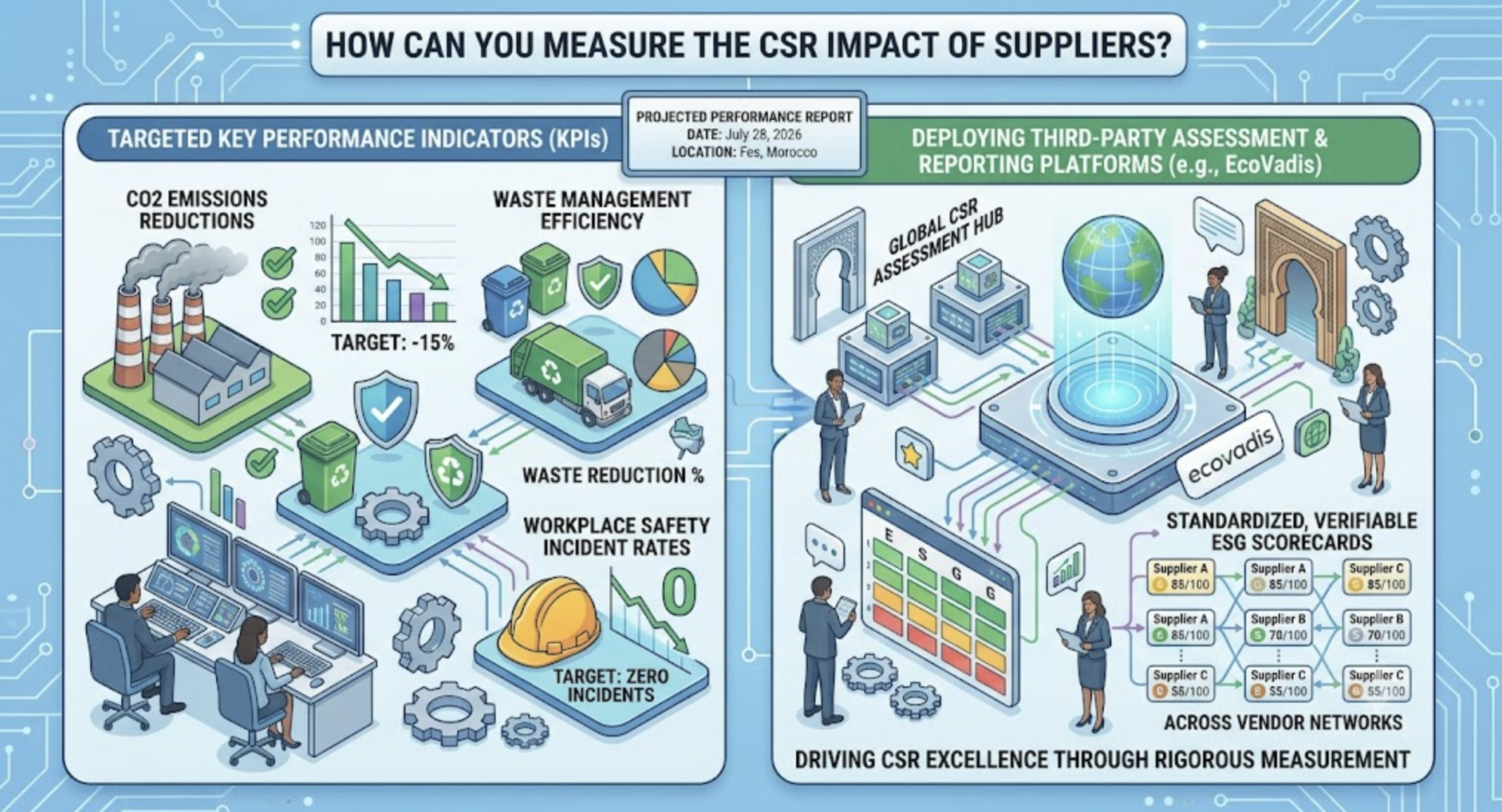
A detailed isometric vector infographic titled "HOW CAN YOU MEASURE THE CSR IMPACT OF SUPPLIERS?" set against a light blue circuit board background. A top central badge reads "PROJECTED PERFORMANCE REPORT, DATE: July 28, 2026, LOCATION: Fes, Morocco". The left panel, "TARGETED KEY PERFORMANCE INDICATORS (KPIs)", illustrates specific metrics: "CO2 EMISSIONS REDUCTIONS" showing factories and a downward bar chart targeting "-15%"; "WASTE MANAGEMENT EFFICIENCY" displaying recycling bins, a green truck, and pie charts; and "WORKPLACE SAFETY INCIDENT RATES" featuring a yellow hard hat and a line chart pointing to a target of "ZERO INCIDENTS". Two technicians sit at a lower control desk monitoring this data. The right panel, "DEPLOYING THIRD-PARTY ASSESSMENT & REPORTING PLATFORMS (e.g., EcoVadis)", features a glowing digital globe hovering over a central server labeled 'ecovadis'. This hub connects to data servers framed by traditional Moroccan architectural arches labeled 'GLOBAL CSR ASSESSMENT HUB'. Business professionals are shown interacting with a digital ESG matrix dashboard and reviewing "STANDARDIZED, VERIFIABLE ESG SCORECARDS ACROSS VENDOR NETWORKS" that display connected scores for Suppliers A, B, and C. The bottom footer reads, "DRIVING CSR EXCELLENCE THROUGH RIGOROUS MEASUREMENT".

Future of CSR Purchasing: Sectoral Trends and Forecasts

The landscape of Corporate Social Responsibility (CSR) procurement is rapidly evolving under the combined pressure of technological innovation, expanding international legislation, and shifting buyer preferences.

Anticipating these sectoral trends enables forward-thinking procurement leaders to modernize their buying strategies, eliminate supply chain risks, and capture a strong competitive advantage in a sustainability-driven market.

1. Evolution of Green Technologies & Digital Sourcing

Advancements in green technology are fundamentally transforming responsible procurement practices:

Artificial Intelligence (AI): Optimizes resource management, models carbon impact, and drives data-backed decision-making.
Blockchain Traceability: Guarantees end-to-end supply chain transparency, verifying product provenance and ethical material sourcing.

This digital transformation equips buyers with real-time data analytics to make informed, highly accountable purchasing decisions.

2. Impact of International Regulations on Sourcing Strategy

Global regulatory frameworks are becoming increasingly stringent, requiring organizations to align supply chain operations with strict environmental and social standards.

To mitigate legal liabilities and financial risks, businesses must embed regulatory compliance early in the procurement planning phase—treating legislative mandates as a strategic driver for operational refinement rather than a mere compliance burden.

Key Macro Trends Shaping Future Procurement

  • Digital Traceability: AI and Blockchain ensuring real-time visibility, material provenance, and automated audit trails.
  • Proactive Regulatory Compliance: Integrating international ESG mandates into early-stage category management and vendor selection.
  • Regional & Ethical Sourcing: Prioritizing local suppliers to shorten transport routes, cut Scope 3 emissions, and empower regional economies.

3. Increasing Preference for Local and Ethical Partnerships

A pronounced shift toward localized, ethically aligned partnerships is redefining global procurement architectures.

Prioritizing regional and ethical suppliers yields significant dual benefits: it drastically lowers logistics emissions while directly stimulating local economic resilience—creating a more agile, transparent, and socially responsible value chain.

4. Sectoral Trends Summary Matrix

Future Trend Driver Primary Technological / Operational Shift Strategic Impact on CSR Procurement
Green Technology & AI Blockchain provenance and AI resource optimization Unrivaled supply chain transparency and precision decision-making
Global ESG Regulations Binding legal mandates and mandatory supply chain disclosure Early-stage compliance integration and risk elimination
Local & Ethical Sourcing Shift from globalized to regionalized supplier networks Reduced transport emissions and strengthened local economy engagement

Conclusion: Prepare Your Sourcing Strategy for Tomorrow

Lead the Next Era of Sustainable Sourcing

Staying ahead of emerging technologies, international standards, and regional sourcing trends ensures long-term supply chain resilience.

Transform your procurement strategy today to capitalize on digital tools, guarantee full regulatory compliance, and build a sustainable competitive advantage.

FAQ - Questions About Optimal CSR Procurement Strategies

Addressing foundational questions about Corporate Social Responsibility (CSR) in purchasing helps procurement leaders navigate the transition toward ethical, transparent, and sustainable supply chains.

Below are practical answers to common questions regarding the implementation, measurement, and sector-wide application of CSR procurement strategies.

1. What are the first steps to integrate CSR into procurement?

Initial Implementation Steps: To begin, organizations must conduct a comprehensive baseline audit of their existing supplier base against core ESG (Environmental, Social, and Governance) criteria.

Analyzing vendor compliance with labor and environmental standards helps identify current strengths, compliance risks, and priority opportunities for operational improvement.

2. How can you measure the CSR impact of suppliers?

Measurement & Metrics: Supplier performance is quantified using targeted Key Performance Indicators (KPIs), such as CO2 emissions reductions, waste management efficiency, and workplace safety incident rates.

Deploying third-party assessment and reporting platforms like EcoVadis provides standardized, verifiable ESG scorecards across vendor networks.

3. What role does training play in implementing CSR procurement?

Importance of Skills Upskilling: Training is essential to build awareness, align internal teams, and engage buyers on sustainability priorities.

Organizing practical workshops on responsible sourcing methodologies, ethical negotiation, and supply chain due diligence equips buyers to integrate CSR criteria directly into daily purchasing decisions.

Key Takeaways for Procurement Leaders

  • Universal Applicability: Every industry—from construction using bio-sourced materials to technology reducing carbon footprints—can successfully integrate CSR sourcing.
  • Transparent Communication: Engage internal and external stakeholders early by sharing clear corporate CSR targets and policies.
  • Collaborative Supplier Workshops: Host joint sessions with vendors to align expectations, address challenges, and share sustainable best practices.

4. Can CSR be integrated into all sectors of activity?

Universal Industry Relevance: Yes, every commercial sector can adopt responsible procurement practices tailored to its operational realities.

For example, the construction sector prioritizes circular and eco-responsible building materials, while the technology sector focuses on reducing production energy consumption, e-waste, and raw material supply chain footprints.

5. How can you involve stakeholders in the CSR procurement strategy?

Stakeholder Engagement Strategies: Involving internal and external stakeholders relies on transparent communication regarding your company’s sustainability policies and long-term goals.

Organizing collaborative workshops and regular review sessions with key suppliers establishes mutual expectations, fosters co-innovation, and aligns supply chain partners around shared ethical standards.

Conclusion: Transform Your Sourcing Strategy Today

Build a Responsible, High-Performing Sourcing Model

Integrating CSR principles into procurement transforms risk management into a source of competitive advantage and brand resilience.

Empower your organization with clear benchmarks, continuous buyer training, and strong vendor partnerships to lead the transition toward sustainable procurement.

Integrating Optimal CSR Procurement Strategies

Understanding and integrating optimal Corporate Social Responsibility (CSR) procurement strategies is essential for any modern business striving for long-term resilience.

Adopting these sustainable practices enables your enterprise to reinforce its environmental and social commitments while optimizing overall expenditure and strengthening corporate brand equity—positioning your business as a recognized ethical leader in its sector.

Strategic Pillars of Responsible Sourcing

  • Reinforced Social & Environmental Accountability: Align daily purchasing decisions with core ethical and ESG benchmarks.
  • Cost Optimization & Process Efficiency: Uncover hidden cost savings through resource management and lifecycle analysis.
  • Industry Leadership & Brand Value: Distinguish your brand in competitive markets as a purpose-driven market leader.

Take Action: Implement Effective CSR Strategies

Position Your Business as an Ethical Leader

Integrating CSR procurement strategies turns compliance into a powerful engine for competitive advantage and sustainable enterprise growth.

Explore our detailed recommendations and practical frameworks to effectively implement these strategies within your organization today.


Line
Featured Post

Popular posts