Spot Buys

Maximize efficiency with a powerful purchasing dashboard

Published By
Olivier Audino
Tags
E-Procurement solution
Maximize the efficiency of your business with a powerful purchasing dashboard—a key tool for optimal management.

In an economic context where precision and speed are crucial, understanding the importance of a tailored dashboard can transform your procurement strategy. It is not just about tracking expenses, but about generating strategic insights that propel the business forward.

Strategic Advantages of a Purchasing Dashboard

  • Comprehensive Spend Visibility: Track organizational expenses and supplier performance in real time.
  • Strategic Insight Generation: Convert raw spend data into actionable operational intelligence.
  • Proactive Decision-Making: Identify cost-saving opportunities and mitigate supply risks before disruptions occur.
  • Best-Practice Integration: Align modern technologies and procurement standards to streamline workflows.

Transform Procurement from Expense Tracking to Value Driver

Integrating best practices and modern analytics technologies turns your dashboard into a centralized command center.

Providing end-to-end visibility across procurement workflows supports proactive, informed decision-making—ensuring your enterprise remains agile, cost-effective, and highly competitive.

Elevate Your Procurement Performance Today

Equip your leadership with real-time spend analytics, actionable supplier intelligence, and full operational control.

Optimize your purchasing strategy and drive sustainable business growth today.

Why a High-Performance Purchasing Dashboard is Essential

A high-performance purchasing dashboard serves as the nerve center of modern procurement operations.

By consolidating disparate spend streams into actionable, real-time intelligence, it enables procurement leaders to optimize cost structures, streamline workflows, and ensure complete operational alignment across the organization.

1. Improving Strategic Decision-Making

Deploying an efficient purchasing dashboard is crucial for elevating strategic decision-making.

By centralizing all procurement data and converting raw metrics into intelligible insights, the dashboard facilitates rapid, data-backed choices. Real-time visualization allows leadership to adapt purchasing strategies dynamically to shifting market conditions and internal corporate goals.

2. Precise Monitoring of KPIs & Operational Performance

Key Performance Indicators (KPIs) are vital for measuring the effectiveness of procurement workflows over time.

An advanced dashboard tracks these KPIs in detail—delivering an intuitive overview of department performance, identifying process bottlenecks, and pinpointing precise areas where sourcing workflows require recalibration.

Pillars of a High-Performance Dashboard

  • Centralized Spend Data: Unify multi-source procurement streams into a single source of truth.
  • Granular KPI Tracking: Monitor lead times, compliance rates, and savings targets continuously.
  • Real-Time Event Detection: Spot unexpected price spikes, supplier failures, or volume discounts immediately.
  • Proactive Resource Optimization: Intervene early to correct operational variances and secure cost advantages.

3. Rapidly Identifying Problems and Strategic Opportunities

A primary advantage of a high-performance dashboard is its ability to flag risks and commercial opportunities almost in real time.

Whether detecting sudden cost increases, vendor delivery bottlenecks, or advantageous volume purchasing rates, the dashboard enables procurement managers to intervene instantly—protecting operating margins and capturing value before market conditions shift.

Conclusion: Transform Procurement Data into Strategic Leverage

Build a Data-Driven Sourcing Ecosystem

Centralizing spend analytics, tracking key performance metrics, and enabling real-time anomaly detection equips your business with unmatched operational agility.

Empower your procurement leadership, eliminate spend inefficiencies, and drive long-term profitability today.

Designing an Effective Purchasing Dashboard

Designing a high-impact purchasing dashboard requires a methodical approach that bridges strategic intent with daily operational execution.

A well-architected dashboard serves as a reliable single source of truth—converting complex spend data into clear, actionable visual intelligence that guides executive decision-making and operational optimization across all business units.

1. Defining Clear Objectives

The crucial first step in creating an efficient purchasing dashboard relies on establishing specific, quantifiable, and measurable objectives. These goals must be directly aligned with the company's overall strategic vision and the tailored requirements of various internal stakeholders.

When goals are articulated with absolute clarity, the dashboard transcends basic reporting to become an indispensable tool for decision support, risk mitigation, and performance management. Establishing clear parameters ensures that every metric displayed directly contributes to organizational growth and operational discipline.

Essential Objective Definition Parameters

  • Strategic Alignment: Direct integration of dashboard metrics with macro business goals, financial budgets, and corporate cost-reduction targets.
  • Specificity and Measurability: Framing objectives using quantifiable thresholds (e.g., target savings percentages, cycle time limits) to evaluate progress objectively.
  • Universal Clarity: Communicating dashboard goals in plain, standardized terms to ensure cross-departmental understanding and adoption across executive and operational tiers.

2. Selection of Key Performance Indicators (KPIs)

Selecting the right KPIs is foundational to building a high-value purchasing dashboard. Rather than cluttering the interface with vanity metrics, procurement managers must curate a balanced set of indicators that directly reflect core operational drivers such as total acquisition cost, vendor performance, fulfillment reliability, and contract compliance.

Focusing on actionable data enables leadership to evaluate supply chain health continuously, spot cost overruns before they escalate, and hold vendors accountable to established SLAs. A refined metric selection strikes the perfect balance between high-level financial health and granular operational control.

Core KPI Selection Benchmarks

  • Total Cost of Purchases: Tracking total spend, budget variance, negotiated savings, and total cost of ownership (TCO) across product categories.
  • Delivery Compliance Rate: Monitoring supplier lead time accuracy, on-time delivery percentages, and order fulfillment completeness (OTIF).
  • Order Satisfaction Index: Measuring internal user feedback, product quality acceptance rates, and vendor resolution efficiency.

Essential Architectural Pillars of a Sourcing Dashboard

  • Strategic Goal Mapping: Ensure every displayed metric ties directly to enterprise-level financial objectives.
  • Curated KPI Ecosystem: Prioritize high-impact indicators to prevent data fatigue and maintain clear focus.
  • Visual Data Hierarchy: Organize data logically using intuitive charts, trendlines, and threshold alerts.
  • Role-Based Personalization: Tailor views dynamically to match executive overviews or detailed category-level analysis.

3. Dashboard Structure and Organization

A well-thought-out visual structure and logical information hierarchy are decisive for a dashboard's daily adoption and effectiveness. Information must be arranged to maximize readability, allowing users to extract key insights within seconds of scanning the screen.

Grouping metrics into logical categories—such as spend analytics, vendor performance, and risk management—creates an intuitive visual flow. Incorporating visual charts and real-time alert triggers ensures that major deviations from targets immediately catch user attention, enabling swift corrective interventions.

Recommended Structural Framework

  • Logical Categorization: Structuring metrics systematically into distinct modules like spend analysis, vendor risk, and operational efficiency.
  • Clear Visual Representation: Utilizing clean bar graphs, heatmaps, and trendlines to make complex procurement datasets instantly understandable.
  • Automated Exception Alerts: Embedding automated visual alerts and notification thresholds to highlight budget breaches or vendor failures instantly.

4. Adaptation to Different User Profiles

Different stakeholders interact with procurement data in unique ways depending on their organizational responsibilities. Customizing the dashboard to cater to diverse user profiles is critical to maximizing its practical utility across the business.

While C-suite executives require consolidated macro overviews focusing on total spend, ROI, and high-level risk scorecards, category managers require granular operational details like purchase order status, SKU pricing trends, and supplier lead times. An adaptable interface guarantees that every user gets immediate access to the data most relevant to their role.

User Personalization Strategy

  • User Needs Identification: Mapping distinct requirements across executives, procurement directors, and category buyers.
  • Role-Based Data Granularity: Delivering high-level executive summaries alongside deep-dive drill-down capabilities for operational teams.
  • Adjustable Interactive Interface: Providing dynamic filters, customizable widget layouts, and adaptable date ranges for personalized analysis.

Conclusion: Build a Next-Generation Sourcing Dashboard

Transform Procurement Reporting into Strategic Action

Combining clear strategic objectives, curated KPIs, structured visual organization, and role-based personalization creates a powerful procurement dashboard that drives operational excellence.

Empower your team with real-time spend visibility, automate risk monitoring, and maximize business profitability today.

A detailed isometric infographic illustration titled "PILLARS OF NEXT-GENERATION PROCUREMENT CONTROL." It features four distinct illustrated columns. Column 1 shows dashboards and money bags for "Complete Spend Clarity." Column 2 maps processes and vendor negotiations for "Visualized Purchasing Flows." Column 3 uses a telescope and warehouse shelves with robotic arms for "Predictive Resource Planning." Column 4 displays dynamic, transforming charts for "Real-Time Forecast Integration." Small professional figures are shown at control desks and interacting with the data throughout.

Continuous Optimization of the High-Performance Purchasing Dashboard

To ensure your purchasing dashboard retains its value over time, continuous optimization is essential.

A dashboard is not a static installation; it requires automated data pipelines, continuous feedback loops, and periodic metric reassessments to stay responsive, reliable, and perfectly aligned with shifting business goals.

1. Automating Updates & Real-Time Data Synchronization

Real-Time Accuracy & Analyst Time Gains: Automating update cycles guarantees that the displayed metrics reflect real-time operational realities, enabling fast, well-informed decision-making.

Automated data sync eliminates manual input errors and liberates procurement analysts from repetitive data gathering—shifting their focus toward strategic trend analysis, cost optimization, and risk evaluation.

Pillars of Continuous Dashboard Optimization

  • Real-Time Automation: Synchronize system data automatically to eliminate manual keying errors.
  • User Feedback Loops: Capture internal feedback systematically to optimize ergonomic flow.
  • Periodic Metric Audits: Reassess KPIs regularly to reflect evolving enterprise goals.
  • Strategic Analyst Focus: Reallocate team resources from data entry to high-impact trend analysis.

2. User Feedback Integration & Ergonomic Refinement

Systematic Feedback Channels: The continuous improvement of an enterprise dashboard relies heavily on active user input.

Establishing structured feedback channels—such as quick digital forms or routine review meetings—helps identify navigation bottlenecks and ergonomic hurdles, leading to layout reorganizations that enhance daily operational usability.

3. Regular Analysis and Metric Reassessment

Adapting to Organizational Shifts: A high-performance dashboard must remain adaptive over time. Conducting periodic reassessments verifies whether tracked KPIs still reflect organizational objectives.

Regular audits uncover emerging supply chain trends or anomalies, enabling procurement leadership to recalibrate existing metrics or integrate new indicators to maintain complete strategic relevance.

Conclusion: Maintain an Agile, Precision Sourcing Engine

Keep Your Procurement Strategy Sharp and Responsive

Combining automated data feeds, active user feedback loops, and dynamic KPI audits ensures your purchasing dashboard remains an indispensable, forward-looking decision-support system.

Eliminate data latency, optimize team workflows, and refine your procurement metrics with continuous dashboard optimization today.

Concrete Examples of High-Performance Purchasing Dashboards

A high-performance purchasing dashboard delivers tangible results across distinct industry sectors when tailored to specific operational priorities.

Whether streamlining manufacturing lead times, accelerating software development cycles, or maximizing retail profit margins, sector-specific dashboards convert raw spend data into direct financial and operational value.

1. Industrial Sector: Supply Chain & Time-to-Market Optimization

In the manufacturing space, monitoring supply chain fluidity and unit cost stability is paramount. An automotive parts manufacturer integrated supplier compliance rates, delivery lead times, and unit prices into their core dashboard.

Measured Impact: By modulating production workflows in real time based on updated vendor data, the company reduced its time-to-market by 25%.

2. Technology Sector: Measuring Supplier Innovation

In fast-moving technology enterprises, purchasing dashboards evaluate supplier-driven innovation and its direct effect on product lifecycles. Tracked metrics include vendor-contributed R&D innovations, tech integration costs, and adoption velocity.

Measured Impact: Leveraging data to negotiate premium terms with top-tier tech suppliers yielded a 30% increase in product development efficiency.

3. Distribution & Retail Sector: Volume Purchase & Margin Maximization

A major European retail distributor implemented a purchasing dashboard focused on volume aggregation, rebate fulfillment, and internal department satisfaction scores.

Measured Impact: Recalibrating sourcing approaches using real-time rebate data resulted in an 18% profit margin improvement over one year.

Checklist for an Effective Purchasing Dashboard

  • Defined & Quantifiable KPIs: Focus strictly on high-impact, measurable indicators aligned with business goals.
  • Real-Time Data Streams: Guarantee metric relevance with automated, real-time data synchronization.
  • Sector-Specific Tailoring: Adapt dashboard metrics to match specific industry supply chain mechanics.
  • Built-in User Feedback: Incorporate feedback channels to continuously refine visual ergonomics.

4. Summary of Cross-Sector Dashboard Impact

Industry Sector Primary KPIs Tracked Measured Operational Impact
Industrial / Manufacturing Supplier compliance rate, delivery lead times, unit costs 25% reduction in time-to-market
Technology & Hardware Supplier innovation contributions, technology integration costs 30% increase in development efficiency
Distribution & Retail Purchase volume, rebate discounts earned, internal satisfaction 18% improvement in profit margins

Conclusion: Maximize Business Profitability with Tailored Dashboards

Elevate Your Procurement Performance

These real-world case studies prove that a well-designed purchasing dashboard significantly enhances operational efficiency, accelerates product cycles, and expands profit margins.

Tailor your purchasing dashboard to your industry's specific dynamics and start driving measurable business growth today.

Common Dashboard Mistakes to Avoid

Designing an efficient purchasing dashboard requires filtering out unnecessary noise to keep executive focus on high-priority metrics.

Avoiding structural pitfalls—such as visual overload, overly generic templates, or ignoring qualitative vendor feedback—ensures your procurement interface remains clean, actionable, and aligned with strategic business targets.

1. Information Overload, Customization & Qualitative Data

Information Overload: Presenting too many metrics causes visual cognitive fatigue and confusion. High-impact dashboards remain simple and direct, limiting displayed indicators strictly to essential KPIs.

Lack of Personalization: A generic, one-size-fits-all dashboard fails to deliver specific strategic value. Tailor views directly to organizational priorities and the distinct needs of end users.

Ignoring Qualitative Data: Numbers alone do not reveal the complete operational story. Incorporate qualitative inputs—such as vendor performance notes and internal team feedback—to provide rich context.

Core Dashboard Pitfalls & Best Practices

  • Promote Visual Clarity: Restrict displayed KPIs strictly to core operational drivers to prevent interface clutter.
  • Tailor to User Profiles: Custom-design dashboard views according to business goals and specific user permissions.
  • Blend Qualitative Feedback: Combine raw spend numbers with vendor reviews and buyer comments for nuanced analysis.

2. Dashboard Errors Summary & Correction Guide

Common Dashboard Error Impact on Dashboard Utility Correction & Best Practice Advice
Information Overload Difficulty in reading, interpreting, and making fast decisions Limit indicators to essential KPIs and prioritize visual hierarchy
Lack of Customization Irrelevance for strategic decision-making across departments Adapt layout and data feeds to the specific environment of the company
Ignoring Qualitative Data Incomplete, one-dimensional view of procurement performance Incorporate vendor feedback and team comments to nuance numeric metrics

Tools and Technologies for an Effective Purchasing Dashboard

Selecting the right technology stack is vital for building a scalable purchasing dashboard.

Procurement platforms must integrate seamlessly with existing ERP infrastructure, adapt as organizational needs expand, and offer robust data visualization and automation capabilities.

3. Modern Business Intelligence Platforms Comparison

Merits of Leading Business Intelligence Tools

  • Power BI: Seamless native integration with Microsoft ecosystems and advanced visualization engines.
  • Tableau: High adaptability, robust customization options, and an extensive global user community.
  • Google Data Studio (Looker Studio): Cost-effective entry point with easy integration across Google Cloud services.
Business Intelligence Tool Ease of Use Key Capabilities & Features Pricing & Cost Structure
Power BI Intermediate Advanced visualizations, native Excel & Microsoft 365 integration Variable (Subscription-based)
Tableau Advanced Deep data customization, complex calculations, strong community support High enterprise tier
Google Data Studio Beginner Native integration with Google tools, low entry barrier Free for basic features

4. Technical Support, System Updates & AI Integration

Technical Support & Updates: Maintaining dashboard performance requires responsive tech support and regular software updates that patch bugs and enhance operational capabilities.

AI-Powered Predictive Analytics: Integrating Artificial Intelligence solutions (e.g., IBM Cognos) equips dashboards with predictive capabilities—forecasting purchasing behaviors and market trends to maximize operational efficiency.

Conclusion: Build a High-Impact Sourcing Dashboard Today

Transform Procurement Data into Strategic Leverage

By avoiding information overload, customizing user views, leveraging top-tier BI tools, and integrating predictive AI analytics, your organization creates an agile, future-proof decision support system.

Eliminate data latency, optimize purchasing workflows, and drive business growth today.

Importance of Data Security in Purchasing Dashboards

Securing data within a modern purchasing dashboard is vital for maintaining the confidentiality, integrity, and availability of sensitive commercial information.

Establishing robust security protocols—such as end-to-end encryption, multi-factor authentication, and continuous security audits—protects procurement intelligence against unauthorized access, leaks, and cyber vulnerabilities, reinforcing stakeholder trust across the entire enterprise.

1. Data Security Fundamentals & Core Safeguards

Encryption and Data Protection: Encrypting data at the source ensures that even in the event of a system breach, unformatted information remains completely unintelligible to unauthorized actors. Up-to-date encryption standards neutralize data exploitation risks.

Granular Access Controls & Authentication: Implementing strong Identity and Access Management (IAM), multi-factor authentication (MFA), or biometric verification restricts system interactions strictly to authorized roles.

Incident Response Protocols: Defining structured incident response procedures enables rapid scope analysis, immediate stakeholder notification, and prompt remediation when anomalies are detected.

2. Regulatory Compliance & Stakeholder Trust

Regulatory Standards: Adhering to strict compliance frameworks—such as GDPR, HIPAA, and regional data protection mandates—prevents costly regulatory penalties while strengthening corporate reputation.

Building Ecosystem Confidence: A security-first architecture assures suppliers, internal buyers, and executive leadership that transactional records, pricing structures, and contract terms are handled with maximum professionalism.

Pillars of Secure & Integrated Purchasing Dashboards

  • End-to-End Data Encryption: Safeguard spend data in transit and at rest across modern cloud systems.
  • Granular Identity Management (IAM): Control data visibility using role-based access limits and MFA protocols.
  • Intrusion Detection & Firewalls: Continuous network monitoring to prevent unauthorized intrusion vectors.
  • Seamless Workflow Automation: Eliminate human keying errors and streamline repetitive data aggregation cycles.

Integrating the Dashboard into the Global Workflow

The true value of a purchasing dashboard depends on its seamless integration into established operational routines without introducing unnecessary complexity.

3. Adapting to Existing Processes & Interface Optimization

Harmonious Operational Alignment: Collaborating closely with front-line buyers ensures the dashboard supports daily activities rather than disrupting existing tasks.

Intuitive User Experience (UX): An intuitive, customizable interface allows users across departments to navigate spend analytics effortlessly. Role-specific dashboards combined with targeted upskilling guarantee high daily adoption rates.

4. Cross-Departmental Collaboration & Task Automation

Enhanced Communication: Sharing centralized, real-time insights aligns internal stakeholders, breaks down departmental silos, and fosters synchronized strategic decision-making.

Automating Repetitive Tasks: Automating routine data harvesting and report generation frees purchasing professionals to focus on high-value activities—such as strategic supplier negotiations, market research, and risk mitigation.

Conclusion: Deploy a Secure, High-Performance Dashboard

Elevate Your Procurement Workflow with Secure Intelligence

Combining enterprise-grade data security, regulatory compliance, and seamless workflow automation transforms your purchasing dashboard into a resilient, high-value strategic command center.

Protect sensitive procurement data, streamline cross-functional workflows, and drive business growth today.
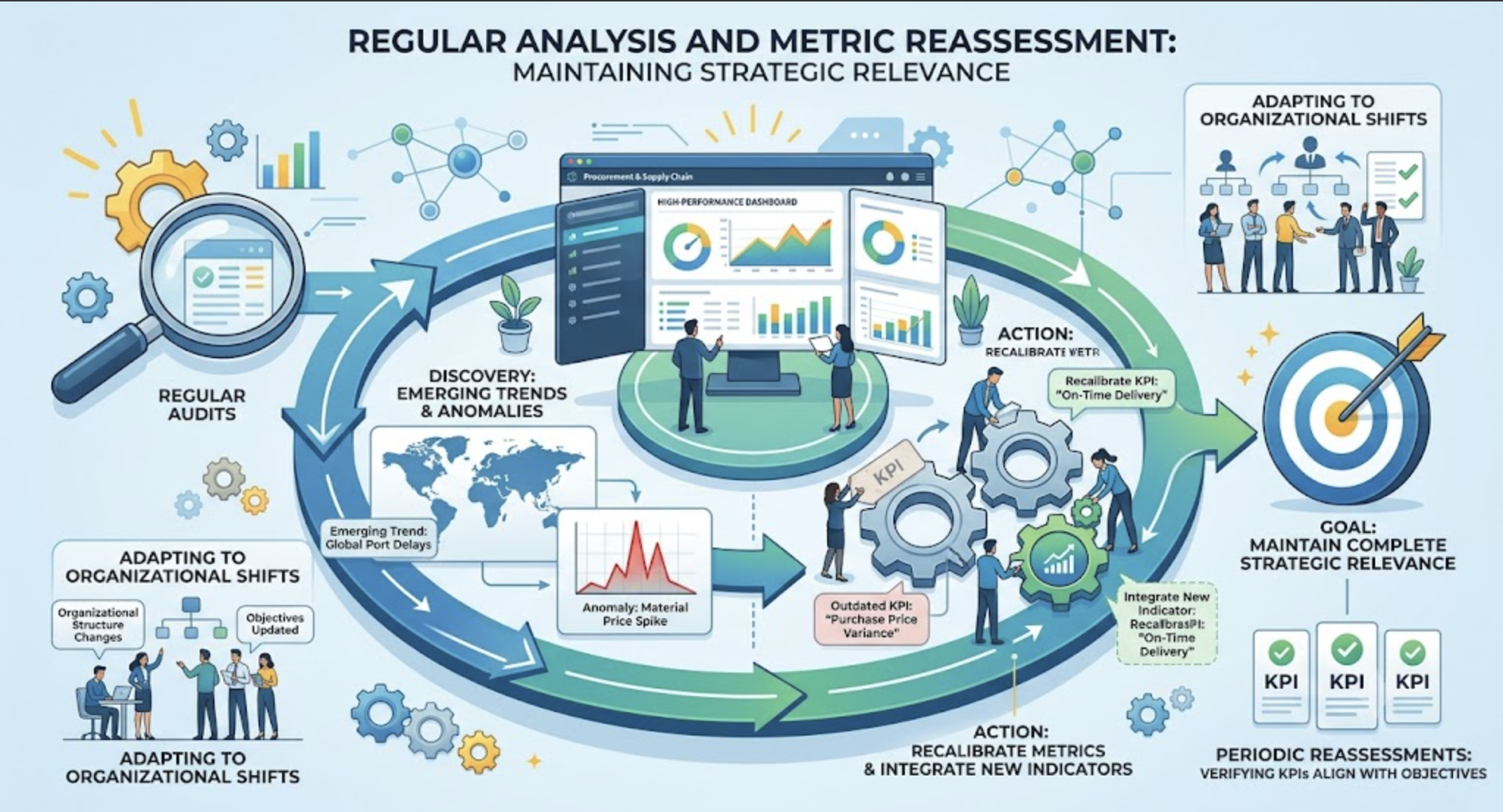
An infographic titled "REGULAR ANALYSIS AND METRIC REASSESSMENT: MAINTAINING STRATEGIC RELEVANCE," illustrating a circular process for updating business dashboards. The central element is a high-performance procurement and supply chain dashboard with multi-screen displays. A large blue arrow indicates a continuous flow from left to right. On the left, "REGULAR AUDITS" leads to "DISCOVERY: EMERGING TRENDS & ANOMALIES," with specific examples like "Emerging Trend: Global Port Delays" on a world map and an "Anomaly: Material Price Spike" on a line graph. This discovery feeds into an "ACTION: RECALIBRATE METRICS & INTEGRATE NEW INDICATORS" section, where figures replace "Outdated KPI: 'Purchase Price Variance'" with new or recalibrated indicators, such as "On-Time Delivery." Arrows from these actions point toward a bullseye target labeled "GOAL: MAINTAIN COMPLETE STRATEGIC RELEVANCE." Smaller panels reinforce key concepts: one shows team members reorganization under "ADAPTING TO ORGANIZATIONAL SHIFTS" with updated objectives and structure, and another summarizes "PERIODIC REASSESSMENTS: VERIFYING KPIs ALIGN WITH OBJECTIVES." The design is a clean vector style with a modern professional color palette of blues and greens.

FAQ - Maximize Efficiency with a Powerful Purchasing Dashboard

A high-performance purchasing dashboard delivers real-time visibility into enterprise spend, vendor compliance, and cost optimization opportunities.

Below are expert answers to frequently asked questions regarding essential KPI selection, software automation, data-driven supplier negotiations, benchmarking models, and itemized cost breakdowns.

1. What key indicators should be included in a procurement dashboard to optimize monitoring?

Essential KPIs & Spend Tracking: Integrate core metrics such as purchase volume by category, delivery lead times, and contract compliance rates.

For instance, tracking month-by-month cost savings provides leadership with an immediate, transparent picture of department performance and total return on investment.

2. How can technology improve procurement management?

Software Automation & Enterprise Platforms: Deploying automation software drastically reduces manual data entry errors while accelerating operational throughput.

Enterprise platforms like SAP Ariba simplify source-to-contract operations, enabling real-time supplier and contract tracking across modern supply chains.

Core Takeaways for Dashboard Efficiency

  • Categorized KPI Monitoring: Track category spend volumes, lead times, and contract compliance month over month.
  • Real-Time System Automation: Leverage solutions like SAP Ariba to eliminate keying errors and simplify oversight.
  • Data-Backed Negotiation Leverage: Use historical vendor benchmarks to build compelling arguments and predict supplier behavior.
  • Objective Supplier Benchmarking: Implement structured scoring models evaluating quality, punctuality, and innovation.
  • Granular Cost Deconstruction: Itemize product spend to identify cost leakages and renegotiate commercial terms.

3. What practices should be adopted for effective negotiations with suppliers?

Collaborative Approach & Historical Performance Data: Adopt a collaborative, win-win negotiation stance supported by clear, predefined strategic objectives.

Leveraging historical performance metrics and transactional datasets allows buyers to substantiate arguments effectively while accurately predicting vendor behaviors during contract renewals.

4. What does supplier benchmarking consist of, and how can it be implemented?

Standard-Based Evaluation & Scoring Models: Supplier benchmarking assesses vendor performance against established industry standards and competitor benchmarks.

Implementation requires establishing a structured scoring matrix evaluated against explicit criteria such as product quality, delivery punctuality, and technological innovation.

5. What impact does a detailed cost analysis have on the purchasing strategy?

Spend Visibility & Renegotiation Leverage: Detailed cost analysis pinpoints excessive spend patterns and highlights hidden savings opportunities across product lines.

Breaking down cost components for individual products provides the necessary leverage to renegotiate contract terms or strategically re-evaluate sourcing channels when necessary.

Conclusion: Drive Business Growth with Data-Driven Procurement

Transform Procurement Data into Strategic Leverage

Integrating curated KPIs, enterprise automation software, vendor benchmarking, and detailed cost analysis turns your purchasing dashboard into a powerful growth engine.

Maximize operational efficiency, eliminate unnecessary spend, and empower proactive decision-making today.

Maximizing Operational Efficiency with a Powerful Purchasing Dashboard

Maximizing efficiency with a powerful purchasing dashboard is crucial for any business striving to maintain financial discipline and operational agility.

These tools provide unparalleled clarity on enterprise spending patterns and highlight hidden savings opportunities—turning raw transactional data into a decisive strategic advantage.

1. Unparalleled Clarity & Enhanced Supplier Negotiations

Clearly illustrating purchasing flows allows procurement teams to identify spend concentrations, category variances, and vendor performance trends.

Having full transparency over these workflows equips buyers with concrete, data-backed leverage to negotiate better commercial terms, volume discounts, and service agreements with suppliers.

Pillars of Next-Generation Procurement Control

  • Complete Spend Clarity: Gain immediate, granular visibility into organizational expenditure and savings potential.
  • Visualized Purchasing Flows: Mapping purchasing cycles unlocks powerful leverage during vendor negotiations.
  • Predictive Resource Planning: Anticipate future material needs to eliminate inventory bottlenecks.
  • Real-Time Forecast Integration: Transform static forecasts into dynamic, proactive procurement strategies.

2. Predictive Resource Demand & Real-Time Strategy

A well-designed purchasing dashboard goes beyond historic reporting by helping leadership anticipate future resource needs before shortages occur.

Its ability to integrate data in real time converts standard forecasts into proactive sourcing strategies—allowing organizations to outperform competitors, mitigate market volatility, and optimize procurement operations continuously.

Conclusion: Shape the Future of Your Procurement Operations

Equip Your Enterprise with Indispensable Procurement Tools

Integrating real-time spend analytics, predictive resource planning, and clear purchasing flows makes your dashboard an essential ally in outperforming market competition.

Equip yourself with this powerful tool, drive maximum operational efficiency, and shape the future of your procurement management today.

Line
Featured Post

Popular posts