Olivier Audino
Webinar
Achats de Classes C: Le levier oublié pour libérer vos acheteurs
Mardi 31 Mars à 14h00

Achats de Classes C: Le levier oublié pour libérer vos acheteurs
Mardi 31 Mars à 14h00


Procurement departments deploy robust ERPs like SAP, Ariba, or Coupa to structure their strategic spend.
These technological systems end up paralyzed by a critical mass of one-off suppliers.
The operational reality is unforgiving. A CPO frequently has to justify why their ERP contains 40,000 suppliers, when 25,000 of them have only been used once. This structural anomaly turns Master Data management into a true financial sinkhole.
Here is the reality :
Faced with this situation, launching an IT migration project to clean the supplier database is a heavy and uncertain initiative. There is a mathematical alternative method : cleaning the system through attrition.
By entrusting these transactions to a Transactional Trusted Third Party, the company blocks the entry of useless new data. This article details how the One-Stop Vendor absorbs legal risk, protects EBITDA, and permanently sanitizes your purchasing ecosystem.
Stop sacrificing your cash flow or supplier relationships to manage payment delays. BME's payment delegation separates the purchasing act from the disbursement : we handle the immediate cash payments required by your vendors, while you maintain your standard payment terms.
Procurement theory dictates that buyers' energy should be allocated to strategic contracts. Field practice demonstrates exactly the opposite.
Large groups deploy massive information systems to secure their global flows.
Applying the heaviness of an ERP process designed for a 2-million-euro call for tenders to a 500-euro emergency is like using a jackhammer to drive a nail.
We systematically observe an inverted Pareto principle in Procure-to-Pay management.
Faced with this logistical bottleneck, the specifier bypasses the buyer and pays with the company credit card. This is the explosion of "Maverick Spend" or rogue spending. The buyer, initially recruited for their negotiation expertise, turns into a simple data clerk.
The pollution of the supplier database is not just a simple IT architecture problem. It is a measurable and direct destruction of value. According to authoritative entities like Gartner, the full cost of processing a single invoice internally easily climbs to 150 euros.
Because this invisible cost encompasses time-consuming tasks with no added value: rushed sourcing in absolute urgency, laborious follow-ups to obtain legal documents (company registration, bank details), and manual data entry which requires an average of 3 hours of actual work.
Let's look at the brutal mathematical demonstration of this impact on EBITDA:
The CPO finances the manual onboarding of "disposable" third parties, mechanically destroying the profitability of their own department instead of converting these FTEs into growth levers. You can precisely diagnose this profitability leak by measuring your workload with our transactional workload calculator.
The proliferation of third parties in the ERP creates a major legal vulnerability for the CPO. Each open supplier line is a gateway to non-compliance risk.
The initial collection of legal documents is only the surface of the problem. An ERP containing 25,000 dormant suppliers represents 25,000 potentially expired compliance files. Keeping this database updated requires continuous monitoring of tax and social security certificates.
No one updates the file of a craftsman used only once three years ago.
This documentary void becomes critical during an audit by regulatory bodies. The Sapin 2 law makes no distinction between a strategic supplier and an occasional vendor. The absence of a valid company registration or tax certificate directly engages the penal liability of the company.
The new European CSRD directive exacerbates this pressure on procurement departments. How can you accurately calculate the carbon footprint (Scope 3) of a supply chain made up of tens of thousands of invisible and poorly documented micro-suppliers? It is technically impossible. The ESG risk becomes uncontrollable.
You can quickly assess the vulnerability level of your database by auditing your processes with our compliance stress test.
This legal pressure falls directly on the buyer's shoulders. The compliance department imposes draconian onboarding rules to protect itself. The buyer, supposed to be a business partner, must enforce these rules on the internal customer.
A plant manager demands a critical spare part for 800 euros by tomorrow morning.
The buyer knows perfectly well that the complete legal verification process (KYC) will take at least two weeks. If they refuse to place the order without the compliance documents, they become the bureaucrat paralyzing production. If they validate the purchase to save the emergency, they expose themselves to internal auditor sanctions.
Paying a highly qualified professional to track down a missing compliance certificate for an 800-euro service makes no economic sense. Their year-end bonus depends on their strategic negotiations, not on data entry for Class C purchases.
Faced with this bottleneck, the internal customer takes their corporate credit card and buys on their own. The system designed to protect the company causes the exact opposite effect : a total loss of spend control through the multiplication of maverick buying.
BME's architecture was designed to natively embed into your current ecosystem (SAP, Coupa, Oracle). No process disruption : your buyers continue to manage their requests from their usual interface. BME operates as a "Shadow Vendor" to consolidate and sanitize your flows in the background.
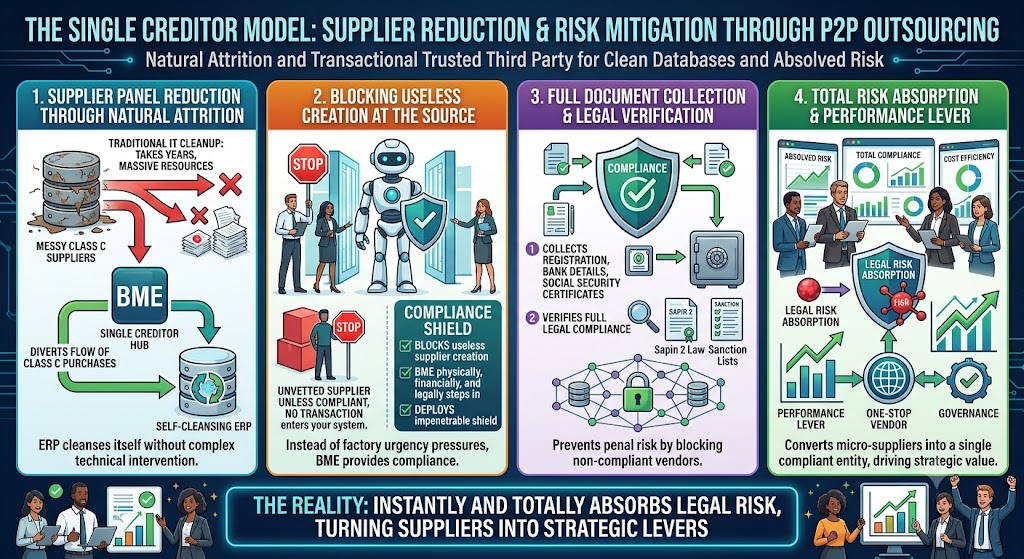
Cleaning a supplier database through a traditional IT project takes years and mobilizes massive resources. The solution is not to migrate the data, but to block useless creation at the source.
This is the principle of natural attrition. By diverting the flow of Class C purchases, the ERP cleanses itself without any complex technical intervention.
The CPO cannot indefinitely bear the penal risk generated by thousands of micro-suppliers. Outsourcing to a Transactional Trusted Third Party completely reverses this model. BME physically, financially, and legally steps between the company and its one-off suppliers.
Instead of leaving document collection to a buyer pressured by factory urgency, BME deploys an impenetrable compliance shield :
If the service provider is not compliant, the transaction never enters your information system. The legal risk is instantly and totally absorbed by the One-Stop Vendor.
The classic argument against outsourcing is the fear of adding yet another complex tool for the teams.
The BME model requires no modification to your IT architecture. It operates through a substitution mechanism that is completely invisible to the internal requester.
The flow integrates natively into your current system, whether you use Coupa, Ariba, or SAP. The buyer validates their request with a single click in their usual interface, without any administrative data entry.
This is exactly where the Master Data is sanitized :
The result is immediate and measurable. Instead of suffering from a fragmented database, the Procurement department interacts with a single supplier. The thousands of obsolete third parties eventually disappear from the screens through natural attrition.
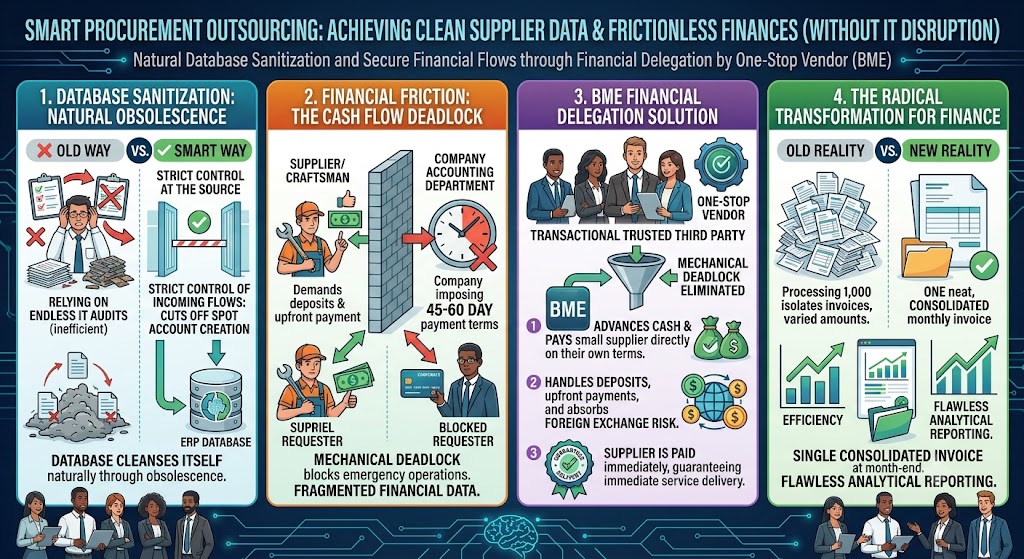
The true sanitization of an ERP does not rely on endless IT audits. It is achieved through strict control of incoming flows. By cutting off the creation of spot accounts at the source, the database cleanses itself naturally through obsolescence.
Procure-to-Pay outsourcing is not limited to documentary compliance. It resolves a major financial friction between large groups and small suppliers.
Craftsmen and small agencies frequently demand deposits or upfront payments to start a service. Conversely, your accounting department imposes strict payment terms of 45 to 60 days.
This cash flow discrepancy blocks emergency operations. To bypass this wall, the internal requester uses the corporate credit card, further fragmenting the financial data.
The financial delegation of the One-Stop Procurement Vendor eliminates this mechanical deadlock:
For your financial department, the transformation is radical. Instead of processing 1,000 isolated invoices of varying amounts, the accounting team receives a single consolidated invoice at the end of the month with flawless analytical reporting.
The Transactional Trusted Third Party model converts an administrative cost center into a true profit center.
According to operational efficiency benchmarks (validated by firms like McKinsey), outsourcing the Tail Spend is one of the fastest levers to restore the profitability of a support function.
Every hour a strategic buyer spends chasing a supplier for bank details destroys your operating margin. By outsourcing Class C management, the company immediately recovers FTEs. These expert resources are reallocated to strategic tenders that truly impact the year-end balance sheet.
Let's do the final calculation of this value restitution:
Accurately measure the financial impact of this sanitization on your profitability by calculating your lost hours with our transactional workload calculator.
Master Data must no longer be an area of legal vulnerability and financial waste.
Deploying a Single Creditor neutralizes the administrative burden without modifying your current software architecture. You block the entry of useless data and let your database cleanse itself.
Rather than undertaking heavy, costly, and risky data migration projects, adopt the attrition strategy. By locking down the creation of new one-off accounts, you let the "old data" die naturally.
It is a sanitization method that consists of blocking the creation of new one-off suppliers in the ERP. By delegating these purchases to a One-Stop Vendor, old inactive accounts eventually disappear naturally, thus avoiding a heavy data migration project.
The Transactional Trusted Third Party acts as a single accounting line in your system. Buyers continue to validate their requests in their usual ERP, but the architecture automatically redirects all micro-transactions to the BME account.
BME ensures the total financial delegation of the transaction. We pay the deposits or upfront cash invoices required by local suppliers, then we bill the large corporate group via a single monthly invoice respecting the standard payment terms of your organization.


Get in touch with our experts, who'll be glad to take you behind the scenes of our procurement outsourcing systems — proven for over 10 years.
.svg)