Olivier Audino
Webinar
Tail Spend: The Overlooked Lever to Free Up Your Buyers' Time
Tuesday March 31 at 2:00 PM


Within executive leadership teams of large corporations, the directive is repeated every year because you must reduce the supplier panel. On paper, the CPO commits to streamlining databases to restore agility to their P2P tool and secure the global supply chain.
The rationalization policy consistently fails the moment it hits the field. Operational teams continue to demand urgent spot purchases, forcing buyers to create new accounts daily for low value transactions.
The result is systemic obesity. A large industrial group ends up on average with a database inflated to 40,000 records, of which nearly 25,000 have recorded only a single transaction over the last twelve months.
This is the strict demonstration of the inverse Pareto principle striking the procurement function
5% of your spend represents 80% of your administrative burden.
Asking a procurement team to cleanse this tail spend manually is an illusion.
To truly cleanse information systems, finance and procurement departments no longer rely on manual data entry, but on structural engineering: Master Vendor Management.
Processing Class C spend consumes your resources. Every spot vendor created is a direct EBITDA loss for your company.
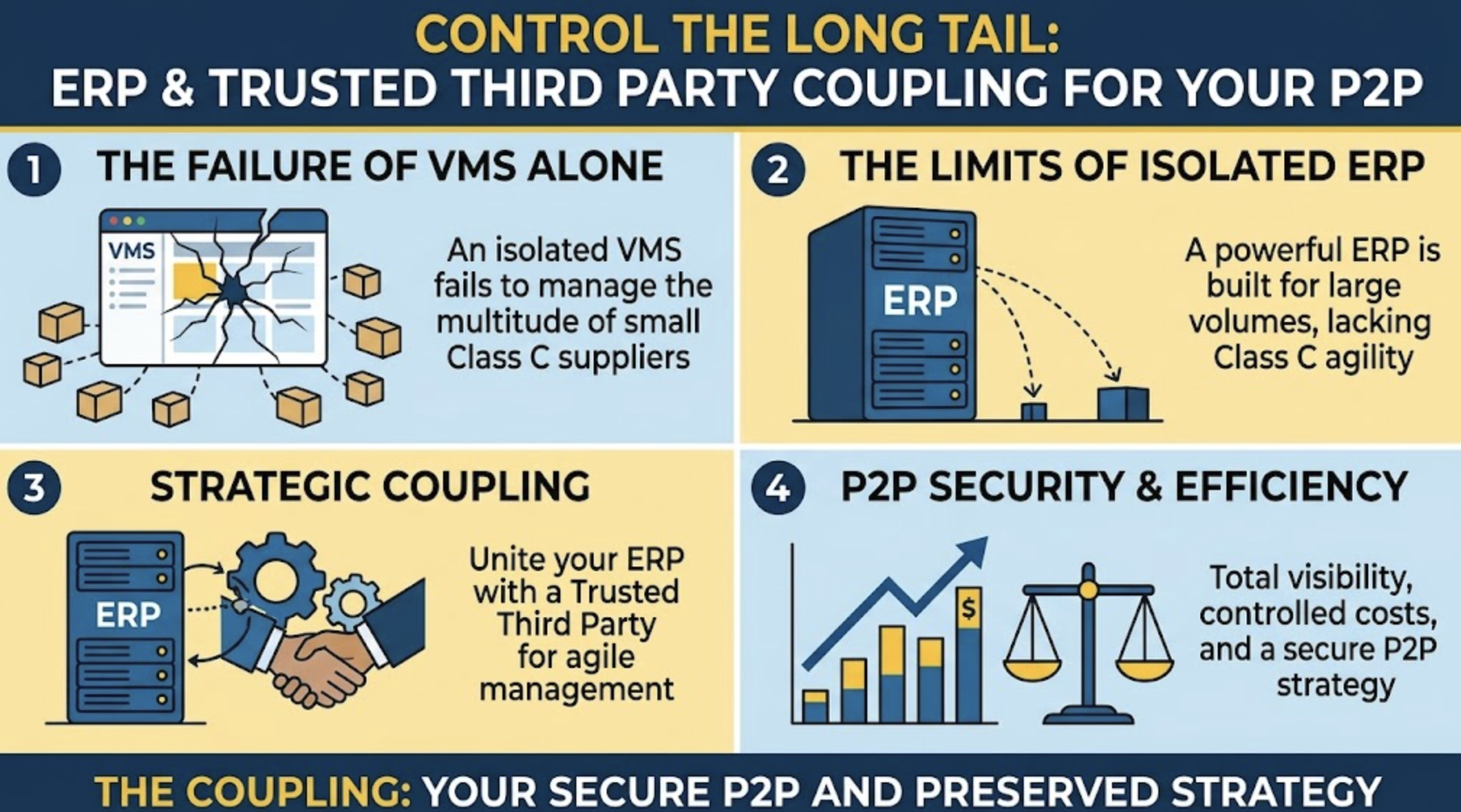
Managing non-strategic purchases, or tail spend management, is the major friction point for procurement departments. Companies invest millions of euros in robust ERPs (SAP, Ariba, Coupa) designed to pilot global contracts and secure complex supply chains.
Using this same heavy software architecture to onboard a local plumber or an occasional event agency is an operational anomaly. It is like using a jackhammer to drive a nail.
Every urgent field request (marketing, maintenance) forces your teams to abandon their strategic priorities to feed supplier master data with disposable third parties. The system gets clogged, accounting saturates, and global financial visibility becomes opaque.
Why do internal supplier panel rationalization campaigns systematically fail? Because they attack the symptom (the number of entries) without fixing the structural issue of the Procure-to-Pay flow.
Recognized analyst firms, such as Gartner or The Hackett Group, demonstrate that processing Class C spend consumes a disproportionate share of resources. Let us translate this burden into strict EBITDA destruction:
Asking a procurement team to cleanse this tail spend manually is an illusion.
To truly cleanse information systems, finance and procurement departments no longer bet on manual entry, but on structural engineering: Master Vendor Management.
Beyond operational friction, the CPO faces a regulatory Sword of Damocles. The legal department and internal audit impose draconian onboarding rules to protect the company from fines. However, on the ground, it is technically impossible for a buyer to conduct a complete compliance audit on thousands of micro suppliers.
Supplier KYC (Know Your Supplier) procedures are often rigorous during initial onboarding.
But who verifies the document updates for a craftsman referenced two years ago for a one-off 800 € job? Nobody.
These thousands of disposable third parties sleep in your systems and constitute a perfect blind spot. In the event of an external investigation, it is not your strategic partners that will bring down your rating, but this myriad of invisible and unaudited small suppliers.
Regulatory requirements set no tolerance threshold. The French Anti-Corruption Agency (AFA) is intransigent: it demands exhaustive mapping and integrity checks on your entire value chain.
Sapin II Law compliance mandates continuous screening (watchlists, international sanctions). At the same time, the duty of vigilance compels you to block any payment if the provider's tax certificate or business registration is more than six months old.
But there is a detail
This administrative complexity is not just a waste of time, it is a major risk of poor supplier quality. The CPO becomes the company punching bag, stuck between internal clients demanding speed and the compliance department demanding strict controls. If they say no to business, they look like bureaucrats. If they say yes, they put themselves at risk.
To measure your actual exposure, you can evaluate your vulnerabilities via
our compliance and legal risk stress testMaster Vendor Management is not a simple attempt at software optimization or a directive given to buyers. It is an architectural restructuring that consists of interposing a third-party, airtight infrastructure between your information system and your non-strategic suppliers. The CPO's goal is to stop struggling against vendor account creation and delegate the absorption of this volume. By grouping the long tail under a single entity, the client company purges its information system to retain only a restricted and highly qualified panel.
By using a procurement hub, you transform a chaos of 5,000 micro-processes into a single, seamless management line. This is what we call systemic optimization.
Class C procurement outsourcing relies on a strict mechanism: the transactional trusted third party. This model replaces the multitude with uniqueness.
The end goal for a CPO is not just management, but value creation. By delegating Class C spend, you free up approximately 30% of your buyers' time. This reclaimed time (FTEs) is no longer an administrative expense, but a performance lever.
Procurement EBITDA optimization is no longer a vague promise, it is a legible line in your accounting balance sheet. By eliminating the cost of processing spot invoices (150 € per unit) and automating compliance, you directly protect the group EBITDA. You no longer view BME as a cost, but as a political and financial lifeline.
To quantify this financial shift precisely within your company, you can evaluate your savings potential by
calculating your recoverable hours with our transactional charge calculatorMaintaining an ERP clogged with tens of thousands of occasional suppliers is no longer a viable option for large corporations. Faced with the intransigence of regulatory authorities (AFA) and the profitability mandate imposed by finance departments, manual management of the long tail silently destroys your EBITDA and exposes the CPO to major legal risk.
Master Vendor Management provides a strict engineering response to this anomaly. By leveraging a transactional trusted third party, procurement departments purge their Master Data, moving from a chaotic ecosystem of 40,000 entities to a controlled and highly qualified panel of fewer than 5,000 partners.
it neutralizes non-compliance risk and restores bandwidth to your expert buyers.
To move from theory to action, you can now schedule a strategic discussion with our experts to conduct an audit of your transactional flows.
To dive deeper into panel reduction mechanics and discover the impact of outsourcing on your daily management,
consult our dossier dedicated to spot purchasing optimization in companies


.svg)