No-Fee SCPIs: Advantages and Key Factors for Investors
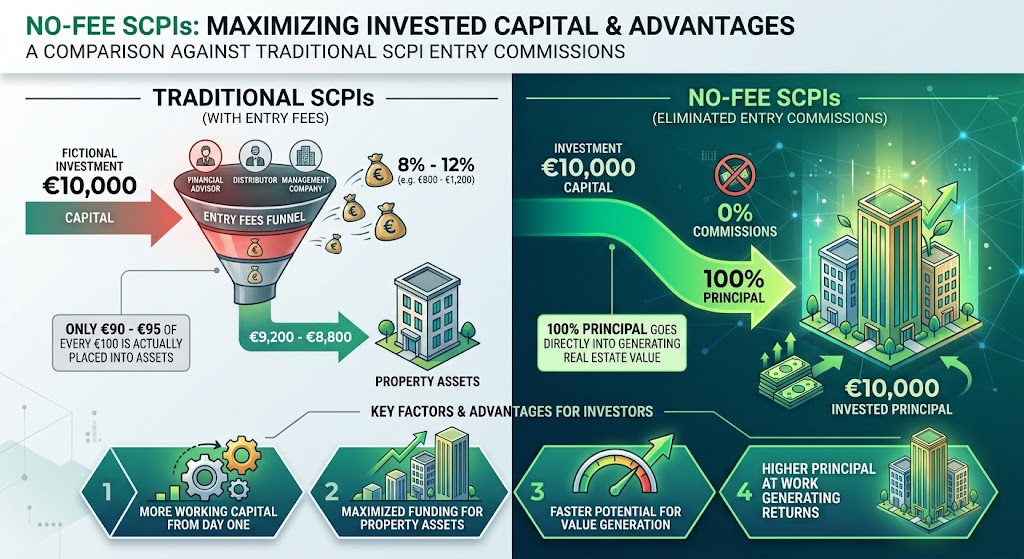
In a traditional SCPI, subscription fees (or entry commissions) compensate advisors, distributors, and management companies, typically ranging from 8% to 12% of the invested amount. Consequently, for every €100 invested, only €90 to €95 is actually placed into property assets.
No-fee SCPIs eliminate this initial entry commission entirely, ensuring that 100% of the invested principal goes directly into generating real estate value.
1. Key Benefits of Zero-Subscription-Fee SCPIs
Core Advantages for Investors
- Zero Entry Fees: No commission is deducted at subscription, allowing investors to receive the full share value upon resale (excluding market fluctuations).
- Enhanced Net Yield Potential: Full capital deployment generates higher relative distribution rates compared to funds burdened by 10% upfront entry fees.
- Shorter Holding Horizon: Investors do not need to hold shares for extended periods simply to break even on heavy initial entry costs.
- Simplified Resale Process: Redemption prices correspond directly to current share valuations, offering complete fee transparency.
2. Essential Points of Attention Before Investing
While eliminating entry fees offers immediate capital deployment, investors must evaluate four structural trade-offs:
• Higher Management Fees: Annual management fees usually run higher (around 15–18% of collected rents vs. 8–12% in traditional SCPIs).
• Acquisition & Renovation Commissions: Management companies often charge acquisition fees (~3% per property purchase) and elevated renovation fees directly against rental income.
• Early Exit Penalties: To prevent short-term speculative trading, early exit penalties apply if shares are sold before a specified holding period (e.g., Iroko ZEN applies 6% under 3 years; Remake Live applies 5% under 5 years).
• Limited Track Record: Most zero-fee funds were launched after 2019. Despite strong recent returns (typically 6–8% in 2024), long-term performance remains unproven.
Conclusion: Balancing Immediate Deployment with Ongoing Costs
A Strategic Alternative to Traditional Real Estate Funds
Zero-subscription-fee SCPIs offer an attractive gateway to real estate investing by eliminating upfront friction costs and maximizing initial capital efficiency.
Investors should carefully compare higher recurring management fees and early exit penalties against the initial entry savings to ensure alignment with their long-term wealth strategy.
No-Fee SCPIs: Advantages and Key Factors for Investors
In a traditional SCPI, subscription fees (or entry commissions) compensate advisors, distributors, and management companies, typically ranging from 8% to 12% of the invested amount. Consequently, for every €100 invested, only €90 to €95 is actually placed into property assets.
No-fee SCPIs eliminate this initial entry commission entirely, ensuring that 100% of the invested principal goes directly into generating real estate value.
1. Key Benefits of Zero-Subscription-Fee SCPIs
Core Advantages for Investors
- Zero Entry Fees: No commission is deducted at subscription, allowing investors to receive the full share value upon resale (excluding market fluctuations).
- Enhanced Net Yield Potential: Full capital deployment generates higher relative distribution rates compared to funds burdened by 10% upfront entry fees.
- Shorter Holding Horizon: Investors do not need to hold shares for extended periods simply to break even on heavy initial entry costs.
- Simplified Resale Process: Redemption prices correspond directly to current share valuations, offering complete fee transparency.
2. Essential Points of Attention Before Investing
While eliminating entry fees offers immediate capital deployment, investors must evaluate four structural trade-offs:
• Higher Management Fees: Annual management fees usually run higher (around 15–18% of collected rents vs. 8–12% in traditional SCPIs).
• Acquisition & Renovation Commissions: Management companies often charge acquisition fees (~3% per property purchase) and elevated renovation fees directly against rental income.
• Early Exit Penalties: To prevent short-term speculative trading, early exit penalties apply if shares are sold before a specified holding period (e.g., Iroko ZEN applies 6% under 3 years; Remake Live applies 5% under 5 years).
• Limited Track Record: Most zero-fee funds were launched after 2019. Despite strong recent returns (typically 6–8% in 2024), long-term performance remains unproven.
Conclusion: Balancing Immediate Deployment with Ongoing Costs
A Strategic Alternative to Traditional Real Estate Funds
Zero-subscription-fee SCPIs offer an attractive gateway to real estate investing by eliminating upfront friction costs and maximizing initial capital efficiency.
Investors should carefully compare higher recurring management fees and early exit penalties against the initial entry savings to ensure alignment with their long-term wealth strategy.






.svg)