Spot Buys

Optimizing Purchasing Costs in SMEs through Automation

Published By
Olivier Audino
Tags
Sourcing

Optimizing SME Procurement Costs Through Automation

In an economic context where every euro counts, automation is proving to be an essential strategy for optimizing procurement costs in Small and Medium-sized Enterprises (SMEs).

Leveraging modern digital technologies enables growing businesses to cut operating expenses, streamline purchasing workflows, and significantly enhance market competitiveness.

1. Driving Efficiency & Cost Reduction in Small Businesses

By thoughtfully integrating automated procurement tools, SMEs eliminate manual processing bottlenecks, reduce transaction errors, and secure better commercial terms.

Digital purchasing solutions transform traditional spend management into an agile, transparent operational capability that accelerates purchasing cycles and protects profit margins.

Key Automation Benefits for SMEs

  • Direct Expense Reduction: Minimize administrative costs and prevent unapproved off-contract spending.
  • Enhanced Process Efficiency: Accelerate purchase order approvals, supplier invoicing, and order verification.
  • Strategic Resource Reallocation: Free up valuable team hours to focus on vendor negotiations and business expansion.
  • Heightened Market Competitiveness: Gain real-time spend visibility to make agile, data-driven financial decisions.

2. Reallocating Resources to High-Value Investments

Automating repetitive procurement tasks does more than generate immediate financial savings—it frees up vital human and financial capital across your organization.

Procurement teams can pivot from routine paperwork to strategic category management, vendor risk mitigation, and value-adding growth initiatives that propel long-term success.

Conclusion: Transform Your SME Purchasing Strategy

Unlock Strategic Savings & Scale Your Operations

Embracing automated procurement technology enables SMEs to achieve immediate cost optimization while building a foundation for sustainable growth.

Empower your business to streamline purchasing processes, eliminate unnecessary expenses, and reallocate resources toward high-impact investments today.

Introduction to Purchasing Automation in SMEs

In a fast-paced business landscape where operational agility is vital, purchasing automation in SMEs represents a fundamental shift in managing procurement workflows.

By deploying digital tools to simplify, standardize, and automate repetitive sourcing tasks, growing enterprises reduce operating costs, increase processing speed, and ensure high transaction accuracy across the entire purchasing cycle.

1. Strategic Benefits for Growing Businesses

Accelerated Cycle Times: Eliminates manual processing delays and streamlines purchase order approvals.
Uncompromised Data Precision: Minimizes manual entry errors, delivering reliable spend analytics for confident decision-making.
In-Depth Spend Visibility: Provides an end-to-end view of purchasing expenses to identify immediate cost-saving opportunities.
Competitive Resilience: Transforms procurement from a reactive administrative chore into a strategic value engine that strengthens supplier partnerships and inventory control.

Optimization of Purchasing Processes

Standardizing procurement procedures ensures every purchase request, receipt, and vendor invoice follows a consistent, transparent workflow.

Automated tracking software gives procurement managers real-time visibility into active transactions—drastically reducing processing lead times and preventing unapproved spend.

1. Error Reduction & Resource Reallocation

Automating data entry and stock tracking eliminates costly inconsistencies caused by manual errors and redundant entries.

By releasing employees from routine administrative tasks, procurement teams can reinvest valuable time into high-impact strategic activities—such as market trend analysis, contract negotiation, and supplier relationship management.

Key Advantages of Buying Cycle Simplification

  • Procurement Process Standardization: Enforces consistent corporate rules across all purchasing workflows.
  • Significant Processing Time Reductions: Speeds up purchase order creation, approval routing, and invoice processing.
  • Enhanced Transaction Auditability: Guarantees end-to-end tracking and financial transparency.

2. Impact of Automation on Common Operational Errors

Operational Error Type Impact Before Digital Automation Impact After Digital Automation
Manual Data Entry Errors High risk of miscalculations and delays Very low risk with automated validation
Inventory Management Inconsistencies Frequent stock discrepancies and overbuying High consistency through real-time tracking

Conclusion: Elevate Your Procurement Strategy

Transition from Operational Management to Strategic Sourcing

Automating purchasing processes turns operational hurdles into sustainable growth opportunities for growing SMEs.

Empower your enterprise with modern automated solutions to minimize human error, optimize costs, and unlock high-value strategic growth.

Improving Supplier Relationships Through Procurement Automation

Purchasing automation in SMEs is fundamentally transforming how growing businesses interact and collaborate with their supplier network.

By deploying automated procurement systems, SMEs achieve faster, error-free communication and full supply chain transparency—building deep partner trust while streamlining day-to-day sourcing workflows.

1. Real-Time Order Tracking & Communication Transparency

Seamless information exchange eliminates communication misunderstandings and administrative friction.

Tracking orders, inventory receipts, and delivery schedules in real time allows procurement managers to resolve potential bottlenecks proactively, elevating vendor satisfaction and maintaining supply continuity.

2. Leveraged Rate Negotiations via Spend Visibility

Effective purchasing automation delivers complete, real-time spend analytics across all procurement categories.

With accurate visibility into spending trends and volume anomalies, procurement teams gain significant leverage when negotiating terms—securing price reductions, extended payment terms, and flexible delivery schedules that directly lower overall costs.

Core Supplier Loyalty & Cost Drivers

  • Accelerated Payment Cycles: Automated invoice matching speeds up vendor payments, building trust and priority buyer status.
  • Error-Free Order Accuracy: Standardized purchase orders eliminate costly miscommunications and billing conflicts.
  • Favorable Commercial Terms: Real-time spend data empowers procurement leaders to secure volume discounts and flexible terms.
  • Long-Term Vendor Retention: Suppliers prioritize business partners who offer simple, transparent, and reliable procurement workflows.

3. Long-Term Supplier Loyalty & Sustainable Cost Savings

Suppliers consistently favor business partners who offer structured, hassle-free operational processes.

By reducing payment lead times, eliminating order discrepancies, and fostering transparent communication, SMEs cultivate long-term supplier loyalty—unlocking preferential pricing, priority service, and enhanced market competitiveness.

Conclusion: Build High-Integrity Supplier Partnerships

Elevate Vendor Relations & Cut Procurement Expenses

Automating purchasing processes turns routine vendor management into a high-trust, value-generating partnership.

Empower your enterprise with real-time spend visibility, seamless communication, and automated workflows to secure better rates and drive sustainable growth.

Technologies and Tools for Purchasing Automation

Adopting dedicated purchasing software radically transforms operational efficiency in SMEs.

Enterprise-grade solutions—such as SAP Ariba, Coupa, and Ivalua—deliver robust capabilities spanning supplier relationship management, strategic sourcing, and real-time spend analytics. Selecting the optimal software depends on your organization's specific operational footprint, size, and industry requirements.

1. Integrating Automation Tools into Your ERP System

Integrating specialized procurement automation software into existing Enterprise Resource Planning (ERP) architecture is critical to maximizing return on investment.

Seamless ERP integration centralizes financial and operational data, delivers end-to-end expenditure visibility, and simplifies reporting. Working alongside experienced ERP implementation consultants ensures smooth deployment without disrupting ongoing daily business operations.

2. Comparative Analysis of Mid-Market Software Solutions

Small and medium enterprises must thoroughly evaluate available software platforms before full-scale deployment.

Comparing solutions such as Basware, Procurify, and Precoro highlights key differences in implementation cost, system compatibility, user experience, and technical support—helping buyers select the ideal fit for their operational complexity.

Overcoming Obstacles to Purchasing Automation in SMEs

Despite clear operational advantages, implementing purchasing automation in growing businesses presents distinct technical and organizational hurdles.

Management frequently misperceives automation as overly complex or cost-prohibitive. Furthermore, a shortage of in-house technical skills can slow adoption, requiring structured change management and targeted training programs.

Key Organizational & Technical Challenges

  • Limited Understanding of Automation Tools: Perception that automated software is overly complex or unsuited for smaller organizations.
  • Lack of Qualified Internal Resources: Shortage of specialized technical staff to configure and maintain digital tools.
  • Apprehension Over Initial Investment: Financial concerns regarding upfront software licensing and integration expenses.
  • Employee Resistance to Change: Hesitancy among teams accustomed to legacy manual procedures.

1. Challenge vs. Solution Framework

Implementation Challenge Strategic Solution
Tool & Process Complexity Deploy simplified training programs, interactive tutorials, and intuitive software interfaces
Lack of Internal Technical Skills Strategic hiring, specialized staff outsourcing, or partnering with implementation consultants
Initial Financial Outlay Explore flexible SaaS subscription models, financing options, or government digitization grants
Internal Employee Resistance Structured change management programs highlighting time savings and error reduction

2. Overcoming Change Resistance & Implementation Strategy

Internal Awareness Campaigns: Clearly communicate tangible benefits, demonstrating how automation eliminates repetitive paperwork and administrative strain.
Early Employee Engagement: Involve end-users early in pilot phases and provide comprehensive hands-on training to build confidence.
Targeted Pilot Projects: Launch small-scale pilot implementations to prove value and ROI before enterprise-wide rollout.
Vendor Partnership: Select software providers offering dedicated customer success management, robust technical support, and continuous training.

Conclusion: Transform Your SME Sourcing Strategy

Master Digital Procurement & Scale Your SME

Overcoming implementation obstacles and choosing the right technology stack enables growing SMEs to unlock full procurement efficiency.

Empower your team with automated tools, seamless ERP integration, and structured change management to drive long-term cost optimization today.
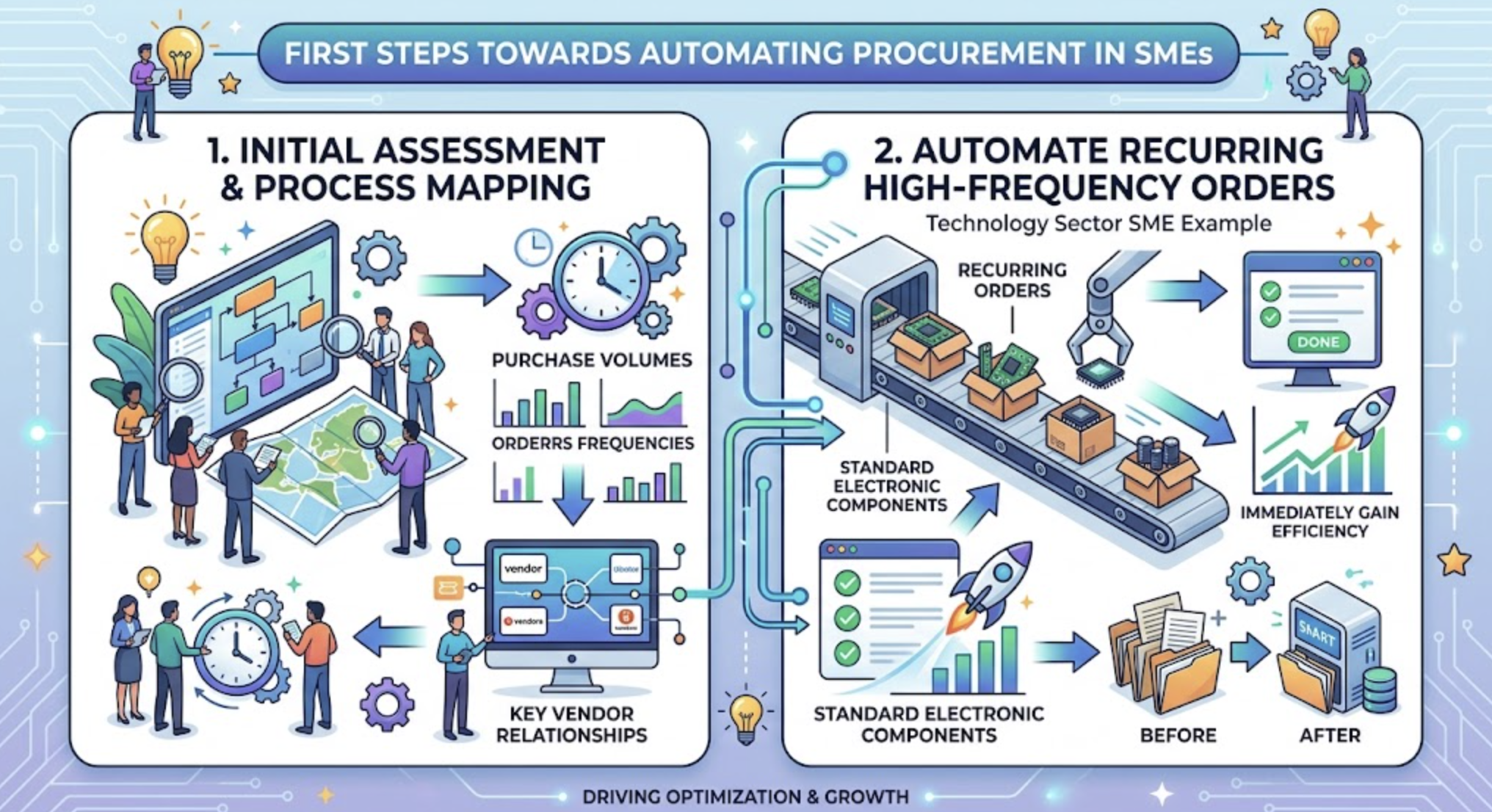
A modern, vector-style infographic titled "FIRST STEPS TOWARDS AUTOMATING PROCUREMENT IN SMEs" divided into two main sections against a subtle digital circuit background. The left section, "1. INITIAL ASSESSMENT & PROCESS MAPPING," illustrates diverse business professionals using magnifying glasses to analyze digital flowcharts, maps, and clocks. It includes bar charts for "PURCHASE VOLUMES" and "ORDERS FREQUENCIES," and a computer monitor displaying a network of "KEY VENDOR RELATIONSHIPS." Arrows connect this to the right section, "2. AUTOMATE RECURRING HIGH-FREQUENCY ORDERS (Technology Sector SME Example)." This side features an automated conveyor belt where robotic arms pack "STANDARD ELECTRONIC COMPONENTS" into boxes. A rising rocket and a green "DONE" screen symbolize "IMMEDIATELY GAIN EFFICIENCY," accompanied by a visual comparison showing a transition from messy paper folders ("BEFORE") to a streamlined digital server ("AFTER"). The bottom footer reads "DRIVING OPTIMIZATION & GROWTH."

Return on Investment (ROI) of Purchasing Automation

Evaluating the return on investment (ROI) of purchasing automation in SMEs is crucial for justifying initial setup costs and securing executive buy-in.

Calculating ROI requires quantifying direct financial savings alongside indirect operational gains—including reduced order entry errors, decreased administrative expenditures, optimized negotiation processes, and accelerated purchasing cycle times that enhance market responsiveness.

1. Calculating the ROI of Automation for SMEs

A thorough ROI calculation accounts for both hard financial returns and strategic operational velocity:

Direct Expense Reductions: Reduced labor costs spent on manual invoice matching and purchase order creation.
Error Mitigation: Elimination of costly order discrepancies, stockouts, and duplicate vendor payments.
Negotiation Optimization: Real-time spend visibility that enables procurement managers to leverage volume discounts.
Cycle Time Acceleration: Shorter lead times that improve market agility and competitive advantage.

2. Real-World SME Success Stories

Small and medium enterprises across sectors demonstrate the transformative impact of procurement automation:

Manufacturing Sector SME: Reduced administrative overhead by 30% in a single year following the deployment of an automated purchasing system.
Commercial Operations SME: Significantly improved supplier relationships and communication transparency, leading to more favorable contract terms and higher overall ROI.

3. Preparing a Profitability Analysis to Justify Investment

Building a compelling business case is essential to mobilize internal stakeholders and secure capital investment.

A comprehensive profitability analysis highlights projected cost savings, regulatory compliance enforcement, process efficiency gains, and broader indirect benefits—such as enhancing corporate reputation through responsible, transparent procurement management.

Future Prospects for Purchasing Automation

Continuous technological advancements are elevating SME procurement to new operational heights.

The integration of artificial intelligence (AI) and automated data processing transforms sourcing workflows—enabling predictive demand forecasting, real-time inventory optimization, and dynamic supply cost management.

Core Impacts of AI on Process Automation

  • Accurate Demand Forecasting: Predict supply needs based on historical consumption trends and market data.
  • Real-Time Stock Level Optimization: Maintain ideal inventory balances to prevent overstocking and stockouts.
  • Enhanced Order Precision: Drastically reduce ordering errors and eliminate surplus material inventory.

Next-Generation Technology Matrix

Emerging Technology Strategic Sourcing & Automation Advantages
AI & Machine Learning End-to-end automation, predictive demand modeling, and dynamic cost optimization
Blockchain Technology Unmatched transaction security, immutable audit trails, and supply chain transparency

Conclusion: Maximize Procurement ROI for Sustainable Growth

Secure Higher ROI & Future-Proof SME Sourcing

Investing in purchasing automation delivers rapid cost savings, eliminates operational errors, and positions SMEs for long-term market leadership.

Empower your organization with AI-driven procurement tools to optimize working capital, improve vendor relationships, and drive maximum profitability.

How AI and Machine Learning Will Transform Sourcing

The incorporation of Artificial Intelligence (AI) and Machine Learning into SME procurement automation extends far beyond simple data management.

These advanced technologies empower procurement teams with extensive market analysis, enabling them to negotiate more effectively with suppliers and make highly strategic, economically advantageous purchasing decisions.

Key Applications of AI in Procurement

  • Predictive Market Analytics: Leverage machine learning algorithms to forecast price changes and anticipate shifting supply chain conditions.
  • Automated Negotiations & Tendering: Streamline RFP creation, supplier bidding, and preliminary negotiation workflows.
  • Automated Contract & Compliance Management: Ensure contractual compliance, mitigate risk exposure, and enforce agreed vendor terms.

1. AI Functionalities and Automation Impact

AI & ML Functionality Direct Impact on Automation
Predictive Market Analysis Better anticipation of supply needs, cost trends, and optimal purchasing windows
Automated Contract Management End-to-end automation, enhanced regulatory compliance, and secure vendor agreements

Preparing Your SME for Future Technological Developments

Faced with the rapid pace of technological progress, SMEs must remain proactive to maintain their competitive edge.

Investing in continuous team education and upgrading core technology systems are critical steps toward fully exploiting the transformative capabilities of modern procurement automation.

1. Strategies for Integrating Next-Generation Technologies

Employee Training Investment: Continuous upskilling in digital tools empowers staff to manage complex automated workflows.
Innovative Tech Partnerships: Collaborate with forward-thinking technology providers to stay ahead of market innovations.
Regular ERP Architecture Updates: Periodically upgrade existing ERP modules to seamlessly incorporate new AI and ML functionalities.

2. Action Plan vs. Expected Benefits Matrix

Strategic Action Plan Expected Enterprise Benefits
Continuous Employee Training Well-prepared, highly skilled workforce capable of maximizing tech ROI
Proactive Technological Adaptation Optimized, highly agile, and competitive procurement operations

Conclusion: Future-Proof Your SME Procurement Strategy

Position Your Business for Strategic Leadership

By anticipating and integrating these technological advances, SMEs optimize their purchasing processes while building long-term operational resilience.

Transform your procurement function today with AI-driven analytics, continuous employee training, and automated workflows to secure a lasting competitive edge.

Conclusion: Transforming SME Procurement Through Automation

In summary, purchasing automation in SMEs is a vital strategic approach—not only for reducing operational costs but also for maximizing efficiency and transparency across procurement workflows.

Modern automation technologies simplify complex sourcing procedures, eliminate manual processing errors, and foster stronger, high-trust relationships with suppliers.

1. Strategic ROI Beyond Simple Cost Savings

While adopting procurement automation requires careful planning and strategic alignment, real-world case studies consistently demonstrate substantial positive returns.

The return on investment extends far beyond direct monetary savings—delivering heightened organizational agility, reduced administrative friction, and superior overall performance in a rapidly shifting economic landscape.

Why SMEs Must Act Now

  • Substantial Cost & Time Savings: Eliminate repetitive tasks to free up resources for strategic growth investments.
  • Proven ROI & Operational Efficiency: Real-world SME testimonies confirm enhanced accuracy and supplier relationship gains.
  • Future-Proof Market Position: Integrate modern best practices today to prepare your business for tomorrow's competitive challenges.

Take the Next Step Toward Futuristic Procurement

Make Automation Your Ally for SME Growth

Taking action today enables your business to embed industry best practices, leverage advanced technologies, and build a resilient sourcing framework.

Transform your procurement function into an agile, futuristic value driver and secure a lasting competitive advantage.
FAQ - Optimizing Purchasing Costs in SMEs Through Automation

Addressing key questions about procurement automation helps Small and Medium-sized Enterprises (SMEs) navigate digital transformation effectively.

Below are clear, actionable answers to common inquiries regarding initial implementation steps, error reduction, supplier negotiations, software integration, and initial investment costs.

1. What are the first steps towards automating procurement in SMEs?

Initial Assessment & Process Mapping: The first step involves thoroughly analyzing your current procurement workflows, evaluating purchase volumes, order frequencies, and key vendor relationships.

For instance, a technology sector SME can immediately gain efficiency by automating high-frequency, recurring orders such as standard electronic components.

2. How does automation help reduce procurement errors?

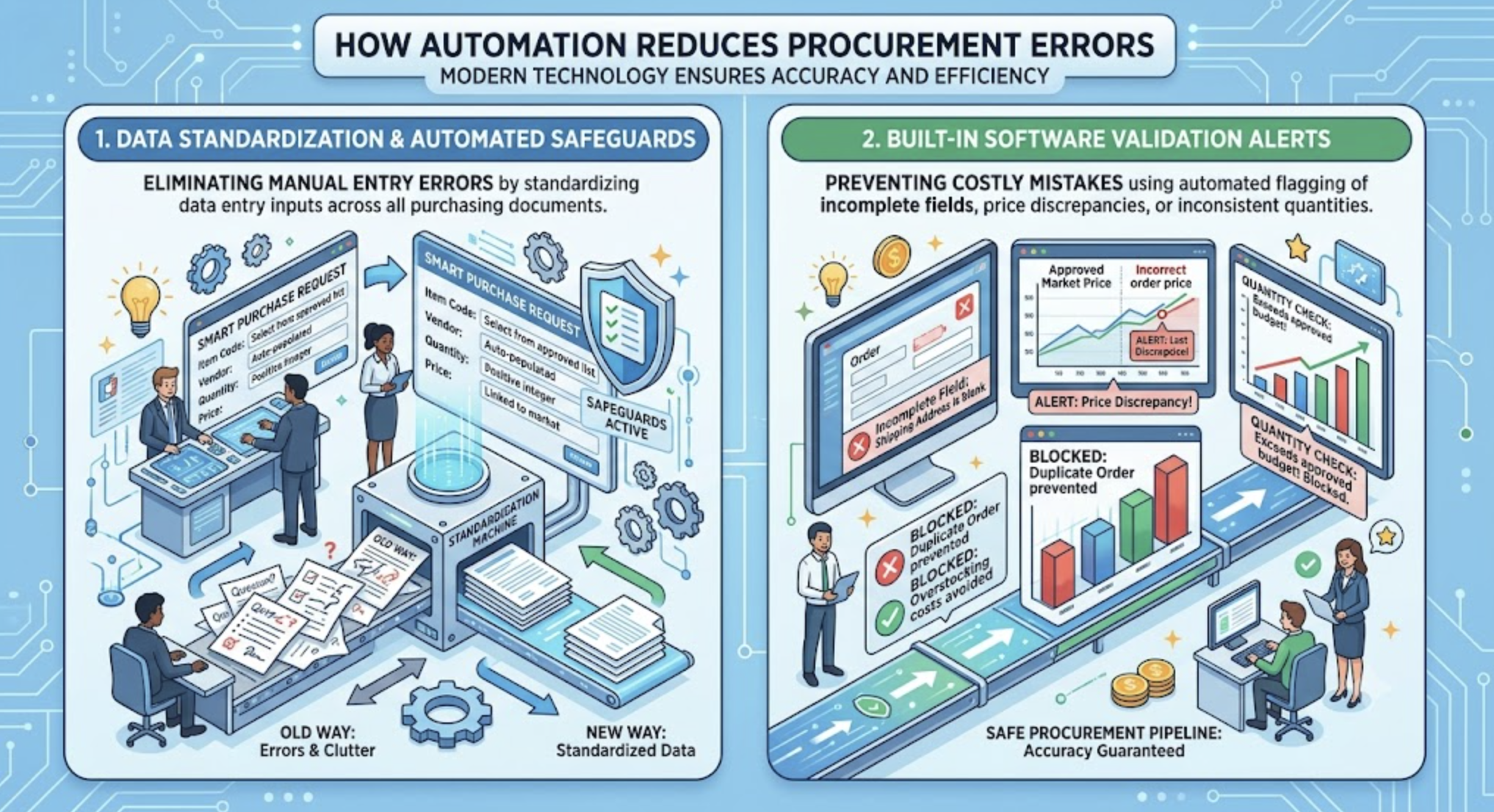
Data Standardization & Automated Safeguards: Automation eliminates manual errors by standardizing data entry inputs across all purchasing documents.

Built-in software validation alerts automatically flag incomplete fields, price discrepancies, or inconsistent quantities—preventing costly mistakes such as duplicate orders or overstocking.

3. What impact does automation have on negotiating with suppliers?

Data-Backed Negotiation Leverage: Automated platforms collect and analyze historical vendor performance data, tracking order accuracy, delivery lead times, and fulfillment quality.

For example, showing automated tracking data that proves a supplier regularly delivers late provides clear leverage to negotiate improved SLAs, penalties, or preferential pricing.

Essential SME Automation Takeaways

  • Seamless System Integration: Connecting procurement software directly to accounting or ERP platforms enables instant 3-way invoice matching.
  • Scalable Investment Options: Initial costs range from a few thousand to tens of thousands of euros, depending on enterprise complexity and module selection.
  • Immediate Error Prevention: Standardized data entry and automated validation alerts stop costly overordering before purchase orders are issued.

4. Can purchasing automation be integrated with other SME management systems?

ERP & Accounting System Integration: Yes, connecting procurement tools to your core management ecosystem delivers significant operational synergies.

Linking procurement software with your accounting system enables automated reconciliation between purchase orders, goods receipts, and invoices (3-way matching)—streamlining financial management and cash flow tracking.

5. What are the initial costs of automating procurement for an SME?

Investment Scope & Budgeting: Upfront expenses vary based on the chosen software solution, typically covering software licensing (SaaS or perpetual), implementation, and team training.

For a manufacturing SME, investing in a robust procurement platform generally ranges between a few thousand to tens of thousands of euros, determined by user seat count, required features, and ERP integration depth.

Conclusion: Accelerate Your SME Sourcing Strategy

Transform Your Procurement Operations Today

Automating procurement workflows removes administrative bottlenecks, eliminates financial errors, and empowers SMEs to operate with enterprise-grade efficiency.

Empower your organization with automated tools, seamless system integrations, and data-backed supplier negotiations to secure maximum return on investment.

Revolutionizing SME Cost Management Through Procurement Automation

The automation of procurement processes in SMEs is revolutionizing their cost management capabilities.

An initial investment in the right technologies pays for itself quickly, thanks to substantial savings, heightened operational control, and increased efficiency. Decision-makers who integrate these digital tools position their business for long-term competitiveness while optimizing current working capital and internal resources.

Key Strategic Advantages for Decision-Makers

  • Rapid ROI on Digital Technology: Initial software investments are swiftly offset by direct spending reductions and efficiency gains.
  • Resource Optimization: Streamline current operational bandwidth and eliminate manual administrative overhead.
  • Long-Term Market Competitiveness: Prepare your organization for future market demands by embedding scalable, automated workflows today.

Take Action: Realize Your SME's Full Potential

Turn Sourcing Challenges into Growth Opportunities

Integrating procurement automation equips small and medium enterprises with concrete strategies to optimize expenditure and secure market leadership.

Do not wait any longer to unlock the full potential of your SME and transform your purchasing operations.

Line
Featured Post

Popular posts