Purchasing performance

Purchasing KPI: Manage Your Strategic Performances

Published By
Olivier Audino
Tags
Sourcing

Driving Procurement Performance with Executive Dashboards

The procurement dashboard is an essential tool for steering strategic performance across your entire supply chain.

By providing a clear, real-time, and detailed view of all procurement workflows, it empowers leaders to make data-driven decisions, eliminate operational bottlenecks, and optimize purchasing expenditure.

1. Strategic Value of a Procurement Dashboard

Core Business Impacts

  • Expenditure Optimization: Uncovers cost-saving opportunities and tracks savings realized across categories.
  • Lead Time Reduction: Monitors cycle times and delivery timelines to accelerate supply chain velocity.
  • Supplier Relationship Management: Measures vendor performance metrics to strengthen strategic partnerships.
  • Data-Driven Decision Making: Converts complex procurement data into clear, actionable executive insights.

2. Breathing New Life into Your Sourcing Strategy

Transforming raw procurement data into measurable operational actions enables procurement teams to pivot from reactive administration to proactive value creation.

Centralizing performance metrics inside an intuitive dashboard ensures strategic alignment, minimizes commercial risks, and propels overall business performance to new heights.

Conclusion: Elevate Your Purchasing Strategy

Transform Procurement Data into Measurable Actions

Deploying a robust procurement dashboard provides the operational clarity required to optimize cost, quality, and lead times across the supply chain.

Empower your organization with real-time purchasing analytics and take full control of your strategic performance.

Why Track Your Purchasing KPIs with Purchasing Dashboards?

In modern procurement, measuring and tracking key performance indicators (KPIs) is essential. It enables your business to detect market trends, forecast inventory needs, and align sourcing strategies with overall corporate goals.

Purchasing dashboards bring this data to life by visualizing key metrics in real time, accelerating spend analysis, and driving informed executive decision-making.

1. Definition & Health Assessment of Purchasing KPIs

Purchasing KPIs provide a structured methodology to evaluate process efficiency, such as realized cost savings or average lead times.

Far beyond simple numbers, these indicators represent the true operational health of your procurement department. Regular analysis uncovers hidden savings opportunities, pinpoints supply vulnerabilities, and transforms your buying strategy.

2. Importance of Purchasing Dashboards in Spend Management

Centralizing procurement data into a single, real-time Business Intelligence (BI) interface saves time and boosts operational efficiency:

Early Problem Detection: Identify bottlenecks and vendor non-compliance before they impact production.
Fluid Stakeholder Communication: Share clear, accurate, and visual reporting across internal departments and executive boards.
Strategic Decision-Making: Equip your team with real-time insights to execute faster, data-backed negotiations.

Strategic Benefits Checklist

  • Real-Time Data Visualization: Immediate visibility across all active purchase orders and category spends.
  • Centralized Information Hub: Single source of truth for faster, more accurate strategic choices.
  • Savings & Vendor Tracking: Continuous monitoring of realized cost reductions and supplier performance.
  • Sustainability & ESG Alignment: Tracks corporate green procurement targets and carbon footprint reductions.

3. Examples of Essential Purchasing KPIs

Purchasing KPI Operational Description
Achieved Savings Total hard financial savings realized on a purchase vs. budget baseline
Delivery Time (Lead Time) Average time elapsed between purchase order issuance and goods receipt
Supplier Quality Rate Percentage of delivered orders fully compliant with agreed specifications
Total Cost of Ownership (TCO) Comprehensive lifecycle cost of an asset from acquisition to disposal

Conclusion: Total Control Over Your Procurement Strategy

Elevate Procurement into a Strategic Value Engine

Adopting an executive purchasing dashboard provides the clarity needed to optimize procurement workflows, align team actions with business goals, and keep enterprise spend under tight control.

Transform your raw procurement metrics into actionable competitive advantages today.

Selecting Relevant Purchasing KPIs for Your Dashboard

Identifying and selecting the right Key Performance Indicators (KPIs) is fundamental to procurement management. Without the right metrics, a purchasing dashboard is like a compass without north—leaving your team without clear strategic direction.

1. Key Selection Criteria for Purchasing Metrics

To ensure your dashboard accurately reflects operational performance, select metrics based on three core criteria:

Strategic Alignment: Direct alignment with overarching corporate objectives.
Clarity & Simplicity: Clear, easily intelligible indicators that all stakeholders understand.
Sector Relevance: Actionable metrics tailored to your industry challenges and supplier tracking needs.

2. Essential Purchasing KPIs to Integrate

Incorporate balanced metrics across key procurement dimensions:

Financial Impact: Realized cost savings and Total Cost of Ownership (TCO).
Supplier Performance: On-time delivery (OTD) and quality compliance rates.
ESG & Sustainability: Percentage of CSR-certified suppliers and carbon emission reductions.
Internal Efficiency: Purchasing compliance rate and order cycle processing times.

3. Weighting and Prioritizing KPIs

Core Weighted Metrics

  • Achieved Savings: Measures hard financial impact and budget optimization.
  • Delivery Quality & Timeliness: Ensures operational continuity and vendor SLA compliance.
  • CSR Certification Percentage: Drives sustainable sourcing and corporate governance.
  • Order Processing Times: Streamlines purchase-to-pay (P2P) workflow velocity.

4. Sample KPI Weighting Framework

Purchasing KPI Strategic Priority Dashboard Weighting
Achieved Savings High 40%
On-Time Delivery (OTD) Medium 25%
Delivery Quality Rate Medium 20%
Purchase Compliance Rate Low 15%

Conclusion: Customizing Dashboard Metrics to Your Goals

Build a Tailored Purchasing Control Center

Adjusting metric weightings ensures your executive dashboard directly reflects your organization's unique operational goals and strategic priorities.

Focusing on relevant, prioritized KPIs converts procurement analytics into actionable, high-value decision-making.
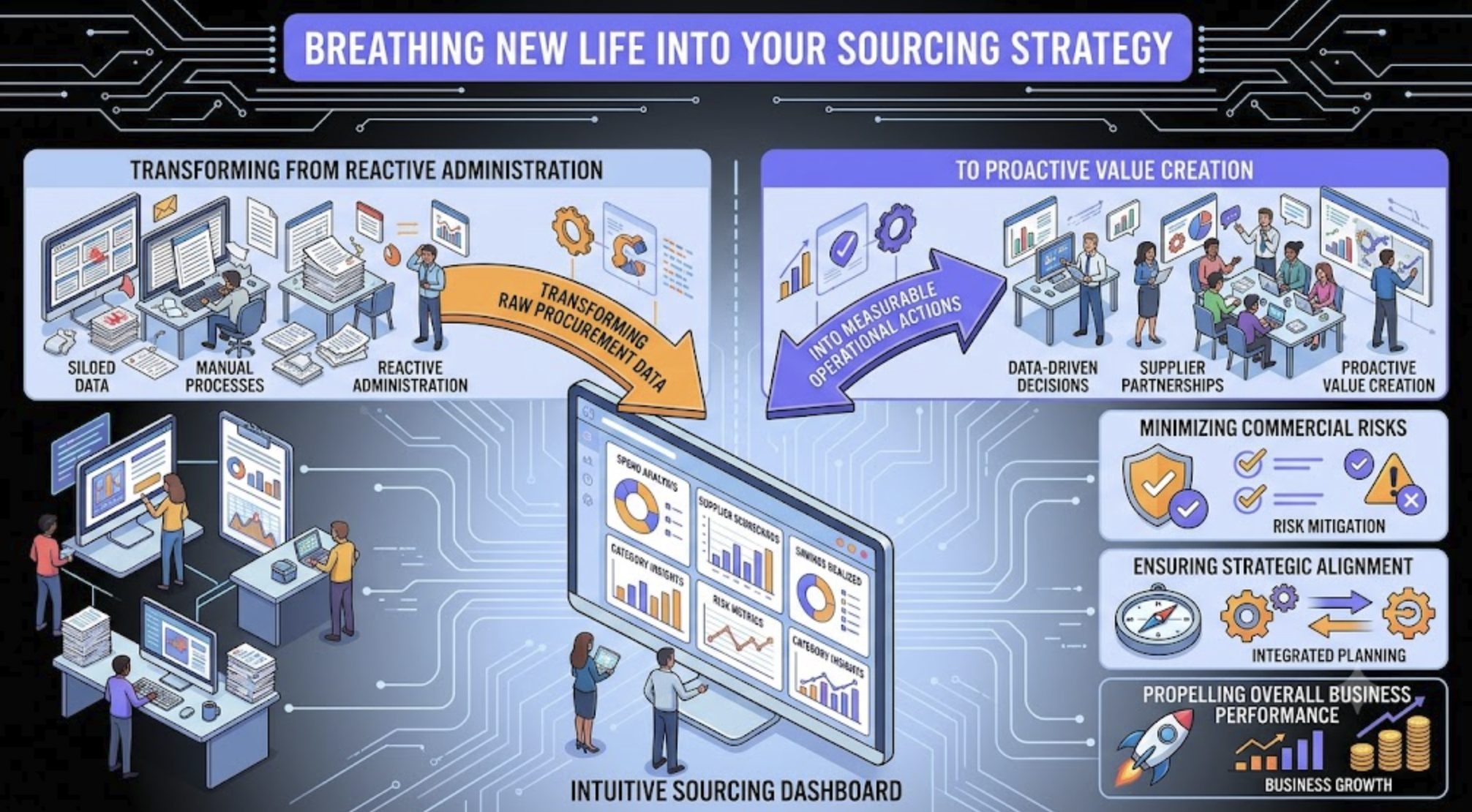
An detailed isometric vector infographic flowchart set against a blue circuit board background, titled "BREATHING NEW LIFE INTO YOUR SOURCING STRATEGY." The visual compares a shift on the left from "TRANSFORMING FROM REACTIVE ADMINISTRATION" (with cluttered desks, paper forms, disoriented workers, and bubbles labeled "SILOED DATA", "MANUAL PROCESSES", "REACTIVE ADMINISTRATION") to the right "TO PROACTIVE VALUE CREATION" (with a collaborative team, data visualization on a modern screen, and bubbles labeled "DATA-DRIVEN DECISIONS", "SUPPLIER PARTNERSHIPS", "PROACTIVE VALUE CREATION"). Connecting arrows detail "TRANSFORMING RAW PROCUREMENT DATA" and "INTO MEASURABLE OPERATIONAL ACTIONS," linking the sections to a central large screen displaying an "INTUITIVE SOURCING DASHBOARD" with metric panels for Spend Analysis, Category Insights, Supplier Scorecards, Savings Realized, and Risk Metrics. This central dashboard is linked to three benefit panels on the bottom right: "MINIMIZING COMMERCIAL RISKS" (Risk Mitigation shield icon), "ENSURING STRATEGIC ALIGNMENT" (Integrated Planning compass icon), and "PROPELLING OVERALL BUSINESS PERFORMANCE" (Business Growth rocket and coin icon).

Designing an Effective Purchasing Dashboard

Creating a practical and informative purchasing dashboard can seem complex, but with the right tools and a structured approach, you can build a control center tailored precisely to your operational needs.

1. Essential Characteristics of a Good Purchasing Dashboard

A successful dashboard hinges on three fundamental pillars:

Readability: Synthesizes complex spend data into clear visual formats such as graphs, gauges, and dynamic charts—eliminating dense, hard-to-read data tables.
Personalization: Tailors content to your company's unique priorities, incorporating the exact KPIs that matter most to your business.
Accessibility: Delivers real-time data access across teams, enabling fast, informed decision-making without delays.

Core Features Checklist

  • Readability: Synthetic data presented through clear, intuitive visualizations.
  • Personalization: Fully adapted to the specific operational goals of the organization.
  • Accessibility: Real-time information available on demand for all relevant stakeholders.

2. Choosing Tools and Technologies

Selecting the right technology stack ensures seamless data integration and visualization:

Business Intelligence Platforms: Power BI, Tableau, and SAP Analytics Cloud offer interactive, high-level spend visualization.
ERP-Integrated Solutions: Oracle Procurement and Coupa connect purchasing workflows directly to real-time dashboards.
Custom Solutions: Advanced spreadsheets or proprietary internal platforms provide tailored flexibility for unique requirements.

3. Optimal Structure of a Purchasing Dashboard

Structure your dashboard methodically to deliver executive clarity at a glance:

1. Overall Summary: High-level scorecard displaying primary purchasing KPIs.
2. Supplier Performance: Detailed breakdown of vendor timeliness, quality rates, and SLA compliance.
3. Financial Indicators: Hard cost savings, procurement ROI, and budget variance analyses.
4. Sustainability Goals: Metrics tracking CSR compliance, carbon reduction, and ESG standards.

4. Dashboard Structure Summary

Dashboard Section Operational Description
Overall Summary Displays primary purchasing KPIs in an executive scorecard format
Supplier Performance Tracks detailed vendor metrics regarding lead times, quality, and compliance
Financial Indicators Monitors realized cost savings, budget variances, and procurement ROI
Sustainability Goals Evaluates metrics related to environmental impact, CSR, and ESG benchmarks

Conclusion: Driving Continuous Procurement Excellence

Transform Procurement Data into Actionable Strategy

A well-designed purchasing dashboard simplifies daily tracking while fostering long-term strategic alignment and continuous improvement across procurement teams.

Empower your organization with real-time purchasing analytics to take full control of your supply chain performance today.

FAQ: Purchasing Dashboard Insights

1. Why Is a Purchasing Dashboard Important?

A purchasing dashboard provides essential visibility for tracking operational purchasing performance, streamlining budget control, and managing supplier relationships.

For instance, it quickly highlights budget overruns—showing if your organization is spending excessively on specific product categories or experiencing unchecked price creeps.

2. What Data Can You Track with a Dashboard?

Modern dashboards track end-to-end procurement operational metrics:

Financial Expenditures: Total procurement spend, hard savings, and budget variance.
Operational Timelines: Lead times, order fulfillment speeds, and delivery delays.
Quality Compliance: Defect rates, return percentages, and supplier specification adherence.

3. How Does a Dashboard Improve Buying Strategies?

Strategic Decision Enhancement

  • Trend Identification: Detects market shifts and seasonal price variations early.
  • Sourcing Opportunities: Highlights high-performing suppliers offering superior rates or terms.
  • Proactive Negotiation: Equips buying teams with historical spend data for leverage in contract renewals.

4. What Tools Do You Use to Create a Dashboard?

A range of powerful digital platforms can be utilized depending on business complexity:

Spreadsheets: Microsoft Excel or Google Sheets for lightweight, custom tracking.
Business Intelligence Solutions: Power BI, Tableau, or SAP Analytics Cloud for interactive, real-time enterprise data visualization.
ERP & E-Procurement Tools: Dedicated modules within Coupa or Oracle Procurement.

5. How Do I Customize a Purchasing Dashboard?

Tailor the layout and metrics to match your company's strategic priorities.

Incorporate specific modules to track critical raw materials, strategic vendor scorecards, or high-priority categories to ensure your team focuses on what directly drives business growth.

Conclusion: Master Your Procurement Performance

Transform Purchasing Analytics into Actionable Insights

Deploying a customized, highly visual purchasing dashboard empowers teams to maintain control over costs, lead times, and supplier performance.

Take charge of your procurement strategy today with real-time data monitoring and streamlined reporting.

Line
Featured Post

Popular posts