Olivier Audino
Webinar
Tail Spend: The Overlooked Lever to Free Up Your Buyers' Time
Tuesday March 31 at 2:00 PM


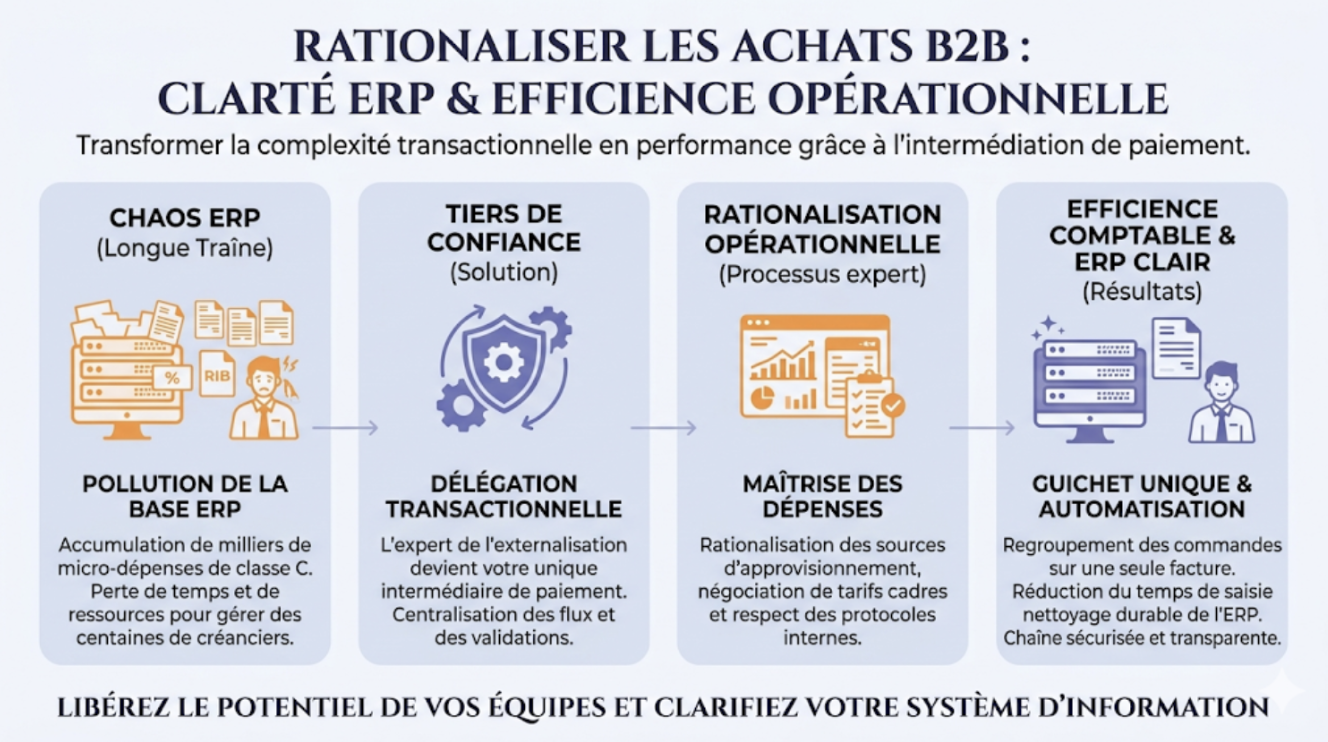
Here is the reality. Procurement departments struggle to use heavy machinery, ERPs configured for multi-million euro contracts, to process one-off 500-euro invoices. Using an infrastructure designed for strategic suppliers on Class C spend is like using a jackhammer to drive a nail.
This technical friction generates what we observe in all large accounts, the inverted Pareto principle of Master Data.
of spend = 80% of the mental load for buyers and accounting.
of effective work. This is the internal time required to create a "Spot" account (company registration check, tax and social certificate collection, bank details, and approval workflow).
of the supplier base consists of disposable third parties, used only once, permanently polluting the IT architecture.
The result? A major operational bottleneck. Faced with an urgent request from an internal client (a spare part, a caterer), the qualified buyer will always prioritize their strategic negotiation. The operational staff, blocked by a 15-day account creation lead time, ends up paying with their corporate credit card. Maverick spend explodes, and the CPO loses control over their tail spend.
But the real hemorrhage is seen in the balance sheets. This is not a simple administrative inconvenience, but a measurable destruction of value.
Let us make the raw calculation of the impact on EBITDA. If your company creates 5,000 occasional suppliers per year, and knowing that the processing cost of an isolated internal invoice averages 150 €, you burn 750,000 € in pure administrative loss. Half a million euros evaporated in data entry without any added value.
To stop this leak, the solution is not software. It requires a breakthrough in financial engineering, relying on a Transactional Trusted Third Party to fully outsource this flow.
The proliferation of supplier accounts in the ERP is not limited to a simple destruction of EBITDA. It directly exposes the group to a major legal and systemic risk.
The CPO legitimately seeks to secure their supply chain and meet compliance requirements. Yet, they face a complex internal political and operational reality on a daily basis.
Why? Because the legal framework collides head-on with the urgency of the field.
This is precisely where classic Master Data management collapses. Buyers, recruited for their strategic expertise, spend 40% of their time acting as mere ERP data entry clerks.
These precious hours (and very costly in FTEs) are swallowed up in collecting administrative documents for third parties that will only be used once. The buyer unwittingly becomes the company's bottleneck.
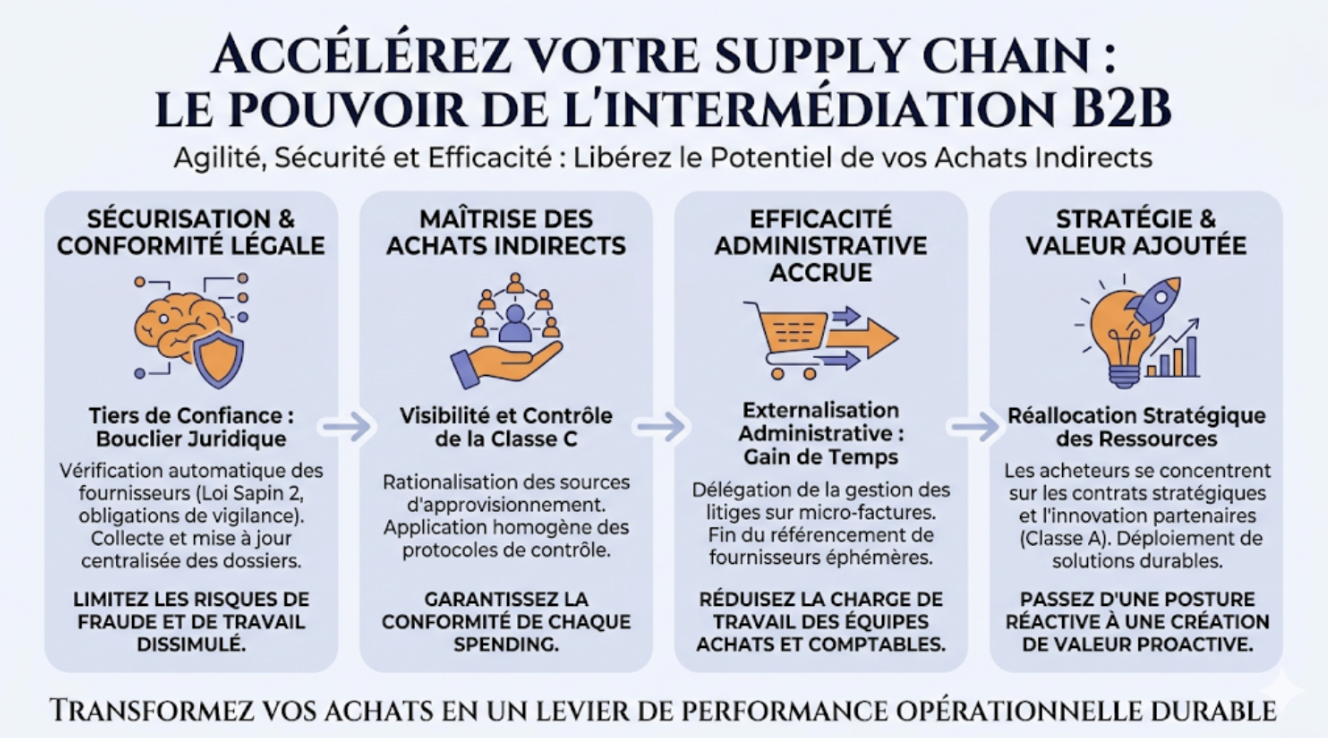
Faced with this deadlock, the integration of a Transactional Trusted Third Party radically transforms supplier risk management. This model acts as a true Compliance Shield.
Instead of creating 5,000 new suppliers in your production tool, your company records only a single order line the Procurement Hub. This partner absorbs the volume and assumes the entire legal burden for Class C.
Here is the reality of the BME mechanics
This transfer of responsibility guarantees a flawless internal audit and frees your buyers from time-consuming disputes. Your teams' energy is finally reinvested in value creation.
Before initiating the cleansing of your Procure-to-Pay database, it is crucial to precisely identify the flaws in your current process. You can now evaluate the urgency of the situation and measure your legal exposure with the BME compliance stress test.
Processing micro-expenses is a silent financial drain. Accounts payable exhausts itself reconciling hundreds of isolated invoices, hunting down missing bank details, and managing time-consuming disputes for trivial amounts. This transactional dispersion paralyzes your financial resources and generates a critical number of data entry errors.
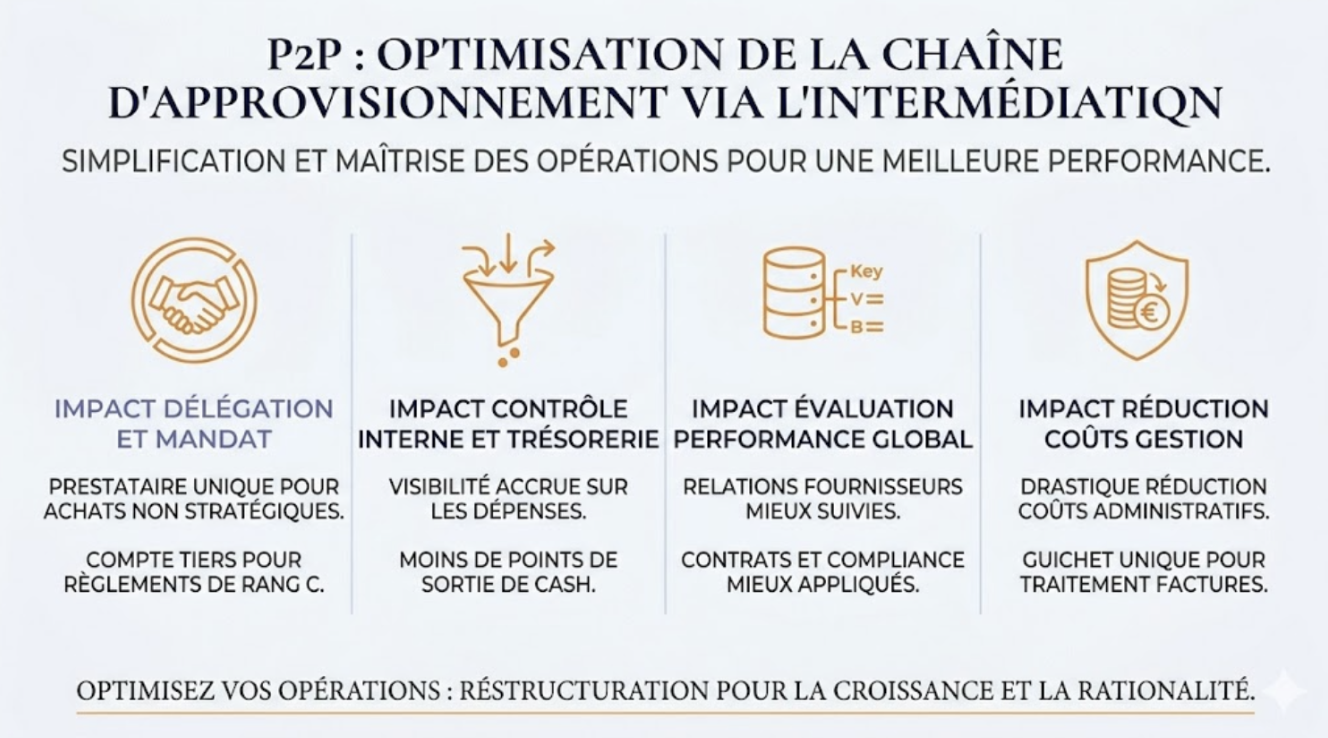
To neutralize this hemorrhage, a true P2P partner does more than act as a simple lodged card. It redesigns the very architecture of your purchasing cycle through a three-step mechanism
This operational triptych allows you to divide the invoice management cost by ten. Accounting teams no longer chase after data; they receive a structured flow, reconciled and ready to be audited.
To concretely measure the achievable savings on your reconciliation process and objectify this shortfall, use our exclusive transactional load calculator.
Theory is not enough for finance departments. To objectify the impact of a Procurement Hub, let us examine real data from a CAC40 industrial group before its transition to the BME model.
The starting point is that the group's SAP ERP contained 40,000 supplier records. On this volume, 25,000 had only recorded a single transaction over the last 24 months. The company generated approximately 5,000 new Class C purchase requests per year (emergency repairs, catering, specific office equipment).
After implementing BME as the Single Creditor, the paradigm was reversed. The company archived 25,000 dormant accounts. The 5,000 annual "Spot" annual purchases are now routed automatically to BME.
The procurement department recovered the equivalent of 3 FTEs (Full Time Equivalents), immediately reallocated to negotiating the Top 20% of spend. The CFO neutralized the 750,000 € in hidden costs, and exposure to potential penalties for lack of vigilance was reduced to zero.
Therapeutic persistence on Class C spend via ill-suited processes destroys the value of your procurement teams. Asking a Lead Buyer to chase down registration documents is funding under-productivity.
Transactional outsourcing is no longer just an optimization option; it is a governance necessity. By consolidating your flows via a dedicated player, you cleanse your Master Data, shield your compliance, and transform an administrative cost center into a true profitability lever.
Are you unsure of your risk exposure regarding those thousands of invisible micro-suppliers? Evaluate your legal and operational flaws immediately by performing our
P2P Compliance Stress TestRegulation (Sapin II Law, AFA requirements, CSRD directive) makes no distinction between a 1 million euro supplier and a 500 euro craftsman. BME acts as a Compliance Shield. In our supplier risk management process, we preventively block any transaction if the third party social compliance certificate or business registration is expired. You delegate the entire vigilance risk.
But there is a detail.
The cost of an intermediation provider is negligible compared to the internal processing cost of 150 € per invoice. By consolidating your flows, you eliminate multiple bank fees, data entry errors, and above all, you neutralize Maverick spend. ROI is generally achieved in less than 6 months thanks to the elimination of low value added tasks.
Yes. Seamless Connection is one of our pillars. We use standard protocols (PunchOut cXML/OCI) or APIs so that the user experience remains native. The employee orders in their usual tool, but the financial flow is simply routed in the background to our infrastructure. No heavy change management is required internally.



.svg)