E-Procurement solution

Supply Chain Optimization: Mastering Supplier Risk Management

Published By
Olivier Audino
Tags
Sourcing
In an economic landscape where uncertainties abound, optimizing the supply chain is of paramount importance for long-term organizational survival.

Mastering supplier risk management is no longer merely an operational necessity—it has evolved into a primary competitive differentiation strategy that safeguards continuity and drives market resilience.

Pillars of Strategic Supply Chain Resilience

  • Anticipate Bottlenecks: Proactively identify potential supply chain vulnerabilities before they escalate into operational disruptions.
  • Deep Risk Comprehension: Evaluate supplier financial stability, geopolitical risk factors, and compliance metrics in real time.
  • Mitigate Operational Friction: Implement structured contingency plans to protect operating margins and ensure inventory continuity.
  • Transform Risk into Opportunity: Leverage robust risk management frameworks to foster continuous innovation and sustainable growth.

Turn Supply Chain Challenges into Growth Opportunities

By deploying actionable risk mitigation strategies and leveraging in-depth industry case studies, organizations can convert supply chain threats into commercial advantages.

Building an agile, risk-aware procurement network enhances operational efficiency, protects brand reputation, and positions your enterprise for lasting market leadership.

Build a Resilient, Risk-Proof Supply Chain

Mitigating supplier risks and optimizing supply chain operations empowers your organization to navigate market volatility with confidence.

Transform supply chain challenges into sustainable competitive advantages with proactive supplier risk management solutions.

Supplier Risk Identification and Mapping

In supplier risk management, mapping is a crucial step in visualizing and analyzing vulnerabilities across your vendor network.

This systematic approach helps businesses identify critical risk areas and prioritize corrective actions. Utilizing geospatial tools to construct detailed risk maps provides a clear view of geographic exposure, driving smarter, data-driven supply chain management decisions.

1. Primary Categories of Supplier Risk

Enterprises face three primary types of supplier risks—financial, geopolitical, and operational. Each vector requires a dedicated, tailored strategy to minimize negative impacts on supply chain continuity.

Core Supplier Risk Vectors

  • Financial Risk: High probability of supply disruption resulting from vendor financial distress, insolvency, or bankruptcy.
  • Geopolitical Risk: Disruptions caused by political instability, regulatory shifts, or import-export constraints in vendor regions.
  • Operational Risk: Inability of a vendor to maintain stable operations, directly impacting product quality, lead times, or production capacity.

2. Supplier Risk Evaluation & Mitigation Matrix

Risk Type Key Risk Indicators Targeted Mitigation Strategies
Financial Liquidity Ratio, Total Debt Levels, Credit Rating Supplier Diversification, Risk Insurance, Protective Contract Clauses
Geopolitical Political Stability Index, Regulatory Framework Shifts Strategic Regional Monitoring, International Standards Alignment, Import-Export Audits
Operational Delivery Lead Times, Product Defect Rates, Production Capacity Regular On-Site Audits, KPI Monitoring Dashboards, Business Continuity Planning

Conclusion: Build a Resilient Risk Mapping Strategy

Proactively Map and Protect Your Supply Chain

Systematic risk mapping empowers organizations to anticipate financial bottlenecks, geopolitical instability, and operational failures before they disrupt operations.

Strengthen your supply chain resilience with geospatial visualization, continuous KPI tracking, and proactive risk mitigation plans today.

Supplier Risk Assessment Methodologies & Mitigation Strategies

A robust evaluation methodology is the backbone of effective supplier risk management, enabling organizations to determine vendor risk exposure in a systematic and repeatable manner.

Combining quantitative data with qualitative analysis—evaluating financial solvency, regulatory compliance, and operational track records—allows risk leaders to anticipate bottlenecks before they happen and construct resilient, future-proof supply chain strategies.

1. Mitigating Dependency Through Supplier Diversification

Relying on a single vendor creates an immediate single point of failure within your supply chain.

If a primary supplier suffers financial insolvency, geopolitical disruption, or operational downtime, a diversified vendor network ensures your enterprise can pivot seamlessly without costly downtime or inventory shortages.

Core Benefits of Supplier Diversification

  • Eliminate Single-Source Vulnerability: Distribute order volumes to protect against single-vendor insolvencies or regional failures.
  • Enhance Crisis Responsiveness: Maintain backup operational capacity to absorb market shocks and emergency supply shifts.
  • Access Global Innovation & Talent: Leverage diverse vendor partnerships to tap into new technological capabilities and emerging regional markets.

2. Single Supplier vs. Diversified Risk Profile

Risk Vector Single Supplier Exposure Diversified Vendor Strategy
Operational Risk High (single bottleneck causes complete shutdown) Moderate (backup channels absorb capacity shifts)
Geopolitical Risk High (regional instability halts all supply) Low (geographically distributed sourcing)
Financial Risk High (vendor insolvency halts supply chain) Low (capital exposure distributed across suppliers)

3. Proactive vs. Reactive Supplier Risk Management

Proactive risk management focuses on identifying and evaluating potential vulnerabilities long before a disruption manifests.

Unlike reactive approaches—which force teams to respond to crises under pressure with limited options—proactive strategies give decision-makers time to deploy structured mitigation plans.

Proactive Tactics Include:
• Implementing continuous automated vendor monitoring tools.
• Conducting regular team training on modern risk assessment standards.
• Collaborating directly with suppliers to strengthen their internal business resilience.

4. Constructing an Effective Business Continuity Plan (BCP / PCA)

A Business Continuity Plan (BCP / Plan de Continuité d'Activité) establishes the precise operational procedures required during a major supply disruption.

By ensuring critical processes are backed up and rapidly recoverable, a well-engineered BCP minimizes operational downtime during emergencies.

Key BCP Elements:
• Precise identification of mission-critical business functions.
• Actionable failover plans for vital manufacturing and logistics operations.
• Clear, pre-structured crisis communication protocols.

Conclusion: Build an Unshakable Supply Chain

Master Supplier Risk Management Today

Combining systematic risk assessment, vendor diversification, proactive monitoring, and robust Business Continuity Planning transforms procurement into a resilient growth engine.

Protect your enterprise from operational bottlenecks, financial volatility, and supply disruptions with intelligent risk management strategies.
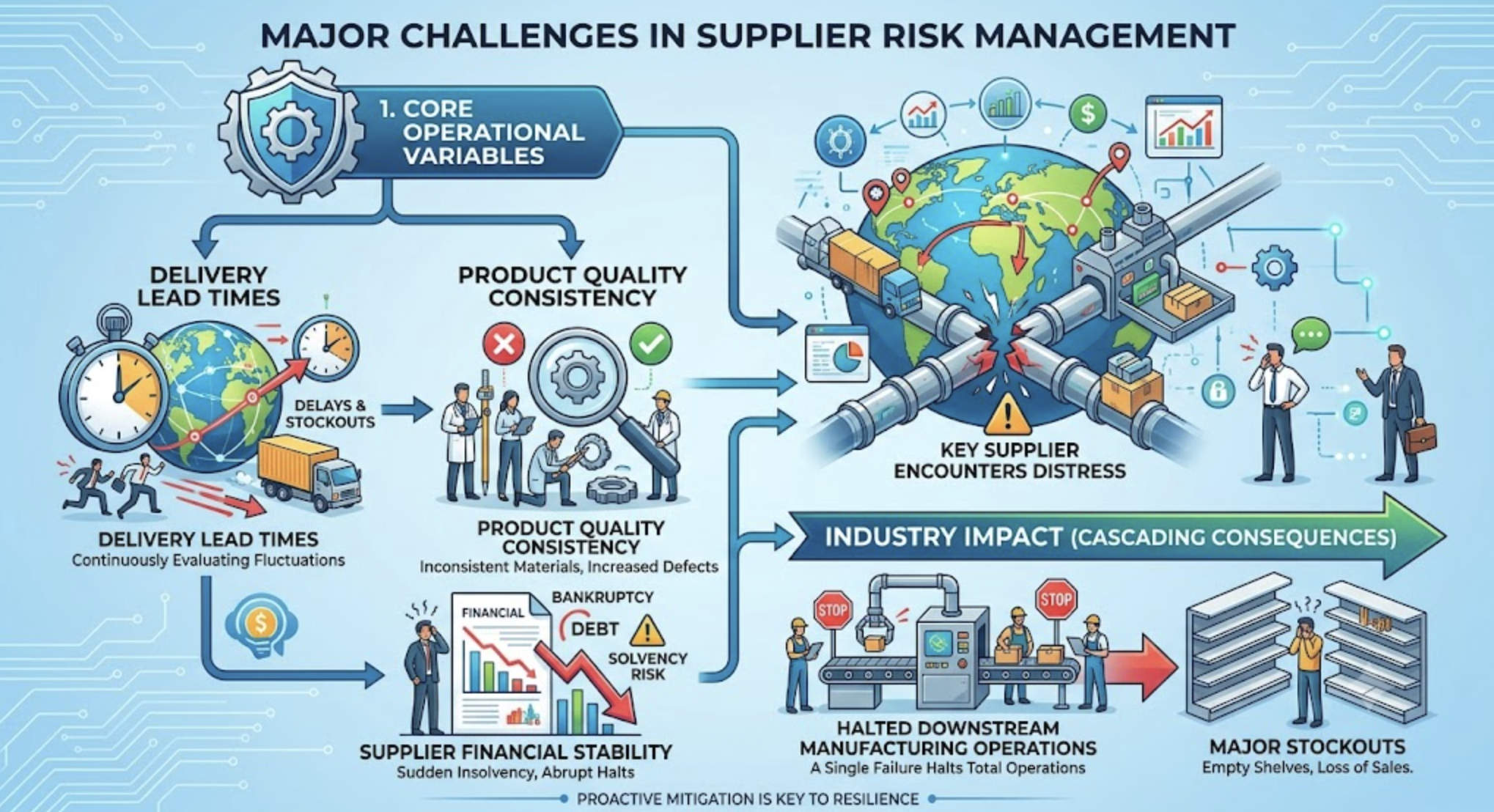
A comprehensive infographic titled "MAJOR CHALLENGES IN SUPPLIER RISK MANAGEMENT" showing an interconnected flow of risks. It highlights three "CORE OPERATIONAL VARIABLES": "DELIVERY LEAD TIMES" (with clocks and trucks), "PRODUCT QUALITY CONSISTENCY" (with gears and quality checks), and "SUPPLIER FINANCIAL STABILITY" (with a falling stock chart). These risks lead to "KEY SUPPLIER ENCOUNTERS DISTRESS", depicted as a breaking globe. Finally, the "INDUSTRY IMPACT" section illustrates the consequences: "HALTED DOWNSTREAM MANUFACTURING OPERATIONS" in an empty factory and "MAJOR STOCKOUTS" with empty retail shelves. The bottom text says "PROACTIVE MITIGATION IS KEY TO RESILIENCE".

Advanced Technologies to Optimize Supplier Risk Management

Leveraging modern digital technologies is essential to safeguard complex supply chains against unexpected market volatility, operational failures, and vendor insolvency.

By integrating specialized risk management software, artificial intelligence, real-time visual dashboards, blockchain, and automated robotics, organizations shift from reactive problem-solving to an intelligent, preventive risk mitigation strategy.

1. Specialized Software & Real-Time Dashboards

Centralized Data & Automated Analysis: Specialized risk management platforms automate risk evaluation, centralize vendor performance metrics, and deploy advanced algorithms to spot hidden anomalies long before they trigger supply interruptions.

Live Monitoring & Alerting: Visual dashboards compile critical performance indicators, risk alerts, and market updates into a single interface—allowing procurement managers to react instantly to market shifts and maintain business continuity.

Core Technological Drivers of Risk Mitigation

  • Predictive AI & Modeling: Forecast potential disruptions by detecting subtle behavioral patterns in vendor historical data.
  • Blockchain Integrity: Construct immutable, fraud-resistant transaction records for seamless supply chain collaboration.
  • Real-Time Dashboards: Visualize vendor performance metrics and instant risk alerts to accelerate response times.
  • Automated & Virtual Audits: Deploy robotics and virtual inspections for continuous, error-free quality control.

2. Artificial Intelligence and Predictive Modeling

Artificial Intelligence (AI) plays a transformative role in supplier risk management through its unmatched capacity to process massive datasets rapidly and accurately.

By analyzing historical performance metrics and identifying vendor behavior patterns, predictive AI algorithms forecast potential supply disruptions before they occur—delivering a proactive, highly preventive risk management framework.

3. Blockchain for Transparency and Security

Blockchain technology provides an indelible, tamper-proof record of every transaction and interaction across the supplier network.

This guarantees enterprise-grade data security, dramatically reduces fraud risks, and enhances cross-functional collaboration by offering all supply chain stakeholders secure, simultaneous access to critical risk intelligence.

4. Automation, Robotics, and Virtual Audits

Automation and robotics minimize human error while accelerating monitoring and quality assurance operations across the supply chain.

Recent advancements enable remote virtual audits and real-time quality inspections—ensuring supplier risk management remains proactive, rigorous, and continuously updated.

Conclusion: Build a Tech-Driven, Risk-Resilient Supply Chain

Empower Sourcing Operations with Cutting-Edge Tech

Combining predictive AI modeling, blockchain transparency, and automated real-time dashboards equips your enterprise to anticipate supply chain shocks with precision.

Transform vendor risk management into a strategic advantage and ensure uncompromised business continuity today.

Rigorous Monitoring and Evaluation of Suppliers

Rigorous supplier monitoring is the foundation of effective risk management, ensuring that vendor operations align continuously with corporate standards and contractual obligations.

By combining structured audit protocols, metric-driven KPI tracking, and transparent vendor relationships, organizations safeguard their supply chain against unexpected performance drops and operational bottlenecks.

1. Regular Audit Protocols

Establishing structured audit protocols is crucial for verifying supplier compliance and spotting operational gaps before they impact end-to-end supply chain continuity.

Comprehensive evaluations combine on-site inspections with remote process reviews. Documenting and analyzing audit findings guarantees that corrective action plans are deployed rapidly to resolve non-compliance issues.

Essential Supplier Audit Checklist

  • Regulatory Compliance Audit: Verify full adherence to regional labor, safety, and trade standards.
  • Financial Stability Assessment: Evaluate debt ratios, cash flow health, and creditworthiness.
  • Ethical & Ecological Review: Examine environmental practices, carbon footprint, and ESG metrics.
  • Crisis Management Evaluation: Review vendor backup systems and emergency business continuity protocols.

2. Management Based on Performance Indicators (KPIs)

Key Performance Indicators (KPIs) provide an objective framework for evaluating vendor effectiveness over time.

Continuously benchmarking delivery timelines, product quality, and emergency response capabilities against industry standards helps managers identify operational friction early and enforce targeted supplier development plans.

3. Supplier KPI Performance Tracking

Performance Indicator Target Benchmark Current Result
On-Time Delivery Rate 98% 95%
Product Quality Compliance 99.5% 99.0%
Emergency Response Capacity 24 hours 36 hours

4. Relationship Building and Strategic Engagement

Building strong, collaborative partnerships with key suppliers is a powerful yet frequently overlooked dimension of risk management.

Transparent communication—supported by regular executive reviews and constructive feedback—fosters mutual trust, encourages supplier investment in compliance standards, and ensures aligned responses during operational disruptions.

Conclusion: Elevate Supplier Performance & Risk Control

Maintain High Procurement Standards

Combining systematic audits, continuous KPI tracking, and transparent supplier partnerships ensures maximum operational reliability.

Empower your enterprise with real-time vendor performance monitoring and proactive risk mitigation strategies today.

Compliance and Regulations: Adapting to Global Standards

Adopting international standards and ensuring strict regulatory compliance is essential to optimizing supplier risk management across global supply chains.

By aligning internal procurement frameworks with recognized benchmarks such as ISO 31000 and ISO 9001, organizations systematically identify, evaluate, and mitigate vendor risks—securing operational continuity while elevating corporate reputation worldwide.

1. Adoption of International Standards (ISO 31000 & ISO 9001)

International standards provide a structured methodological framework for proactive risk governance.

Implementing these standards involves analyzing internal and external operating contexts, establishing clear risk management objectives, and deploying robust control mechanisms. This systematic approach protects supply pipelines while reinforcing buyer-supplier trust.

2. Impacts of Sectoral Regulations on Procurement

Industry-specific regulations directly shape supplier risk management strategies, particularly in highly controlled sectors like pharmaceuticals and food production.

Strict traceability mandates and product quality standards require organizations to integrate compliance checks directly into vendor evaluation workflows. Continuous legislative monitoring and ongoing team training are vital to prevent costly regulatory breaches and supply interruptions.

Core Regulatory & Compliance Pillars

  • ISO Framework Adoption: Implement ISO 31000 (Risk Management) and ISO 9001 (Quality Management) for systematic risk governance.
  • Sector-Specific Compliance: Embed strict traceability and quality controls tailored to pharma, food, and industrial standards.
  • Legislative Vigilance: Conduct continuous regulatory monitoring and staff training to adapt to evolving legal mandates.
  • Targeted Compliance Audits: Schedule regular audit protocols and track regulatory KPIs to resolve compliance gaps early.

3. Strengthening Compliance Audits for Risk Governance

Regular compliance audits serve as a critical defense line to verify that supplier operations align with current laws and enterprise standards.

Establishing a structured audit calendar and defining key performance indicators (KPIs) allows procurement leaders to detect non-compliance risks early—resolving vulnerabilities before they escalate into major operational or legal liabilities.

Conclusion: Ensure Uncompromised Global Compliance

Master Regulatory Risk & Protect Your Supply Chain

Integrating ISO frameworks, sectoral regulations, and continuous compliance audits ensures total supply chain transparency and resilience.

Empower your enterprise to navigate global regulatory complexities with confidence and maintain a sustainable competitive advantage.

Feedback and Key Lessons in Supplier Risk Management

Analyzing real-world industry feedback and past supply chain disruptions provides invaluable lessons for building a resilient procurement ecosystem.

By learning from sector-specific case studies, eliminating critical planning errors, and embracing digital transformation, organizations can transition from reactive crisis control to proactive, automated risk management.

1. Industry Case Studies: Building Resilience from Disruptions

Electronics Manufacturing: After a major crisis caused by a critical supplier failure, an international components manufacturer overhauled its risk strategy. By deploying automated tools to evaluate vendor financial health and production capacity continuously, they achieved greater global flexibility and resilience.

Automotive Sector: Facing the global semiconductor shortage, an automotive leader leveraged a pre-planned crisis management framework with regularly tested action plans. This proactive readiness enabled swift operational pivoting, significantly mitigating production downtime.

2. Common Mistakes to Avoid & Continuous Improvement

Overlooking Geographic Diversity: Concentrating suppliers in a single region leaves the supply chain highly vulnerable to localized climate or political crises.

Underestimating Geopolitical Factors: Failing to track regulatory shifts and international tensions exposes procurement channels to sudden trade barriers.

Feedback-Driven Optimization: Integrating audit findings continuously into mitigation strategies ensures processes evolve alongside emerging threats.

Cross-Industry Cross-Pollination: Applying pharmaceutical supply chain simulation methods to other industries helps teams model disruption scenarios and prepare contingency plans in advance.

Core Takeaways for Strategic Risk Management

  • Avoid Geographic Concentration: Distribute supplier networks across diverse regions to prevent single-point failures.
  • Incorporate Audit Feedback: Turn audit results into actionable, continuous process improvements.
  • Cross-Industry Innovation: Adopt supply chain disruption simulations (such as those used in pharma) to stress-test readiness.
  • Digital & Cloud Collaboration: Utilize cloud ERP and BI platforms to share real-time risk intelligence seamlessly.

3. Digital Transformation & Cloud Computing in Supplier Risk

Modernizing supplier risk management relies heavily on digital integration.

ERP & Business Intelligence: Accessing real-time vendor performance data allows risk managers to spot flaws rapidly and adjust orders automatically to prevent stockouts.

Cloud-Based Scalability: Secure cloud platforms facilitate multi-location collaboration, robust data protection, continuous analytics monitoring, and reliable disaster recovery.

4. Process Automation & Real-Time Risk Alerting

Automating evaluation and monitoring processes standardizes risk assessments while eliminating manual administrative burden.

Dedicated automation software conducts routine audits, tracks supplier KPIs, generates detailed reports, and triggers real-time risk alerts—allowing risk managers to take immediate corrective action and focus on high-impact strategic analysis.

Conclusion: Modernize Your Supplier Risk Strategy

Build a Resilient, Technology-Driven Sourcing Network

Integrating past feedback, avoiding geographic concentration, and leveraging cloud-based automation turns supplier risk management into a strategic advantage.

Protect your supply chain against future volatility with automated tracking, predictive intelligence, and seamless vendor collaboration.
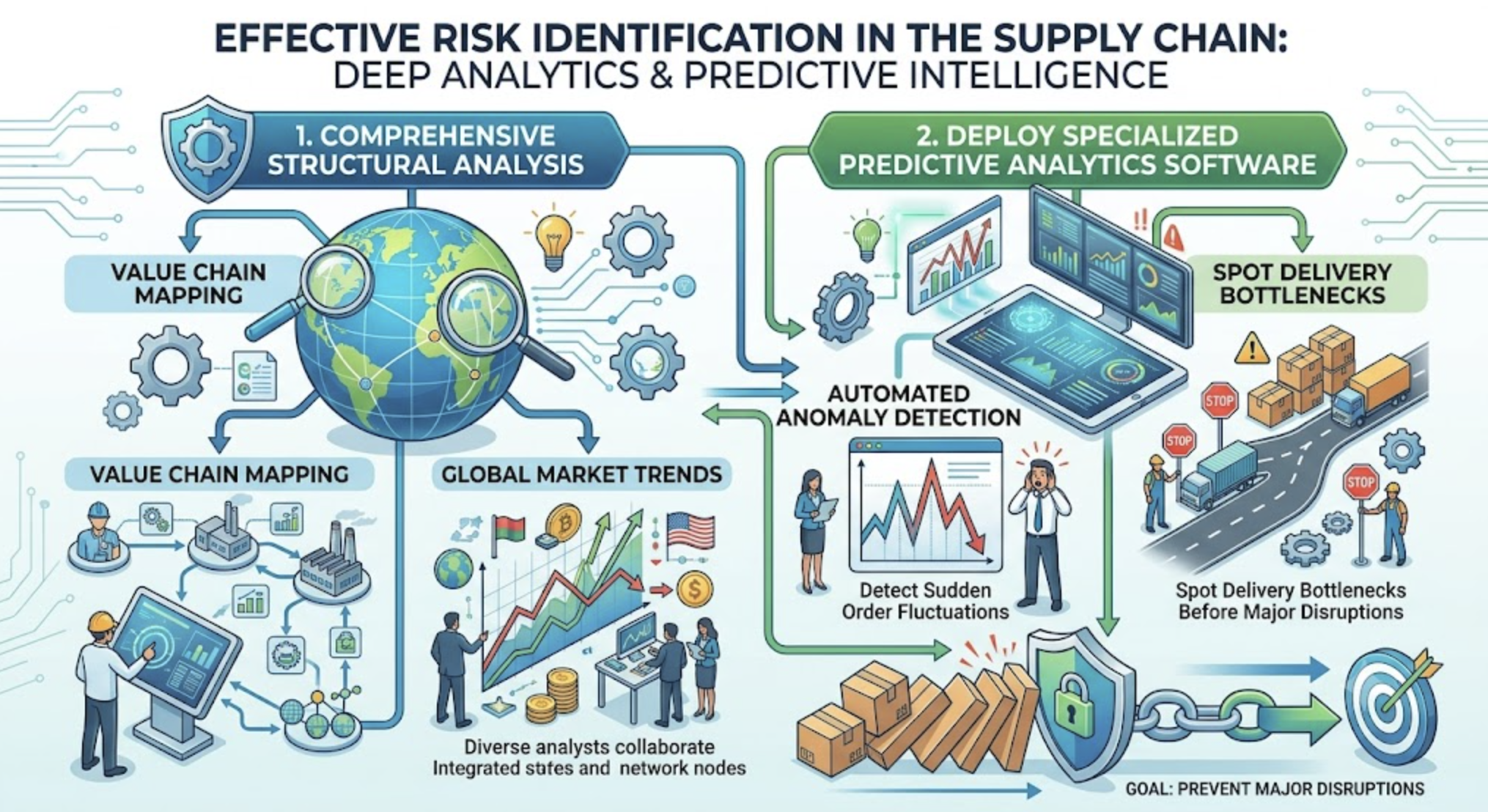
A detailed digital infographic titled "EFFECTIVE RISK IDENTIFICATION IN THE SUPPLY CHAIN: DEEP ANALYTICS & PREDICTIVE INTELLIGENCE." It features two numbered sections in a circular, connected workflow. Section 1, "COMPREHENSIVE STRUCTURAL ANALYSIS," is on the left in blue, showing illustrations for "VALUE CHAIN MAPPING" (factories, logistics, analysts using a screen) and "GLOBAL MARKET TRENDS" (charts, analysts collaborating, and world flags). Section 2, "DEPLOY SPECIALIZED PREDICTIVE ANALYTICS SOFTWARE," is on the right in green, showing "AUTOMATED ANOMALY DETECTION" (a user looking at a jagged graph with the text "Detect Sudden Order Fluctuations") and "SPOT DELIVERY BOTTLENECKS" (delivery trucks stuck in a bottleneck with workers holding "STOP" signs and the text "Spot Delivery Bottlenecks Before Major Disruptions"). Arrows connect these steps, leading down to a final section illustrating the "GOAL: PREVENT MAJOR DISRUPTIONS," depicted by falling dominoes stopped by a padlock shield that points to a target with arrows. The overall style is a clean, modern vector illustration.

Anticipating Future Changes in Supplier Risks

To maintain long-term competitive resilience, modern enterprises must continuously monitor market shifts and anticipate emerging supply chain disruptions.

From integrating AI predictive analytics to navigating climate change impacts and managing geopolitical volatility, forward-thinking organizations are actively redefining their risk frameworks to safeguard operational continuity.

1. Emerging Technological & Environmental Trends

Advanced technologies like Artificial Intelligence and Machine Learning enable businesses to predict potential supplier failures and optimize procurement processes in real time.

Simultaneously, the global market is shifting toward sustainable and ethical supply chains—making ESG compliance and environmental impact primary criteria for selecting and evaluating suppliers.

Core Technological Drivers in Risk Management

  • Artificial Intelligence: Predictive analytics for early risk identification and proactive mitigation.
  • Blockchain Technology: Immutable ledgers ensuring end-to-end transaction transparency and traceability.
  • Robotic Process Automation (RPA): Streamlined execution to eliminate human errors and boost operational speed.

2. Technology Trend Impact Matrix

Technological Trend Impact on Risk Management
Artificial Intelligence Risk prediction and proactive, data-driven response protocols
Blockchain Enhanced supply chain transparency, security, and traceability
Automation (RPA) Reduction of human errors and significant efficiency improvements

3. The Impact of Climate Change on Supplier Risks

Climate change poses an increasing threat to global procurement. Extreme weather events—such as severe droughts, hurricanes, and floods—disrupt transport logistics and cause severe material shortages.

Businesses must build robust climate mitigation frameworks, including rigorous scenario planning, emergency response strategies, local sourcing partnerships, and investments in climate-resilient supplier infrastructure.

4. Climate Risk Mitigation Strategies

Strategy Operational Description
Resilient Infrastructure Constructing and supporting facilities capable of withstanding extreme weather conditions
Sustainable Practices Utilizing renewable or recycled resources to minimize long-term environmental impacts
Local Suppliers Reducing risks associated with long-distance transportation and lowering overall carbon footprint

5. Forecasts on Global Supply Chain Evolution

As global trade becomes more interconnected, international supply risks grow increasingly complex.

While geographical diversification protects against localized disruptions, it introduces new political, economic, and social risk vectors across different sourcing regions that require vigilant monitoring.

Key Global Issues to Watch:
• Political stability and legislative shifts in supplier countries.
• International economic and currency fluctuations.
• Evolving international social and labor benchmarks.

6. Regional Risk Analysis Matrix

Sourcing Region / Country Identified Risk Factors
China Geopolitical instability, trade regulation shifts, and tariff risks
India Quality control consistency and unexpected delivery lead-time delays
Brazil Environmental regulatory risks, climate impact, and political instability

Conclusion: Build a Future-Proof Risk Strategy

Proactively Navigate Evolving Global Risks

Anticipating technological advancements, climate threats, and geopolitical shifts ensures your enterprise remains agile and protected against global market shocks.

Empower your procurement network with predictive AI modeling, sustainable sourcing practices, and proactive risk mapping today.

Risk Management and Sustainability: Integrating ESG Criteria

Integrating Environmental, Social, and Governance (ESG) criteria into supplier risk management is becoming crucial for the long-term sustainability of business operations.

Evaluating suppliers through an ESG lens proactively prevents reputational damage, operational friction, and legal liabilities—pursuing the dual objective of sustainable performance and social responsibility.

1. Strategic Benefits of ESG Criteria Integration

ESG Criteria Vector Strategic Advantages for the Enterprise
Environmental Reduces overall ecological footprint, enforces resource efficiency, and prevents costly legal penalties.
Social Improves relationships with local communities, reinforces human rights benchmarks, and increases employee satisfaction.
Governance Enhances corporate transparency and compliance, protects data privacy, and mitigates fraud risks.

2. Core Strategies for Seamless ESG Integration

Successfully implementing ESG criteria requires structured strategies to embed sustainable standards directly into everyday vendor evaluation workflows.

This involves upskilling procurement teams on ESG frameworks, developing responsible purchasing policies, and deploying real-time environmental and social monitoring tools across the supply chain.

Key Pillars for ESG Integration

  • Stakeholder Education: Conduct comprehensive training sessions on ESG principles and compliance for procurement teams.
  • Responsible Purchasing Policies: Establish formal procurement policies that mandate strict ESG criteria for all suppliers.
  • Dedicated Monitoring Systems: Implement continuous environmental and social auditing tools to track supplier performance over time.

3. Long-Term Impact on Risk Reduction & Competitiveness

Effective ESG integration significantly lowers long-term supply chain vulnerabilities. By anticipating issues linked to unsustainable practices, companies avoid unexpected costs while building an adaptable, future-proof sourcing network.

Key Impacts Include:
Incident Reduction: Significant decrease in environmental accidents and social/labor disputes.
Enhanced Trust: Stronger corporate reputation and heightened stakeholder confidence.
Global Edge: Increased competitiveness in international markets sensitive to strict ESG standards.

Conclusion: Drive Responsible & Sustainable Sourcing

Elevate Your Sourcing Standards with ESG Integration

Embedding ESG principles into supplier risk evaluations shields your enterprise from legal penalties, brand erosion, and operational bottlenecks.

Build a resilient, sustainable, and fully compliant supply chain with intelligent vendor monitoring tools today.

FAQ - Supply Chain Optimization

Optimizing the supply chain requires mastering risk detection, building sourcing resilience, and utilizing next-generation technology.

Below are concise answers to fundamental questions regarding major supplier risk challenges, predictive risk identification, technological mitigation tools, and robust auditing protocols.

1. What are the major challenges in supplier risk management?

Core Operational Variables: Key challenges center on continuously evaluating delivery lead times, product quality consistency, and supplier financial stability.

Industry Impact: A single key supplier encountering financial distress or insolvency can trigger major stockouts and halt downstream manufacturing operations.

2. How to effectively identify risks in the supply chain?

Deep Analytics & Predictive Intelligence: Effective risk identification requires a comprehensive structural analysis of value chains and global market trends.

Deploying specialized predictive analytics software allows teams to automatically detect operational anomalies and risk patterns—such as sudden order fluctuations or delivery bottlenecks—before they cause major disruptions.

Core Takeaways for Supply Chain Optimization

  • Multi-Geographic Diversification: Spread sourcing across diverse regions to insulate operations against localized crises.
  • Predictive Analytics & AI: Forecast supply shocks and order anomalies prior to material shortages.
  • Blockchain Traceability: Establish tamper-proof, transparent product tracking across all supply nodes.
  • Unannounced On-Site Audits: Combine scheduled reviews with surprise audits to uncover hidden non-conformities.

3. What strategies should be adopted to improve supply chain resilience?

Diversification & Modern IT Infrastructure: Diversifying supply sources and investing in advanced information technology are the pillars of supply chain resilience.

Engaging multiple vendors across distinct geographical regions protects the enterprise against localized climate disasters, political instability, or regional trade barriers.

4. What role does technology play in risk mitigation?

Anticipation & Secure Traceability: Emerging technologies like Artificial Intelligence (AI) and Blockchain play a crucial role in predicting operational failures and securing commercial transactions.

Blockchain provides immutable, end-to-end traceability of materials and finished goods throughout every tier of the supply network.

5. What does a regular supplier audit consist of to secure the supply chain?

Compliance Verification & Surprise Audits: Regular audits verify vendor adherence to quality standards, labor regulations, and financial health benchmarks.

Conducting unannounced, surprise audits provides an accurate operational picture, helping managers spot undeclared non-conformities and correct vulnerabilities early.

Conclusion: Master Supply Chain Resilience Today

Build a Risk-Proof Sourcing Strategy

From predictive AI modeling and multi-region vendor diversification to rigorous compliance audits, proactive management transforms supply chain challenges into growth opportunities.

Empower your enterprise with real-time risk intelligence, automated tracking, and complete supply chain transparency.

Supplier Risk Management in Supply Chain Optimization

In the complex world of supply chain optimization, supplier risk management is crucial. Successfully navigating this field requires an indispensable, systematic approach.

Adopting a proactive strategy enables organizations to turn operational challenges into strategic opportunities—minimizing risks while significantly improving operational efficiency and supply chain resilience.

Pillars of Proactive Risk Optimization

  • Systematic Frameworks: Deploy structured methods to navigate complex, multi-tiered supply chains.
  • Opportunity Creation: Convert operational vulnerabilities into drivers for efficiency and growth.
  • Proactive Hazard Mitigation: Anticipate supply disruptions before they impact downstream operations.
  • Enterprise Resilience: Build robust contingency plans to ensure continuous, uninterrupted resource availability.

Anticipate Hazards & Ensure Resource Security

Understanding the paramount importance of a proactive risk management strategy allows procurement leaders to anticipate market volatility, safeguard critical inventory, and maintain a robust supply ecosystem.

Explore detailed strategies for optimal, secure, and future-proof management of your global enterprise resources.

Build a Resilient, Secure Sourcing Infrastructure

A systematic and proactive approach to supplier risk management converts potential disruptions into lasting competitive advantages.

Ensure optimal resource security, elevate supply chain resilience, and protect your enterprise against market uncertainties today.

Line
Featured Post

Popular posts