Olivier Audino
Webinar
Tail Spend: The Overlooked Lever to Free Up Your Buyers' Time
Tuesday March 31 at 2:00 PM



Procurement management in large groups relies on a stark asymmetry. To secure a strategic 2 million euro contract, your P2P processes are remarkably efficient. But when faced with a 500 € micro-expense with an occasional provider, this same machinery becomes a bottleneck.
The absence of a supplier intermediation system forces your teams to process a "Spot" order with the same administrative rigor as a multi-year partnership. The result is mathematical. The compliance effort often exceeds the face value of the purchase.
Here is the reality
Each account creation for a disposable third party consumes about 3 hours of cumulative workload across procurement, accounting, and legal. For a CPO, the challenge is no longer just to buy well, but to protect the productivity of their talent against transactional saturation.
Information systems like SAP, Oracle, or Coupa are designed to structure data, not to absorb the volatility of the long tail. Without a trusted third party, your ERP becomes the receptacle for thousands of supplier records, 70% of which will only be used once.
The integrity of your supplier Master Data is the absolute prerequisite for reliable reporting. However, the lack of an upstream filter transforms your database into an accumulation of duplicates and obsolete information.
According to analyses by Gartner, supplier data pollution is one of the primary obstacles to procurement digital transformation. Maintaining these open accounts presents three major risks
To cleanse your infrastructure, it is imperative to adopt a strategy for procurement ERP rationalization by delegating the spot flow to a single pivot point.
In procurement engineering, we systematically observe an inverted Pareto principle. Class C, or tail spend management, represents less than 5% of the overall financial volume, but mobilizes more than 80% of the mental and administrative load of your Lead Buyers.
Why? Because an occasional supplier is, by definition, unknown to the system. The buyer must launch a complete onboarding process for a service that will never be renewed. This administrative time is stolen from strategic time.
Using an ERP designed to secure 2 million euro contracts in order to manage a 500 € repair invoice is like using a jackhammer to drive a nail.
To objectify this shortfall, you can calculate your transactional load and identify the volume of wasted FTEs.
Calculate my transactional loadFor a Chief Financial Officer or a CPO, managing the Long Tail is not a sourcing problem, it is a problem of financial engineering. The lack of supplier intermediation creates a mechanical EBITDA leak that few companies dare to quantify accurately.
Here is the reality
The administrative cost of a transaction does not depend on its amount. Whether you buy software for 50,000 € or a locksmith service for 300 €, the control chain remains identical. This is where the absence of a trusted third party becomes critical.
Maverick spend, or uncontrolled buying, is the direct consequence of a P2P process that is too rigid for the field. When an internal requester (marketing, maintenance) faces a refusal for onboarding a small amount, they bypass the procurement department and use a corporate credit card.
This bypass destroys profitability in two ways
By aggregating these flows via a single procurement hub, you transform these phantom expenses into controlled flows, directly impacting your EBITDA by eliminating manual management costs.
To objectify the loss, let us apply the standard value destruction formula observed among our Fortune 500 clients
Consider a group managing 2,000 new occasional suppliers per year. The total loaded cost including the buyer's time (document collection), the compliance department (KYC validation), and accounting (data entry and payment) is 150 € per entity.
Annual loss calculation
The result
This amount represents the equivalent of 3 to 4 FTEs (Full Time Equivalents) whose mission consists of data entry rather than strategy. Class C procurement outsourcing allows this workforce to be reinjected into strategic tenders where their added value is real.
To simulate your own case, use our transactional load calculator.
Access the transactional load calculatorIf administrative cost is a drag on performance, the non-compliance risk is a threat to the company's sustainability. Legislation makes no distinction regarding amounts when it comes to probity.
The French Anti-Corruption Agency (AFA) is very clear in its recommendations, the third pillar of the Sapin II Law requires third-party evaluation. Many groups limit this evaluation to their "strategic" suppliers, leaving a gaping blind spot on the 80% of occasional suppliers.
It is precisely within this mass of small, unregulated payments that risks of corruption, conflicts of interest, or undeclared labor hide. Without an automated Compliance Shield, it is physically impossible for a human procurement team to verify every business registration and social compliance certificate across the Long Tail.
Requirements go a step further with the CSRD directive. From now on, sustainability reporting demands traceability across the entire value chain. An occasional supplier unaudited on their social or environmental practices becomes a flaw in your non-financial report.
BME intervenes here as a technological filter. Our infrastructure delegates the systematic collection and verification of legal documents
Do not remain exposed to a fine of up to 5% of your turnover.
Measure your current risk level via our P2P Compliance Stress Test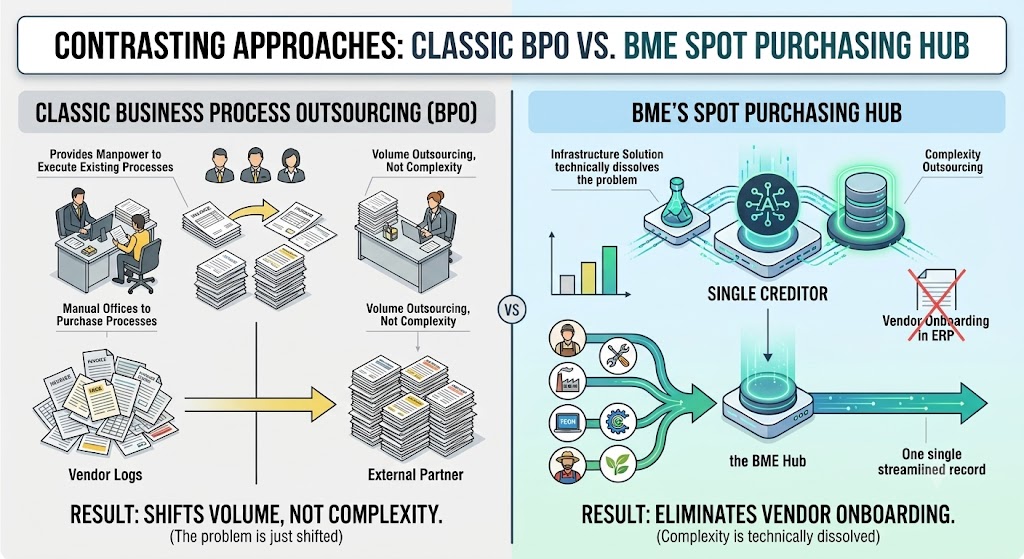
Intermediation should not be confused with a simple service provision. It is a software and financial infrastructure that interposes itself between your procurement systems (SAP, Coupa, Ivalua) and the market. Here is the precise mechanism that allows you to transform an administrative cost center into an EBITDA lever.
Here is the mechanics
BME's first action lever is the drastic reduction of supplier Master Data. Instead of opening and maintaining 1,000 records for occasional providers, you only open a single pivot record for BME.
By becoming your Single Creditor, we absorb all the complexity of third-party onboarding. Your buyers no longer create accounts; they select an entity that is already audited and ready to use. This simplification eliminates duplicates and secures the database against obsolescence.
The Transactional Trusted Third Party relies on a total delegation of legal responsibility. This is what we call the Compliance Shield.
BME does not just verify documents; we manage the entirety of the financial portage. This means that BME advances the cash flow to pay the small artisan or local provider (often on demand or with a deposit), while you pay BME according to your key account payment terms (e.g., 60 days).
Here is a flow comparison to illustrate the operational breakthrough
| Performance Indicator | Classic Internal Management | BME Intermediation |
|---|---|---|
| Number of ERP accounts | N third parties = N records | 1 Single Creditor |
| Onboarding time | 15 days (average) | Immediate (already active account) |
| Legal verification (Sapin II) | Manual and random | Automated and systematic |
| Accounting processing | N disparate invoices | 1 consolidated monthly invoice |
| Invoice dispute risk | High (micro-amounts) | Zero (upstream reconciliation) |
For the end user (the requester), the change is invisible. Thanks to the Seamless Connection via PunchOut or API, they make their request in their usual interface. BME captures the flow in the background, manages the purchase, compliance, and logistics.
At the end of the month, your accounting department does not receive 500 invoices of 500 €, but a single Consolidated Invoice. Each line of this unique invoice is perfectly broken down by analytical code and cost center, ready to be integrated into the general ledger without any additional manual data entry.
The theory of intermediation is not enough to convince a finance department. To objectify the impact of a Procurement Hub, let us examine real data from a CAC40 industrial group before its transition to the BME model.
The starting point is that the group's ERP contained 45,000 active supplier records. A data analysis revealed that 28,000 of them had recorded only a single transaction over the last 24 months.
The group generated approximately 6,500 new Class C purchase requests per year (emergency on-site interventions, one-off marketing services, specific office furniture). Without an intermediation solution, each request forced the opening of a new third-party account.
Drawing upon benchmarks from the analyst firm Gartner and audited internal costs, the total processing cost of a new supplier (from sourcing to accounting reconciliation) was established at 150 €.
Gross annual loss calculation
To this is added the opportunity cost of the buyers. The average time dedicated to collecting registration and social compliance certificates for these files represented 4,800 hours per year.
After the implementation of BME as the Single Creditor, the 28,000 dormant accounts were archived. The 6,500 annual transactions are now processed under a single supplier reference.
| KPI Indicator | Initial Situation (Without BME) | Target Situation (With BME) |
|---|---|---|
| Supplier Master Data Volume | 45,000 records | 17,000 records (62% cleansing) |
| Transactional management cost | 975,000 € / year | 95,000 € (Consolidated service fees) |
| Buyer administrative load | 4,800 hours / year | < 200 hours (Simple validation) |
| Non-compliance risk (Sapin II) | High (sampling) | Zero (BME systematic verification) |
The net gain for the group's EBITDA exceeded 800,000 € in the very first year, while freeing up 3 FTEs (Full Time Equivalents) for strategic negotiation missions.
Simulate these gains with our transactional load calculatorThe absence of a trusted third party for your occasional suppliers is not a simple "administrative inconvenience". It is a governance flaw that weakens your EBITDA and exposes your Executive Management to major criminal risks via the Sapin II Law.
The engineering of the problem is clear, your processes are too heavy for the Long Tail. Supplier intermediation brings the necessary flexibility to the field while guaranteeing absolute control rigor at headquarters. By entrusting your Class C spend to an expert like BME, you move from passive management to strategic data steering.
Do not let your hidden costs paralyze your talent anymore. Immediately evaluate your legal exposure and financial leaks by taking our
P2P Compliance Stress TestSupplier intermediation does more than just pay. BME deploys a Compliance Shield. We collect, verify, and archive the entire KYC file (business registration less than 3 months old, social compliance certificates, sanction lists). If a document is missing or expired, the payment process is preventively blocked by our system. You delegate the entirety of the vigilance risk.
But there is a detail
The cost of an intermediation provider is negligible compared to the internal processing cost of 150 € per invoice. By consolidating your flows, you eliminate multiple bank fees and data entry errors, and above all, you neutralize Maverick spend. ROI is generally achieved in less than 6 months by eliminating low-value-added tasks.
Yes. Seamless Connection is one of our pillars. We use standard protocols (PunchOut cXML/OCI) or APIs to keep the user experience native. The employee places orders in their usual tool, but the financial flow is automatically routed to BME. No heavy change management is required.



.svg)