Olivier Audino
Webinar
Tail Spend: The Overlooked Lever to Free Up Your Buyers' Time
Tuesday March 31 at 2:00 PM


The fact is mathematical. 70% of the large group supplier base is composed of disposable third parties.
Buyers, recruited to structure global panels, find themselves entering tax registration numbers for one-off repairs of €800.
The current creation process in the ERP paralyzes operational teams and dilutes the profitability of the Procurement department. The Pareto law applies in reverse here. 5% of expenses (Class C) account for 80% of the mental and administrative workload.
Freezing the creation of new suppliers in the information system is no longer a management option; it is a governance emergency.
But imposing a strict zero creation policy blocks factories and marketing departments. How do you close the door on Master Data without stifling business operations?
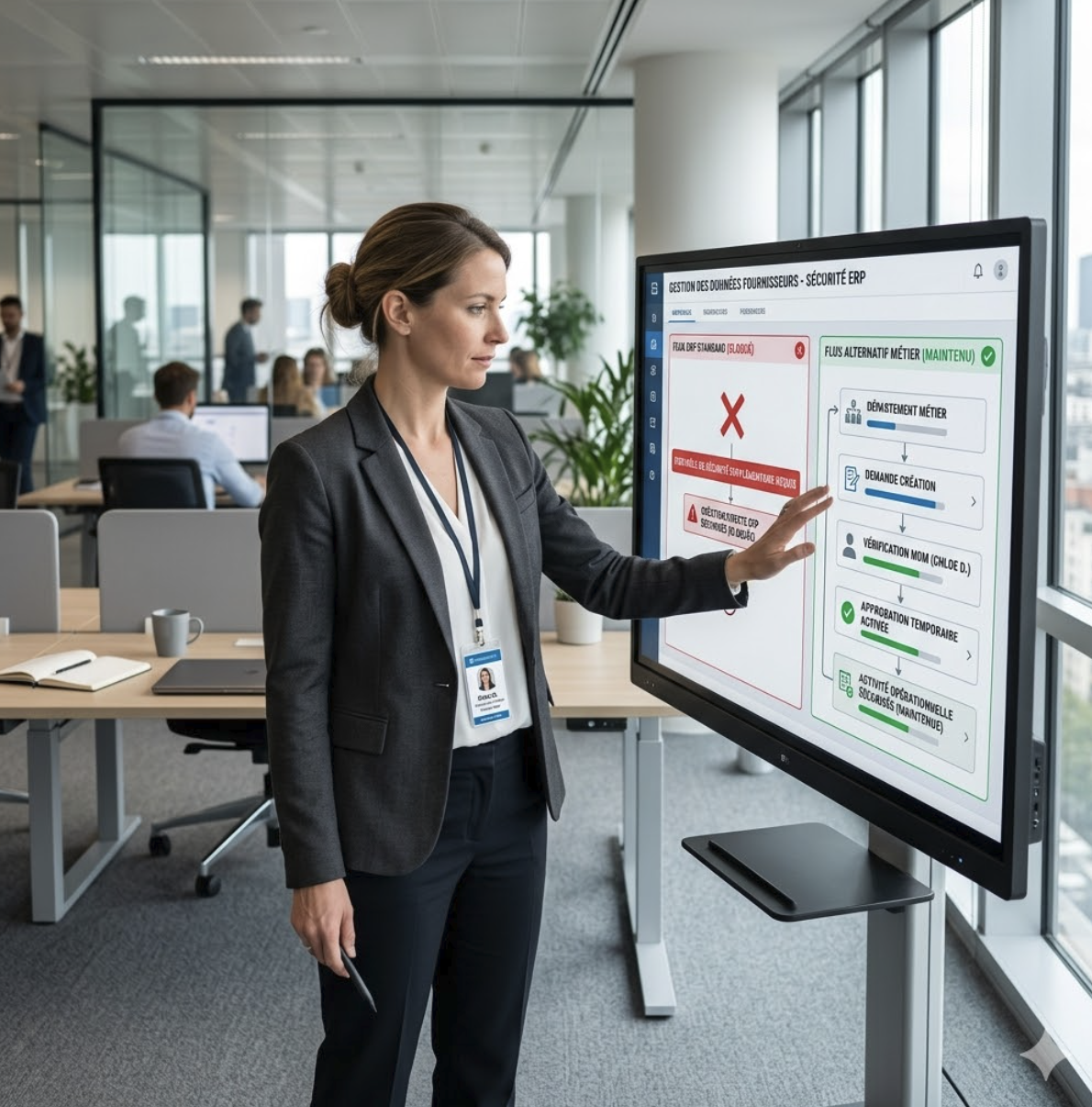
Far from increasing your risk, freezing creations in your ERP is the ultimate defense mechanism against Master Data contamination. By mandating passage through our trust gateway, you ensure that 100% of your supplier flows are audited even before their first transaction.
The modern buyer suffers from a major cognitive dissonance between their job description and their operational daily life.
Sold as a "Value Creation" strategist, they actually spend nearly 40% of their time on administrative clerk tasks.
This asymmetry is explained by the use of a central tool often ill-suited for the very high volume of the Long Tail.
Using an ERP designed to secure €2 million contracts to process a €500 invoice from a local craftsman is like using a jackhammer to drive a nail.
Procurement ERPs (Coupa, Ariba, SAP) are software fortresses. They require perfect data completeness to function (business registration, banking details, certificates).
It takes an average of 3 hours of cumulative actual work (follow-ups, document collection, entry, validations) to finalize a Spot ERP supplier account creation.
Analyses from firms like Gartner confirm it: traditional Procure-to-Pay architectures desperately lack the agility required to absorb unplanned purchases.
Faced with a factory manager demanding a critical spare part for the next day, the buyer is trapped by compliance procedures.
If they apply the classic supplier referencing process, the average 15-day delay makes the transaction obsolete or puts the production chain at risk.
Because between a strategic negotiation determining their bonus and an administrative onboarding, the buyer will logically prioritize the former. The small request stagnates.
The buyer becomes, despite themselves, the company's bottleneck. Faced with this wall, the internal requester gets impatient and often ends up bypassing the rule.
Before considering a strict freeze on creations, it is essential to objectify this financial and human loss by measuring your load with our transactional load calculator.
When the referencing process takes 15 days, the field always finds a shorter path. The internal client pulls out the company credit card or processes the purchase as an expense report.
This is the explosion of Maverick spending. The process has been bypassed, the buyer is taken out of the game, and the company loses all control over its spending.
The CFO sees these non-processed purchases arriving at the end of the line. Accounting must manually process dozens of incomplete receipts, manage non-recoverable VAT, and juggle payment reminders.
Whether the purchase is rogue or forced into the system as a disposable supplier, the cost of supplier creation or administrative processing remains exorbitant. It averages €150 per Spot invoice processed internally.
Let us perform a brutal mathematical demonstration. For a large group that handles 4,000 occasional supplier creations per year:
The procurement team is nonetheless judged on its ability to generate savings. The inability of traditional Procure-to-Pay to handle Class C with agility purely and simply cancels out the gains obtained by buyers during their strategic negotiations.
If the financial impact is severe, the legal risk is systemic. Procurement departments invest massively to audit their Top 20% of suppliers.
However, below the waterline, thousands of small craftsmen and occasional service providers escape any real control.
Because performing a full Know Your Supplier (KYS) for an €800 expense would take far too much time for the back-office. Buyers turn a blind eye: tax compliance certificates expire and checks against international sanctions lists fall through the cracks.
Yet, the French Anti-Corruption Agency (AFA) makes no distinction regarding volume. The risk of non-compliance applies from the very first euro spent.
The CPO ends up with corrupted Master Data and maximum criminal exposure.
It is imperative to measure this flaw in your governance by assessing your base via our compliance stress test.
Faced with a saturated ERP, the classic reaction of a Procurement department is to launch a vast cleanup project.
Internal resources or consultants are mobilized to deactivate inactive accounts, hunt for duplicates, and verify the validity of registration numbers.
Six months later, the ERP is clogged again. Trying to clean up your Master Data while leaving the creation process open to spot purchases is like bailing out a boat with a hole in it without plugging the leak.
Master Data Management (MDM) requires absolute completeness. Each line must be accurate, up to date, and legally viable.
Yet, the reality for large groups is relentless: nearly 70% of the suppliers present in the database have only been invoiced once over the last three years.
These disposable suppliers are not harmless. They distort spend analysis, increase IT maintenance costs, and multiply financial error risks, particularly false bank details fraud or double payments.
The historical unitary paradigm (1 field supplier = 1 ERP account) is mathematically unsustainable when applied to Class C.
As long as your software architecture requires the creation of a new file for every local craftsman, caterer, or emergency service provider, the database will remain structurally unstable.
It is unrealistic to require a buyer to maintain a high compliance standard for supplier profiles that have no intention of joining a long-term strategic panel.
The only viable method is no longer curative cleaning, but the total cessation of non-strategic new creations. To definitively clean the system, you must stop allowing this transactional volume to enter your ERP.
The only viable alternative to stop database congestion is transactional intermediation.
It is not about blocking urgent field purchases, but about diverting the operational flow of tail spend outside your internal infrastructure.
This is the principle of the One Stop Shop. A Trusted Transactional Third Party technically and financially inserts itself between your central ERP (Coupa, Ariba, SAP) and your thousands of small suppliers.
The uncontrolled accumulation of supplier records for spot needs is a technical debt that suffocates your information system. The BME One Stop Shop acts as a structural barrier: it halts the creation of unnecessary accounts and sustainably cleans up your repository.
Managing Class C purchases should no longer saturate your information system or slow down your operations.
Insisting on forcing every occasional supplier into a rigid ERP is a governance anomaly. It mechanically destroys your profitability, exposes the group to legal risks, and exhausts your teams.
Agility will not come from yet another software configuration or a database cleanup campaign. It will come from a structural transformation of your acquisition model.
By entrusting the processing of your Long Tail to a Trusted Transactional Third Party, you perform an immediate pivot:
It is time to close your ERP door to hidden costs and internal friction. Rationalizing Procure to Pay begins with the outsourcing of its transactional complexity.
Creating an account for a spot purchase unnecessarily clutters your Master Data and costs an average of €150 in hidden administrative fees per invoice.
This heavy process paralyzes operations and forces your teams to waste time on very low value added tasks, instead of focusing on strategic purchasing and cost optimization.
By outsourcing your Class C purchases, BME becomes your One Stop Shop and acts as the exclusive creditor for your entire long tail.
Instead of hosting thousands of lines of disposable suppliers in your information system, you keep only one single active supplier account in your ERP: Buy Made Easy.
Absolutely not, it is quite the opposite. By using a Trusted Transactional Third Party, the delegation of the KYC (Know Your Supplier) process is total and systematic.
We rigorously collect and verify tax compliance certificates, business registration extracts, and international sanctions lists before every expenditure commitment, guaranteeing perfect legal compliance in the face of Sapin 2 law and AFA requirements.



.svg)