
Supplier risks and audit

Master Supplier Risk Management for a Solid Supply Chain

Published By
Olivier Audino
Tags
Sourcing

Controlling Supplier Risk Management to Strengthen Supply Chains

Controlling supplier risk management is crucial to strengthening your supply chain and safeguarding operational continuity.

Faced with an increasingly complex and interconnected business environment, organizations need to closely monitor their suppliers to prevent disruptions and optimize overall operational performance.

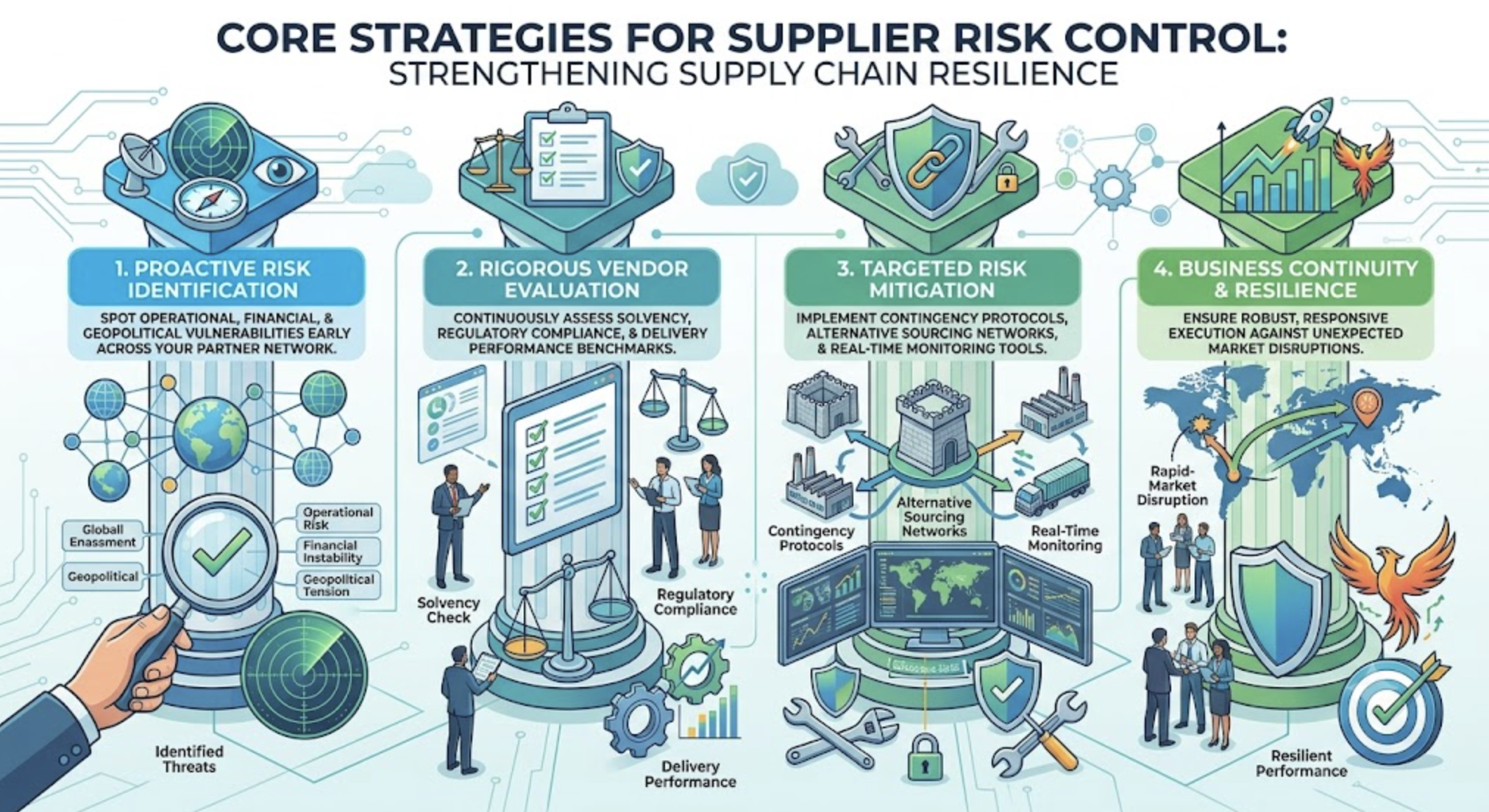
Core Strategies for Supplier Risk Control

  • Proactive Risk Identification: Spot operational, financial, and geopolitical vulnerabilities early across your partner network.
  • Rigorous Vendor Evaluation: Continuously assess solvency, regulatory compliance, and delivery performance benchmarks.
  • Targeted Risk Mitigation: Implement contingency protocols, alternative sourcing networks, and real-time monitoring tools.
  • Business Continuity & Resilience: Ensure robust, responsive execution against unexpected market disruptions.

Turn Sourcing Challenges into Opportunities

Integrating robust risk evaluation practices enables procurement leaders to transform management challenges into opportunities for network consolidation and innovation.

By monitoring supplier performance transparently and addressing vulnerabilities head-on, enterprises build a highly resilient, agile supplier ecosystem capable of thriving amidst market volatility.

Build a Resilient, Future-Proof Supplier Network

Mitigating vendor risks equips your supply chain with superior responsiveness, cost stability, and long-term business continuity.

Take control of supplier risk management and optimize your procurement ecosystem today.

Introduction to Supplier Risk Management

Effective Supplier Risk Management is essential because it allows businesses to prevent disruptions that could cripple their supply chain.

By identifying and mitigating risks in advance, organizations maintain smooth operations and avoid unexpected costs. In highly competitive markets, a robust supplier risk strategy reassures stakeholders and clients regarding enterprise reliability and stability.

1. The Consequences of Poor Supplier Risk Management

Failing to properly manage supplier risks leads to production delays, inflated purchasing costs, and potential operational halts.

Beyond immediate financial losses, inadequate oversight severe damages corporate reputation and customer trust. Furthermore, non-compliance with legal and environmental standards exposes the organization to heavy regulatory fines and legal sanctions.

2. Navigating Globalized Supply Chain Challenges

In a globalized economic environment, enterprises rely heavily on geographically dispersed supplier networks.

This global footprint exposes supply chains to heightened geopolitical, economic, and environmental vulnerabilities. Deploying sophisticated Supplier Risk Management mechanisms—taking into account logistical, political, and macro-economic dynamics—is vital for long-term corporate survival and resilience.

Identifying and Mapping Supplier Risks

Recognizing distinct risk categories is the foundational step toward securing your procurement pipeline.

Supplier risks typically encompass financial risks (e.g., vendor bankruptcy), operational risks (e.g., manufacturing delays), and logistical risks (e.g., transit and delivery bottlenecks).

Core Pillars of Risk Identification

  • Multidimensional Risk Recognition: Categorize vulnerabilities across financial, operational, and logistical vectors.
  • Advanced Data Analytics & Audits: Evaluate historical performance data and conduct continuous supplier audits.
  • Visual Risk Mapping: Map dependencies to pinpoint critical high-risk intersection points.
  • Targeted Mitigation Prioritization: Focus risk management resources where operational impact is highest.

3. Risk Identification Techniques & Priority Matrix

Risk Category Identification Techniques Strategic Importance
Financial In-depth financial statement analysis, credit monitoring, insolvency alerts High
Operational Regular onsite audits, performance benchmark evaluations, quality checks Medium to High
Logistical Real-time logistics tracking, freight monitoring, supply chain assessments Medium

Conclusion: Build a Secure & Resilient Supply Chain

Protect Your Operations with Proactive Risk Oversight

Combining comprehensive risk identification, data-driven audits, and visual supply chain mapping establishes a resilient procurement foundation.

Mitigate global supply chain vulnerabilities, ensure regulatory compliance, and safeguard business continuity today.

Methodologies for Reducing Supplier Risks

Establishing a resilient supplier risk management framework requires a structured combination of thorough initial evaluations, routine operational audits, and multi-sourcing diversification.

By replacing ad-hoc vendor checks with documented, data-driven methodologies, organizations protect their supply chains against unexpected operational breakdowns and quality failures.

1. Supplier Assessment and Selection: Criteria & Process

Systematic risk reduction begins with rigorous pre-contract evaluations. Vendor assessments must analyze financial solvency, operational stability, environmental/social compliance, and delivery reliability.

Essential Selection Steps: Standardize pre-qualification questionnaires, execute rigorous bid analyses, conduct on-site facility audits, and complete comprehensive professional reference checks.

Essential Supplier Selection Criteria

  • Historical Reliability: Benchmark past fulfillment performance, lead times, and order accuracy.
  • Financial Solvency & Capacity: Verify balance sheet strength to prevent sudden vendor bankruptcies.
  • Regulatory Compliance: Enforce adherence to industry-specific legal, safety, and quality standards.
  • ESG & Sustainability Commitment: Assess environmental impact and social responsibility practices.

2. Regular Supplier Audits & Corrective Action Tracking

Carrying out routine internal or third-party audits ensures suppliers consistently meet quality, safety, and ESG benchmarks over time—detecting operational vulnerabilities before they disrupt production lines.
Supplier Category Audit Frequency Key Issues Identified Corrective Action Implemented
Supplier A Biannual Recurring delivery lead time delays Strengthened supply chain routing & buffer stock protocols
Supplier B Annual Material non-compliance detected Mandated raw material vendor substitution
Supplier C Quarterly Product quality variability Overhauled quality control (QC) testing processes

3. Strategic Supplier Diversification

Avoiding single-source dependency is vital for supply chain resilience.

Developing secondary supplier relationships for critical components and diversifying vendor geography insulates your enterprise from localized geopolitical turmoil, economic shocks, and regional natural disasters.

Supplier Risk Management Software & Tools

Selecting dedicated supplier risk management software provides real-time risk visibility, automated assessments, and customizable alert triggers directly within your ERP ecosystem.

4. Risk Management Software Solutions Comparison

Platform Core Capabilities & Features Pricing Structure
SupplyRisk Pro Real-time risk analytics, seamless ERP integration, custom reporting engines €200 / month
RiskMaster X Instant risk alert triggers, automated vendor assessments, full mobile support €150 / month
ChainGuardian Predictive AI analytics, machine learning risk modeling, intuitive dashboard suite €250 / month

Conclusion: Safeguard Your Supply Chain Infrastructure

Build a Proactive, Tech-Enabled Risk Management Framework

Combining standardized vendor selection criteria, routine audit schedules, multi-sourcing, and real-time risk tracking software ensures complete supply chain continuity.

Protect your production, maintain regulatory compliance, and eliminate vendor disruptions today.
The Contribution of Digital Platforms in Supplier Risk Management

Digital platforms are transforming Supplier Risk Management by enabling seamless collaboration and communication between all actors across the supply chain.

They facilitate real-time information sharing and empower procurement leaders to anticipate and resolve bottlenecks using advanced tracking tools and predictive analytics.

Key Advantages of Digital Risk Platforms

  • Enhanced Operational Visibility: Gain end-to-end transparency into vendor performance and supplier tier activities.
  • Accelerated Malfunction Response: Drastically reduce reaction times when supply chain disruptions or errors occur.
  • Risk-Driven Cost Optimization: Lower operational overhead by proactively controlling risk exposure.

1. Using Artificial Intelligence to Anticipate Risks

Artificial Intelligence (AI) plays an increasingly pivotal role in modern Supplier Risk Management.

By evaluating massive datasets, AI uncovers hidden trends and risk patterns that traditional analysis misses—delivering proactive, predictive solutions before potential disruptions become critical failures.

2. Applications of AI in Risk Management

AI Application Area Direct Operational Impact
Failure Prediction Substantial reduction in supply chain and delivery disruptions
Supplier Behavioral Analysis Enhanced accuracy in vendor selection, evaluation, and benchmarking
Predictive Risk Modeling Optimization of overall risk mitigation and continuity strategies

Best Practices for Sustaining Supplier Risk Management

To ensure long-term risk management effectiveness, setting up targeted Key Performance Indicators (KPIs) is essential.

KPI tracking allows procurement teams to quantify strategy performance, spot operational gaps, and continuously refine supply chain safeguards.

Essential Risk Performance Metrics

  • Supplier Compliance Rate: Percentage of orders meeting strict regulatory and quality standards.
  • Average Issue Resolution Time: Speed at which supplier incidents are detected and resolved.
  • Total Cost of Supplier Incidents: Direct and indirect financial impact caused by vendor failures.

3. KPI Tracking & Benchmarking Framework

Indicator Target Value Measurement Frequency
Supplier Compliance Rate greater than 95% Monthly
Incident Response Time Within 48 hours Weekly
Cost of Supplier Incidents 10% annual reduction Annual

Conclusion: Build a Secure & Tech-Driven Supply Chain

Empower Your Supply Chain with AI & Continuous Monitoring

Combining digital collaboration platforms, predictive AI risk modeling, and structured KPI tracking guarantees sustainable supply chain resilience.

Mitigate supplier risks, enforce operational compliance, and safeguard business continuity today.

Ongoing Team Training and Awareness in Supplier Risk Management

As part of comprehensive Supplier Risk Management, maintaining a high level of competence and awareness among purchasing teams is crucial.

Organizing regular training on the latest risk management and compliance practices not only elevates internal skills but also reinforces a strong culture of caution and vigilance throughout the organization.

1. Pillars of the Supplier Risk Training Program

Continuous team education equips buyers to identify emerging risks and utilize modern technological tools effectively to mitigate operational vulnerabilities before they escalate.

Key Training Curriculum Modules:
• Financial and operational risk management seminars.
• Hands-on practical workshops on deploying specialized risk management software.
• Continuing education modules covering evolving international regulations and compliance standards.

Strengthening Communication and Collaboration with Suppliers

Transparent communication and close collaboration with key vendors serve as fundamental pillars for successful Supplier Risk Management.

Fostering relationships grounded in trust and mutual respect enables proactive risk mitigation. Regular alignment meetings, joint audits, and shared digital platforms significantly improve mutual understanding and streamline shared risk resolution.

Core Strategies to Improve Vendor Collaboration

  • Joint Risk Management Committees: Establish dedicated cross-functional teams with suppliers to review shared vulnerabilities.
  • Shared Project Management Platforms: Centralize communication, tracking, and documentation in real time.
  • Transparent and Fair Contracting: Draft clear, equitable agreements that align incentives and risk ownership.

Conclusion: Build a Sustainable & Resilient Supply Chain

Securing Supply Chains in Complex Economic Environments

Continuous team upskilling and collaborative supplier relationships form the foundation of proactive, long-term risk management.

Empower your team, strengthen vendor partnerships, and safeguard your supply chain resilience today.

Conclusion: Towards Proactive Supplier Risk Management

Managing supplier risk is no longer about reacting to unexpected operational failures—it is about building a modern, data-driven framework that anticipates disruptions before they strike.

By pairing structured risk evaluation methodologies with cutting-edge technologies like artificial intelligence and predictive analytics, forward-thinking enterprises convert supply chain vulnerabilities into a durable competitive advantage.

1. Summary of Essential Risk Strategies

Mastering supplier risk requires an end-to-end operational commitment: identifying threats early across financial, operational, and geopolitical vectors; deploying regular third-party audits; enforcing strict selection benchmarks; and establishing collaborative multi-sourcing networks.

Arming procurement professionals with these methodologies equips your organization to protect operating margins and ensure unbroken business continuity.

Pillars of Next-Generation Risk Management

  • Deep Digital Process Integration: Embed real-time tracking platforms directly into everyday procurement workflows.
  • Predictive Big Data Analytics: Leverage machine learning models to forecast vendor failures and market shifts.
  • Proactive Organizational Stance: Move beyond reactive firefighting to continuous risk prevention.
  • Indispensable Skill Investments: Upskill purchasing teams continuously to master modern risk technologies.

2. Future Trends & The Shift to Proactive Oversight

The future of procurement belongs to organizations that embrace end-to-end digital transformation. Automated data processing and predictive risk analytics will play pivotal roles in helping businesses stay secure and competitive amidst global economic uncertainty.

Remaining content with reactive risk management is no longer viable. Adopting a proactive posture—by staying at the forefront of digital procurement tools and committing to continuous team education—is an essential investment in the long-term sustainability and protection of your business.

Future-Proof Your Supply Chain Operations Today

Build an Agile, Tech-Driven Risk Ecosystem

Combining predictive AI models, digital collaboration platforms, and continuous upskilling establishes a bulletproof supply chain infrastructure.

Transform your risk management practices, secure vendor continuity, and maximize operational resilience today.
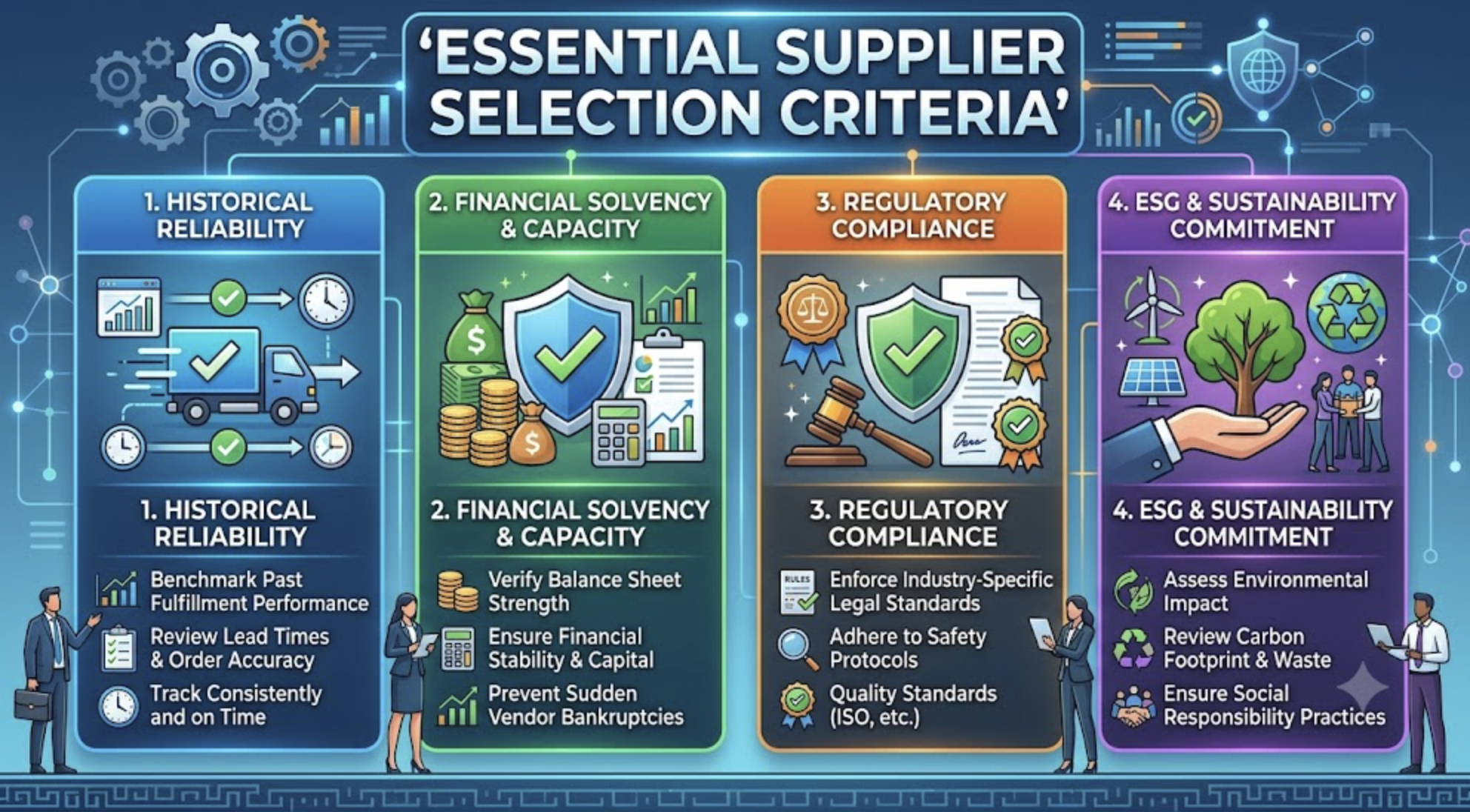
A modern infographic with a dark background and purple glowing lines, titled "'ESSENTIAL SUPPLIER SELECTION CRITERIA'". It is divided into four distinct, color-coded vertical panels.  HISTORICAL RELIABILITY (Blue): Features a delivery truck with arrows and clocks. Text lists benchmarking past performance, reviewing lead times, and tracking order accuracy. Small professional figures with graphs and checkmarks are included.  FINANCIAL SOLVENCY & CAPACITY (Green): Features money bags, stacks of coins, and a balance sheet with graphs. Text focuses on verifying balance sheet strength and preventing vendor bankruptcies. Small figures with calculators and data are shown.  REGULATORY COMPLIANCE (Orange): Features legal seals, a gavel, and safety stamps. Text enforces industry standards, safety protocols, and quality standards (ISO). Small figures checking rules and performance are included.  ESG & SUSTAINABILITY COMMITMENT (Purple): Features a hand holding a tree, a globe with arrows, solar panels, and wind turbines. Text assesses environmental impact and social responsibility practices. Small figures with recycle symbols and eco-data are shown. The overall layout is clear and structured, with glowing network nodes and circuit patterns in the background. Small business people are strategically placed to interact with each section.

FAQ - Questions Fréquentes sur la Gestion des Risques Fournisseurs

La maîtrise des risques fournisseurs est un pilier essentiel pour sécuriser votre chaîne d'approvisionnement et préserver la rentabilité de votre entreprise.

Retrouvez ci-dessous les réponses aux questions fondamentales concernant l'évaluation des partenaires, la prévention des ruptures de stock, la diversification géographique et l'impact des technologies de Big Data.

1. Quels sont les critères clés pour évaluer un fournisseur ?

Stabilité financière & Normes de qualité : Les critères fondamentaux incluent la santé financière, la capacité de production, le respect rigoureux des standards de qualité et la tenue des délais de livraison.

Exemple sectoriel : Dans l'industrie textile, un fournisseur performant doit garantir un approvisionnement continu en matières premières tout en respectant strictement des normes éthiques et sociales engagées.

2. Comment anticiper les risques de rupture de stock ?

Analyse prédictive & Seuils d'alerte : L'exploitation des données de vente passées et l'ajustement dynamique des seuils de réapprovisionnement sont indispensables pour éviter les pénuries.

Exemple sectoriel : Un fabricant de jouets s'appuiera sur des modèles prévisionnels pour calibrer ses niveaux de stock plusieurs mois avant la période de fort pic d'activité de Noël.

Piliers Clés de la Prévention des Risques Achats

  • Évaluation Multi-Critères : Vérifier la solvabilité financière et le respect des chartes éthiques.
  • Modélisation Prédictive : Anticiper les pics de demande pour calibrer les stocks de sécurité.
  • Diversification Géographique : Répartir les sources d'approvisionnement pour parer aux crises régionales.
  • Valorisation du Big Data : Détecter en temps réel les dérives de performance et les retards de livraison.

3. Quelle stratégie adopter pour diversifier les sources d'approvisionnement ?

Multi-Sourcing & Dispersion Géographique : Il est fortement conseillé de bâtir un réseau de partenaires répartis sur plusieurs zones géographiques distinctes.

Exemple sectoriel : Une entreprise de l'agroalimentaire gagnera à importer ses ingrédients stratégiques depuis différents continents afin de neutraliser l'impact de perturbations climatiques ou politiques régionales.

4. Quels sont les impacts d'une mauvaise gestion des fournisseurs ?

Ruptures d'Activité & Atteinte Réputationnelle : Un suivi défaillant peut engendrer des arrêts de chaîne de production, une dégradation de la qualité des produits et, in fine, nuire gravement à l'image de marque.

Exemple sectoriel : Un fabricant de matériel électronique négligeant les contrôles qualité de ses composants s'expose à une hausse critique des taux de retour pour produits défectueux.

5. Comment le Big Data peut-il améliorer la gestion des risques fournisseurs ?

Analyse Approfondie & Prévision des Tendances : Le traitement de volumes massifs de données permet d'évaluer la fiabilité réelle des prestataires et d'anticiper les anomalies logistiques.

Exemple sectoriel : Un acteur du e-commerce peut exploiter l'analyse prédictive pour surveiller l'historique des délais d'expédition de ses transporteurs et ajuster proactivement ses promesses de livraison.

Conclusion : Sécurisez la Performance de votre Chaîne d'Approvisionnement

Structurez votre Gestion des Risques Fournisseurs

De l'évaluation initiale à l'exploitation prédictive des données Big Data, le pilotage proactif des risques fournisseurs garantit la continuité opérationnelle et protège vos marges.

Anticipez les ruptures de stock, diversifiez vos partenaires et sécurisez l'ensemble de vos processus Achats dès aujourd'hui.

Mastering Supplier Risk Management for Supply Chain Resilience

Mastering supplier risk management is critical to strengthening your supply chain and ensuring long-term operational continuity.

By integrating structured risk principles and proactive mitigation practices, organizations anticipate supply disruptions, elevate supply chain responsiveness, and secure steady performance across all market conditions.

Pillars of Proactive Risk Management

  • Risk Anticipation & Mitigation: Identify vulnerabilities early across your supplier network to neutralize threats before they impact production.
  • Supply Chain Robustness: Build operational redundancies and real-time monitoring to absorb market shocks smoothly.
  • Consistent Performance & Growth: Safeguard profit margins and delivery timelines to power sustainable business expansion.
  • Competitive Market Stance: Replace reactive firefighting with a proactive risk culture to stay ahead in demanding markets.

Take a Proactive Approach to Stay Competitive

Don't let the unexpected get in the way of your business growth and customer trust.

Adopting an end-to-end proactive framework allows your organization to maintain unbroken continuity, optimize vendor relationships, and remain agile in an increasingly dynamic and demanding global market.

Strengthen Your Supply Chain Strategy Today

Combining predictive risk evaluation, robust supplier monitoring, and continuous team enablement turns potential supply vulnerabilities into a lasting competitive advantage.

Protect your operations, eliminate unexpected supply failures, and drive business growth today.

Line
Featured Post

Popular posts