
Olivier Audino
Webinar
Tail Spend: The Overlooked Lever to Free Up Your Buyers' Time
Tuesday March 31 at 2:00 PM


| Aspect | Impact | Description |
|---|---|---|
| Purchasing Costs | Significant reduction | Decrease in purchasing costs achieved through optimized negotiation and procurement processes. |
| Product Quality | Improvement | Increase in product quality driven by rigorous quality controls and access to better raw materials. |
| Logistics | Optimization | Enhanced logistics efficiency through streamlined management of material and product flows. |
| Competitiveness | Strengthening | Boosted market competitiveness result from cost reduction, quality improvement, and logistics optimization. |
| Advantage | Description |
|---|---|
| Increased quality | Access to higher-quality raw materials through an expanded network of reliable suppliers. |
| Risk reduction | Decreased dependence on any single supplier, diversifying sources and minimizing supply disruption risks. |
| Continuous innovation | Opportunity to explore emerging market trends and rapidly adopt cutting-edge textile technologies. |

| Aspect | Impact | Description |
|---|---|---|
| Transport Costs | Significant decrease | Reduction in freight costs achieved through route optimization, efficient shipping strategies, and pooled cargo. |
| Inventory Management | Optimization & simplification | Increased efficiency in inventory oversight, lowering holding costs while minimizing stockout risks. |
| Delivery Reliability | Notable improvement | Enhanced delivery dependability resulting from precise logistics planning and execution. |
| Product Traceability | Enhanced transparency | Increased visibility and tracking of goods throughout the supply chain, strengthening transparency and customer trust. |
| Trend | Associated Innovation | Impact on the Group |
|---|---|---|
| Eco-friendly textiles | Recycled and organic fibers | Access to a rapidly growing, environmentally conscious market segment. |
| Smart textiles | Integrated health-monitoring sensors | Creation of high value-added garments for sports, healthcare, and wellness sectors. |
| Production automation | Robotic sewing and assembly systems | Reduction in manufacturing costs and improvement in production lead times. |
| Certification | Benefits |
|---|---|
| ISO 9001 | Optimizes internal processes, boosts operational efficiency, and elevates customer satisfaction. |
| Oeko-Tex Standard 100 | Guarantees that textiles are thoroughly tested and verified free from harmful or toxic substances. |
| REACH | Ensures full compliance with European Union regulations regarding chemical usage and safety. |
| Technology | Key Benefits |
|---|---|
| Digital Platforms | Real-time order management and operational cost reduction. |
| Big Data | Predictive analytics and early market trend anticipation. |
| Collaborative Tools | Strengthened member cohesion and negotiation power optimization. |
| Document Digitalization | Waste reduction, paperless workflow, and sustainability promotion. |
| Advantage | Description |
|---|---|
| Supply stability | Secures a reliable source of raw materials and finished goods, reducing risks tied to material availability. |
| Continuous innovation | Fosters risk and reward sharing on new technologies and innovations, driving market adaptability and competitiveness. |
| Quality improvement | Elevates quality standards through regular exchanges, ensuring continuous product enhancement and high customer satisfaction. |
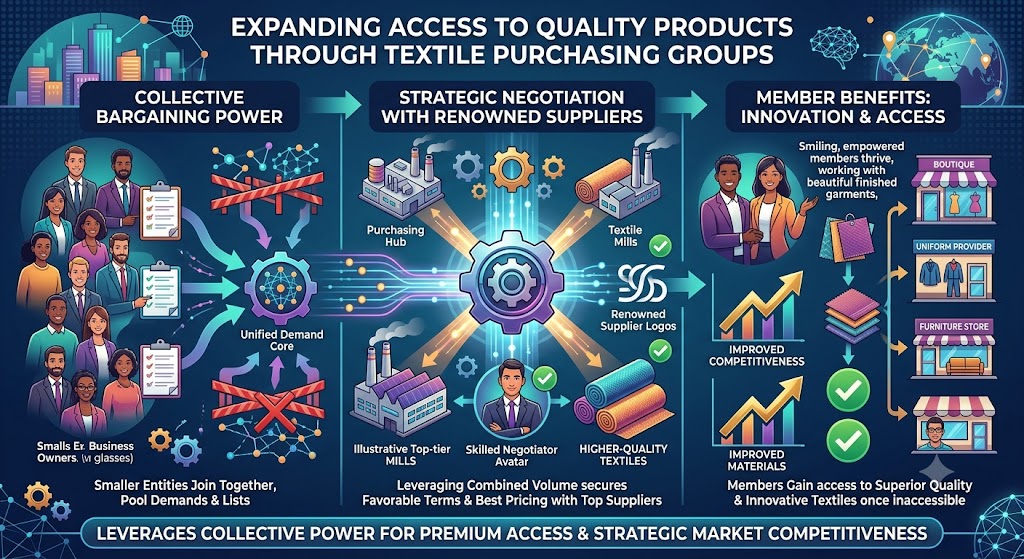
A textile purchasing group enables small businesses to lower their procurement costs by buying in bulk. For example, a boutique purchasing through a group can save up to 30% on high-quality fabrics.
Joining a purchasing group often provides access to higher-quality materials. Members can, for instance, share valuable insights regarding reliable suppliers and cutting-edge manufacturing technologies.
Risks include reliance on collective group decisions and the potential for internal disagreements. For example, a dispute over supplier selection could disrupt production schedules.
Yes, some purchasing groups negotiate exclusive products for their members, providing a unique market advantage. For instance, a textile mill might produce a specific fabric color exclusively for the group.
A new member can rapidly leverage group benefits by actively participating in meetings and utilizing existing group infrastructure, such as pre-negotiated supplier framework agreements.
Optimizing procurement through a textile purchasing group offers substantial advantages. Cost reductions, quality improvements, and strategic collaboration define this approach. It opens the doors to more efficient management while strengthening commercial relationships and market competitiveness.
Embracing this strategy can transform your textile purchasing process, securing economic benefits and a robust network. Consider adopting this method to optimize your resources and elevate your influence in the market.



.svg)