E-Procurement solution

Choosing Your B2B E-commerce PSP: The 2026 Guide

Published By
Olivier Audino
Tags
Sourcing

Online Payments: A Strategic Lever for E-Commerce Growth

Online payment processing has evolved into a central strategic lever for modern e-commerce platforms. Modern consumers expect a frictionless, fast, and secure checkout experience across every sales channel.

A single payment failure or unexpected checkout friction can trigger immediate cart abandonment and direct loss of revenue. In this environment, selecting a Payment Service Provider (PSP) is no longer a routine technical choice—it represents a crucial commercial and competitive strategy.

Navigating the Modern PSP Ecosystem

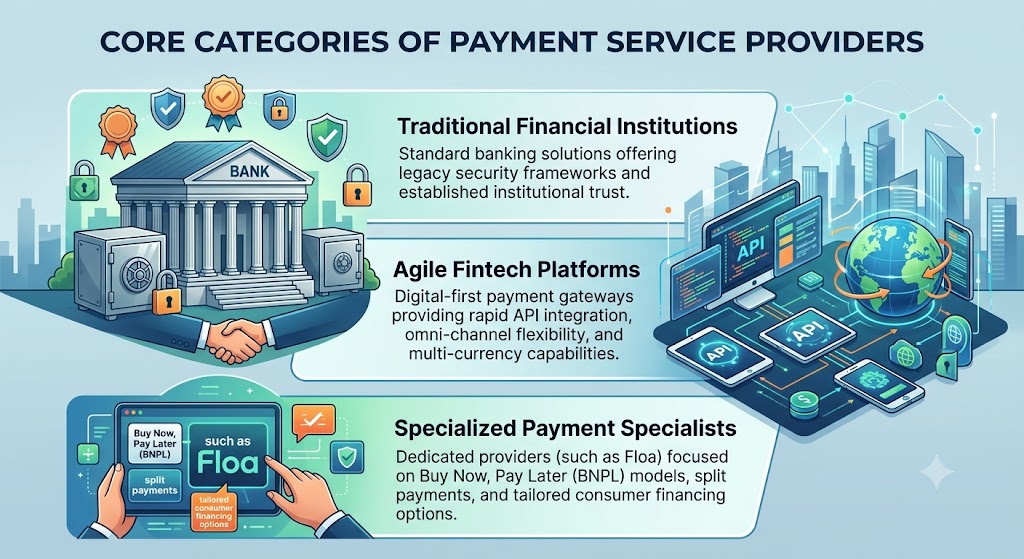
Core Categories of Payment Service Providers

  • Traditional Financial Institutions – Standard banking solutions offering legacy security frameworks and established institutional trust.
  • Agile Fintech Platforms – Digital-first payment gateways providing rapid API integration, omni-channel flexibility, and multi-currency capabilities.
  • Specialized Payment Specialists – Dedicated providers (such as Floa) focused on Buy Now, Pay Later (BNPL) models, split payments, and tailored consumer financing options.
With a crowded marketplace of financial solutions, identifying the optimal payment partner requires matching consumer checkout expectations with enterprise growth targets.

Conclusion: Choosing the Right Payment Partner for Your Business

Converting Checkout Friction into Revenue Optimization

The right Payment Service Provider directly impacts conversion rates, customer retention, and overall brand credibility.

Evaluate payment partners based on checkout speed, security protocols, multi-channel capabilities, and flexible financing options to turn your payment processing into a competitive advantage.

What is the Role of a Payment Service Provider?

A Payment Service Provider (PSP) is a financial intermediary responsible for securing, processing, and facilitating transactions between online shoppers and e-commerce merchants.

Acting as a digital bridge between the customer's bank, the acquiring merchant bank, and the e-commerce storefront, a PSP centralizes financial flows and streamlines multi-channel and cross-border transactions.

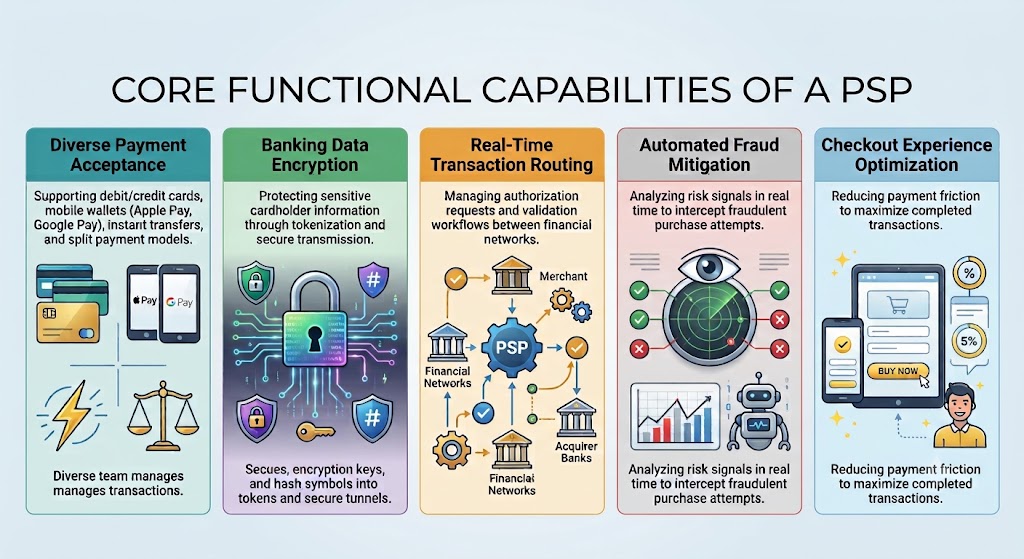
Core Functional Capabilities of a PSP

  • Diverse Payment Acceptance – Supporting debit/credit cards, mobile wallets (Apple Pay, Google Pay), instant transfers, and split payment models.
  • Banking Data Encryption – Protecting sensitive cardholder information through tokenization and secure transmission.
  • Real-Time Transaction Routing – Managing authorization requests and validation workflows between financial networks.
  • Automated Fraud Mitigation – Analyzing risk signals in real time to intercept fraudulent purchase attempts.
  • Checkout Experience Optimization – Reducing payment friction to maximize completed transactions.

How PSP Selection Directly Drives E-Commerce Performance

Payment processing is the final step in the sales funnel. Yet, many online merchants still underestimate its direct influence on conversion rates and total revenue.

1. Elevating the User Experience to Cut Cart Abandonment

A slow or overly complex payment flow drastically increases cart abandonment rates. Conversely, an optimized, frictionless checkout builds buyer confidence and drives higher order completion rates.

Modern consumers prioritize one-click checkout speeds, responsive mobile UI, frictionless authentication, and flexible financing options. Modern PSPs provide native solutions that balance user convenience with robust underlying security.

2. Transaction Security & Compliance Management

As digital fraud attempts grow, regulatory standards become increasingly stringent. Leading PSPs maintain full compliance with PCI DSS protocols and natively integrate Strong Customer Authentication (SCA) mechanisms such as 3D Secure 2.
The Business Impact of Poor Security Governance:
Deficient payment security leads to direct financial loss, elevated chargeback rates, brand reputation damage, and severe customer trust erosion. Selecting a proven PSP partner is fundamental to protecting e-commerce operations.

Conclusion: Turning Payment Gateways into Growth Enablers

Strengthening Security while Maximizing Conversion

The ideal Payment Service Provider seamlessly balances user convenience, regulatory compliance, and fraud prevention.

By selecting a reliable PSP aligned with modern consumer preferences, e-commerce brands protect their revenues, reduce cart abandonment, and establish a foundation for scalable international growth.
Key Criteria to Analyze Before Choosing a PSP in 2026

Not all Payment Service Providers address the same operational requirements. Selecting the ideal partner depends on sales volume, brand positioning, and evolving consumer expectations.

1. Transaction Fees and Total Cost Structure

Costs are often the first metric evaluated by decision-makers. However, evaluation must extend far beyond the baseline per-transaction percentage. An apparently low-cost provider can ultimately lead to net financial losses if its payment authorization and acceptance rates are low.

Comprehensive PSP Cost Components

  • Fixed Monthly Platform Fees – Standard recurring gateway operational charges
  • Variable Transaction Commissions – Percentage + fixed fee per authorization
  • Onboarding & Setup Costs – Initial implementation and integration fees
  • Dispute & Refund Overhead – Administrative costs incurred during refunds or chargebacks

2. Available Payment Methods & Localized Solutions

In 2026, offering traditional credit card payments alone is no longer sufficient to maintain high conversion rates. Modern e-commerce platforms must support:

Mobile Wallets (Apple Pay, Google Pay, digital wallets)
Instant Bank Transfers
Buy Now, Pay Later (BNPL) & Fractional Payments
Localized Regional Methods tailored to targeted export markets

Fractional payment options represent a proven lever to boost Average Order Value (AOV) and reduce checkout friction.

3. Technical Integration & Interoperability

The payment gateway must seamlessly connect with your existing digital architecture: e-commerce CMS platforms, ERP systems, CRM software, multi-vendor marketplaces, and native mobile applications. A complex integration delays product roadmaps and creates substantial technical debt.

4. Payout Speed & Treasury Health

Settlement timelines directly impact working capital liquidity. While leading PSPs process fund transfers within 24 hours, others enforce multi-day holding periods. For fast-growing e-commerce enterprises, settlement speed represents a critical strategic benchmark.

Conclusion: Strategic Selection for Scalable E-Commerce Growth

Optimizing Gateway Selection Beyond Baseline Processing Fees

Choosing a payment service provider in 2026 requires balancing total cost structures, payment method availability, technical interoperability, and cash flow speed.

Align your PSP architecture with modern consumer payment habits to eliminate checkout friction, improve working capital, and secure a lasting competitive advantage.

Comparative Analysis of Leading Payment Service Providers

Selecting the right Payment Service Provider (PSP) requires balancing market positioning, functional capabilities, and economic trade-offs. Below is a strategic breakdown comparing major international and specialized payment gateways.
PSP Gateway Market Positioning Core Strengths Limitations
Stripe Global Fintech Platform Developer-first API, extensive payment method library, high flexibility Higher baseline processing fees on complex workflows
PayPal Mass-Market Consumer Brand Exceptional consumer brand trust, high international recognition External checkout redirection can disrupt native site UX
Adyen Large Enterprise & Multi-Market Advanced global acquiring, unified omnichannel processing Engineered primarily for high enterprise transaction volumes
Mollie SMEs and Mid-Caps Transparent pricing, effortless onboarding, intuitive developer UX Limited native capabilities for complex enterprise needs
Floa BNPL & Omnichannel Finance Specialized split payments, friction-free installment UX Targeted positioning focused on specific consumer sectors
Legacy Banks Traditional Financial Institutions Centralized banking relationships, established institutional backing Slower technical innovation cycles and rigid integration paths

Why Buy Now, Pay Later (BNPL) Solutions Are Gaining Ground

Installment and split payments have emerged as essential conversion drivers in modern e-commerce. BNPL allows consumers to spread purchasing costs over time without sacrificing checkout speed or user convenience.

Merchant Benefits of BNPL Integration

  • Average Order Value (AOV) Growth – Encourages larger cart sizes by reducing immediate upfront financial friction
  • Conversion Rate Optimization – Converts hesitant buyers during checkout consideration phases
  • Cart Abandonment Reduction – Provides flexible payment alternatives for premium product lines
  • Enhanced Customer Loyalty – Delivers modern, consumer-friendly payment options that drive repeat transactions
Specialized providers like Floa empower merchants to rapidly integrate flexible financing natively into their checkout flows, maintaining brand consistency while driving higher sales velocity.

Anticipating E-Commerce Payment Evolutions for 2026

The digital payment landscape continues to evolve rapidly, driven by technical innovation and shifting consumer behaviors.

Key 2026 Payment Industry Trends

  • Ubiquitous Mobile Wallets – Seamless tap-to-pay and biometric one-click wallet checkouts becoming standard
  • Expansion of Instant Payments – Real-time account-to-account (A2A) transfers replacing slow clearing routes
  • AI-Driven Antifraud Security – Predictive machine-learning models identifying risk without introducing user friction
  • Hyper-Personalized Checkout Paths – Dynamic checkout UX displaying localized payment preferences automatically
  • Omnichannel Ecosystem Convergence – Unifying online, in-store, and mobile app payment data under single dashboards

Conclusion: Strategic Planning for Long-Term Scalability

Selecting a Future-Proof Payment Infrastructure

Choosing a Payment Service Provider is a fundamental long-term growth decision. A gateway selected today must not only solve current conversion needs but also scale alongside future corporate expansion.

Align your organization with scalable PSP technologies, flexible BNPL options, and AI-driven security to guarantee enterprise resilience in an evolving e-commerce market.
Conclusion: Strategic Payment Infrastructure as a Business Growth Driver

Selecting an optimal Payment Service Provider (PSP) for your e-commerce platform in 2026 requires looking far beyond standard fee comparisons. Security, customer experience, processing speed, technical interoperability, and payment method diversity have become non-negotiable operational benchmarks.

5 Essential Pillars of Modern Payment Success

  • Uncompromising Security & Compliance – Shielding customer data with robust PCI DSS and 3D Secure standards
  • Frictionless Customer Journeys – Minimizing checkout steps to directly maximize conversion rates
  • Rapid Transaction Processing – Ensuring instant authorization and fast treasury settlements
  • Seamless Technical Integration – Interoperating effortlessly across CMS, ERP, and CRM stacks
  • Diverse Payment Capabilities – Catering to modern preferences with mobile wallets, BNPL, and local methods
A PSP plays a direct role in commercial performance. An ill-fitted payment gateway acts as a bottleneck to conversions, whereas a high-performing partner streamlines the buying journey and strengthens customer retention.

Investing in Long-Term E-Commerce Competitiveness

In an increasingly competitive digital marketplace, treating payment processing as a strategic asset rather than an administrative utility is critical.

By investing in an efficient, future-proof payment solution, e-commerce merchants unlock a powerful, continuous lever for revenue growth, customer loyalty, and operational success.

Sponsored Article
Line
Featured Post

Popular posts