Purchasing profession

CSR Purchasing Training: Key to Sustainable Purchasing

Published By
Olivier Audino
Tags
Sourcing
Exploring the keys to sustainable procurement through a dedicated Corporate Social Responsibility (CSR) purchasing training course is essential for modern companies aware of their environmental and social footprint.

In a global marketplace where CSR compliance is becoming a non-negotiable vendor selection criterion, structured training is no longer an option—it is a strategic necessity for long-term enterprise growth.

1. Why CSR Purchasing Training is a Strategic Necessity

As international regulations tighten and eco-conscious consumer expectations rise, procurement teams must evolve beyond traditional price negotiations.

Comprehensive training equips buyers with the skills needed to integrate ethical criteria into RFP processes, evaluate vendor sustainability credentials, and insulate the supply chain against ESG-related compliance risks.

Core Training Learning Pillars

  • CSR Strategy Integration: Embed ethical, environmental, and social benchmarks seamlessly into standard purchasing workflows.
  • ESG Supplier Auditing: Gain actionable methodologies to audit, score, and evaluate vendor sustainability performance.
  • Process Optimization: Streamline purchasing operations while generating positive societal and environmental outcomes.
  • Regulatory Alignment: Ensure proactive compliance with evolving international labor, carbon, and sustainability mandates.

2. Driving Value Through Ethical & Sustainable Sourcing

Empowering your procurement team with dedicated CSR training transforms purchasing from a cost center into a strategic value engine.

By mastering sustainable sourcing techniques, organizations optimize life-cycle costs, eliminate supply chain waste, foster collaborative supplier innovation, and strengthen enterprise brand reputation across international markets.

Conclusion: Transform Your Purchasing Strategy Today

Master Sustainable Sourcing & Drive Positive Impact

Investing in CSR purchasing training prepares your enterprise to navigate future market demands with ethical, highly efficient, and sustainable procurement practices.

Optimize your purchasing processes while making a lasting, positive contribution to society and the environment.

The Need for CSR Purchasing for Sustainable Development

In the current context of ecological and social crisis, corporate social responsibility (CSR) can no longer be an option.

Adopting responsible purchasing practices directly influences the global value chain—promoting ethical, sustainable development. At the heart of this transformation, CSR Purchasing Training plays a pivotal role.

1. Understanding the Direct Impact on Sustainable Development

Responsible purchasing reduces negative environmental impacts, promotes social equity, and optimizes internal governance structures.

Through targeted CSR purchasing training, procurement professionals learn to evaluate and select vendor networks not only on unit costs, but on their operational commitment to social responsibility and environmental sustainability.

2. The Economic & Strategic Challenges of Sustainable Sourcing

Key Commercial Advantages

  • Enhanced Brand Reputation: Demonstrating transparent, responsible sourcing strengthens market trust among consumers and stakeholders.
  • New Market Opportunities: Opens access to tenders and client segments that mandate strict ESG compliance.
  • Responsible Investment Attraction: Boosts corporate valuation and competitiveness by appealing to green and ESG-focused capital funds.

3. Towards a More Equitable Society: The Social Role of CSR Purchasing

Integrating social criteria directly into purchasing decisions enables enterprises to actively improve community well-being.

Empowering local suppliers and enforcing fair labor conditions across all supplier tiers are core skills taught in CSR purchasing training—building transparent, ethical supply chains that foster societal equity.

4. Strategic Summary: Pillars of Responsible Sourcing

CSR Purchasing Pillar Impact on Sustainable Development
Environmental Protection Reduces carbon footprint, optimizes resource usage, and minimizes supply chain waste
Social Equity & Human Rights Ensures fair labor standards, safe working conditions, and supplier empowerment
Economic Competitiveness Attracts ESG investment, enhances corporate image, and opens sustainable growth markets

Conclusion: Turning CSR into a Growth & Innovation Engine

Acquire the Skills for Sustainable Transformation

The necessity of responsible purchasing is firmly established in an era acutely focused on environmental and social accountability.

CSR Purchasing Training equips procurement leaders with essential competencies to evolve purchasing practices, transforming sustainability into a powerful driver of enterprise performance and innovation.

The Fundamentals of CSR Purchasing

Understanding the core fundamentals that govern Socially and Environmentally Responsible Purchasing (CSR) is essential for modern procurement teams.

CSR procurement extends far beyond transaction price and delivery terms. It requires a comprehensive analysis of the environmental, social, and economic footprint of every purchase—aligning corporate spending with ethical vendor practices and sustainable business models.

1. What is CSR Purchasing?

CSR purchasing involves selecting supplier networks that adhere to strict ethical standards and demonstrate clear commitments to sustainable operations.

The ultimate objective is to foster an economic model where quality, cost efficiency, and positive impact on society and the environment coexist in total harmony.

2. The 3 Key Principles of CSR Procurement

Sustainable purchasing strategies are guided by three foundational pillars:

Sustainability: Minimizing negative environmental impacts and actively promoting circular economy practices.
Equity: Improving working conditions, upholding fair trade, and reducing inequalities across global supply chains.
Transparency: Documenting and communicating procurement practices clearly to build enduring trust among internal and external stakeholders.

3. Practical Applications & Core Skillsets

Putting CSR principles into practice requires conducting regular supplier audits, establishing eco-responsible purchasing policies, and training teams in ESG sensitivity.

Essential Skills Taught in CSR Purchasing Training

  • Product Sustainability Assessment: Methodologies to evaluate product life cycles, material recyclability, and carbon intensity.
  • CSR Contract Negotiation: Drafting contractual clauses and SLAs that enforce environmental and social compliance.
  • Tech-Driven Performance Tracking: Leveraging digital platforms to monitor vendor compliance and drive continuous ESG improvements.

4. Core Principles Summary Matrix

Pillar Principle Description & Operational Scope
Sustainability Minimizes environmental impact and accelerates transition toward a circular economy
Equity Improves working conditions, enforces human rights, and reduces supply chain inequality
Transparency Provides clear documentation and open communication to foster stakeholder trust

Conclusion: Empowering Ethical Procurement Leadership

Drive Measurable Value & Social Impact

Mastering the fundamentals of CSR purchasing equips procurement professionals to look beyond short-term costs and build resilient, ethical supply lines.

Transform your purchasing capability today to generate long-term corporate value while making a positive contribution to society.
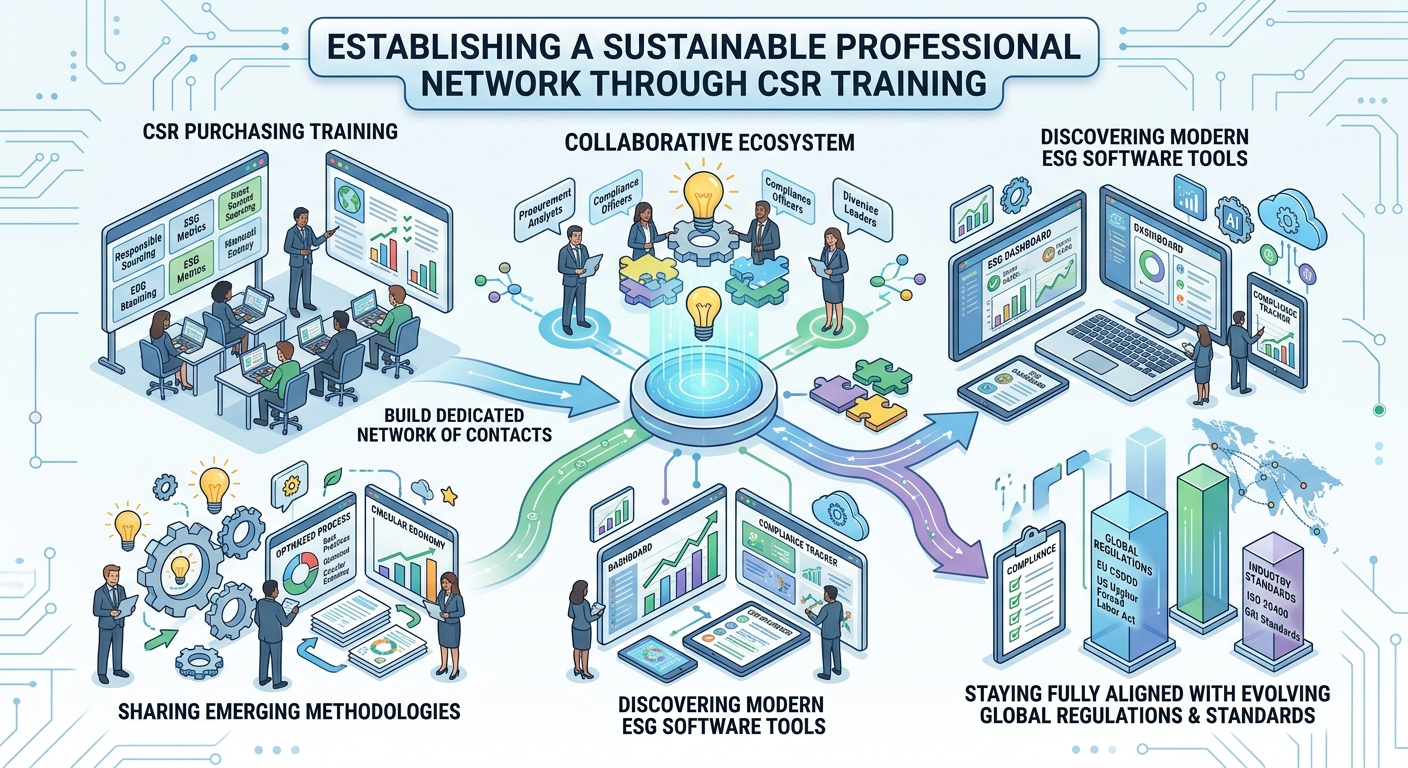
A detailed digital vector infographic titled "ESTABLISHING A SUSTAINABLE PROFESSIONAL NETWORK". The design is divided into two main panels connected by glowing network nodes against a light blue, interconnected digital background. The left panel, "CSR PURCHASING TRAINING", shows diverse business professionals in a collaborative workshop environment, shaking hands and discussing responsible sourcing, accompanied by icons of growing plants and connecting puzzle pieces. A flowing data stream connects this group to the right panel, "THE COLLABORATIVE ECOSYSTEM". This section is split into three interconnected action areas: "SHARING EMERGING METHODOLOGIES" featuring a lightbulb and collaborative gears; "DISCOVERING ESG SOFTWARE TOOLS" displaying a modern desktop monitor with environmental analytics and an ESG dashboard; and "ALIGNING WITH GLOBAL REGULATIONS" showing a balance scale, a globe, and a compliance checklist shield. The bottom footer reads, "DRIVING RESPONSIBLE SOURCING THROUGH COLLABORATION".

Ethical Principles in the Supply Chain

Embedding ethical principles across supply chain operations is critical for long-term procurement success and brand protection.

Through specialized CSR Purchasing Training, organizations learn to enforce strict human rights, labor, and environmental standards—ensuring purchasing activities uphold moral accountability alongside commercial efficiency.

1. The Strategic Importance of Ethics in Purchasing

Setting high ethical benchmarks ensures businesses refuse participation in inhumane labor conditions or environmentally destructive practices.

Eliminating child labor, upholding fair working standards, and enforcing eco-friendly purchasing protocols serves as more than legal compliance—it builds an influential reputational shield for the enterprise.

2. Governance, Transparency & Control Mechanisms

Robust governance structures maintain supply chain integrity. Communicating clear ethical policies across all vendor tiers and establishing regular independent audits guarantees that ethical standards are actively respected, fostering stakeholder trust across the value chain.

3. Ethical Partnerships & Vetting Supplier Networks

Vetting suppliers based on rigorous ethical scorecards guarantees alignment on social responsibility, equity, and environmental compliance. Partnering with shared-value vendors builds a resilient, risk-resistant supply network.

Environmental Impact & Sustainable Purchasing

Evaluating the total ecological footprint of goods and services enables procurement teams to minimize material waste, lower energy consumption, and reduce greenhouse gas emissions—turning environmental stewardship into a sustainable commercial advantage.

1. Strategies for Greener Procurement

CSR Purchasing Training equips buyers to integrate eco-design criteria, negotiate waste-return and recycling contractual clauses, and advance circular economy models that optimize long-term operational expenditures.

2. Environmental Performance Indicators (KPIs)

Core Environmental Metrics Checklist

  • Energy Efficiency Gains: Tracking percentage reduction in overall facility and transport energy consumption.
  • Circular Material Usage: Measuring increased adoption of recyclable, bio-based, or renewable inputs.
  • Emissions Reductions: Quantifying measurable reductions in Scope 1, 2, and 3 CO2 emissions and pollutants.

3. Sustainable Purchasing Impact Matrix

Purchasing Practice Environmental Impact Economic Impact
Choice of Green Suppliers Direct reduction of toxic emissions and carbon output Long-term total cost of ownership (TCO) optimization
Sustainability Contract Clauses Accelerated support for circular economy initiatives Strengthened, collaborative supplier relationships
Continuous Employee Training Heightened internal ecological and social awareness Growth in internal process and product innovation

Conclusion: Building an Ethical, Sustainable Value Chain

Elevate Your Supply Chain Governance Today

Integrating ethical governance and environmental performance tracking creates a powerful, future-proof procurement ecosystem.

Transform your purchasing practices to safeguard corporate reputation, minimize environmental impact, and drive sustainable growth.

Role of CSR Purchasing Training Courses

In today's highly competitive business landscape, empowering procurement teams through a dedicated CSR Purchasing Training course has become a strategic imperative for organizations committed to environmental and social responsibility.

This training equips buyers to master sustainable procurement methodologies, integrate ethical considerations into purchasing workflows, and capitalize on efficiency opportunities while drastically shrinking the enterprise ecological footprint.

1. Strengthening Strategic Sourcing Skills

Developing specialized competencies enables procurement professionals to evaluate complex vendor supply chains beyond unit pricing.

Buyers gain actionable skills to identify sustainable sourcing alternatives, streamline material usage, and drive cost-effective process innovations aligned with long-term corporate ESG goals.

2. Regulatory Compliance & Risk Mitigation

Non-compliance with evolving environmental and social regulations carries severe penalties—ranging from heavy legal fines to irreparable brand damage.

CSR Purchasing Training provides deep clarity on legislative frameworks, environmental mandates, and labor standards, ensuring buyers navigate complex regulatory environments safely and insulate the business against non-compliance liabilities.

3. Improving Stakeholder Relationships & Brand Trust

Organizations with transparent, socially responsible purchasing policies build superior brand reputation and market distinction.

Training provides the tools to engage customers, suppliers, and local communities effectively—fostering collaborative supply chain partnerships rooted in transparency, ethics, and mutual social responsibility.

Core Competencies Acquired in CSR Training

  • Supplier Impact Assessment: Methodologies to evaluate supplier environmental footprint and social compliance.
  • Ethical Negotiation Strategies: Tactics for structuring commercial agreements aligned with sustainability targets.
  • CSR Supplier Management: Managing long-term vendor relationships through shared ESG objectives.
  • Certification Verification: Utilizing recognized CSR certifications (e.g., ISO 14001, Fairtrade) to audit compliance.

4. Summary of Enterprise Impact & Advantages

Strategic Advantage Direct Operational Impact on the Company
Enhanced Strategic Skills Accelerated adaptation to market evolutions, eco-design, and regulatory shifts
Proactive Risk Reduction Fewer compliance penalties, legal safety, and protected corporate brand equity
Improved Relationships Deeper stakeholder trust, vendor alignment, and elevated customer loyalty

Conclusion: Transforming Procurement into a Value Engine

Elevate Your Sourcing Capabilities Today

Investing in CSR Purchasing Training turns regulatory requirements and ethical expectations into powerful drivers of innovation, resilience, and growth.

Empower your team to lead sustainable procurement initiatives that strengthen brand reputation and secure a lasting market advantage.

Practical Application of CSR Purchasing Skills

Integrating CSR Purchasing Training competencies into everyday procurement operations equips professionals to apply sustainable methodologies directly in real-world business contexts.

The daily application of these principles ensures a smooth, progressive transition toward sustainable sourcing practices—strengthening brand reputation, risk management, and regulatory compliance.

1. Integrating CSR Skills into Daily Operations

Applying acquired CSR competencies daily ensures buyers identify suppliers who rigorously adhere to environmental benchmarks, enforce ethical working conditions, and promote circular economy principles across their operations.

Skills Application Checklist

  • Evaluate Supplier Environmental Footprint: Rigorously assess vendor lifecycle impacts, material usage, and carbon performance.
  • Verify Partner CSR Certifications: Audit vendor credentials against recognized international standards (e.g., ISO 14001, Fairtrade).
  • Promote Supply Chain Transparency: Enforce clear documentation and open reporting across all tier-one and sub-tier suppliers.

2. Quantifying CSR Performance Progress

Performance Indicator Baseline (Before Training) Target Outcome (After Training)
Material Recycling Rate 20% 45%
% of CSR-Certified Suppliers 30% 70%

3. Encouraging Organizational Change & Cultural Transformation

The competencies gained through CSR Purchasing Training extend beyond commercial transactions to transform broader corporate culture.

By championing sustainability values, trained buyers influence internal policies, mentor colleagues, review procurement guidelines, and lead continuous cross-departmental dialogue on ESG best practices.

4. Strategies & Tools for Continuous ESG Improvement

Engagement Strategies & Technical Resources

  • CSR Awareness Workshops: Organize internal training sessions to educate colleagues on sustainable sourcing goals.
  • Incorporate CSR in Performance Appraisals: Embed measurable sustainability criteria into employee and department evaluation benchmarks.
  • Create Sustainable Incentives: Reward buyers and category managers who achieve significant ESG milestones.
  • Integrated Enterprise ERP Modules: Deploy ERP systems featuring embedded CSR and spend analytics tracking.
  • Supplier Risk Analysis Tools: Utilize specialized software platforms to audit vendor compliance and supply chain vulnerabilities.
  • Sustainability Reporting Platforms: Standardize ESG data collection to deliver transparent reporting for stakeholders and regulators.

Conclusion: Accelerate Your Enterprise Sustainability Journey

Lead the Transformation Toward Ethical Sourcing

Applying CSR purchasing skills daily transforms individual buying decisions into systemic corporate progress and long-term business resilience.

Equip your procurement teams with the tools, metrics, and methodologies needed to build an ethical, sustainable, and high-performing supply chain.

CSR Purchasing Certification

Earning an official certification in CSR Purchasing Training formally validates the skills and knowledge required to integrate social and environmental accountability into procurement processes.

Certification serves as a benchmark of credibility and expertise, demonstrating to stakeholders that your business applies a rigorous, methodical sourcing approach compliant with international sustainability standards.

1. Importance & Benefits of CSR Procurement Certification

Validating your procurement team's CSR competencies builds immediate trust among corporate clients, vendor networks, and eco-conscious consumers.

Certified practices enhance corporate brand image, protect against greenwashing liabilities, and provide a distinct competitive advantage when competing for major ESG-sensitive commercial tenders.

2. Certification Types & Validation Process

Different certification programs cater to specific pillars of CSR—ranging from labor ethics and fair trade to carbon footprint management and supply chain transparency.

Achieving certification generally requires completing specialized training coursework, passing a comprehensive examination, and executing a practical end-of-study project demonstrating real-world implementation in your purchasing function.

Most Recognized Certifications in CSR Purchasing

  • ISO 26000 Guidelines: International reference for generalist social responsibility and organizational governance.
  • SA8000 Certification: Leading global standard focused on social accountability, human rights, and workplace conditions.
  • EcoVadis CSR Rating: Widely adopted platform auditing environmental impact, ethics, labor, and sustainable procurement.
  • B Corp Certification: Rigorous evaluation verifying high standards of verified social and environmental performance.

3. Comparative Overview of Certification Programs

Certification Standard Governing Organization Core Focus & Strategic Scope
ISO 26000 ISO (International Organization for Standardization) Generalist framework (Environmental, Social, Governance)
SA8000 Social Accountability International (SAI) Human rights, fair labor, and supply chain working standards
EcoVadis EcoVadis Assessment Platform CSR performance auditing across environmental and ethical metrics
B Corp B Lab Comprehensive assessment of overall social and environmental business performance

Conclusion: Validate Your Corporate Sustainability Commitment

Elevate Your Purchasing Function to Global Standards

Obtaining a CSR purchasing certification proves your organization's commitment to ethical, sustainable, and highly effective procurement management.

Empower your team with accredited CSR credentials that enhance brand credibility and secure a lasting competitive advantage.

Measuring the Impact of CSR Purchasing

Evaluating the tangible outcomes of CSR Purchasing Training requires a structured framework of Key Performance Indicators (KPIs).

Establishing precise metrics—such as carbon footprint reductions, circular material adoption rates, and vendor ethical compliance—ensures an objective evaluation of sustainable procurement strategies while identifying priority areas for continuous operational refinement.

1. Key Performance Indicators for CSR Purchasing

Essential CSR Sourcing KPIs

  • Greenhouse Gas Emission Reduction: Tracking total Scope 1, 2, and 3 CO2 emissions across procurement categories.
  • Eco-Designed Product Sourcing: Percentage growth in purchases of certified eco-designed or circular products.
  • Supplier Social Audit Compliance: Vendor compliance rate across third-party social and environmental audits.

2. CSR Performance Tracking Matrix

Performance Indicator 2020 Historical Baseline 2023 Measured Progress 2025 Strategic Target
CO2 Emissions (Tons) 5,000 4,500 3,000
Recycled Products (%) 15% 25% 50%
Compliant Suppliers (%) 80% 90% 100%

3. Modern Measurement Tools & Reporting Technologies

Deploying specialized procurement software and automated data analytics is essential to accurately quantify CSR initiatives.

Digital tools automate data collection, generate real-time ESG reports, and eliminate manual processing errors—allowing procurement managers to focus on strategic decision-making and continuous performance optimization.

4. Impact Analysis & Real-World Case Studies

Analyzing case studies and real-world feedback reveals how CSR Purchasing Training delivers measurable business value.

Documented corporate experiences illustrate how structured sustainable procurement cuts total operational costs, opens new markets, and strengthens brand reputation—providing an invaluable blueprint for continuous ESG improvement.

Conclusion: Drive Continuous ESG Improvement

Quantify Your Sustainable Sourcing Success

Measuring the impact of CSR purchasing turns sustainability targets into clear, verifiable business achievements.

Empower your organization with data-driven CSR metrics and modern reporting tools to build a transparent, high-performing supply chain.
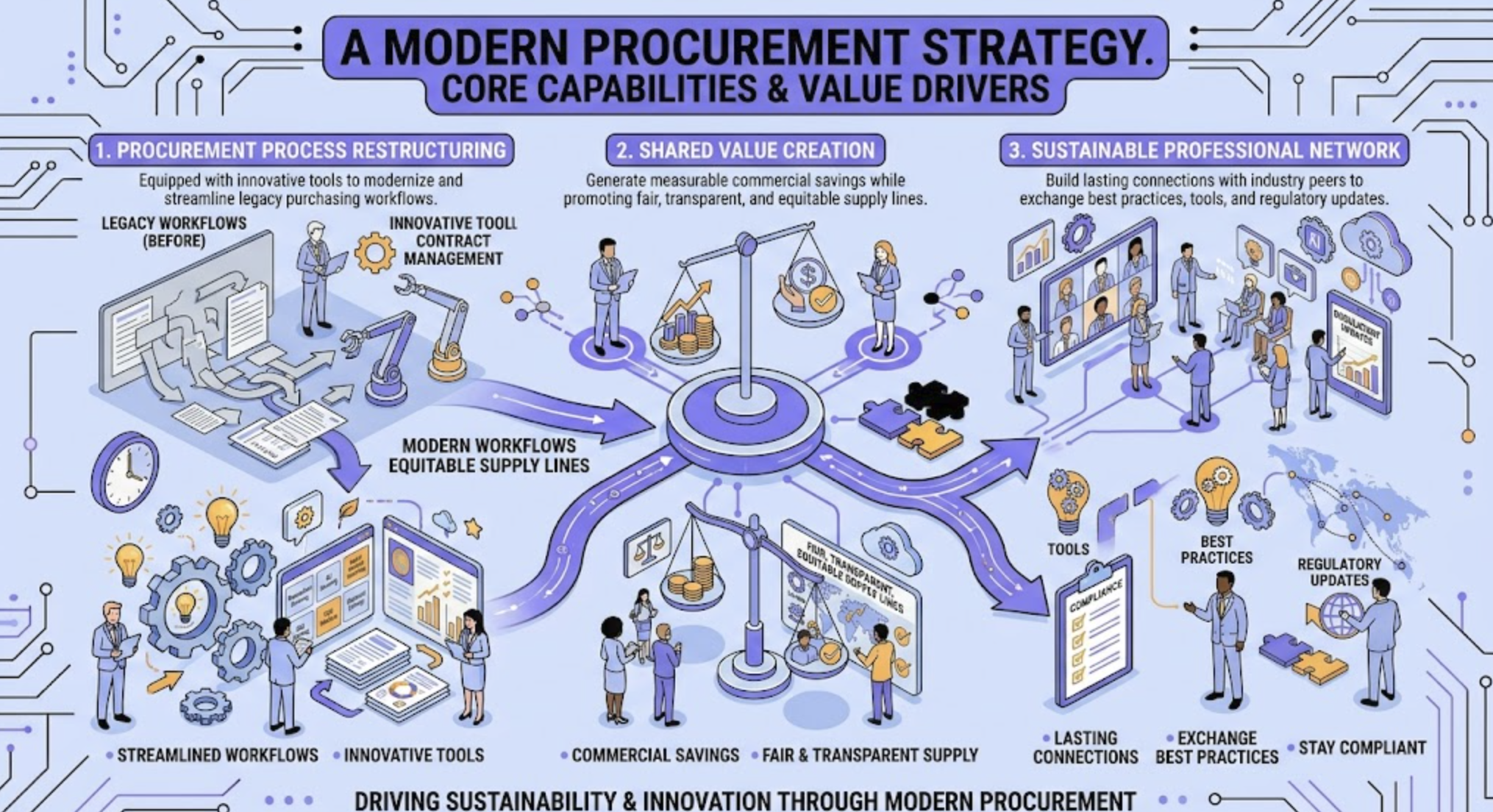
A modern, detailed vector infographic titled "A Modern Procurement Strategy. Core Capabilities & Value Drivers", presented in a technical diagram style with a blue and purple color scheme. The top left corner displays a date of "July 28, 2026" and location of "Fes, Morocco." The infographic is divided into three main columns, interconnected by glowing data streams.  The left column, "1. PROCUREMENT PROCESS RESTRUCTURING", with text "Equipped with innovative tools to modernize and streamline legacy purchasing workflows," visualizes a shift from "LEGACY WORKFLOWS (BEFORE)" panels of chaotic forms to "INNOVATIVE TOOL. CONTRACT MANAGEMENT" robotic arms and data screens. Below, icons point to "STREAMLINED WORKFLOWS" and "INNOVATIVE TOOLS".  The middle column, "2. SHARED VALUE CREATION", with text "Generate measurable commercial savings while promoting fair, transparent, and equitable supply lines," features a large, balanced scale. On one side are coins and charts with "COMMERCIAL SAVINGS." On the other side is a panel with text for "FIU*, TRANSPARENT, EQUITABLE SUPPLY LINES" (with diverse teams connected by puzzle pieces). Below, icons are for "COMMERCIAL SAVINGS" and "FAIR & TRANSPARENT SUPPLY".  The right column, "3. SUSTAINABLE PROFESSIONAL NETWORK", with text "Build lasting connections with industry peers to exchange best practices, tools, and regulatory updates," displays a large digital remote professional interface grid. Diverse teams discuss ideas with icons for "TOOLS", "BEST PRACTICES", and "REGULATORY UPDATES". Below, a list points to "LASTING CONNECTIONS", "EXCHANGE BEST PRACTICES", and "STAY COMPLIANT".  Diverse people figures work at various futuristic desks throughout the scene. The entire composition rests on a background pattern of circuit board traces. The footer text reads "DRIVING SUSTAINABILITY & INNOVATION THROUGH MODERN PROCUREMENT."

Adopting New Technologies for Sustainable Purchasing

The integration of new technologies into sustainable procurement is rapidly transforming traditional buying methods.

Cutting-edge digital solutions—such as Artificial Intelligence (AI) and Blockchain—unlock unprecedented efficiency, transparency, and accountability across purchasing processes. Professionals trained in CSR Purchasing Training leverage these tools to evaluate vendor networks, optimize logistics, predict risks, and minimize overall environmental footprints.

1. Technological Innovations Driving Sustainable Sourcing

Modernizing responsible purchasing relies on dedicated technological tools:

Supplier Performance Management Platforms: Monitor real-time environmental and social practices of vendor partners.
Recyclable Resource Management Software: Help businesses eliminate waste, manage material life cycles, and advance circular economy models.

Adopting these technologies satisfies strict CSR standards while optimizing operational costs and strengthening supply chain resilience.

2. Continuous Education & Tech Adoption

To remain competitive and execute sustainable practices effectively, procurement professionals must continuously update their technical skill set.

Incorporating modules on emerging technologies into CSR purchasing programs—supplemented by seminars, webinars, and interactive workshops—ensures seamless integration of digital tools into long-term corporate procurement strategies.

Market Evolution and the Future of CSR Purchasing

The booming CSR procurement market reflects a profound global shift toward environmental and social accountability.

Incorporating sustainable criteria into procurement is no longer optional—it is an absolute market requirement. Companies adopting responsible purchasing build stronger brand reputations, mitigate supply vulnerabilities, and achieve higher economic performance through optimized resource management.

1. Key Market Trends Impacting Procurement

Market Trend Direct Impact on Sustainable Procurement
Eco-Design Integration Drives companies to develop durable, recyclable, and environmentally conscious products
Ethical Supplier Selection Encourages transparent, fair, and socially responsible vendor relationships
Global Regulatory Standards Forces enterprises to continuously review and upgrade purchasing policies for full compliance

2. Future Forecasts & Technological Breakthroughs

Key Innovations Shaping the Future of Sourcing

  • AI & Advanced Spend Analytics: Automates risk analysis, optimizes purchase data, and accelerates data-backed decision-making.
  • Blockchain Traceability: Delivers immutable verifiability and complete end-to-end supply chain transparency.
  • Collaborative Vendor Platforms: Strengthens partner relationships, enhances shared ESG goals, and optimizes category costs.
Technological Innovation Potential Impact on Sustainable Procurement
AI & Analytics Process optimization, predictive risk management, and intelligent decision-making
Blockchain Unrivaled verifiability, provenance tracking, and supply chain integrity
Collaborative Platforms Deeper vendor alignment, joint ESG innovation, and cost optimization

Conclusion: Navigating the Future of Sustainable Sourcing

Lead the Technological Evolution in Procurement

The future of CSR purchasing belongs to organizations that master emerging technologies and integrate them seamlessly into their sourcing strategies.

Equip your procurement leadership with advanced CSR training and digital tools to build a transparent, resilient, and future-proof enterprise.

Conclusion: Reinforcing Commitment to Responsible Purchasing

CSR Purchasing Training plays a crucial role in transforming corporate procurement into a sustainable, ethically aligned operational engine.

By embedding principles of social and environmental responsibility into buying workflows, buyers equip themselves to drive long-term business resilience while contributing directly to a more sustainable global economy.

1. CSR Purchasing Training: Summary of Key Benefits

Mastering responsible purchasing requires a thorough understanding of product and service lifecycles across environmental and social dimensions.

Trained procurement professionals develop specialized skills in evaluating and negotiating with suppliers according to strict ethical, social, and ecological benchmarks—ensuring value creation beyond initial unit costs.

2. Consolidation of Acquired Knowledge & Skills

Core Capabilities & Value Drivers

  • Procurement Process Restructuring: Equipped with innovative tools to modernize and streamline legacy purchasing workflows.
  • Shared Value Creation: Generate measurable commercial savings while promoting fair, transparent, and equitable supply lines.
  • Sustainable Professional Network: Build lasting connections with industry peers to exchange best practices, tools, and regulatory updates.

3. Establishing a Sustainable Professional Network

Engaging in CSR purchasing training opens valuable opportunities to build a dedicated network of professional contacts committed to responsible sourcing.

This collaborative ecosystem is essential for sharing emerging methodologies, discovering modern ESG software tools, and staying fully aligned with evolving global regulations and industry standards.

Call to Action for Sustainable Transformation

Unify Your Enterprise Around Responsible Sourcing

Achieving meaningful progress in responsible purchasing requires an active commitment from every stakeholder—from senior management down to front-line purchasing operators.

CSR Purchasing Training serves as a powerful catalyst for organizational change. Empower your enterprise today to turn sustainable purchasing strategies into concrete steps toward global Sustainability Goals.