
Purchasing performance

Group Purchasing for Wood Pellets: Reducing Costs and Securing B2B Supply

Published By
Olivier Audino
Tags
Sourcing

Group Purchasing of Pellets: A Strategic Lever for Cost Reduction

Faced with energy cost volatility, group purchasing of wood pellets has emerged as a strategic lever for companies seeking to reduce operating expenses while securing their supply chain. For SMEs, mid-caps, and multi-site organizations, this collective approach mutualizes demand and significantly strengthens negotiating power with suppliers.

Navigating Market Price Volatility in Sustainable Heating

Wood pellets represent a high-performance, sustainable heating alternative today. However, market prices can fluctuate sharply depending on seasonal demand, local availability, and regional economic pressures.

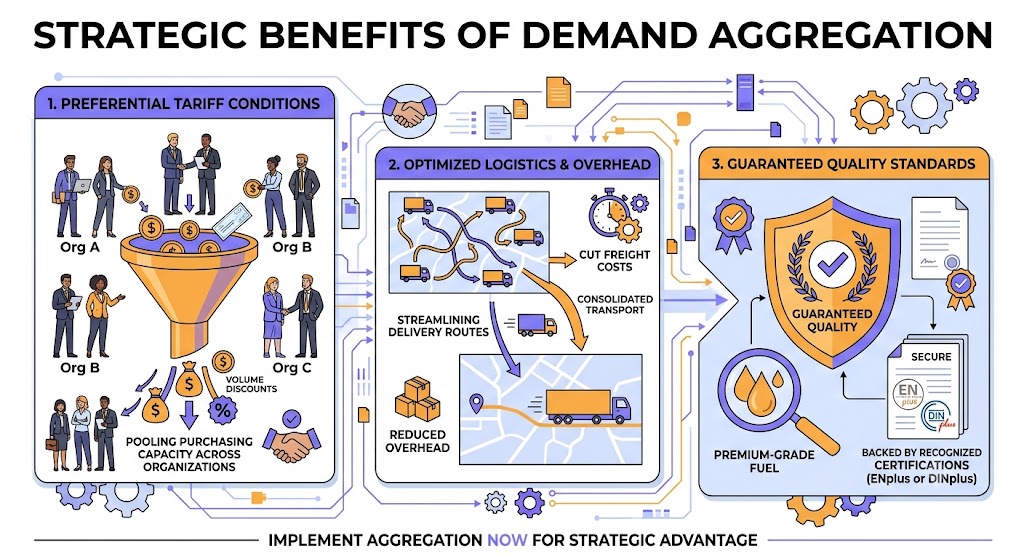
Strategic Benefits of Demand Aggregation

  • Preferential Tariff Conditions – Unlocking volume discounts by pooling purchasing capacity across organizations
  • Optimized Logistics & Overhead – Streamlining delivery routes and transport schedules to cut freight costs
  • Guaranteed Quality Standards – Securing premium-grade fuel backed by recognized certifications (ENplus or DINplus)
By consolidating individual purchasing needs into a structured collective procurement strategy, enterprises convert market volatility into predictable, cost-effective energy management.

Conclusion: Securing Supply and Long-Term Energy Performance

Transforming Collective Sourcing into Operational Advantage

Group pellet procurement effectively balances financial performance with corporate environmental responsibility across multi-site and enterprise operations.

Empower your procurement strategy through aggregated demand, optimized transport logistics, and certified fuel quality to guarantee enterprise energy resilience.

Why Centralize Group Pellet Procurement?

Centralizing a group pellet purchase transforms a one-off operational task into a strategic performance lever for the enterprise. By consolidating energy needs into a unified supply stream, organizations optimize both financial costs and administrative overhead. Centralization reduces supplier sprawl, shortens processing cycles, and enhances executive visibility over financial commitments.

Operational, Financial, and Logistical Impact

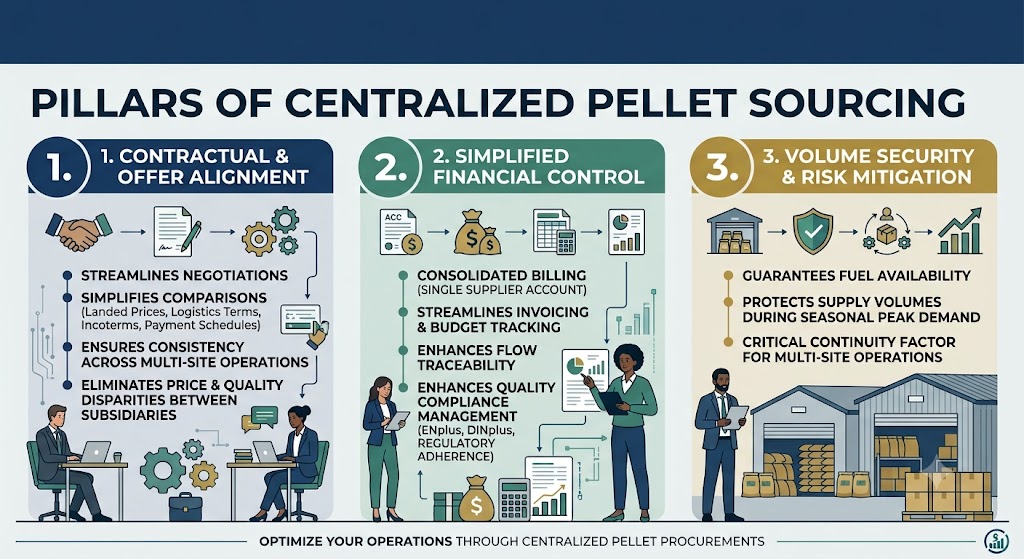
Pillars of Centralized Pellet Sourcing

  • Contractual & Offer Alignment – Streamlines contract negotiations and simplifies proposal comparisons (landed prices, logistics terms, Incoterms, and payment schedules). Ensures consistency across multi-site operations by eliminating price and quality disparities between subsidiaries.
  • Simplified Financial Control – Consolidated billing under a single supplier account streamlines invoicing and budget tracking while enhancing flow traceability, quality compliance management (ENplus, DINplus), and regulatory adherence.
  • Volume Security & Risk Mitigation – Guarantees fuel availability and protects supply volumes during seasonal peak demand—a critical continuity factor for multi-site operations.

Execution Methodology

Implementing a B2B group pellet procurement strategy requires a structured, rigorously managed roadmap from initial scoping to post-delivery follow-up. Every phase aims to secure optimal pricing, quality assurance, and supply continuity while streamlining administrative and logistical workflows.

Conclusion: Strategic Control Over Industrial Energy Costs

Optimizing Bulk Procurement Through Structured Governance

Centralization elevates group pellet purchasing into a disciplined, value-generating procurement strategy for modern enterprises.

By unifying demand across sites, standardizing quality parameters, and simplifying account management, organizations achieve sustainable energy savings and robust supply chain security.
A Structured Method for B2B Group Pellet Procurement

1. Scoping Demand and Technical Requirements

Scoping forms the essential initial phase. It requires precisely mapping site-specific needs: estimated volumes, seasonality, storage constraints, unloading infrastructure, and delivery conditions.

The organization must also establish expected Service Level Agreements (lead times, tolerances, delivery windows) and define the contractual framework (single vs. multi-supplier, contract duration, renewal options). Thorough upfront scoping dictates RFP effectiveness and contract commitment reliability.

2. Consulting Qualified Suppliers

A successful supplier consultation relies on a detailed Request for Proposal (RFP) integrating strict technical and environmental evaluation criteria:

RFP Evaluation Criteria

  • 100% Softwood Composition – Guaranteeing optimal energy yield and minimal ash content
  • Quality Certifications – Requiring ENplus or DINplus standards
  • Geographic Sourcing & Footprint – Evaluating origin proximity and carbon impact
  • Logistics & Network Capacity – Assessing regional coverage and fleet capability
To maintain an objective view of pricing, delivery terms, and collective purchasing models, consult group pellet procurement structures to evaluate contractual frameworks, ancillary fees, and the net impact of volume aggregation on delivered costs.

3. Negotiating and Securing Contractual Terms

Negotiations must look beyond the base per-ton price. Decision-makers should evaluate total landed cost, factoring in pallet fees, transport charges, access surcharges, and non-compliance penalties. In competitive markets where favorable terms are rare, securing optimal negotiated conditions represents a vital strategic opportunity.

Establishing key service KPIs is essential:

On-Time Delivery (OTD) Rate
Damage & Loss Percentage
Certificate Compliance Verification

Contractual security also relies on clear price indexation clauses (wood, energy, transport costs) and volume flexibility mechanisms to handle unexpected demand fluctuations.

4. Managing Delivery and Invoicing Workflows

Logistical management guarantees long-term performance. This involves structuring delivery routes by zone, formalizing reception protocols (visual inspections, compliance documentation), and consolidating billing under a single supplier account.

A monthly executive dashboard centralizing delivery performance, total spend, and quality metrics will allow leadership to refine contracts and ensure accurate budget forecasting.

Conclusion: Operational Efficiency and Cost Mastery

Unlocking Strategic Value in Group Pellet Sourcing

By following this structured four-step methodology, group pellet purchasing evolves into a real lever for financial and operational efficiency.

Achieve significant cost reductions, secure continuous energy supply, and guarantee full regulatory compliance across all enterprise sites.
Key Indicators and Regulatory Compliance

Managing group pellet procurement effectively relies on precise Key Performance Indicators (KPIs) and rigorous compliance auditing at every operational stage. These dual pillars ensure both economic and logistical efficiency while guaranteeing product quality and supplier reliability.

Measuring Logistics and Supply Performance

Continuous monitoring of logistical indicators is essential to evaluate vendor service quality. Procurement teams must systematically track key metrics:

Core Delivery Performance Indicators

  • OTIF / OTD Rates (On-Time In-Full / On-Time Delivery) – Assessing delivery punctuality and complete order fulfillment
  • Landed Cost per Site – Analyzing regional cost variances to optimize pooled logistics and transport routing
  • Quality Compliance Rate – Verifying ENplus and DINplus certificate validity, pellet granulometry, and moisture content

Documentary Control and Supply Chain Audits

Documentary Verification: Every shipment must be accompanied by full supporting documentation, including delivery notes, quality certificates, technical datasheets, and transport waybills. These records guarantee complete traceability and streamline internal or external audit processes.

Auditing Supply Chain Partners: Periodic audits of production facilities and logistics providers safeguard the long-term sustainability and compliance of group pellet purchases. Regular audits help detect operational anomalies early, prevent commercial disputes, and strengthen long-term vendor partnerships.

Conclusion: Securing Fluxes and Controlling Costs

Achieving Full Transparency in Energy Procurement

Combining precise KPI tracking with thorough documentary control secures supply flows and keeps operational costs under tight control.

By embedding systematic audits and real-time performance tracking, enterprises build a transparent, highly resilient, and compliant energy procurement strategy.

Line
Featured Post

Popular posts