Needs analysis
Procurement strategy

Incoterms 2020: Master Your International Trade

Published By
Olivier Audino
Tags
Sourcing

Incoterms 2020: The Essential Guide to Global Trade Rules

Navigating international trade requires absolute clarity regarding obligations, costs, and risk transfers between buyers and sellers.

The Incoterms 2020 rules serve as the global standard for international commercial contracts, optimizing cross-border transactions and eliminating friction in supply chain management.

1. Why Mastering Incoterms Is a Strategic Advantage

Core Operational Benefits

  • Clear Risk Division: Precise pinpointing of the exact location where liability transfers from buyer to seller.
  • Cost Optimization: Transparent allocation of freight charges, insurance, customs duties, and handling fees.
  • Dispute Mitigation: Standardized international definitions that prevent costly legal misunderstandings.
  • Supply Chain Efficiency: Streamlined logistics coordination across multi-modal transport networks.

2. How Incoterms 2020 Transform Commercial Operations

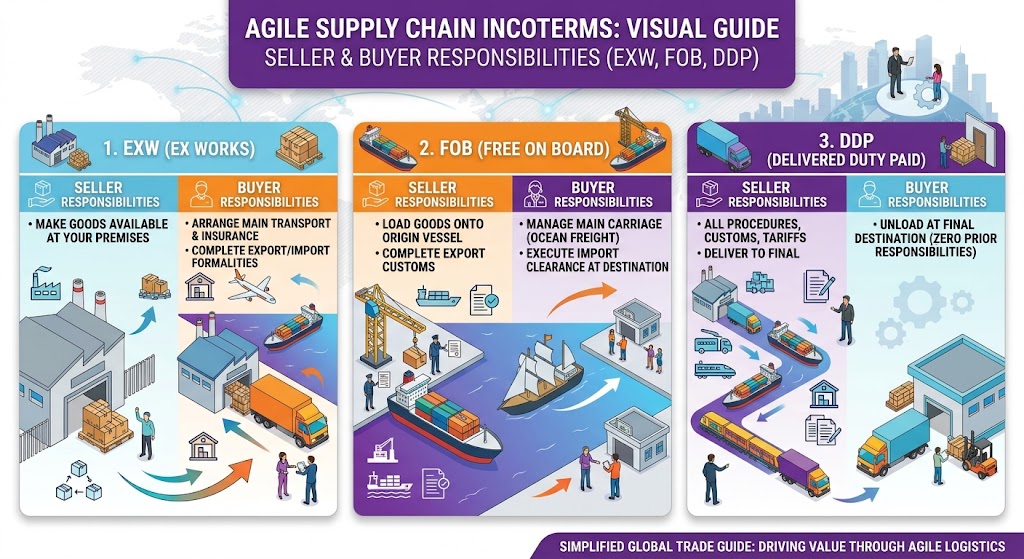
Whether managing EXW (Ex Works) factory pickups, FOB (Free on Board) ocean freight, or DDP (Delivered Duty Paid) door-to-door deliveries, choosing the appropriate Incoterm directly impacts your working capital, operational control, and customer service level.

Mastering these rules allows procurement and sales teams to negotiate stronger contract terms and safeguard profit margins.

Conclusion: Propel Your Global Business Forward

Mastering International Sourcing & Distribution

From novice traders to seasoned logistics experts, a solid command of Incoterms 2020 empowers organizations to minimize risk and maximize operational efficiency worldwide.

Transform your international commercial strategy, protect your profit margins, and drive sustainable growth across global markets.

Understanding Incoterms 2020 Fundamentals & Strategic Importance

Incoterms 2020 play a pivotal role in international commerce by establishing clear, standardized rules for delivering goods between buyers and sellers worldwide.

Published by the International Chamber of Commerce (ICC), these terms ensure that all global trade stakeholders share a unified understanding of task divisions, freight costs, and risk transfers across cross-border shipping workflows.

1. The Origins & Evolution of Incoterms 2020

The Incoterms 2020 framework is the result of decades of global market expansion. First introduced by the ICC in 1936, these rules are updated periodically to adapt to modern logistics technological advances and shifting regulatory requirements.

Without these standardized terms, global trade would face significant friction, as every transaction would be subject to conflicting regional legal interpretations and cultural norms.

2. Core Objectives of the Incoterms Framework

Key Operational Objectives

  • Standardized Global Negotiations: Eliminates friction by replacing ambiguous logistics descriptions with internationally recognized 3-letter rules.
  • Risk & Cost Elimination: Clear pre-determination of who pays for main carriage, terminal handling fees, and insurance.
  • Mitigating Legal Disputes: Transparent definition of exact physical transfer points drastically reduces cross-border litigation.
  • Documentary Clarity: Specifies precisely which party is responsible for export packaging, transit permits, and import customs clearance.

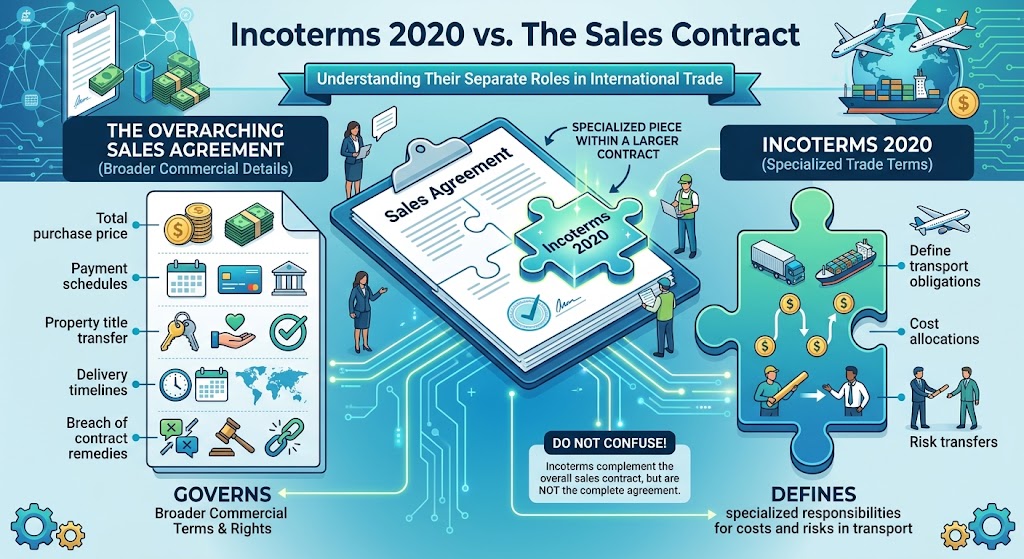
3. Incoterms 2020 vs. The Sales Contract

It is vital not to confuse an Incoterm with a complete contract of sale. Incoterms define only transport obligations, cost allocations, and risk transfers.

Broader commercial details—such as total purchase price, payment schedules, property title transfer, delivery timelines, and breach of contract remedies—remain governed by the overarching sales agreement. Incoterms serve as an essential, specialized piece within the larger commercial contract puzzle.

4. The 3 Core Pillars Defined by Incoterms 2020

Pillars of Every Incoterm Transaction

  • Transport Responsibilities: Who hires, pays for, and manages the main freight carrier and local drayage.
  • Transfer of Risk & Costs: The precise geographic location where financial responsibility and risk shift from seller to buyer.
  • Documentary Obligations: Specific requirements for securing export licenses, import duties, and transit customs documentation.

Conclusion: Standardizing Global Logistics with Precision

Transforming International Trade into a Predictable Workflow

Integrating Incoterms 2020 into your commercial operations turns complex international shipping into a structured, highly predictable process.

By establishing unambiguous boundaries for cost, risk, and transport documentation, Incoterms safeguard corporate profit margins and strengthen global supply chain relationships.

Incoterms 2020 Comparison Table

Understanding the exact division of responsibilities between buyer and seller is critical for avoiding logistical bottlenecks and unbudgeted transit expenses.
Incoterm Seller Responsibilities Buyer Responsibilities
EXW (Ex Works) Make goods available at premises Main transport, insurance & export/import formalities
FOB (Free On Board) Load goods onto origin vessel & complete export customs Ocean freight pickup, main carriage & destination import clearance
DDP (Delivered Duty Paid) All procedures, customs, tariffs & delivery to final destination Unloading at final destination (zero responsibilities prior)

Key Benefits of Mastering Incoterms 2020

  • Risk Reduction: Significantly reduces costly logistical misunderstandings and contractual errors.
  • Financial Predictability: Establishes clear pre-budgeting for freight, taxes, and terminal handling charges.
  • Operational Efficiency: Accelerates cross-border customs clearance and freight handoffs.

Conclusion: Transforming Global Trade Operations

Elevate Your International Sourcing & Strategy

Mastering these Incoterms 2020 fundamentals fundamentally improves cross-border commercial operations, turning potential supply chain vulnerabilities into streamlined, competitive advantages.

Protect your margins, eliminate friction, and execute seamless international trade transactions.
Types & Classification of Incoterms 2020: A Clear Overview

Incoterms 2020 are designed to simplify cross-border trade transactions by establishing unambiguous rules for buyers and sellers. Understanding their classification enables logistics and procurement teams to select the exact rule tailored to their transit mode.

1. Classification: Maritime vs. Multimodal Incoterms

The Incoterms 2020 rules are organized into two primary structural families:

Maritime Incoterms: Apply exclusively to sea and inland waterway transport (FOB, CIF, CFR, FAS). They govern seller obligations up to loading goods on board or alongside the vessel.
Multimodal Incoterms: Cover any mode or combination of transport—road, rail, air, or sea (EXW, FCA, CPT, CIP, DAP, DPU, DDP). They offer crucial flexibility for modern multi-leg supply chains.

2. Overview of the 11 Incoterms 2020

The Complete List of 11 Standardized Rules

  • EXW (Ex Works): Minimum seller obligation; buyer manages all transport and export/import formalities from origin.
  • FCA (Free Carrier): High flexibility; seller delivers export-cleared goods to the buyer's designated carrier.
  • CPT (Carriage Paid To): Seller pays main freight to destination; risk transfers upon carrier handoff at origin.
  • CIP (Carriage and Insurance Paid To): Main freight paid plus mandatory high-level insurance coverage.
  • DAP (Delivered At Place): Delivered to destination; buyer handles import unloading and customs duties.
  • DPU (Delivered at Place Unloaded): The only rule requiring the seller to unload goods at the destination point.
  • DDP (Delivered Duty Paid): Maximum seller liability; door-to-door delivery with paid import taxes and duties.
  • FAS (Free Alongside Ship): Maritime rule; seller delivers goods alongside the vessel at the port of origin.
  • FOB (Free On Board): Maritime rule; risk transfers once goods are loaded safely on board the vessel.
  • CFR (Cost and Freight): Maritime rule; seller pays ocean freight to the destination port.
  • CIF (Cost, Insurance, and Freight): Maritime rule; seller pays ocean freight plus basic marine insurance.

3. Incoterms 2020 Comparison Table

Incoterm 2020 Type Transfer of Risk Seller Obligations Buyer Obligations
EXW Multimodal Factory / Origin Prepares & packages goods Assumes all transport, costs & risks
FCA Multimodal Carrier Handoff Delivers cleared goods to carrier Assumes costs & risks post-handoff
CIF Maritime On Board Vessel Pays sea freight & marine insurance Assumes risks & fees post-loading
DDP Multimodal Final Destination Assumes all freight, duties & taxes Receives goods at destination

Conclusion: Streamlining Cross-Border Logistics

Optimizing Trade Execution Across Global Markets

Mastering the distinction between maritime and multimodal rules empowers organizations to select trade terms that minimize liabilities and eliminate hidden freight costs.

Select the right Incoterm to safeguard working capital, clarify operational handoffs, and drive sustainable growth in global trade.

Deciphering Responsibilities & Risk Transfers in Incoterms 2020

Understanding obligations and risk transfer boundaries in Incoterms 2020 is essential for any enterprise engaged in international commerce.

These rules establish the precise geographical and operational point where seller liability transforms into buyer responsibility, alongside exact cost distribution across both parties.

1. Who Bears What Under Incoterms 2020?

Each Incoterm 2020 explicitly defines buyer and seller obligations regarding goods delivery, insurance coverage, and handling fees.

While certain terms dictate that the seller absorbs all costs up to loading the vessel, others place the bulk of freight and logistics responsibilities on the buyer. Clear alignment on these duties prevents misunderstandings and unbudgeted transit surcharges.

2. Defining the Moment of Risk Transfer

Risk Transfer Benchmarks

The transfer of risk marks the precise moment liability for loss or damage shifts from seller to buyer:

  • FOB (Free On Board): Risk shifts the moment goods are loaded safely onto the vessel at origin.
  • DAP (Delivered At Place): Risk transfers upon delivery at the designated destination point.
  • Pricing Accuracy: Pinpointing the exact transfer location allows teams to adjust export prices dynamically and secure proper insurance coverage.

3. Strategic Impact on Sales Contracts

Incoterms 2020 strongly influence how sales contracts are drafted and negotiated. Selecting the appropriate term clarifies operational handoffs, resolves potential disputes before they arise, and ensures seamless execution across your entire supply chain.

4. Key Obligations & Risks Overview

EXW (Ex Works): Buyer assumes full costs and risks starting directly from the seller's factory.
FOB (Free On Board): Seller loads goods onto the vessel; risk transfers upon loading.
CIF (Cost, Insurance & Freight): Seller manages marine insurance and sea freight to the destination port.
DAP (Delivered At Place): Seller ensures delivery to the designated final location.

5. Summary Table of Risks & Responsibilities

Incoterm Buyer Responsibility Transfer of Risk
EXW Assumes full responsibility from the departure point As soon as goods leave the factory floor
FOB Assumes liability starting from vessel loading Once loaded safely onto the vessel
CIF Assumes transport costs from destination port onwards Upon delivery at the destination port
DAP Assumes liability after arrival at destination Upon physical delivery to the named destination place

Conclusion: Navigating Cross-Border Contracts with Confidence

Mastering Trade Terms for Seamless Global Operations

Deciphering the complexities of risk transfers and buyer-seller responsibilities streamlines global procurement and sales workflows.

Aligning your sales contracts with Incoterms 2020 protects profit margins, eliminates friction, and secures cross-border commercial success.

Selecting the Optimal Incoterm 2020 Based on Transport Mode & Context

Choosing the right Incoterm 2020 rule for your commercial transaction is essential for establishing a seamless supply chain. Multiple operational, regulatory, and organizational factors influence this selection.

1. Key Criteria for Choosing the Right Incoterm

When finalizing an international trade agreement, evaluate three foundational pillars:

Mode of Transport: Ocean freight, air cargo, or multi-leg overland transport directly determines which rules are legally applicable.
Level of Risk Exposure: The operational responsibilities and insurance burdens each party is prepared to manage.
Logistical Maturity: First-time exporters or importers benefit from rules that limit operational commitments, whereas experienced enterprises with established carrier volume contracts can leverage flexible rules to optimize freight rates.

2. Practical Contextual Examples & Common Pitfalls

Ocean Freight: Rules such as FOB (Free On Board) and CIF (Cost, Insurance, and Freight) remain standard defaults for port-to-port ocean cargo.
Multimodal Supply Chains: For complex, multi-leg international journeys, CPT (Carriage Paid To) and CIP (Carriage and Insurance Paid To) provide superior integration flexibility.

3 Guidelines to Avoid Logistics Pitfalls

  • Understand Full Legal Scope: Audit all mandatory responsibilities for customs clearances, tariffs, and terminal handling charges.
  • Evaluate In-House Logistics Capacity: Never select a rule requiring operational management beyond your team's current expertise.
  • Consult Trade Experts: Prevent costly misunderstandings by seeking professional supply chain guidance prior to contract execution.

3. Recommended Incoterms by Mode of Transport

Transport Mode Recommended Incoterm Responsibility & Risk Handoff Notes
Maritime / Ocean FOB, CIF Seller remains responsible up to vessel loading (or destination port freight for CIF)
Air Freight FCA, CPT Buyer assumes liabilities once goods are cleared and handed over to the air carrier
Multimodal CPT, CIP Maximum integration flexibility across multi-leg combinations (road, rail, air, sea)

Conclusion: Strategic Execution for Global Trade

Ensuring Smooth Cross-Border Import and Export Workflows

The choice of an Incoterm 2020 rule must always be a deliberate, strategic decision tailored to your enterprise's capabilities and risk tolerance.

By carefully auditing transport constraints and organizational readiness, companies avoid hidden freight surcharges and secure predictable international logistics performance.

Incoterms 2020: Integration with Customs Formalities & Regulations

Navigating the complex interplay between Incoterms 2020 rules and international customs clearance is critical for cross-border supply chains.

Acting as operational guardrails, these regulations ensure that international trade flows seamlessly in full compliance with local laws. Understanding this integration draws the line between a smooth import-export process and a costly logistics bottleneck.

1. Impact of Incoterms 2020 on Customs Declarations

Incoterms directly establish which trading party bears primary responsibility during customs processing.

For example, under DDP (Delivered Duty Paid), the seller absorbs the entire burden of customs formalities and duties. Conversely, EXW (Ex Works) shifts all clearance duties directly to the buyer.

Furthermore, Incoterms govern documentation requirements—requiring sellers to supply necessary commercial invoices, origin certificates, and packing lists to maintain frictionless border transit.

Customs Operational Directives

  • Documentary Clarification: Explicitly defines which party provides specific export/import filings.
  • Error Reduction: Minimizes processing mistakes and customs delays by establishing clear compliance ownership.

2. Tax Regulations & Financial Implications

Incoterms play a pivotal role in establishing import and export tax liabilities. Customs duty and VAT valuations heavily depend on the precise geographical location where risk and cost handoffs occur.

In maritime transit under CIF (Cost, Insurance, and Freight), freight and insurance expenses are included up to the destination port. This directly impacts tariff calculation formulas and dictates where customs duties apply.

Tax Planning Benchmarks

  • Critical Risk Transfer Point: Pinpoints the exact moment fiscal liability and damage risks shift between buyer and seller.
  • Landed Cost Planning: Allows finance teams to integrate customs duties and local tariffs into precise margin calculations.

3. Operational Extremes: DDP vs. EXW Analysis

The trade rules DDP and EXW represent the polar extremes of customs and fiscal responsibility in global commerce:

DDP (Delivered Duty Paid): Maximum seller commitment. The seller handles full customs import clearance, pays all import tariffs/taxes, and assumes risk until final delivery at the buyer's warehouse.
EXW (Ex Works): Minimum seller commitment. The buyer handles export/import declarations and manages transport right from the seller's factory floor.

4. Comparative Summary: DDP vs. EXW

Incoterm Customs Responsibility Risk Exposure
DDP Seller (Full Export & Import Clearance) Seller (Until Final Destination Delivery)
EXW Buyer (Full Export & Import Clearance) Buyer (From Factory Floor Onward)

Conclusion: Safeguarding Cross-Border Compliance

Mastering Customs Integration for Frictionless Trade

Integrating Incoterms 2020 seamlessly into customs declaration workflows is an essential capability for modern international enterprises.

By strategically selecting terms that align with your organizational customs expertise, companies eliminate compliance risks, control landed costs, and drive predictable global supply chain performance.
Practical Fact Sheets for Key Incoterms 2020: Advantages & Common Limitations

Navigating international trade rules efficiently requires a detailed understanding of core Incoterms 2020. Terms like EXW, FCA, and CIF each carry distinct operational benefits and structural trade-offs.

To maximize contract efficiency and protect profit margins, enterprises must evaluate how each term impacts their supply chain control, cost allocation, and risk management.

1. Incoterm 2020 EXW: Ex Works (Factory Pick-Up)

Under EXW (Ex Works), the seller fulfills their obligation simply by making the goods available at their factory premises or designated warehouse. All subsequent transport, loading, freight charges, and export clearances fall entirely on the buyer.

EXW Advantages & Limitations Summary

  • Advantage – Minimal Logistics Burden for Seller: The seller avoids international shipping complexities, freight negotiations, and export documentation.
  • Advantage – Maximum Freight Control for Buyer: Gives buyers full freedom to organize routing, select preferred carriers, and optimize freight costs.
  • Limitation – High Operational Burden for Buyer: The buyer assumes complete risk from the seller’s door onward.
  • Limitation – Export Clearance Requirement: The buyer must complete local export customs clearance, which can be challenging in foreign jurisdictions without local representation.

2. Incoterm 2020 FCA: Free Carrier (Delivery to Named Carrier)

Under FCA (Free Carrier), the seller clears the goods for export and delivers them to the buyer's designated carrier at an agreed location.

This rule offers excellent operational balance: the seller handles export clearance and initial loading at their facility, while the buyer takes over responsibility for main international transport.

FCA Advantages & Limitations Summary

  • Advantage – Shared Responsibility: Equitable risk distribution that works across both single and multimodal supply chains.
  • Advantage – Carrier Selection Flexibility: Allows the buyer to use their preferred freight forwarders while ensuring the seller handles export clearance.
  • Limitation – Precise Documentation Required: Demands explicit naming of the exact handoff point in transport documents.
  • Limitation – Misunderstanding Handoff Boundaries: Risks arise if the exact moment of risk transfer (e.g., loaded vs. unloaded at carrier terminal) is not clearly specified in the contract.

3. Incoterm 2020 CIF: Cost, Insurance, and Freight

Under CIF (Cost, Insurance, and Freight), a popular maritime-only Incoterm, the seller pays main ocean freight and procures marine insurance coverage up to the destination port.

This simplifies logistics for the buyer during transit, though risk technically transfers to the buyer once goods are loaded on board the vessel at the origin port.

CIF Advantages & Limitations Summary

  • Advantage – Full Maritime Handling by Seller: The seller manages ocean vessel booking, freight payments, and origin port handoffs.
  • Advantage – Included Transit Insurance: Mandatory marine insurance coverage is arranged and paid for by the seller.
  • Limitation – Minimum Cover Risks: The seller is only required to secure basic, minimum insurance cover (Clause C), which may be insufficient for high-value cargo.
  • Limitation – Destination Port Risk Transfer: The buyer assumes loss/damage risk once loaded at origin and absorbs all port handling/unloading charges at destination.

Conclusion: Choosing the Right Incoterm for Your Operations

Strategic Freight Alignment for Global Success

Selecting between EXW, FCA, and CIF requires balancing internal logistics capabilities against acceptable levels of risk exposure.

By understanding the specific advantages and limitations of each rule, enterprises can negotiate stronger contract terms, avoid unexpected freight surcharges, and execute predictable international trade.

Frequently Asked Questions (FAQ): Incoterms 2020

Why Are Incoterms 2020 Essential for International Trade?

Incoterms 2020 establish clear roles for each party in an international transaction. They define who pays for transport and handles customs clearance. For instance, under FOB (Free On Board), the buyer assumes transport costs starting from the port of departure. These explicit rules eliminate misunderstandings and safeguard both trading partners.

What Is the Primary Difference Between EXW and DDP?

EXW and DDP represent opposite ends of the responsibility spectrum:

EXW (Ex Works): The buyer handles all logistics, freight, and customs after picking up goods at the seller's factory.
DDP (Delivered Duty Paid): Includes full door-to-door delivery with all tariffs, taxes, and import customs paid directly by the seller.

Consequently, DDP places maximum operational burden and responsibility on the seller compared to EXW.

What Does the Term CIF Mean in Incoterms 2020?

CIF stands for Cost, Insurance, and Freight. This means the seller covers main carriage and costs up to the destination port while procuring marine insurance for the transit. Once the vessel arrives at the destination port, the buyer takes over import customs clearance and final inland transport.

What Notable Changes Were Introduced in Incoterms 2020?

Key Modifications in the 2020 Edition

  • Enhanced Cost Allocation Clarity: Provides precise breakdowns detailing each party's exact cost liabilities.
  • Heightened Security Requirements: Integrates modern transport security obligations across shipping and customs workflows.
  • Better Freight Protection: Ensures enhanced risk management during cargo transit.

How Do You Choose the Right Incoterm for Your Transaction?

Selecting the right Incoterm requires evaluating overall freight budgets and risk tolerances. You should consider which party is best positioned to bear transport risks. For example, if a seller aims to minimize operational expenses, EXW may be the ideal choice. Consulting a logistics expert helps ensure optimal trade execution and prevents costly misunderstandings.

Conclusion: Streamlining Your Global Sourcing

Mastering Trade Terms for Seamless Execution

Understanding and selecting the right Incoterms 2020 rule optimizes cross-border commercial operations and prevents logistical bottlenecks.

By clarifying responsibilities and balancing costs, businesses can secure predictable international supply chains.

Line
Featured Post

Popular posts