Olivier Audino
Webinar
Tail Spend: The Overlooked Lever to Free Up Your Buyers' Time
Tuesday March 31 at 2:00 PM



The procurement outsourcing market is currently saturated with interchangeable marketing promises. For a Chief Procurement Officer (CPO) or a Lead Buyer, the difficulty is no longer finding a provider capable of "sourcing", but finding one capable of cleansing an agonizing transactional infrastructure.
The reality is asymmetrical. In a Fortune 500 corporation, 5% of spend (Class C) generates 80% of the teams' mental load. Yet, the majority of proposed solutions merely add an extra layer of administrative complexity where you need purification.
A true spot purchasing hub must not be a simple invoicing intermediary, but a Transactional Trusted Third Party capable of physically eliminating the noise in your ERP. If your provider only talks about "purchase savings" without mentioning the supplier invoice processing cost, they are selling you hot air.
This guide details the 3 clinical criteria to distinguish real engineering from mere brokering.
Transform your tail spend management into a net EBITDA leverAdopting a procurement hub requires tangible proof. Reject any partner unable to guarantee
Strict rationalization of your supplier Master Data.
An anti-corruption process compliant with strict AFA directives.
Full absorption of cash flow risk on the long tail.
Direct loss per processed invoice
The status quo is expensive. Deploying the armada of a large ERP to manage minor purchases is a financial anomaly denounced by analysts. Every delay in digitizing your P2P flow directly cuts into your EBITDA through invisible administrative costs.
Most Class C procurement outsourcing providers present themselves as "sourcing machines". They promise to find the best translator, the closest caterer, or the cheapest maintenance provider.
This is a fundamental targeting error that ignores Procure-to-Pay engineering.
The problem with spot purchasing is not the face value purchase price of the item or service. The problem is the administrative machinery you activate to pay for it. According to the analyst firm Gartner, the total internal supplier invoice processing cost averages 150 €.
The result
If you mandate a broker to save 20 € on a 500 € service, but your teams still have to create the supplier in SAP, validate bank details, and process the invoice manually, you have lost money. The face value savings are literally pulverized by the 150 € of internal management costs. To stop this leak, it is imperative to start by measuring your actual load with our transactional calculator.
Every "good find" from a classic sourcing provider often results in opening a new account in your ERP. Today, 70% of a large group's supplier base consists of disposable third parties that have only been used once.
This pollution of supplier Master Data creates a massive technical and legal debt. A provider that does not act as an airtight filter merely shifts the problem. It saturates your system with obsolete data that will have to be audited, one day or another, by your compliance departments. This disorder weakens your posture regarding Sapin II Law requirements.
Using an ERP designed by firms like McKinsey to manage 2 million euro contracts in order to place a 500 € supply order is like using a jackhammer to drive a nail. It is heavy, it is slow, and it ends up breaking the nail.
The buyer becomes the involuntary bottleneck for the field. Faced with urgency, the internal client ends up practicing maverick spend, ruining your entire tail spend management strategy.
To secure your infrastructure, you can now run a compliance stress test to measure your AFA exposure.
Run my compliance stress testThe first filter for choosing a spot purchasing hub provider is not its catalog, but its IT architecture. A provider that asks you to manually create its suppliers in your system is not a partner, it is disguised workload.
The stake is the digitalization of the Procure-to-Pay (P2P) process. Your infrastructure must be able to absorb the volatility of Class C spend without clogging your Master Data.
This is the fundamental pillar. A true procurement hub must act as a Single Creditor. This means that in your ERP (SAP, Oracle, Ivalua), you only manage one single supplier record for BME. The 1,000 or 5,000 intermittent suppliers you work with every year disappear from your database to be consolidated under a single accounting line.
By replacing thousands of third parties with a single pivot point, you instantly eliminate the pollution of your supplier Master Data. You no longer have to audit dormant accounts or manage bank detail updates for providers used once every three years. The gain in EBITDA is measured here by the massive reduction in IT and accounting maintenance costs.
User experience is the second lock. If the buyer or internal client has to leave their usual environment to place an order, the process will fail. The right provider must offer a PunchOut integration or API.
This seamless connection allows the requester to navigate the procurement hub's interface while remaining connected to their ERP. Once the cart is validated, the information automatically flows back into your existing approval workflow. Zero double entry. Zero transmission errors. The buyer no longer wastes 30 minutes per order copying quote lines; they validate the purchasing act in one click.
Outsourcing does not mean losing visibility. On the contrary. An engineering provider must return cleaner data to you than what you had internally. Because every transaction passes through a single funnel, you obtain granular reporting on your tail spend.
Because a consolidated invoice is not a "catch-all" invoice. It must be broken down by analytical code, by cost center, and by purchase category. It is this precision that allows the CPO to justify the savings achieved and to steer their strategy of reducing administrative FTEs by measuring their load with our calculator towards higher value-added missions.
Access the transactional charge calculator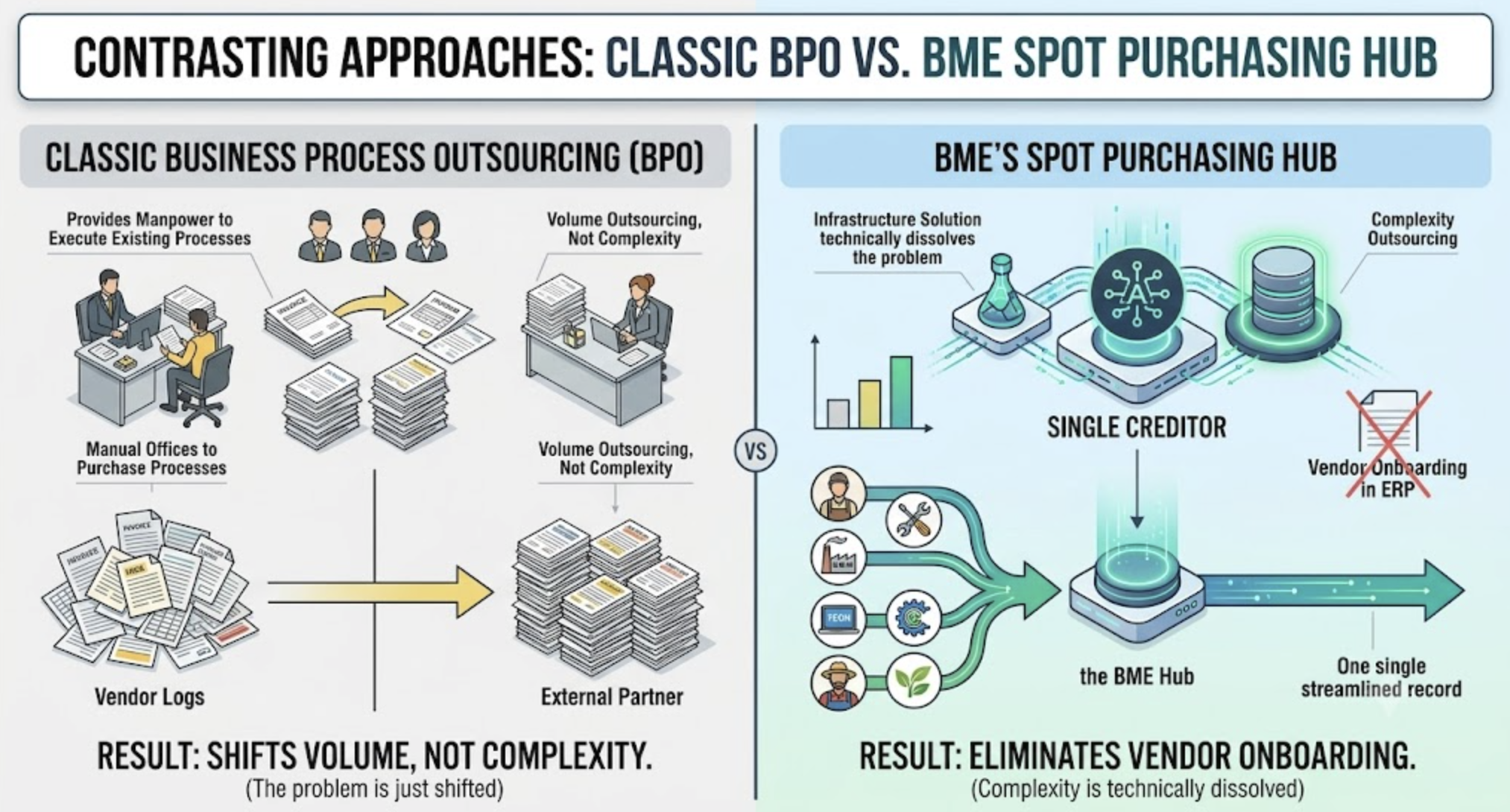
If data engineering is the brain of the procurement hub, compliance is its armor. For a CPO, the risk linked to Class C procurement management is not financial, it is criminal. Choosing a provider that merely "declares" it is compliant is no longer enough.
A true partner must offer a guarantee of probity across the entire transactional chain, particularly for those thousands of small suppliers that usually fly under the radar of your compliance departments.
A buyer's operational reality is simple, they cannot spend 2 hours verifying the registration certificate (Kbis), the social compliance certificate (URSSAF), and the identity of the beneficial owner of an artisan for a 400 € service.
The Sapin II Law makes no distinction regarding amounts. In the event of undeclared labor or corruption on a "Spot" purchase, the criminal liability of the CPO and the executive is engaged. Multiply this risk by 5,000 unaudited annual transactions, and you get an unacceptable level of exposure.
The French Anti-Corruption Agency (AFA) is very clear, companies must implement proportionate verification procedures. However, "proportionate" does not mean "non-existent".
The majority of procurement outsourcing providers manage compliance reactively (they ask for paperwork after the fact or during a dispute). A trusted provider must transform this constraint into a proactive Compliance Shield that interposes itself even before the money leaves your accounts via rigorous supplier risk management.
This is where you will distinguish the expert from the snake oil salesman. Ask this question, "What happens if a supplier is no longer up to date with their social compliance certificate on the day of payment?"
A high-performing procurement hub must have a preventive blocking system. At BME, if a legal document is missing or expired, the system technically blocks the transfer. Zero exceptions. It is this algorithmic rigor that allows you to successfully pass a compliance Stress Test.
| Compliance Criterion | Internal Management / Classic Broker | BME Procurement Hub |
|---|---|---|
| Document Collection (Registration, Tax/Social) | Manual, random on Class C. | 100% systematic and automated. |
| Updates (KYC) | Often obsolete (over 6 months). | Continuous real-time monitoring. |
| Payment Security | Payment made even without a complete file. | Immediate algorithmic preventive blocking. |
| AFA Liability | Maximum exposure on the long tail. | Total outsourcing of legal risk. |
Stop taking unnecessary risks with your long tail. Evaluate your level of legal exposure.
Run my compliance Stress TestTo understand the value of a spot purchasing hub, we must step away from commercial brochures and dive into the accounting reality of a European industrial group processing 5,000 Class C orders per year. Here, the challenge is not to save a few cents on the price of a ball bearing, but to stop a massive capital leak in support processes.
Without intermediation by a Transactional Trusted Third Party, every micro-purchase activates the same heavy machinery as a strategic contract. This structural dysfunction transforms your procurement experts into database managers.
The supplier invoice processing cost is the silent killer of your profitability. According to benchmarks from McKinsey, automation and consolidation are the only levers to reduce the management costs that consume support functions.
The calculation is chilling
This amount is not a theoretical estimate; it is the price you pay to maintain a supplier Master Data polluted by disposable third parties. For a CPO, justifying such an expense without added value creation becomes untenable during performance audits. You can run this same diagnostic for your organization by measuring your load with our transactional calculator.
Beyond the cash-out, the impact is measured in human capital. Managing the long tail internally mobilizes qualified resources on zero-value tasks.
Each "Spot" account creation requires about 3 hours of effective work (cumulative across procurement, legal, and accounting). For 5,000 transactions, this represents 15,000 hours of annual work.
Why continue like this?
By dividing these 15,000 hours by the average annual working time (1,600h), you discover that 9.3 FTEs (Full Time Equivalents) are mobilized solely to manage administrative noise. By delegating this flow to a procurement hub, you do more than just save money; you recover 9 buyers to reallocate them to strategic tenders or to the management of ESG and Sapin II risks.
Outsourcing via a Procure-to-Pay (P2P) digitalization process allows you to shift from an administrative blocker posture to that of a strategic field partner. The result is immediate the Master Data is cleansed and legal risk is neutralized.
Before initiating such a transformation, we advise you to run a compliance stress test to measure your actual exposure to AFA sanctions.
Run my compliance stress testChoosing a spot purchasing hub provider should not be a leap of faith based on a commercial brochure. It is an arbitration of financial engineering and technology. If the candidate cannot prove their ability to cleanse your supplier Master Data, to automate Sapin II procurement compliance (in accordance with AFA recommendations), and to provide financial portage for Class C risk, walk away.
Every day of delay in Procure-to-Pay (P2P) digitalization is a day you burn EBITDA in pure administrative loss. Using a global ERP to manage minor transactions is a heresy that costs 150 € per invoice, a benchmark confirmed by Gartner analysts.
The role of the modern CPO is no longer to monitor transactions, but to steer an infrastructure of trust. Regain control today by identifying your process vulnerabilities
Run your P2P compliance stress test to measure your actual exposureTo avoid empty promises, a CPO must challenge the operational robustness of the provider. Here are the answers to the most frequent questions during the audit phase of a spot purchasing hub solution.
Classic Business Process Outsourcing (BPO) often merely provides manpower to execute your existing processes. It is volume outsourcing, not complexity outsourcing.
The result
The spot purchasing hub, as designed by BME, is an infrastructure solution. We do not just place the order; we eliminate the need for vendor onboarding in your ERP by becoming the Single Creditor. Where BPO shifts the problem, the procurement hub technically dissolves it.
This is one of the biggest bottlenecks of Class C spend. A dispute over a 200 € invoice can cost more in resolution time than the value of the order itself.
But there is a detail
As a Transactional Trusted Third Party, BME takes full responsibility for the dispute (quantity, quality, invoicing). Your accounting teams never see the dispute. We resolve it directly with the final supplier and guarantee an error-free consolidated invoice. You buy peace of mind with your internal clients.
Managing the long tail is often the blind spot of CSR policy. How do you guarantee that 5,000 micro-suppliers respect your environmental standards?
Why
Because it is impossible to manually audit every craftsman. The procurement hub acts as a filter. We integrate your ESG criteria into our compliance shield. If a provider does not meet your decarbonization or ethical requirements, they are blocked at the source. You regain control of your Scope 3 without increasing the burden on your buyers.
Watch our webinar on mastering spot purchasing


.svg)