
Olivier Audino
Webinar
Tail Spend: The Overlooked Lever to Free Up Your Buyers' Time
Tuesday March 31 at 2:00 PM

Tail Spend: The Overlooked Lever to Free Up Your Buyers' Time
Tuesday March 31 at 2:00 PM


Within executive committees, a dangerous confusion persists between the simple delegation of a purchasing task and the actual transfer of legal responsibility. Many CPOs think they are securing their Procure-to-Pay process by signing a mandate contract. They delegate order placement to save time, but they forget a fundamental detail. By choosing an agent instead of a commission agent, your company remains totally exposed to the legal and financial risks of Class C.
Your thousands of suppliers are replaced by a single line in your ERP. You receive a single, clear, and detailed global monthly invoice.
The commission agent performs legal checks, blocks suspicious transactions, and advances cash to small suppliers on your behalf.
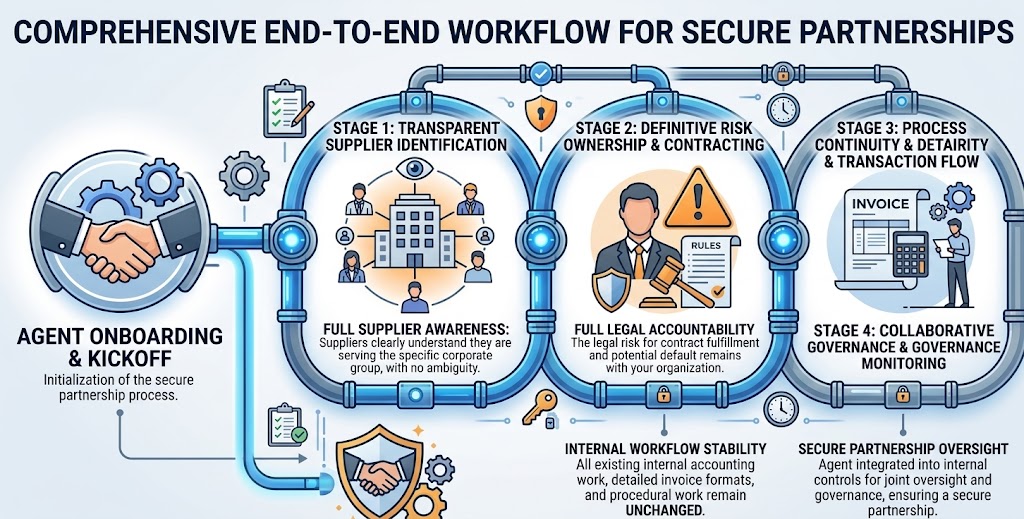
Legally, a procurement agent is a service provider that acts "in the name and on behalf of" your company. You are the principal, and you grant them the power to negotiate or purchase on your behalf.
However, the agent is merely a transparent intermediary. The final transaction, the commercial contract, and the invoice directly bind your company to the final supplier according to the rules of the Civil Code.
This legal transparency has direct consequences for your daily management and risk exposure. With an agent, the reality is as follows:
To secure this relationship, it is crucial that your procurement agent is perfectly integrated into your internal control processes.
Unlike a mandate, a commission contract is founded on commercial opacity. The commission agent acts "in their own name but on behalf of the principal," according to the principles of Commercial Law.
They purchase the service or product in their own name, and then resell it to you. This interposition creates a true legal shield, isolating your company from thousands of occasional suppliers.
| Procure-to-Pay analysis criteria | Procurement Agent | Commission Agent (BME Solution) |
|---|---|---|
| Legal responsibility (KYC) | Retained by your company | Transferred to the commission agent |
| Supplier dispute management | Your responsibility | Absorbed by the Trusted Third Party |
| Final client visibility | Total (the supplier knows you) | Opaque (the supplier only knows BME) |
| Impact on Master Data | None (supplier creation mandatory) | Massive (Single Creditor in ERP) |
To truly sanitize your processes, the Transactional Trusted Third Party is essential. By acting as a commission agent, they become your one and only supplier for your entire long tail.
Your thousands of suppliers disappear from your radar screens. They are replaced by a single line in your ERP, generating a single, clear, and analytically detailed global monthly invoice.
To truly sanitize your processes, the Transactional Trusted Third Party is essential. By acting as a commission agent, they become your one and only supplier for your entire long tail.
Your thousands of suppliers disappear from your radar screens. They are replaced by a single line in your ERP, generating a single, clear, and analytically detailed global monthly invoice.
The commission agent absorbs the risk on your behalf. They perform the necessary legal checks, block suspicious transactions, and advance cash to small suppliers.
You are fully protected. To check if your current processes expose you to a major legal risk, audit your organization via our Compliance Stress-Test.
Take control of your Class C and secure your legal compliance now.
Access the Compliance Stress-TestYes. An agent has the power to legally bind you to a third party. However, all legal, contractual, and criminal obligations linked to this signature fall directly on your company, and not on the agent, in accordance with the provisions of the Civil Code.
Since the final contract is established between your company and the initial supplier, it is up to your Legal Department to handle the dispute. With a commission agent, the agent absorbs the procedure, as they purchased the good in their own name.
You must analyze the Total Cost of Ownership (TCO). While the service fees of a commission agent may seem different, they instantly cancel out the hidden cost of internal management (approximately 150 euros per account creation) and eliminate your exposure to criminal risk.


Get in touch with our experts, who'll be glad to take you behind the scenes of our procurement outsourcing systems — proven for over 10 years.
.svg)