Olivier Audino
Webinar
Tail Spend: The Overlooked Lever to Free Up Your Buyers' Time
Tuesday March 31 at 2:00 PM



Procurement management within large corporations is currently suffering from an engineering asymmetry. On one hand, robust technological firepower (SAP, Coupa, Ivalua) calibrated to secure strategic, seven-figure contracts. On the other, a deluge of micro-transactions that overwhelm your teams.
A single-point procurement hub is far more than administrative centralization. It is a pivotal infrastructure, a Transactional Trusted Third-Party that allows you to offload Class C transactional volume to a single creditor.
In large organizations, 5% of spend generates 80% of the mental load for procurement and finance teams. A single-point hub eliminates this friction, allowing your teams to focus on creating strategic value.
Free your procurement teams from administrative burden and refocus them on core value-add activities.
Estimate your gains with our transactional calculatorDeploying an oversized ERP to handle countless micro-orders is an economic non-starter. The absence of a single procurement hub is no longer just operational discomfort; it is a financial hemorrhage that directly destroys your EBITDA.
Regain control of your database. By outsourcing the tail spend, you purge your supplier Master Data of redundant entries.
Eliminate time-consuming data entry. Reallocate your Procurement and Finance teams to high-value strategic missions.
Secure your processes against audits. Outsourcing ensures all workflows comply strictly with regulatory standards.
Unlike a traditional purchasing consortium that focuses on price, a procurement hub focuses on the Procure-to-Pay (P2P) process. Its role is to absorb the complexity of tail spend on behalf of the client company.
By using a procurement hub, you transform a chaos of 5,000 micro-processes into a single, seamless management line. This is what we call systemic optimization.
The procurement hub acts as a technological and legal intermediary. It positions itself between your ERP and thousands of occasional suppliers. For the company, there is only one interface, one point of contact, and above all, a single financial entry point.
As a Transactional Trusted Third-Party, BME ensures three critical functions:
Outsourcing Class C procurement via a procurement hub is the structural response to tail spend management. By delegating the management of suppliers with purchasing volumes below 15,000 €, the CPO streamlines the organization.
Because managing an occasional supplier in-house is an economic non-starter. Between setting up the vendor profile, KYC verification, and invoice reconciliation, the company mobilizes resources whose cost often exceeds the purchase amount itself.
To precisely measure this waste of resources within your organization, you can use our tool:
Implementing a procurement hub within an industrial group is not just a service management task, but a restructuring of the transactional flow. According to a McKinsey study, digitalization and automation of transactional tasks can free up to 50% of procurement team time. BME materializes this gain through five technological pillars.
The first lever is the drastic reduction of supplier Master Data. Instead of maintaining 1,000 records for occasional service providers, you only open one pivot account: BME. As the single creditor, we absorb all the administrative noise of the tail spend.
At the end of the month, your accounting department does not receive 500 disparate invoices, but a single consolidated invoice. Each line of this global invoice is broken down by cost center or analytical code. This mechanism drastically streamlines your accounts payable and eliminates manual entry errors.
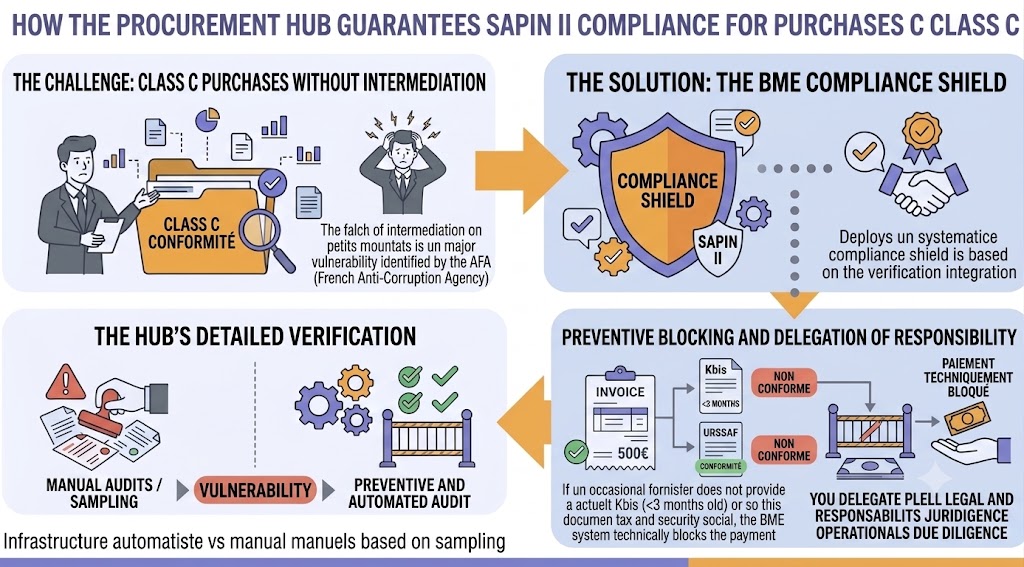
Regulations (Sapin 2 Law, AFA requirements) impose equal vigilance on all third parties, regardless of the amount. The lack of intermediation forces your teams to manually collect legal documents from suppliers who may only work with you once.
BME deploys an automated compliance shield. We manage the entire supplier KYC process. This includes the systematic collection and verification of business registration certificates (Kbis), tax compliance documents (URSSAF), and anti-corruption due diligence.
If a document becomes obsolete, our system triggers an immediate preventive block. No payment is issued until the file is regularized. This rigor guarantees perfect compliance during audits by the French Anti-Corruption Agency (AFA) and meets the new requirements of the CSRD directive regarding value chain traceability.
A high-performance procurement hub must be invisible to the end user. Thanks to seamless connection via PunchOut cXML or API integration, BME integrates natively with your existing procurement ERP (SAP, Oracle, Ivalua). The employee performs their purchase request in their usual tool; the flow is simply routed in the background to BME.
To eliminate any internal change management friction. Simultaneously, BME ensures financial portage. We front the cash to pay small service providers on demand or via deposit, while respecting your corporate payment terms. This setup protects the financial health of your local suppliers without degrading your working capital.
To measure the impact of this setup on your organization, you can run our diagnostic tool now:
Implementing a procurement hub within an industrial group is not just a service management task, but a restructuring of the transactional flow. According to a McKinsey study, the digitalization and automation of transactional tasks can free up to 50% of procurement team time. BME materializes this gain through five technological pillars.
Imagine a production line at a standstill. The technician needs a specific 450 € part available only from a local non-referenced supplier. The buyer, engaged in a strategic 5 million euro request for proposal, does not have the 3 hours required to create this vendor profile in SAP.
Facing an emergency, the technician bypasses the process and uses a purchasing card or expense report. This maverick spend deprives the procurement department of any visibility and exposes the company to a major non-compliance risk. According to a Deloitte report, mastering indirect spend remains the number 1 priority for 78% of CPOs to protect profit margins.
BME resolves this technical deadlock: the technician orders via the Procurement Hub, and the buyer validates it in one click because BME is already the Single Creditor. The line restarts in 24 hours, without polluting the Master Data and without any administrative data entry. You can calculate these productivity gains immediately via our transactional charge calculator.
In the service sector or at the headquarters of large corporations, the issue shifts toward professional services. A Marketing Director wants to engage a niche agency for a 12,000 € flash campaign. The internal onboarding process (KYC, anti-corruption verification, legal validation) takes 15 days.
Marketing cannot wait. The service is consumed before the purchase order is even issued. This time lag creates time-consuming accounting disputes and administrative bottlenecks at the end of the month.
Implementing the BME procurement hub allows you to:
To audit your current exposure on these gray-market services, we recommend taking action:
Maintaining a structure where expert buyers spend 3 hours creating a vendor record for a 500 € invoice is an economic anomaly. Facing stricter regulatory controls and constant margin pressure, the CPO can no longer afford to ignore the hidden cost of tail spend.
The transactional trusted third-party provides a clinical response to this systemic problem. It cleanses Master Data, neutralizes non-compliance risk, and restores the procurement function to its role as a value creator.
A team that focuses on 2 million euro negotiations rather than bank detail entry.
Procure-to-Pay outsourcing is no longer just an optimization option; it is the mandatory infrastructure to protect your EBITDA and secure your governance.
To move from theory to action, watch our exclusive content to understand how to master your spot buys and secure your flows.
Watch the Webinar Mastering spot buysDeploying a Procurement Hub raises legitimate questions regarding data sovereignty and flow control. Here are clinical answers to the most frequent questions from procurement leadership.
The lack of intermediation on small amounts is the primary vulnerability flagged by the French Anti-Corruption Agency (AFA). BME deploys a systematic Compliance Shield.
But there is a detail
Unlike manual audits based on sampling, our infrastructure applies an automated preventive block. If an occasional supplier does not provide a business registration certificate (Kbis) less than 3 months old or their tax compliance document (URSSAF), the BME system technically blocks the payment. You delegate the entire legal and operational responsibility for due diligence.
This is precisely where it performs best. The cost to process a supplier invoice in-house is 150 €, regardless of the purchase amount.
The result
For a 300 € purchase, your company is actually spending 450 € (purchase + management). By using the BME Procurement Hub, you crush this administrative cost, replacing it with a single, consolidated service line. The gain on your EBITDA is immediate and measurable from the very first hundred transactions through managed Class C procurement outsourcing.
The Procurement Hub protects your local ecosystem. BME provides financial portage: we pay the small artisan or niche provider on demand or via deposit if necessary.
Why
Because large corporations often have payment terms incompatible with the survival of small businesses. BME absorbs this cash flow friction. Your group retains standard payment terms with BME while ensuring optimal financial health for your local suppliers.
Integration is designed to be "Low-IT". The Seamless Connection uses standard protocols (OCI/cXML) compatible with SAP, Oracle, or Coupa. Once the link is established, the buyer validates their requests without manual entry. Master Data cleansing is automatic: you stop opening "disposable" vendor accounts and keep only the BME line.
To identify the current flaws in your P2P process:
Run my P2P compliance stress test


.svg)