Olivier Audino
Webinar
Achats de Classes C: Le levier oublié pour libérer vos acheteurs
Mardi 31 Mars à 14h00



A company's competitiveness no longer depends solely on the acquisition of raw materials. Today, procurement departments in large groups face a major challenge that significantly hinders their daily productivity. This involves managing a multitude of small transactional expenses, often invisible in global reporting, but formidably expensive in administrative time.
To counter this efficiency loss, more and more organizations are deciding to completely rethink their long-term acquisition strategy. The solution naturally establishing itself in the market is purchasing intermediation. This approach allows for the full delegation of the operational burden linked to low-ranking suppliers to a specialized player. Discover how this targeted outsourcing deeply transforms the profitability and agility of finance and procurement departments.
For the majority of procurement departments, the quest for performance often hits a wall of complexity, the overwhelming volume of low-value transactions. This is where procurement intermediation intervenes, a rationalization strategy that has become essential for major groups seeking to clean up their supplier panel and streamline daily operations.
To counter this efficiency loss, more and more organizations are deciding to completely rethink their long-term acquisition strategy. The solution naturally establishing itself in the market is procurement intermediation. This approach allows for the full delegation of the operational burden linked to low-ranking suppliers to a specialized player. Discover how this targeted outsourcing deeply transforms the profitability and agility of finance and procurement departments.
Non-strategic procurement, commonly called Class C procurement, encompasses all goods and services necessary for company operations that do not directly enter into the final product's composition (supplies, small equipment, subscriptions, one-off services). Although they represent a minor share of the acquisition budget, they monopolize team time and saturate accounting departments.
Afin de bien cibler les gisements d'économies, il est indispensable de structurer une rigorous mapping of spending categories within your organization.
| Characteristic | Strategic Procurement (Class A) | Non-Strategic Procurement (Class C) |
|---|---|---|
| Financial volume | Approximately 80% of the total budget | Between 5% and 10% of the total budget |
| Supplier base | Restricted and qualified (Partnerships) | Very broad (High dispersion) |
| Administrative load | Controlled and automated | Time-consuming (up to 80% of order volume) |
Faced with this overwhelming volume, entrusting the management of these references to a partner via the complete outsourcing of your secondary procurement processes allows for the immediate relief of internal teams.
Tail Spend Management consists of regaining control over this myriad of micro-expenses, often imperceptible on the radar of large traditional ERP systems. This lack of visibility leads to major operational drift
To stem this phenomenon, intermediation is the solution. By mandating a commissioner expert in B2B negotiation, the client company replaces a multitude of small creditors with a single point of contact and invoicing.
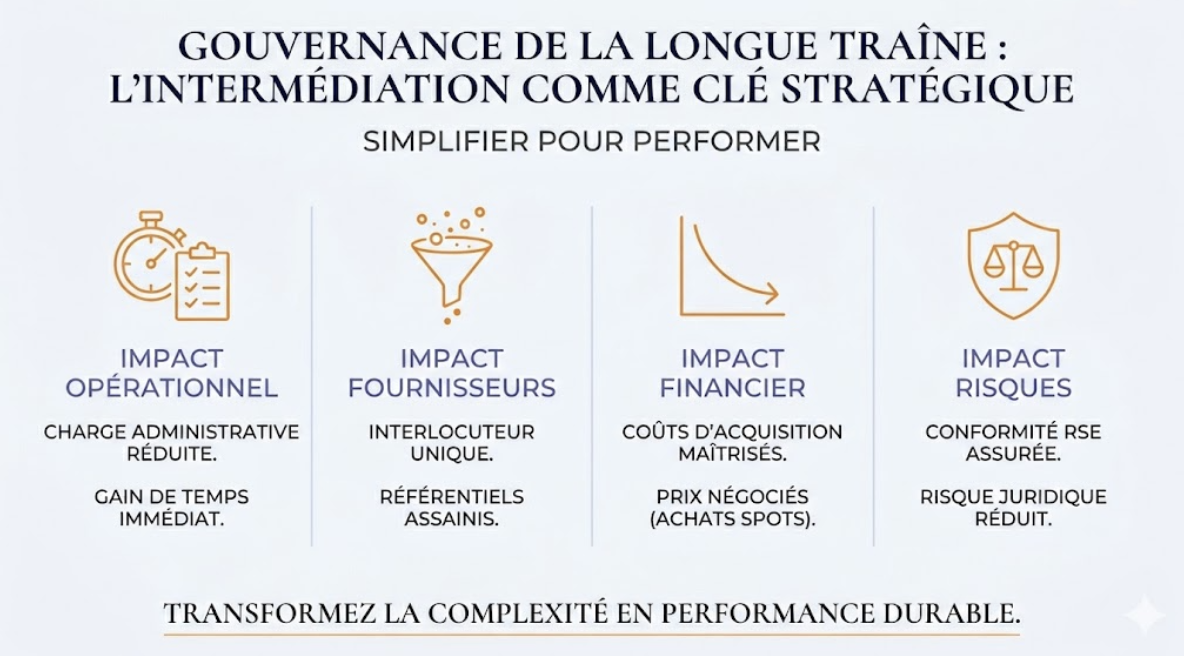
Delegating the management of a diverse supplier panel to a specialized partner goes beyond simple subcontracting. It is a true operational model transformation aiming for quantifiable and immediate results, both on the expense line and the overall efficiency of support teams.
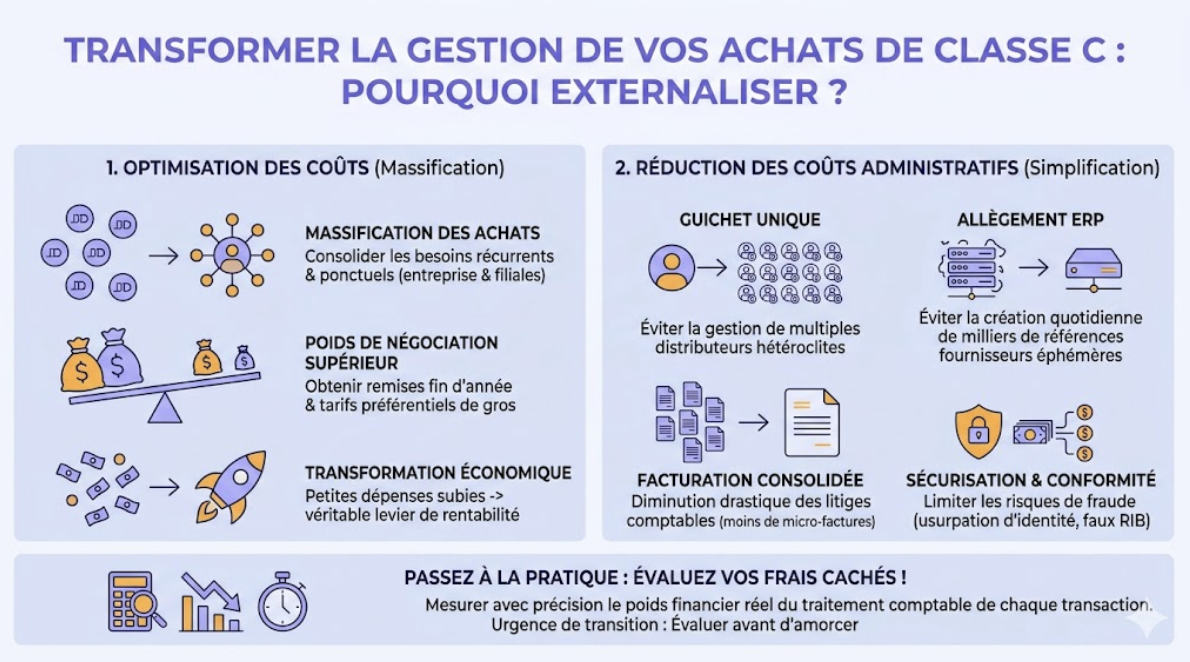
Dispersion of orders across multiple distributors prevents obtaining advantageous commercial terms. Conversely, procurement cost optimization becomes a tangible reality when these fragmented flows are entrusted to a central player. The intermediary service provider will consolidate all of the company's or its various subsidiaries' recurring and one-off needs.
This purchasing consolidation gives them significantly greater negotiating power in the market. By grouping volumes, the proxy obtains year-end rebates and preferential bulk pricing. This strategy relies on the principle of strategically pooling acquisition volumes, thereby transforming a multitude of small unavoidable expenses into a real profitability lever.
The purchase price of a low-value good is paradoxically often lower than its internal management cost. Between creating a third-party record in the information system, issuing the purchase order, tracking delivery, and bank reconciliation, the bureaucratic burden is very heavy. Relying on a single point of contact creates a spectacular reduction in administrative costs at several levels.
To measure the urgency of such a transition, it is often revealing to precisely evaluate the real financial weight of the accounting processing for each transaction within your finance department.
Before initiating any transition, it is essential to precisely evaluate your hidden costs related to the transactional process to measure the urgency of the situation within your accounting department.
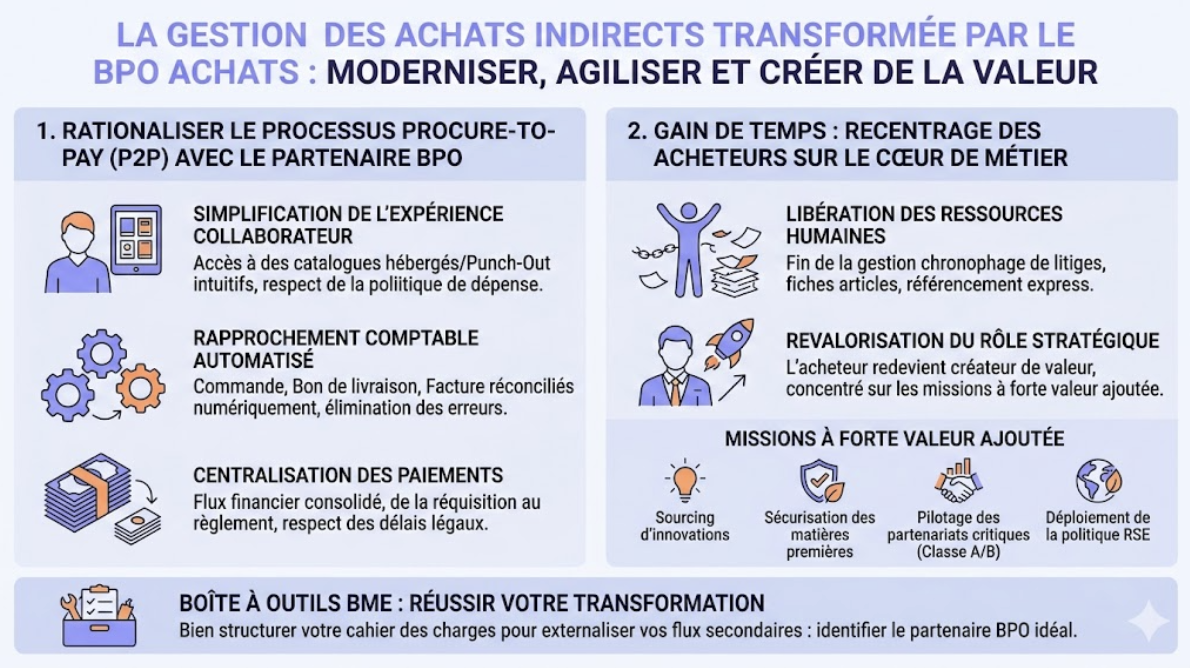
Traditional approaches quickly show their limits when faced with the growing complexity of cross-functional spending categories. This is why indirect procurement management is currently undergoing a revolution thanks to the emergence of next-generation outsourcing solutions. Procurement BPO (Business Process Outsourcing) does not just process low-value orders; it injects technology, compliance, and agile processes into often-siloed organizations.
The intervention of a commission agent or a specialized partner disrupts operational efficiency. By taking over the entire transactional cycle, the service provider ensures that the Procure-to-Pay (P2P) process is executed fluidly, transparently, and digitally. From the initial request issued by the requester to the final payment, every step is tracked and secured without involving the client's accounting department.
By choosing to outsource these logistical and administrative operations, the client company benefits from true process mechanization
Users access intuitive hosted or Punch-Out catalogs, ensuring strict compliance with the company's spending policy.
The order, delivery note, and invoice are digitally reconciled by the third party to eliminate entry errors and pricing anomalies.
Financial flows are consolidated, offering complete optimization of the chain from requisition to payment, while scrupulously respecting legal deadlines for subcontractors.
One of the most immediate benefits of this intermediation is the release of human resources. Often bogged down by time-consuming billing disputes, creating item records, or express onboarding of small distributors, internal talent loses sight of their primary mission. Outsourcing the long tail acts as a true performance accelerator.
Freed from this administrative pollution, teams can finally revalue their strategic role within the organization. They refocus on high-value missions such as sourcing innovations, securing raw materials, managing critical partnerships (Class A and B procurement), and deploying CSR policy. The buyer is no longer an order manager, they become a value creator for executive management.
To ensure the success of this transformation project, we advise you to properly structure your specifications for outsourcing your secondary flows, a key step to identify the BPO partner most aligned with your challenges.
Theory alone is not enough for finance departments. Let us examine the raw data of a major European manufacturing industry player that was facing uncontrollable database inflation. With more than 15,000 active suppliers, 75% of whom were requested only once or twice a year for small amounts, the accounting department was nearing total asphyxiation.
By deploying an intermediation program coupled with a digital platform, the group radically transformed its operational management. The results obtained over twelve months demonstrate the multiple benefits generated by delegating Class C spend within a complex organization.
| Performance Indicator (KPI) | Initial Situation | Results after Intermediation |
|---|---|---|
| Supplier panel size | 15,000 active | Reduction to 3,500 (76% decrease) |
| Account creation time | 14 days average | Immediate (purchase via proxy) |
| Processing cost savings | Unmeasured | Estimated 1.2 million euro gain |
Managing Class C spend is no longer an administrative burden. As we have seen through our case study and various analyses, entrusting the management of this long tail to an expert partner allows for substantial savings while freeing your internal talent from time-consuming tasks linked to Master Data.
Do not let your non-strategic procurement weigh on your profitability and productivity anymore, as the internal processing cost of a one-off invoice can destroy your EBITDA gains. It is time to rethink your operational model and capitalize on data consolidation to permanently cleanse your supplier databases.
The trigger generally occurs when an obvious mismatch is observed between the value of a good and the time spent acquiring it. Warning signs include a high number of low-value invoices saturating accounting, a constantly increasing provider panel, and buyers overwhelmed by operational tasks. To objectify this decision, it is highly recommended to precisely measure the total cost of ownership related to the administrative processing of these minor orders using our transactional load calculator to validate the switch to intermediation.
Quite the opposite. By entrusting these flows to a broker, the client company generally deploys a digitized purchasing portal (e-procurement type). According to analyses by Gartner, internal employees enjoy a purchasing experience similar to B2C e-commerce, while automating their purchase requests within the strict framework of the company's spending policy.
One of the major assets of intermediation lies in risk transfer. It is the outsourced partner that assumes the responsibility of qualifying distributors, verifying legal certificates, and combating undeclared labor. For ordering parties, relying on our Vigilegal solution for non-compliance guarantees total peace of mind regarding the regulatory requirements of the French Anti-Corruption Agency (AFA) (Sapin II law, duty of vigilance, CSRD), particularly by conducting a comprehensive compliance stress test.



.svg)