Call for tenders and e-Procurement

Essential KPIs to Boost Purchasing Performance

Published By
Olivier Audino
Tags
Sourcing

Transforming Procurement Performance with Essential KPIs

In today's highly competitive market, essential key performance indicators (KPIs) can fundamentally transform how you track, manage, and optimize your procurement operations.

Monitoring the right metrics provides a transparent, data-driven vision of your purchasing strategy's core strengths and vulnerabilities.

1. Core Value of Procurement Metrics

Key Advantages of KPI Monitoring

  • Strategic Visibility: Provides a clear diagnostic view of your buying strategies.
  • Operational Efficiency: Maximizes performance and eliminates operational bottlenecks.
  • Value Generation: Drives sustainable cost optimization and value creation across the business.
  • Empowered Decision-Making: Equips both novices and procurement experts with actionable metrics.

2. Strengthening Supply Chain Performance

Mastering these analytical tools enables procurement teams to navigate market volatility, enhance supplier relations, and elevate supply chain responsiveness.

Read on to discover how adopting targeted KPIs can fortify your business decisions and optimize your end-to-end supply chain.

Conclusion: Maximizing Value Across Your Supply Chain

Elevating Procurement Decisions Through Metrics

Establishing clear, actionable KPIs turns procurement performance from a reactive function into a proactive competitive advantage.

Master these key performance indicators to optimize your buying strategies, reduce risk, and generate measurable business value.

What Is a KPI & Why Is It Crucial for Purchasing Performance?

Determining whether your purchasing department is operating effectively requires clear, measurable metrics. Key Performance Indicators (KPIs) act as essential measurement tools to track progress toward overall strategic goals.

1. Definition of a KPI: Measuring Purchasing Performance

In business, a KPI functions as a compass, indicating whether operations are aligned with target goals. Within procurement, these metrics evaluate process effectiveness, benchmark department performance against industry standards, and spotlight operational areas needing improvement.

Purchasing KPIs cover core areas including:
• Cost reduction tracking
• Delivery time efficiency
• Internal customer satisfaction

2. Importance of KPIs in Purchasing Performance Management

Core Management Impact

  • Process & Cost Optimization: Helps optimize expenditures, boost profitability, and evaluate supplier efficiency.
  • Rapid Root-Cause Analysis: Unexpected cost increases can be instantly traced to root causes and mitigated.
  • Risk Mitigation & Foresight: Provides quantified operational visibility to anticipate supply chain risks and capitalize on market opportunities.

3. Aligning KPIs with Strategic Objectives

For KPIs to deliver maximum impact, they must directly mirror company-wide strategic objectives.

Cost Reduction Goals: Track hard savings and expenditure management.
Sustainability & Quality Goals: Measure carbon footprint reductions, ESG initiatives, and supplier scorecard metrics.
Deadline Management: Focus on lead time management and delivery compliance to support business continuity.

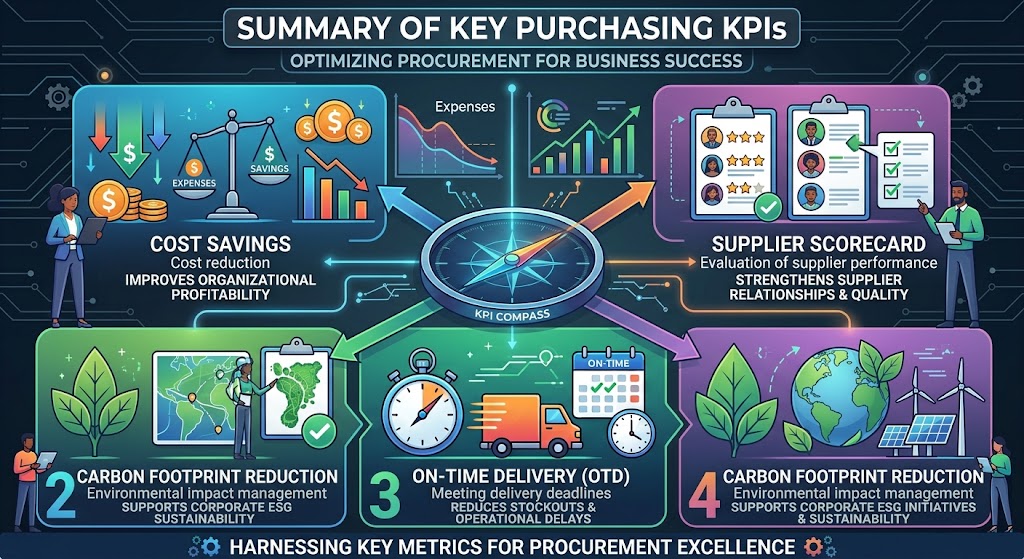
4. Summary of Key Purchasing KPIs

KPI Strategic Goal Impact on Procurement
Cost Savings Cost reduction Improves organizational profitability
Supplier Scorecard Evaluation of supplier performance Strengthens supplier relationships & quality
On-Time Delivery (OTD) Meeting delivery deadlines Reduces stockouts & operational delays
Carbon Footprint Reduction Environmental impact management Supports corporate ESG initiatives & sustainability

Conclusion: Guiding Procurement Excellence Through Metrics

Continuous Improvement & Strategic Value

KPIs define, measure, and guide purchasing performance, establishing the structural framework required to evaluate and refine buying practices continuously.

By maintaining tight alignment between procurement metrics and business goals, organizations maximize operational efficiency and secure long-term value.

Purchasing Performance KPI Categories

In modern procurement, leveraging structured Key Performance Indicators (KPIs) is essential to evaluate every dimension of purchasing performance.

Categorizing metrics across financial, operational, quality, and supplier dimensions allows businesses to optimize spend, strengthen vendor relationships, and consistently meet internal stakeholder expectations.

1. Financial KPIs & Their Impact on Purchasing Performance

Financial KPIs assess the economic return of procurement decisions on company bottom lines. Beyond simple cost reduction, they measure capital efficiency and return on investment across purchasing initiatives:

Total Cost of Ownership (TCO): Analyzes all direct and indirect expenses associated with acquiring, operating, and maintaining a product or service.
Achieved Purchase Savings (Savings): Quantifies savings generated through contractual renegotiations, demand management, or process refinements.
Procurement ROI: Evaluates net financial returns relative to the operational costs incurred by the procurement department.
Indicator Description Strategic Goal
Total Cost of Ownership (TCO) Analysis of all associated direct/indirect costs Reduction of overall corporate expenditure
Achieved Savings Variance between baseline and finalized costs Direct expansion of profit margins
Procurement ROI Financial gain relative to purchasing investment Optimization of procurement budget allocation

2. Operational KPIs as Purchasing Performance Drivers

Operational KPIs measure the efficiency and velocity of daily procurement execution. They safeguard workflow continuity and confirm that suppliers comply with strict SLA deadlines and quality criteria:

Contract Compliance Rate: Tracks vendor adherence to agreed commercial terms, reducing contractual exposure.
On-Time Delivery (OTD): Evaluates supplier timeliness for goods and services to prevent operational bottlenecks.
Active Supplier Concentration: Monitors vendor distribution per category to encourage supply chain diversification and mitigate sole-source risk.

Core Drivers of Operational Excellence

  • Process Optimization: Streamlines purchase-to-pay (P2P) workflows and eliminates cycle-time delays.
  • Delivery Assurance: Guarantees consistent material availability for business operations.
  • Risk Mitigation: Proactively reduces vendor dependency and supply disruption vulnerabilities.

3. Quality KPIs to Elevate Purchasing Performance

Product and service quality directly impacts organizational reputation and end-user satisfaction. Monitoring quality KPIs minimizes non-conformance incidents and prevents unexpected rework costs:

Supplier Non-Compliance Rate: Tracks the percentage of shipments or services failing to meet agreed specification benchmarks.
Internal Customer Satisfaction Index: Measures internal stakeholder feedback regarding procurement responsiveness and service quality.
Cost of Non-Quality: Calculates financial losses resulting from defective materials, returns, or operational downtime.

Conclusion: Building a Strategic Procurement Framework

Transforming Purchasing into a Value Engine

Establishing structured monitoring across financial, operational, and quality KPIs turns procurement from a transactional cost center into a strategic value driver.

By continuously tracking these core metrics, enterprise procurement teams can safeguard margins, minimize supply chain risks, and deliver sustainable business value.

Focusing on Essential KPIs for Purchasing Performance

In modern procurement, tracking the right metrics is fundamental to understanding true performance. Key Performance Indicators (KPIs) act as benchmark markers that indicate whether your purchasing strategies are on target.

Focusing on core metrics enables procurement teams to drive efficiency, eliminate hidden expenditure, and generate measurable enterprise value.

1. Total Cost of Ownership (TCO)

Often underestimated, Total Cost of Ownership (TCO) is crucial for enlightened purchasing decisions. TCO moves beyond the initial purchase price to reveal the true cost of an asset over its entire lifetime.

Full Lifecycle Expenses: Includes initial acquisition, maintenance, logistics, operating costs, and end-of-life disposal.
Lifecycle Analysis: Prevents false savings—such as buying low-cost machinery that incurs triple the expenditure in long-term maintenance.

2. Achieved Savings (Hard vs. Planned Savings)

Achieved savings measure the concrete financial impact realized through strategic sourcing, skillful supplier negotiations, and diligent contract management.

Achieved vs. Planned Savings: It is vital to distinguish between actual budget reductions (hard savings) and projected estimates (planned savings).
Demonstrating ROI: Calculating realized savings proves the procurement department's direct contribution to company bottom lines.

3. Contract Compliance Rate

The Contract Compliance Rate evaluates whether suppliers adhere to agreed commercial terms, pricing structures, and SLAs.

High compliance prevents unbudgeted surcharges and hidden costs, ensuring that operations proceed according to plan while fostering healthy, transparent vendor relationships.

Essential Purchasing KPIs Checklist

  • Total Cost of Ownership (TCO): Complete lifecycle financial analysis.
  • Realized Savings: Measured cost reduction vs. baseline budgets.
  • Contract Compliance Rate: Vendor adherence to negotiated terms.
  • Supplier Performance Score: Comprehensive multi-criteria scorecard evaluations.
  • On-Time Delivery (OTD): Punctuality rate of supplier shipments and services.

4. Summary Table of Essential Procurement KPIs

KPI Strategic Importance Measurement Methods
Total Cost of Ownership (TCO) Understands actual, end-to-end expenditure Product lifecycle cost analysis
Achieved Savings Direct expense reduction and margin enhancement Comparison of budget vs. actual costs
Contract Compliance Rate Ensures adherence to contractual commitments Regular contract and invoice audits
Supplier Performance Score Evaluates overall vendor reliability and quality Balanced performance scorecard metrics
On-Time Delivery (OTD) Guarantees delivery punctuality and continuity Comparison of scheduled vs. actual delivery dates

Conclusion: Guiding Your Purchases to Success

Strategic Metric Selection for Sustainable Growth

These essential KPIs provide a clear, comprehensive overview of procurement performance across the business.

By carefully selecting and tracking metrics tailored to your organization, you can steer purchasing operations toward predictable efficiency, lower risks, and maximum value.
FAQ: Purchasing Performance Questions

Why Are KPIs Important for the Procurement Department?

KPIs help measure the overall effectiveness of purchasing activities and allow operational performance to be systematically monitored over time.

For example, tracking cost per order reveals how much each transaction costs on average—the lower this metric, the more efficient and profitable the purchasing operations become.

How Do You Choose the Right KPIs for Your Purchasing Team?

KPI selection must directly align with your overarching business goals:

Efficiency Focus: Monitor average delivery lead times and order cycle speeds.
Quality Focus: Track return rates, non-conformance incidents, or supplier complaints.

Because every enterprise operates under different strategic priorities, KPIs must be continuously adapted to mirror your specific operational targets.

What Are the Most Commonly Used Purchasing KPIs?

Core Industry Metrics

  • Procurement Cost: Measures total operational and acquisition expenses across buying activities.
  • Supplier Compliance Rate: Verifies whether vendors keep contractual commitments regarding pricing, SLAs, and lead times.
  • Percentage of Savings Achieved: Demonstrates hard financial savings realized on product and service purchases.

How Can You Improve Your Purchasing KPIs?

Improving metrics requires regular data analysis to pinpoint operational bottlenecks:

Supplier Optimization: If delivery lead times are unacceptably long, evaluate alternative vendors or negotiate stricter SLAs.
Process Automation: Deploy technology to automate purchase orders and invoice matching, eliminating manual errors and accelerating processing speeds.

What Role Does Technology Play in Tracking Purchasing KPIs?

Technology streamlines metric collection and visualization. Automated procurement software gathers, processes, and presents data in real-time dashboards and detailed analytical reports.

These digital tools empower teams to identify emerging bottlenecks quickly, make data-driven strategy adjustments, and consistently meet strategic purchasing goals.

Conclusion: Elevating Procurement Operations

Continuous Optimization Through Actionable Metrics

Monitoring targeted purchasing KPIs provides the clarity needed to streamline workflows, control expenditures, and strengthen supplier relationships.

By leveraging digital tools and data analytics, procurement teams convert raw purchasing data into a strategic driver of long-term business value.

Line
Featured Post

Popular posts