
Purchasing performance

Responsible AI and Digital Footprint: Balancing Innovation and Sustainability in Procurement

Intelligence artificielle responsable appliquée aux Achats durables
Published By
Olivier Audino
Tags
Sourcing

Responsible AI in Procurement: Balancing Technological Innovation & Environmental Impact

Artificial Intelligence has established itself as a premier growth lever and transformation driver across modern enterprise environments.

Yet, behind its operational promises lies an often overlooked reality: its environmental footprint. Every trained model, processed query, and stored data point consumes significant energy, at times matching heavy industrial resource consumption.

Procurement Departments at the Forefront of Digital Sustainability

Pillars of Responsible AI Governance

  • Energy Sobriety & Efficiency – Optimizing computational workflows to minimize carbon footprint and power consumption.
  • Algorithmic Transparency – Ensuring clear, auditable AI models that deliver measurable and accountable results.
  • Strategic Innovation Balance – Harnessing advanced technology without expanding the organization's ecological footprint.
  • Sustainable Operational Excellence – Shifting from purely functional adoption to value-driven, eco-responsible technology selection.
Far from a simple regulatory constraint, sustainable AI represents a modern standard of operational excellence. Adopting responsible AI guarantees that every technological solution proves both its performance capability and its environmental accountability.

Conclusion: Ethical & Sustainable AI Vision

Driving Purpose-Driven Digital Transformation with Buy Made Easy

This approach aligns with the core vision of Buy Made Easy: leveraging artificial intelligence in service of ethical, measurable, and sustainable enterprise performance.

By ensuring every processed data point delivers meaningful value with minimal environmental overhead, procurement leaders build a resilient, future-proof digital infrastructure.

AI & Sustainability: Mastering a Delicate Balance

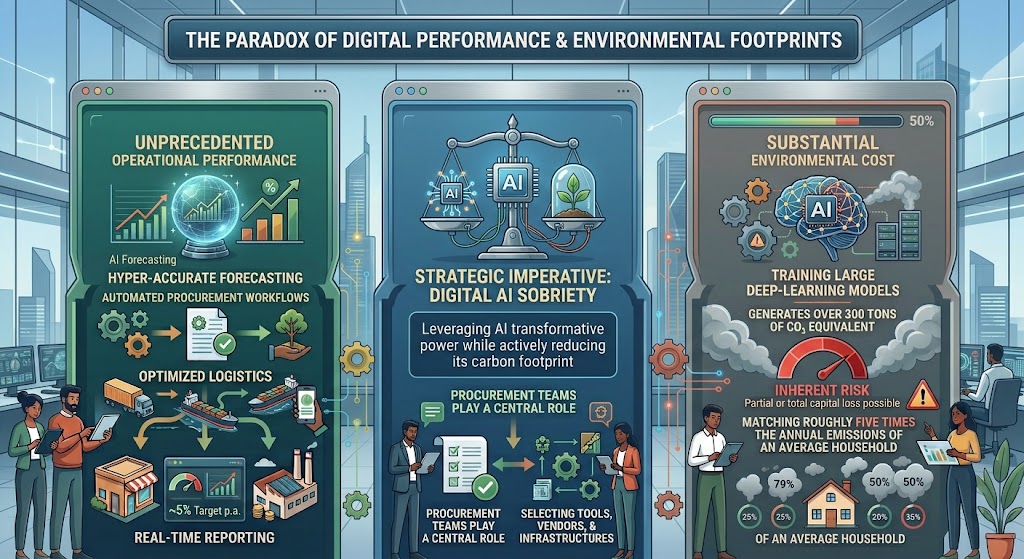
1. The Paradox of Digital Performance & Environmental Footprints

The rapid rise of Artificial Intelligence has unlocked unprecedented operational performance: hyper-accurate forecasting, automated procurement workflows, optimized logistics, and real-time reporting.

However, this technological leap carries a substantial environmental cost. Training large deep-learning models can generate over 300 tons of CO₂ equivalent—matching roughly five times the annual emissions of an average household.

In this context, digital AI sobriety becomes a major strategic imperative: leveraging the transformative power of AI while actively reducing its carbon footprint. Procurement teams play a central role by selecting tools, vendors, and infrastructures that balance innovation with sustainability.

2. Evolving Regulatory Requirements for Responsible AI

European regulatory frameworks—including the European Green Deal, the EU AI Act, and emerging digital sobriety directives—are establishing strict environmental and data protection standards for enterprise software procurement.

Procurement Action Items for AI Compliance

  • Energy Efficiency Criteria in RFPs – Integrating mandatory energy consumption and performance metrics into AI software tenders.
  • Green Cloud Infrastructures – Prioritizing data center partners powered by renewable energy with optimized cooling systems.
  • Certified Carbon Impact Reports – Requiring AI vendors to provide audited carbon emissions and environmental disclosures.

Foundations of Responsible AI in Procurement

Transparency, Explainability, and Algorithmic Ethics

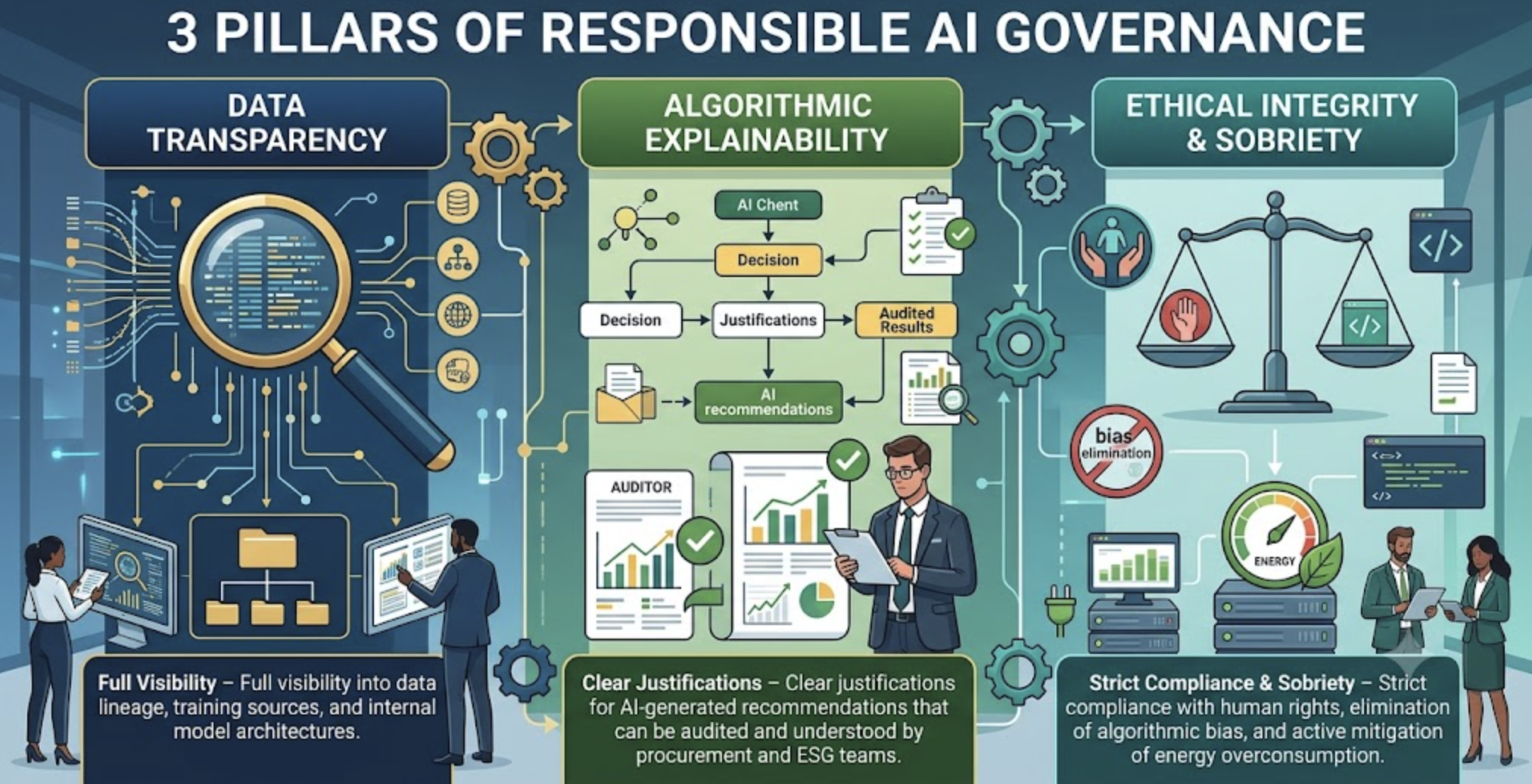
Embedding responsible AI within corporate procurement functions relies on three fundamental pillars to ensure automated decisions maintain neutrality, trust, and environmental compliance:

3 Pillars of Responsible AI Governance

  • Data Transparency – Full visibility into data lineage, training sources, and internal model architectures.
  • Algorithmic Explainability – Clear justifications for AI-generated recommendations that can be audited and understood by procurement and ESG teams.
  • Ethical Integrity & Sobriety – Strict compliance with human rights, elimination of algorithmic bias, and active mitigation of energy overconsumption.

Conclusion: Transforming Sustainability into Strategic Value

Elevating Procurement as a Guardian of Responsible Tech

By integrating environmental, ethical, and explainability criteria into technological evaluations, procurement leaders serve as guardians of responsible digital transformation.

Moving beyond simple performance metrics to select sustainable, fully compliant AI partners establishes a resilient foundation for long-term operational excellence and corporate ESG leadership.

Integrating Sustainability into AI Procurement Tenders

Evaluation frameworks for AI solutions across procurement departments are shifting rapidly. Selection criteria go far beyond initial pricing or functional capabilities—they now systematically incorporate environmental and social metrics.

New Sustainable AI Procurement Criteria

  • Model & Infrastructure Carbon Footprint – Auditing server energy consumption, model training duration, and hardware lifecycle recycling.
  • Data Center Localization – Prioritizing European cloud hosting facilities powered by renewable energy sources.
  • Algorithmic Governance – Guaranteeing adherence to ethical guidelines and alignment with ISO 42001 certification standards.
  • Digital Sobriety Policies – Requiring vendors to embed verifiable digital sobriety protocols within their corporate ESG roadmaps.
This holistic approach transforms AI into a strategic procurement category, where every technological investment doubles as a long-term commitment to sustainability.

Responsible AI: A Competitive Advantage for Procurement Leaders

Far from an operational constraint, AI digital sobriety serves as a powerful economic catalyst. By cutting energy overhead, streamlining data flows, and increasing algorithmic transparency, organizations achieve three key advantages:

Lower Operational Expenditures – Reduced computational usage directly lowers server and cloud processing costs.
Enhanced Stakeholder Attractiveness – Strengthens reputation and appeal among demanding ESG-focused partners and investors.
Reinforced Regulatory Compliance – Prepares the enterprise for strict European digital and environmental directives.

Case Study: Buy Made Easy – Balancing AI, Ethics & Sustainable Performance

1. Native Green AI Architecture & Digital Sobriety

At Buy Made Easy, artificial intelligence is engineered as a core driver of sustainable performance. Designed from inception around Green AI principles, the platform minimizes digital carbon footprint while maximizing operational efficiency:

• Hosted on low-impact cloud infrastructure powered by over 80% renewable energy.
• Delivers an average 42% reduction in compute resources required for AI data processing.
• Features continuous energy consumption tracking per AI module, visible within the Buy Made Easy ESG dashboard.
• Applies an environmental efficiency score to evaluate every AI deployment prior to rollout.

2. Explainable, Audited Algorithms Compliant with Global Standards

Fully compliant with the EU AI Act and ISO 42001 standards, Buy Made Easy ensures every automated output—supplier recommendations, performance scoring, or compliance alerts—is:

Explainable: Decision criteria remain fully transparent and justifiable.
Human-in-the-Loop: Supervised continuously by domain experts.
Audited: Routinely checked to eliminate algorithmic bias and drift.

3. Measurable Environmental & Operational ROI

Key Impact Metrics (Buy Made Easy Platform Benchmarks)

  • –27% Server Energy Consumption across data-processing AI modules
  • +18% Faster Processing Speeds, freeing valuable team bandwidth for strategic tasks
  • –30% Digital Carbon Footprint Reduction across automated procurement operations
  • Positive Environmental ROI achieved within the first 6 months of deployment

Conclusion: Aligning Technology with Purposeful Performance

Sustainable AI as the Benchmark of Future Procurement Excellence

Responsible AI proves that high operational performance and environmental stewardship are mutually reinforcing goals.

By combining Green AI architecture, explainable governance, and measurable ESG impact, platforms like Buy Made Easy set a new standard for ethical, resilient, and competitive digital procurement.
Driving Digital Sobriety Through Procurement Leadership

1. From Raw Power to Digital Frugality: A New Technological Culture

The era of unconstrained, brute-force computing power is officially drawing to a close. Today, the true performance of an AI model is no longer measured solely by processing speed or data volume, but by its capacity to deliver maximum operational value with minimal energy consumption.

This paradigm shift lies at the core of procurement-led digital sobriety, inviting forward-thinking organizations to fundamentally rethink their digital architecture.

Pillars of Digital Frugality in Enterprise AI

  • Eliminating Data Redundancy – Streamlining data collection pipelines to reduce unnecessary storage and processing overhead.
  • Pooling Compute Resources – Mutualizing server infrastructure to optimize resource utilization across teams.
  • Deploying Specialized AI Models – Prioritizing targeted, lightweight models over oversized, energy-intensive LLMs.
  • Performance-to-Energy Benchmarking – Evaluating every technology through a strict performance-versus-energy ratio integrated directly into procurement dashboards.

2. Procurement Leaders as Architects of Technological Sustainability

Procurement departments have become the primary guardians of sustainable digital transformation. By embedding energy efficiency, algorithmic governance, and digital traceability into vendor selection, procurement teams ensure ethical and eco-responsible AI deployment.
Key Governance Responsibilities:
• Select certified "Green Cloud" technology partners.
• Enforce full algorithmic transparency in RFPs.
• Continuously monitor the carbon and digital footprint of AI vendors.
• Align all technology investments with corporate ESG roadmaps.

Actionable Sustainability Tracking with Buy Made Easy

Platform features that turn sustainable procurement governance into tangible results:

  • Real-Time AI Energy Metrics – Transparent monitoring of energy consumption across active AI modules.
  • Vendor Digital Sustainability Scorecard – Clear ESG rankings to evaluate technology providers during tenders.
  • Smart Carbon Tracking Module – Integrated carbon footprint analytics tailored for strategic procurement projects.

Conclusion: Turning Responsible AI into a Strategic Advantage

Elevating Corporate Performance Through Frugal Digital Innovation

Moving from passive compliance to proactive digital sobriety transforms environmental responsibility into a strong market differentiator.

By combining lean, governed AI architectures with actionable ESG metrics, organizations using Buy Made Easy achieve the perfect balance between top-tier economic performance and environmental accountability.
Conclusion: AI as a Sustainable Compass for Procurement

Artificial Intelligence is no longer just a productivity lever—it is evolving into an ethical and sustainable compass for procurement leadership.

By adopting a strategic framework built on digital sobriety, responsible governance, and algorithmic transparency, organizations successfully convert emerging technologies into drivers of measurable sustainability.

3 Concrete Commitments from Buy Made Easy

  • Ethical & Explainable AI – Full compliance with European governance standards, including the EU AI Act and ISO 42001 certification.
  • Lean & Eco-Responsible AI – Hosted on energy-efficient cloud infrastructure designed to minimize carbon output.
  • High-Performance Operations – Optimizing procurement workflows while actively shrinking the enterprise digital carbon footprint.
The fundamental question is no longer “Should we adopt AI?”, but rather “How do we make it sustainable and governable?”. Procurement departments that anticipate this shift will transform regulatory compliance into a decisive competitive edge.

Transition to Responsible AI with Buy Made Easy

Empower Your Procurement Teams with Ethical & Frugal AI

Looking to integrate artificial intelligence into your procurement processes while ensuring CSR compliance, risk governance, and digital sustainability?

Discover how Buy Made Easy guides organizations through deploying ethical, lean, and high-performing AI solutions.

Frequently Asked Questions (FAQ)

How Can AI Make Procurement More Sustainable?

Artificial Intelligence reduces operational waste, improves spend analysis, and pinpoints eco-friendly suppliers across global supply chains. By streamlining workflows and optimizing logistics, AI minimizes resource consumption and accelerates circular economy initiatives.

What Defines Responsible AI in Procurement?

Responsible AI rests on three core pillars: ethics, transparency, and digital sobriety. It guarantees unbiased algorithms, complete data traceability, and a minimized environmental footprint throughout technological processing.

How Does Buy Made Easy Apply Digital Sobriety to Its AI Solutions?

Buy Made Easy engineers its AI modules using a native “Green AI” architecture. This includes hosting on low-energy servers, continuous real-time consumption tracking, and algorithmic optimization to reduce carbon loads without compromising performance.

Why Must Procurement Departments Drive Digital Sustainability?

Procurement teams select software, platforms, and tech vendors for the enterprise. Their role is to embed CSR and digital sobriety criteria into tenders, ensuring ethical, responsible AI usage across the entire value chain.

What Concrete Benefits Does Sustainable AI Deliver to Enterprises?

Triple Impact of Sustainable AI Adoption

  • Enhanced Operational Performance – Optimized workflows and faster processing speeds.
  • Lower Energy Costs – Streamlined data computing reduces server energy expenses.
  • Stronger ESG Attractiveness – Appeals to sustainability-minded business partners, clients, and investors.

Conclusion: Strategic Alignment of Tech & Sustainability

Pioneering Responsible Digital Transformation in Procurement

Adopting sustainable AI bridges economic performance with environmental stewardship, creating a future-proof procurement ecosystem.

By embedding digital sobriety into tech evaluation frameworks, procurement leaders drive long-term profitability, regulatory compliance, and positive ecological impact.

Line
Featured Post

Popular posts