Sourcing

Revealing the Unexplored Potential of Strategic Suppliers

Published By
Olivier Audino
Tags
Sourcing

Unlocking the Untapped Potential of Strategic Suppliers

Revealing the full potential of strategic suppliers can fundamentally transform your enterprise growth trajectory.

By transitioning from transactional vendor relationships to true strategic partnerships, organizations unlock high-value opportunities, drive collaborative innovation, and secure long-term competitive advantages.

1. Strategic Suppliers as Value Drivers

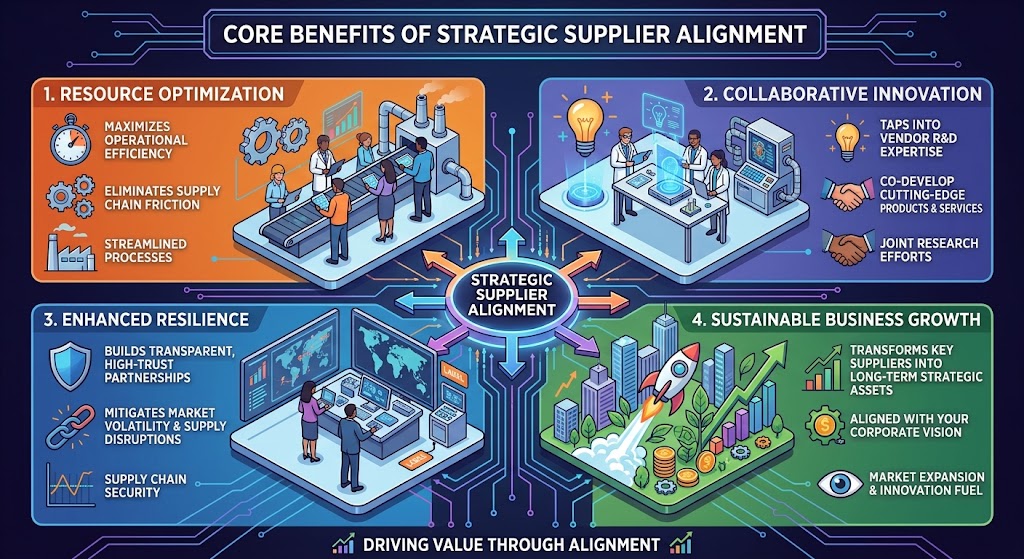
Core Benefits of Strategic Supplier Alignment

  • Resource Optimization: Maximizes operational efficiency and eliminates supply chain friction.
  • Collaborative Innovation: Taps into vendor R&D expertise to co-develop cutting-edge products and services.
  • Enhanced Resilience: Builds transparent, high-trust partnerships that mitigate market volatility and supply disruptions.
  • Sustainable Business Growth: Transforms key suppliers into long-term strategic assets aligned with your corporate vision.

2. Rethinking Commercial Relationships for Lasting Impact

Modern procurement demands a shift toward deep integration, joint value creation, and mutual accountability.

Treating key suppliers as integral growth partners enables businesses to elevate quality, optimize resource allocation, and propel operations to new heights.

Conclusion: Transform Your Supplier Network into a Growth Engine

Elevate Business Growth Through Strategic Partnerships

Rethinking your business relationships unlocks unprecedented operational efficiency and innovation potential across your supply chain.

Empower your organization to collaborate effectively with strategic suppliers and build lasting value for years to come.

Understanding the Determining Role of Strategic Suppliers

A strategic supplier is far more than a standard commercial vendor—they act as an indispensable partner in driving business growth.

Beyond delivering goods and services, strategic suppliers directly contribute to collaborative innovation, strict quality assurance, cost optimization, and supply chain continuity.

1. Definition & Core Contributions of a Strategic Supplier

A strategic supplier occupies a critical node within the global supply chain. Their value-add extends far beyond simple transactional exchanges.

By providing innovative technology, tailored commercial terms, and robust business continuity planning, strategic suppliers keep core operations running smoothly while creating market differentiation.

Core Contributions Checklist

  • Innovation & Quality: Delivers cutting-edge technology and high-standard product specifications.
  • Cost Optimization: Unlocks financial efficiency through process improvements and long-term volume pricing.
  • Supply Chain Continuity: Safeguards uninterrupted production through well-established risk mitigation plans.

2. Strategic Supplier Value Matrix

Strategic Contribution Business Importance
Innovation Helps differentiate products and services in competitive markets
Cost Reduction Directly increases profitability and margin performance
Product/Service Quality Improves customer satisfaction and brand reputation
Supply Chain Continuity Ensures uninterrupted manufacturing and delivery operations

3. Key Differences Between Strategic and Standard Suppliers

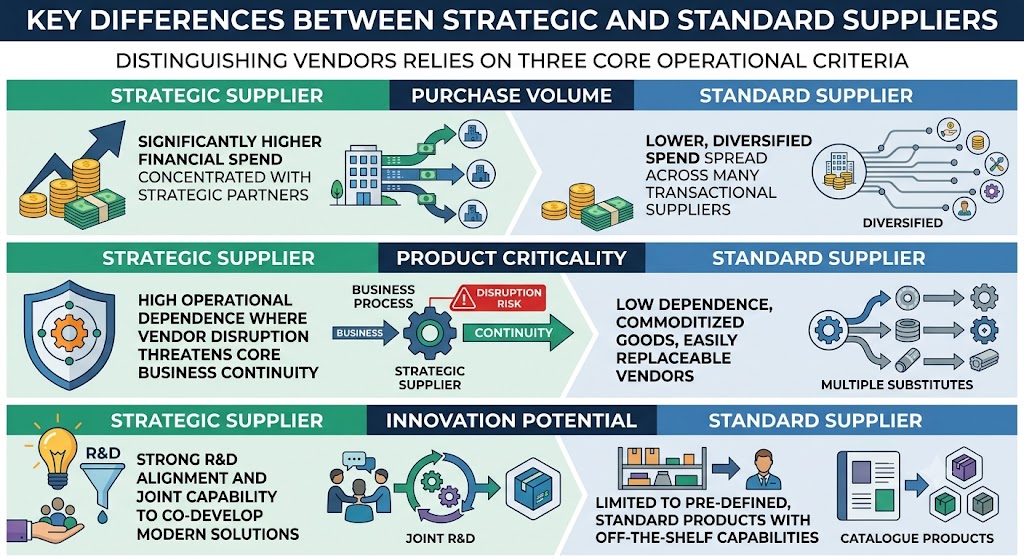
Distinguishing strategic vendors from transactional suppliers relies on three core operational criteria:

Purchase Volume: Significantly higher financial spend concentrated with strategic partners.
Product Criticality: High operational dependence where vendor disruption threatens core business continuity.
Innovation Potential: Strong R&D alignment and joint capability to co-develop modern solutions.

4. Strategic Impact on Enterprise Growth & Resilience

Key Competitive Advantages

  • Increased Competitiveness: Built on high-trust, collaborative commercial partnerships.
  • Supply Chain Agility & Resilience: Enables fast pivot capabilities during market shocks or supply disruptions.
  • Market Adaptability: Provides operational flexibility to meet shifting consumer demands.

Conclusion: Strengthening Enterprise Solidity

Transforming Vendor Relationships into Strategic Growth

Understanding and elevating the role of strategic suppliers allows companies to extract maximum value from key business relationships.

By integrating key suppliers into your core corporate strategy, you build a resilient, highly competitive supply chain primed for long-term growth.
Effective Process for Identifying Strategic Suppliers

Knowing how to identify a strategic supplier plays a major role in commercial success. A high-performing vendor does not merely ship products; they become a key partner in driving continuous business growth and operational stability.

1. Expense Analysis to Identify Key Partners

Conducting a thorough expenditure analysis is crucial. By mapping spending patterns across product categories, organizations uncover which vendors represent the largest portion of their procurement budget.

Categorizing suppliers based on purchase volume provides clear visibility into financial commitments and helps prioritize relationships with vendors that deliver significant value to the business.

2. Core Selection Criteria Beyond Financial Spend

5 Key Identification Criteria

  • Expenditure Mapping: High spend concentration requiring close commercial oversight.
  • Product Criticality Assessment: Essential or unique components with few market substitutes.
  • Financial Impact Evaluation: Contribution to economies of scale, margin health, and overall profitability.
  • Innovation Potential Analysis: Capacity to offer advanced technologies and co-develop tailored solutions.
  • Risk & Dependency Assessment: Geopolitical stability, capacity constraints, and single-source exposure.

3. Using the Kraljic Matrix for Supplier Classification

The Kraljic Matrix is a powerful analytical framework for portfolio segmentation. It categorizes suppliers into four distinct quadrants: Leverage, Strategic, Bottleneck (Critical), and Routine (Standard).

Isolating suppliers in the Strategic Quadrant (high supply risk, high profit impact) highlights partners with the greatest potential for long-term co-development, joint value creation, and collaborative innovation.

4. Strategic Supplier Identification Matrix

Evaluation Criterion Operational Description
Significant Expenditures Represents a major proportion of overall procurement spend
Product Criticality Delivers unique or indispensable components to core operations
Financial Impact Drives economies of scale and directly protects margin growth
Innovation Potential Demonstrates joint R&D capabilities and cutting-edge technology
Risk & Dependency Exhibits high switching costs or operates in volatile regions

Conclusion: Optimizing Strategic Sourcing Frameworks

Build a Resilient, High-Value Supply Chain

Applying structured criteria and spend analysis ensures that your organization focuses energy on vendors that deliver real competitive advantage.

Transform your procurement strategy by identifying key partners, mitigating risk, and unlocking long-term collaborative value.

Optimizing Strategic Supplier Relationship Management

In the dynamic world of procurement management, cultivating strong relationships with strategic suppliers is fundamental. These key partners play a decisive role in driving enterprise competitiveness and long-term market growth.

Optimizing these commercial alliances requires structured methods, collaborative frameworks, and proactive performance tracking to extract maximum joint value.

1. The Importance of Strategic Partnerships

Strengthening strategic partnerships is essential to maximize value creation. Fostering mutual respect and shared commitment builds win-win solutions, facilitating close collaboration on innovative initiatives while securing critical supply lines.

Long-term contractual relationships encompass performance standards, joint R&D, and corporate social responsibility (CSR) goals—yielding substantial cost savings and early access to industry innovations.

Core Benefits of Strategic Partnerships

  • Priority Access to New Technologies: Early adoption of cutting-edge vendor solutions and market innovations.
  • Cost Reduction via Economies of Scale: Shared financial efficiencies and optimized long-term volume pricing.
  • Higher Delivery Reliability: Secured inventory allocations and heightened operational resilience.

2. Establishing Transparent Communication Channels

Open communication is at the heart of a successful vendor relationship. Establishing regular dialogue enables companies to share demand forecasts, operational requirements, and strategic goals with key suppliers—building trust and eliminating costly misunderstandings.

Scheduled Business Reviews: Regular alignment meetings to assess operational progress and strategic priorities.
Real-Time Digital Collaboration: Leveraging collaborative platforms for transparent data sharing and inventory tracking.
360-Degree Feedback Surveys: Gathering constructive feedback to drive continuous supply chain improvements.

3. Rigorous Monitoring of Supplier Performance

To optimize strategic supplier management, having a structured tracking system is crucial. Defining clear KPIs that account for quality, total costs, lead times, and innovation capabilities ensures vendors continuously meet their contractual commitments.

Interactive dashboards summarize performance metrics, enabling procurement leaders to pinpoint bottlenecks, recognize high performance, and motivate vendors to invest in co-development opportunities.

4. Strategic Supplier Performance Scorecard

Performance Indicator (KPI) Annual Target Benchmark Current Operational Status
Specification Compliance Rate 95% 92%
Customer / Stakeholder Satisfaction 4.0 / 5.0 Stars 3.8 / 5.0 Stars
On-Time Delivery (OTD) Rate 98% 97%

Conclusion: Building Sustainable Strategic Alliances

Securing Long-Term Commercial Success

Optimizing relationships with strategic suppliers demands a balanced strategy built on solid partnerships, transparent communication, and rigorous performance tracking.

By executing these best practices, enterprise procurement teams guarantee the strength, stability, and mutual profitability of their strategic alliances.
FAQ: Revealing the Unexplored Potential of Strategic Suppliers

Why Is It Important to Choose the Right Strategic Suppliers?

Selecting the right strategic suppliers significantly enhances product quality while optimizing overall procurement costs.

A dependable supplier delivers materials of consistent quality, preventing production delays and safeguarding customer satisfaction across your distribution channels.

How Do You Recognize a Potential Strategic Supplier?

High-potential strategic suppliers stand out through key operational qualities:

Reliability & Flexibility: The agility to adapt quickly to shifting demand or supply chain disruptions.
Innovation & Vision: A willingness to co-develop modern solutions and align with your enterprise values and long-term corporate goals.

What Benefits Do Strategic Suppliers Bring to Your Business?

Core Strategic Advantages

  • Preferential Commercial Terms: Optimized pricing models, favorable payment terms, and volume rebates.
  • Exclusive Product Access: Priority allocation and exclusive access to in-demand products or innovations.
  • Margin Expansion: Enhanced operational efficiency that directly elevates your net profitability.

How Do You Maintain Good Relationships with Strategic Suppliers?

Regular, transparent communication forms the bedrock of sustainable vendor partnerships.

Establishing monthly performance reviews and structured dialogue enables both parties to address operational risks proactively, foster mutual trust, and deepen strategic alignment.

What Mistakes Should You Avoid When Managing Strategic Suppliers?

Avoid over-reliance on a single vendor. Over-concentration creates critical single-point-of-failure risks that can compromise your entire supply chain during unforeseen disruptions.

Maintaining a balanced supplier portfolio minimizes operational vulnerability and ensures business continuity.

Conclusion: Unlocking Long-Term Supply Chain Value

Transforming Vendor Management into a Competitive Advantage

Identifying, nurturing, and diversifying strategic supplier relationships converts raw procurement functions into a resilient growth engine.

Empower your enterprise with collaborative vendor strategies to secure supply continuity, drive innovation, and maximize commercial performance.

Line
Featured Post

Popular posts