Olivier Audino
Webinar
Comment 3 leaders de l'Auto ont fait économiser +1000 heures à leurs équipes Achats
Jeudi 02 Octobre à 11h00

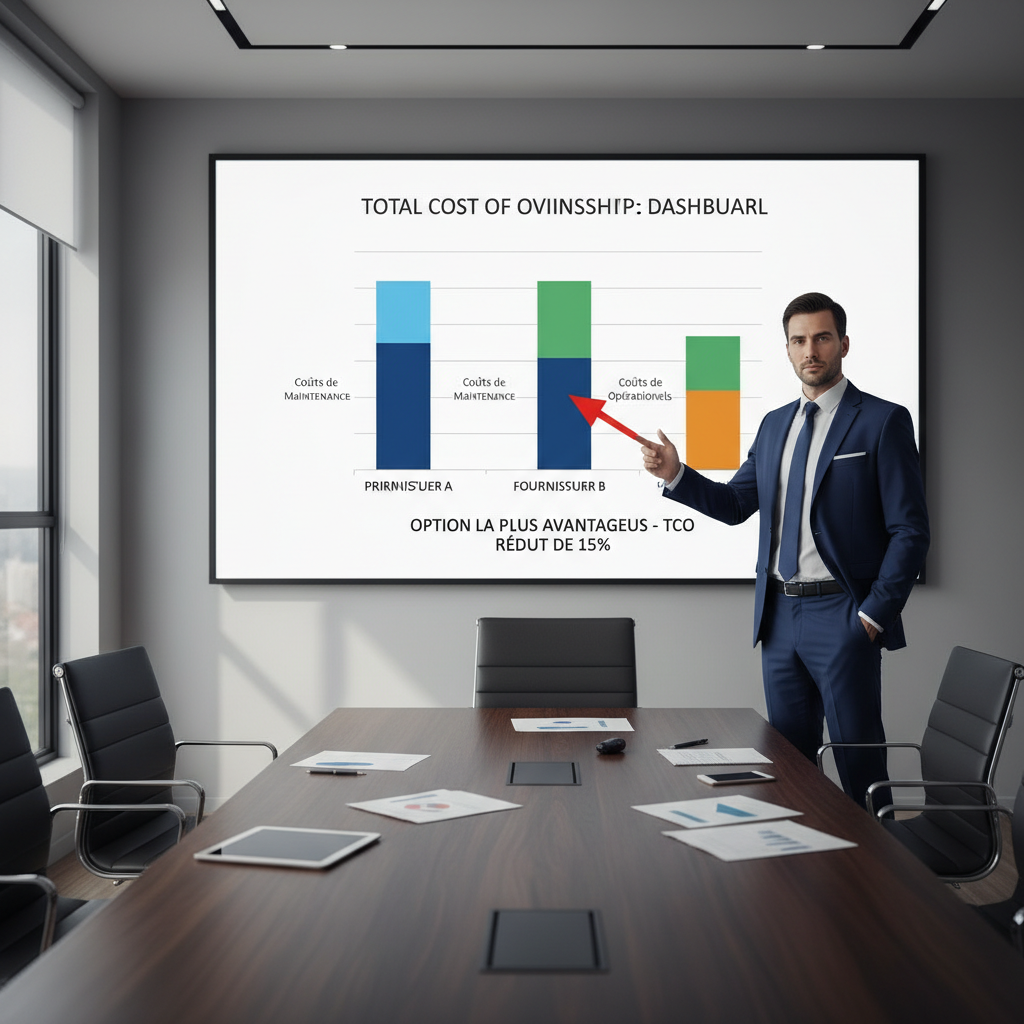

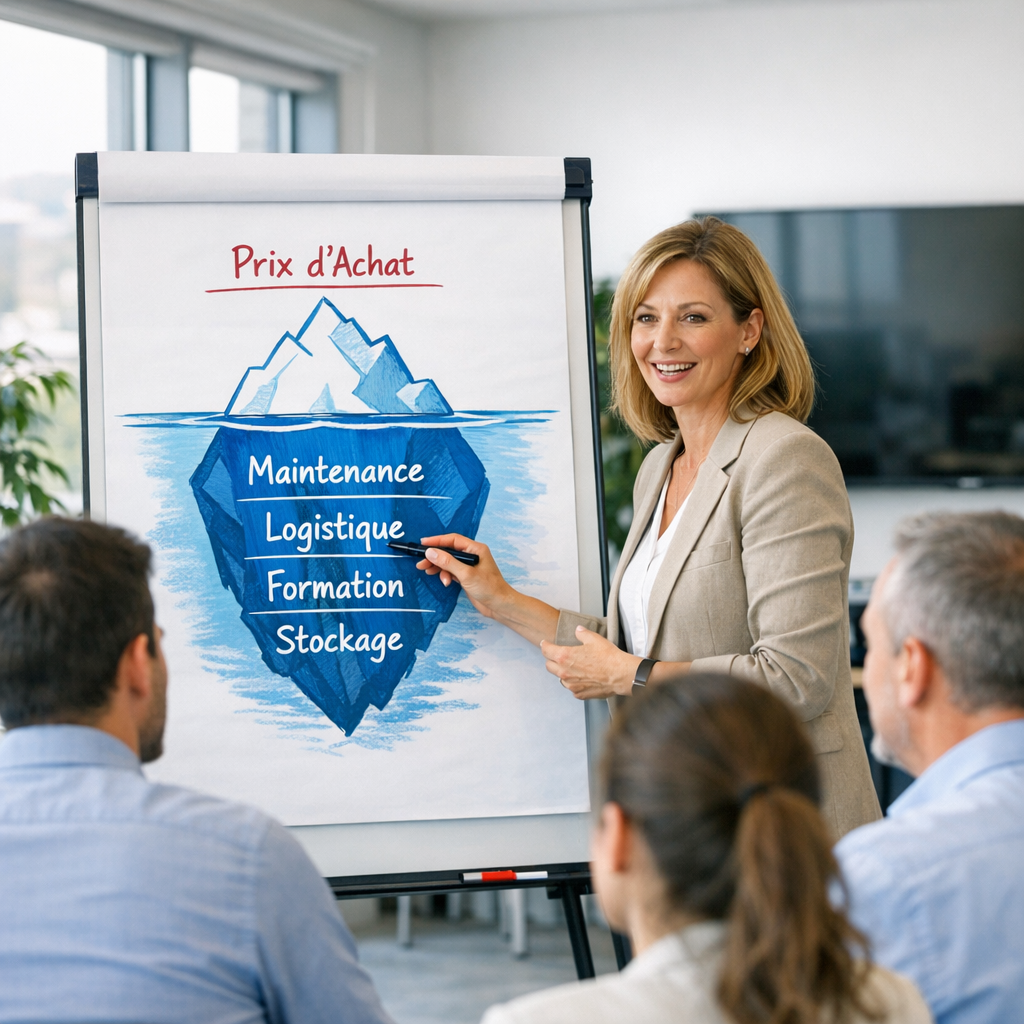
When a buyer compares several offers, the natural reflex is often to focus primarily on the purchase price. Yet this amount only reflects part of the economic reality. Commissioning fees, maintenance costs, time spent on support, risks of poor quality or early replacement gradually add up and fundamentally change the financial equation. This is exactly what Total Cost of Ownership (TCO) is designed to measure: the overall cost of a product or service over its entire lifecycle.
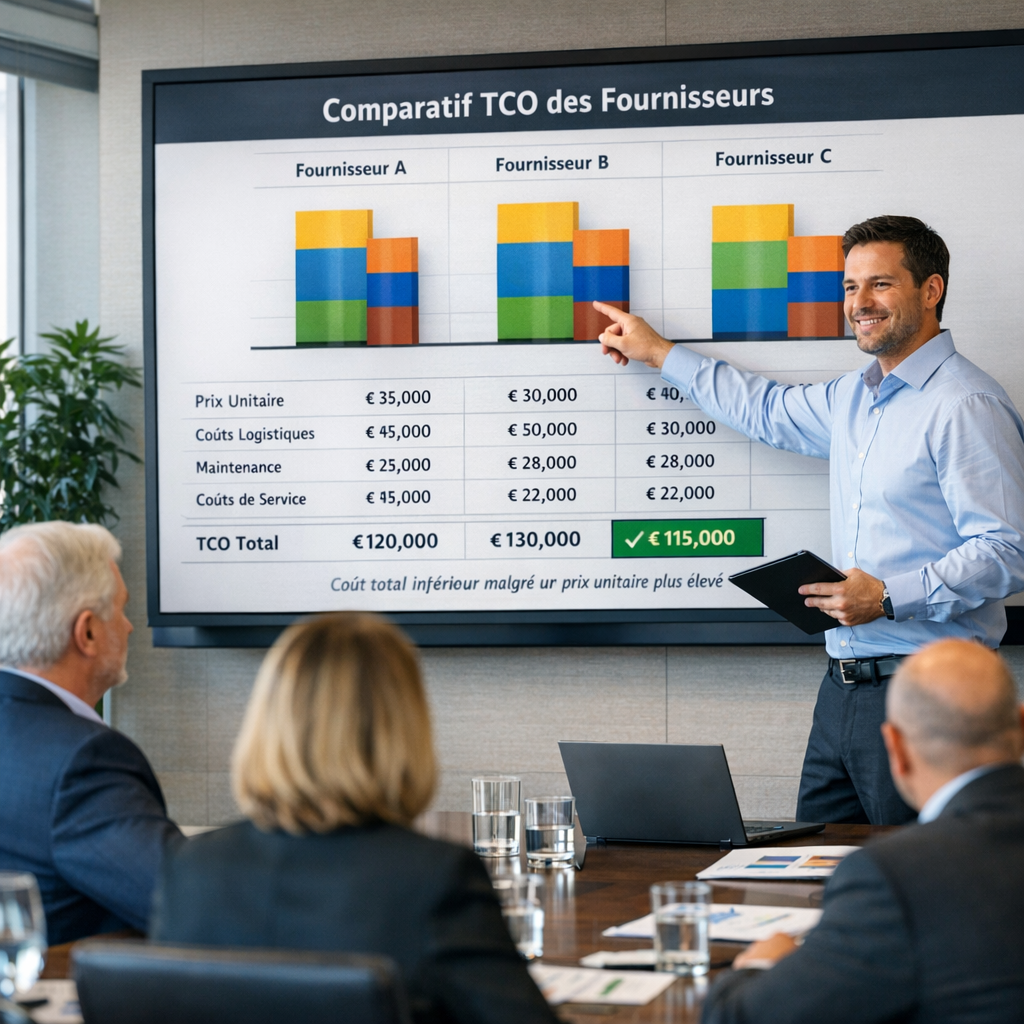
For a procurement function, the goal is therefore not only to negotiate an attractive price, but to compare complete scenarios that include acquisition, operation, support and end-of-life costs. A structured TCO methodology makes it possible to highlight significant gaps between options that initially looked similar. Educational resources dedicated to the total cost of ownership show how managing the overall cost has become a strategic lever for companies that want to secure their decisions.
TCO is also part of a broader trend towards more professional procurement practices, supported by numerous international publications and organisations such as CIPS (Chartered Institute of Procurement & Supply) , which recommend systematically including the overall cost in supplier comparisons. In this article, we outline an operational method to calculate TCO, break down the different cost components, illustrate the approach with a practical case, and show how to use the overall cost to make better purchasing decisions.
Total Cost of Ownership (TCO) is based on a broader view of the cost of a product or service. The objective is no longer to compare prices only, but to include all expenses related to acquisition, usage, support and end of life. This approach helps avoid decisions based on misleading upfront amounts and provides a comprehensive financial analysis. The work relating to lifecycle assessment and international standards shows that a long-term view of costs is now recognised as a best practice in economic evaluations.
For procurement teams seeking to manage purchasing performance more effectively, TCO offers a reliable framework to compare suppliers on the real cost of their solutions, not just on the initial quote.
Direct costs include the expenses that are immediately identified at the time of purchase. They cover the purchase price, delivery fees, installation costs and all services associated with the initial deployment. Even though these amounts are straightforward to measure and appear clearly on quotes or invoices, they often account for only a small share of the total cost over time.
Indirect costs include all the expenses required for day-to-day operation, such as technical support, upgrades, training, consumables or administrative processing. These elements are regularly identified as soon as a structured analysis is carried out, especially as part of a complete evaluation of costs linked to sourcing and supplier management. They largely explain the differences observed between the list price and the real cost of a solution.
A breakdown, delay, configuration error or lack of supplier availability creates additional costs. These expenses do not appear in the initial offer but directly impact operational performance: lost time, rework, non-compliance, mobilisation of teams, potential penalties. TCO includes these elements to reflect the real economics of usage.
Over the long term, expenses related to maintenance, spare parts, obsolescence or contract renewal are often the most significant. TCO considers the complete cost of a piece of equipment or service from acquisition to retirement, including enhancement work, upgrades and exit costs. For companies engaged in company-wide cost optimization, this lifecycle view is essential.
Cost category
Description
Concrete examples
Direct costs
Initial expenses linked to the purchase
Price, delivery, installation
Indirect costs
Usage and operating expenses
Support, training, consumables
Non-quality costs
Costs generated by error, defect or delay
Rework, incidents, downtime
Risk-related costs
Expenses linked to uncertainty or variability
Supplier delays, service fluctuations
Lifecycle costs
Expenses spread across full lifetime
Maintenance, upgrades, end of contract
Calculating Total Cost of Ownership requires a structured approach. The objective is not to multiply formulas, but to build a coherent model that allows you to compare several options while taking all costs over time into account. This approach supports better optimisation of procurement processes and helps steer decisions based on factual criteria rather than an isolated unit price.
The first step is to define all the costs that make up the lifecycle of the product or service. This means a comprehensive inventory that brings together direct, indirect, non-quality, operating and exit costs. Organisations that want to structure this analysis often rely on supplier assessment methods to better understand the operational impact of each option and to analyse supplier performance .
TCO is only reliable if the data used comes from verified sources: technical teams, finance, procurement, operations and end users. The quality of this data collection directly determines the relevance of the final calculation. Metrics must be factual, measurable and directly linked to the real usage of the product or service.
Some expenses never appear on quotes, yet they strongly influence profitability: internal time spent on support, supply delays, administrative overload, performance variability or service interruptions. Sector studies published by firms such as Deloitte show that these elements often represent a significant share of the overall cost, particularly in environments with high technological dependency.
Once the costs have been identified and quantified, the calculation consists of summing all items over the analysis period. The result provides a complete view that allows you to compare several purchase or renewal scenarios objectively. This method prevents decisions based solely on the “price” line and reveals the financial consequences of each choice.
Cost item
Elements to include
Impact on TCO
Acquisition
Price, installation, configuration
Initial financial baseline
Operation
Maintenance, support, consumables
Recurring costs
Internal time
Management, coordination, user support
Resources mobilised
Non-quality
Delays, defects, interruptions
Reactive and corrective costs
Lifecycle
Renewal, upgrades, migration
Long-term financial impact
Exit
Termination, transfer, replacement
Real final cost
To illustrate the method, let us take the example of a company comparing two subscription-based collaborative software solutions. At first glance, one offer displays a lower monthly price, which might immediately influence the decision. A Total Cost of Ownership analysis, however, shows that the overall cost can be very different once you include deployment fees, support, internal resources and exit conditions. This type of comparison is part of a broader approach to optimising costs across the organisation , where the objective is to improve profitability without compromising service levels.
Direct costs include the subscription price, commissioning fees and initial training. In our scenario, Solution A offers a lower subscription fee but higher start-up costs, while Solution B has a higher monthly price but reduced installation expenses. Taken in isolation, these elements are not enough to distinguish between the two offers.
Indirect costs concern the time spent by internal teams on configuration, user assistance and managing simple incidents. A less intuitive solution, or one that is poorly integrated with existing tools, is likely to generate more internal support requests and increased technical interventions. These hours never show up on invoices, but they have a direct impact on the overall cost.
The lifecycle includes updates, functional enhancements, version upgrades and, eventually, the possibility of switching to another solution. Studies published by firms such as Boston Consulting Group (BCG) and Gartner emphasise the importance of taking into account reversibility conditions, data migration costs and constraints linked to contract termination. An offer that is inexpensive in the short term can become much more costly if switching providers is complex.
By aggregating all cost items over a three-year period, the company obtains a complete view of the overall cost for each solution. The table below illustrates this type of comparison: while Solution A appears more economical at the outset, the TCO calculation shows that Solution B can become more advantageous thanks to better control of indirect costs and more favourable exit conditions.
Cost item (3 years)
Solution A
Solution B
Subscriptions
€45,000
€54,000
Commissioning and initial training
€12,000
€6,000
Internal time (support, configuration)
€18,000
€9,000
Incidents and adjustments
€9,000
€4,500
Exit and migration costs
€15,000
€6,000
Estimated TCO over 3 years
€99,000
€79,500
Total Cost of Ownership only delivers value if it is used as a true decision-making tool. The objective is not just to produce a detailed calculation, but to compare several options using the same framework, to factor in risks and to project costs over time. In this logic, TCO becomes a common language between procurement, finance and business stakeholders, and fits naturally into structured purchasing decision processes .
To be usable, TCO must be built on an identical model for all offers being evaluated. Each scenario needs to integrate the same cost categories, the same analysis period and the same volume assumptions. This consistency allows for quick comparison of several suppliers, not on a single price line, but on their overall medium- or long-term financial impact.
Some solutions present a higher level of risk: technological dependency, concentration on a limited number of providers, exposure to price changes or to service availability issues. TCO can incorporate these elements through conservative scenarios, for example by simulating extra costs related to service interruptions or additional interventions. Recommendations issued by professional bodies such as management accounting institutes highlight the importance of linking these financial scenarios to explicit assumptions about risk and performance.
Reading a TCO requires attention to the time horizon: a three-year contract is not managed in the same way as a five- or seven-year commitment. It can be useful to convert the overall cost into an average annual cost or a unit cost per user, site or transaction. This normalisation makes it easier to compare solutions with different cost profiles, for example between
Adopting Total Cost of Ownership transforms the way organisations evaluate their spending. Beyond comparing prices, TCO measures the real profitability of a solution by integrating operational costs, potential risks and the overall impact on teams. This approach strengthens the ability of companies to take balanced decisions aligned with their strategic goals and with the way they organise and manage their procurement .
TCO provides a robust analytical basis that makes it easier to compare several offers, even when their pricing structures differ. Decision-makers have an objective framework for arbitrating between scenarios, reducing the influence of biases linked to the initial price. This methodology fits naturally with the implementation of procurement dashboards and purchasing KPIs .
Hidden costs related to internal time, incidents, delays or technical adjustments represent an important share of the overall cost. By making them visible, TCO helps identify sources of savings that cannot be detected through a simple price comparison. Organisations thus improve the accuracy of their financial forecasts and limit unplanned overruns.
TCO analysis highlights suppliers that generate the lowest variability and the most reliable operations. A provider with a higher price but excellent reliability can have a lower TCO than a cheaper but unstable competitor. This long-term view encourages more relevant supplier management and supports relationships based on sustainable performance.
By integrating the time spent by teams in the cost calculation, organisations can measure the real workload generated by a solution more accurately. This helps identify tasks to automate, processes to simplify and activities that mobilise too many internal resources. TCO therefore becomes a management tool to optimise time allocation and improve overall productivity.
Total Cost of Ownership provides a structured method to compare several solutions by taking into account all costs generated throughout their lifecycle. By including direct and indirect costs, internal effort, risks and exit conditions, companies gain a reliable view of the real profitability of each option. This approach helps avoid decisions based solely on an attractive purchase price and reveals the economic gaps that appear over time.
Organisations that master TCO strengthen their ability to secure their choices, improve financial control and optimise the overall impact of their investments. They also equip their procurement teams with a shared language to discuss scenarios with finance and operational stakeholders.
Adopting a TCO approach does not require complex tools: the key is to structure data collection, compare scenarios consistently and include operational implications in the analysis. Procurement departments that apply this method quickly see gains in visibility, coherence and efficiency, while benefiting from solid arguments to justify their decisions.
Do you want to analyse your spend using a robust, TCO-based approach tailored to your organisation? Our experts can help you build a complete model and assess several purchasing scenarios.

The calculation is based on a structured addition of all costs linked to a product or service: acquisition, operation, internal time, non-quality, lifecycle and exit conditions. The key is to define a consistent model and use the same cost categories to compare several options. This framework provides a reliable estimate of the overall cost.
The most commonly neglected elements are internal time spent by teams, downtime, technical adjustments and end-of-contract expenses. These items never appear on quotes but have a strong impact on the real profitability of a solution.
The purchase price only reflects the initial amount paid when ordering. TCO includes all expenses generated during the entire lifecycle of the product or service. A cheaper supplier upfront can have a much higher TCO if support, maintenance or operational risks drive up indirect costs.
Yes, and services are often where TCO reveals the largest differences. User support, internal time, incidents and contractual changes can modify the overall cost much more significantly than the price shown on the quote.
Absolutely. TCO can be embedded into a broader procurement management framework, for example when building a purchasing dashboard or prioritising investments. It helps align decisions with both operational and budget objectives.



.svg)