Purchasing profession

Optimizing Supplier Management Through Calls for Tenders

processus d’appel d’offres structuré pour renforcer la transparence et la compétitivité achats
Published By
Olivier Audino
Tags
Sourcing

Optimizing Supplier Management Through Strategic Tendering

In today's competitive business environment, mastering the tendering process can fundamentally transform your supplier management strategy and vendor relationships.

Whether you aim to lower procurement costs, elevate quality standards, or drive operational agility, a structured tender produces tangible, measurable results across your end-to-end supply chain.

1. Key Strategic Benefits of Competitive Tendering

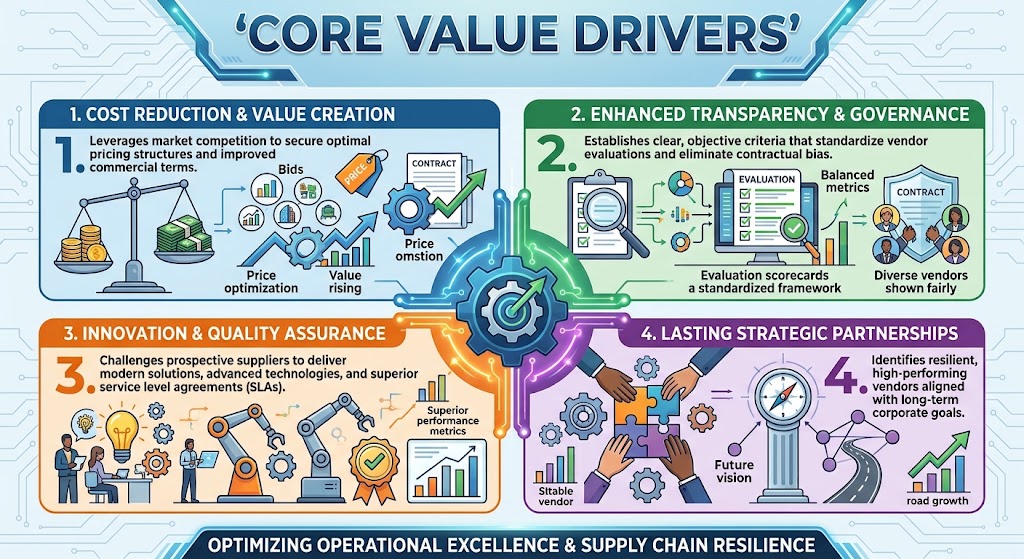
Core Value Drivers

  • Cost Reduction & Value Creation: Leverages market competition to secure optimal pricing structures and improved commercial terms.
  • Enhanced Transparency & Governance: Establishes clear, objective criteria that standardize vendor evaluations and eliminate contractual bias.
  • Innovation & Quality Assurance: Challenges prospective suppliers to deliver modern solutions, advanced technologies, and superior service level agreements (SLAs).
  • Lasting Strategic Partnerships: Identifies resilient, high-performing vendors aligned with long-term corporate goals.

2. Transforming Tenders into a Powerful Growth Lever

Strategic tendering shifts vendor management from a simple tactical routine into a disciplined, high-value business process.

By establishing precise technical specifications, managing vendor interactions through transparent channels, and applying rigorous scoring frameworks, organizations turn competitive bidding into a sustainable lever for enterprise growth.

Conclusion: Propel Your Business to New Heights

Elevate Your Supplier Network with Strategic Tendering

Unlocking the true potential of tendering empowers procurement teams to build transparent, innovative, and cost-effective vendor ecosystems.

Master the tendering process to lower supply chain risks, optimize corporate expenditure, and forge lasting strategic partnerships.

Understanding the Fundamental Principles of Tenders

A tender is a primary tool in strategic supplier management. Its core purpose is to select the most suitable vendor to fulfill specific business requirements.

Executed through a formalized procedure, tenders evaluate suppliers across multifaceted criteria—including cost, quality, SLA standards, and sustainability—ensuring total transparency, healthy market competition, and resource optimization.

1. Definition & Strategic Objectives of Tenders

Tendering is a structured methodology used by corporate enterprises and public sector organizations to identify optimal suppliers.

By establishing precise specifications and evaluation benchmarks, tenders create a competitive environment that encourages prospective vendors to submit highly compelling commercial and technical offers.

Core Advantages of Process Transparency

  • Increased Competitiveness: Drives vendor innovation and unlocks optimal pricing structures.
  • Resource Optimization: Guarantees every euro invested yields maximum operational return.
  • Fairness & Compliance: Ensures all participating suppliers receive equal evaluation opportunities.

2. Types of Tenders & Market Applications

Different tender categories address specific procurement requirements and market conditions:

Open Tenders: Accessible to all interested suppliers, offering maximum inclusivity.
Restricted Tenders: Limited to pre-qualified suppliers for targeted vendor selection.
Public Tenders: Mandatory for public sector procurement, ensuring strict statutory compliance and maximum transparency.
Private Tenders: Deployed in the private sector to build strategic, long-term vendor partnerships.
Type of Tender Accessibility Sector of Use
Open Open to all suppliers Public & Private sectors
Restricted Pre-selected candidates only Public & Private sectors
Public Mandatory regulatory process Public sector
Private Targeted vendor invitations Private sector

3. Tenders vs. Other Procurement Procedures

Distinguishing tenders from alternative purchasing workflows lies in procedural depth and strategic focus:

Structure: Tenders are highly formalized, detailed, and structured compared to quick market inquiries.
Duration: Tenders require longer execution timelines than Requests for Quotes (RFQs), which often focus solely on fast price comparisons.
Strategic Focus: Calls for Expressions of Interest (AMI) explore market interest and identify vendor capabilities, whereas tenders execute immediate, contract-binding supplier selection.

Conclusion: Optimizing Supplier Relationship Management

Driving Strategic Procurement Performance

Mastering the core principles of tendering enables procurement teams to maximize commercial leverage and streamline vendor selection.

By applying the right tender structure to your sourcing needs, you safeguard corporate compliance, lower risks, and build long-term value across your supply chain.
Impact of Tenders on Supplier Management Strategy

Tenders play a central role in how modern businesses manage vendor relationships. Beyond selecting the most qualified suppliers, competitive tendering sharpens market competitiveness and integrates critical sustainability standards into supplier management strategies.

1. Objective Supplier Selection Through Tenders

Tenders offer an objective, structured methodology for identifying suppliers best aligned with enterprise needs.

By establishing clearly defined and comparable metrics, organizations ensure that selections are grounded in tangible, auditable data—minimizing potential risks associated with subjective choices.

Core Supplier Selection Criteria

  • Product & Service Quality: Rigorous evaluation of technical capabilities and specifications.
  • Delivery Reliability: Proven operational capacity to meet lead time commitments consistently.
  • ESG Compliance: Adherence to strict environmental, ethical, and social standards.
  • Innovation & Value Proposition: Supplier capacity to introduce cost-saving or high-tech solutions.

2. Strengthening Market Competitiveness

Fostering a competitive bidding environment is one of the primary strategic advantages of tendering.

By encouraging vendors to present their most competitive proposals, organizations achieve substantial cost savings and shorten delivery timelines. This healthy market competition drives suppliers to continuously innovate and elevate their service delivery.

Competitive Advantages of Strategic Bidding

  • Procurement Cost Reduction: Unlocks optimal market pricing through structured competitive leverage.
  • Lead Time Optimization: Streamlines supply chain velocity and contract execution speeds.
  • Access to Market Innovation: Captures cutting-edge vendor technologies through rigorous bid evaluations.

3. Integrating ESG Criteria in Tender Evaluations

Incorporating Environmental, Social, and Governance (ESG) criteria into tender frameworks has become a strategic priority for modern procurement teams.

This approach ensures that supply chains adhere to strict sustainability benchmarks, attracting value-aligned suppliers while mitigating legal and reputational risks.

4. Summary: ESG Criteria & Supply Chain Impact

ESG Dimension Tender Evaluation Criteria Strategic Supply Chain Impact
Environmental Carbon footprint, waste management & eco-sourcing Reduces ecological footprint & ensures regulatory compliance
Social Fair labor practices, workplace safety & diversity Safeguards corporate ethics & strengthens brand reputation
Governance Anti-corruption policies, compliance & financial stability Mitigates legal risks & builds long-term stakeholder trust

Conclusion: Maximizing Tender Value in Supplier Strategy

Elevate Your Supplier Strategy

Leveraging structured tenders empowers organizations to optimize procurement expenditure, secure reliable operational handoffs, and embed sustainability directly into their core supply chains.

Transform vendor selection into a continuous growth driver by aligning tender frameworks with enterprise objectives.

Methodologies & Best Practices for a Successful Tender

Succeeding in a competitive tender is no trivial matter. It demands meticulous preparation, structured strategy, and proven methodologies to ensure you select the right supplier while optimizing cost and quality.

1. Elaboration of Precise Specifications

The crucial first step in any tender is establishing clear, detailed specifications. Consider this document as the official roadmap for your project.

Explicitly detailing your exact expectations prevents misunderstandings later in the procurement process. Specifications should incorporate:

• Detailed technical requirements & scope of work
• Operational milestones & delivery timelines
• Objective proposal evaluation criteria

2. Transparent Communication with Suppliers

Transparent communication is essential for a successful tender outcome. It clarifies expectations and establishes a relationship of trust with prospective partners.

Maintaining open dialogue across multiple communication channels (calls, structured meetings, or formal Q&A email portals) keeps suppliers engaged, resolves ambiguities quickly, and encourages vendors to submit their most competitive bids.

3. Leveraging E-Procurement & Digital Tools

Modern digital tools transform tender management by automating time-consuming administrative tasks, such as bid collection, document verification, and proposal scoring.

E-procurement platforms like SAP Ariba or Coupa centralize supplier submissions in one secure repository, facilitating side-by-side comparison, reducing human error, and accelerating decision-making.

Tendering Best Practices Checklist

  • Write Clear & Detailed Specs: Eliminate ambiguity by publishing comprehensive technical requirements.
  • Maintain Open Communication: Establish structured Q&A workflows and regular updates for participating vendors.
  • Centralize Proposals via e-Sourcing: Utilize digital platforms to streamline bid intake, audit trails, and evaluation matrices.

4. Summary of Key Tender Stages

Tender Stage Core Operational Description
Specifications Document Create a precise specification drafting all technical, legal, and operational criteria
Supplier Communication Maintain regular, transparent exchanges and structured Q&A forums with vendors
Digital Integration Deploy e-sourcing tools like SAP Ariba to automate evaluation and management

Conclusion: Transforming Your Supplier Relationships

Achieve Sustainable Value Through Rigorous Sourcing

A well-managed tender process builds transparency, lowers procurement risks, and fundamentally transforms your supplier ecosystem.

By applying these best practices, enterprise procurement teams can secure optimal commercial terms, ensure high-quality delivery, and build lasting strategic partnerships.

FAQ: Optimizing Supplier Management Through Tenders

Q1: Why Use a Tender for Supplier Management?

A tender allows you to systematically compare supplier offers to secure the optimal balance between price and quality.

Leveraging market competition through a structured tender process can yield substantial procurement savings—often reducing costs by up to 20% while elevating overall vendor performance.

Q2: How Do You Write an Effective Tender?

Writing an effective tender requires absolute clarity regarding project scope and business requirements:

• Express technical specifications and deliverables precisely.
• Define objective evaluation criteria upfront, including target delivery lead times and quality standards.

Publishing explicit benchmarks enables prospective vendors to submit highly relevant, comprehensive, and tailored proposals.

Q3: What Are the Key Benefits of Effective Supplier Management?

Core Business Benefits

  • Direct Cost Reduction: Unlocks competitive pricing and eliminates unnecessary expenditure.
  • Enhanced Quality Standards: Guarantees strict compliance with product and service level specifications.
  • Stronger Strategic Partnerships: Reliable supplier relationships pave the way for preferential commercial terms, priority support, and long-term stability.

Q4: What Key Criteria Should Be Evaluated in a Tender?

A holistic tender evaluation should look beyond initial purchase price to assess:

• Total cost and commercial pricing structures
• Technical quality and specification compliance
• Operational delivery capacity and lead times
• After-sales support, warranty guarantees, and communication ease

Q5: How Do You Evaluate Responses to a Tender Objectively?

Deploy a weighted scoring grid to evaluate each proposal objectively.

Assign numerical scores across essential dimensions—such as price competitiveness, specification compliance, financial stability, and customer references. This standardized approach eliminates subjective bias and streamlines optimal vendor selection.

Conclusion: Elevating Sourcing & Supplier Relationships

Drive Strategic Value with Structured Tenders

Mastering the tendering process gives enterprise procurement teams total transparency, improved risk control, and optimized supply chain performance.

Transform vendor selection into a continuous growth driver by applying structured evaluation frameworks and strategic sourcing practices.

Line
Featured Post

Popular posts