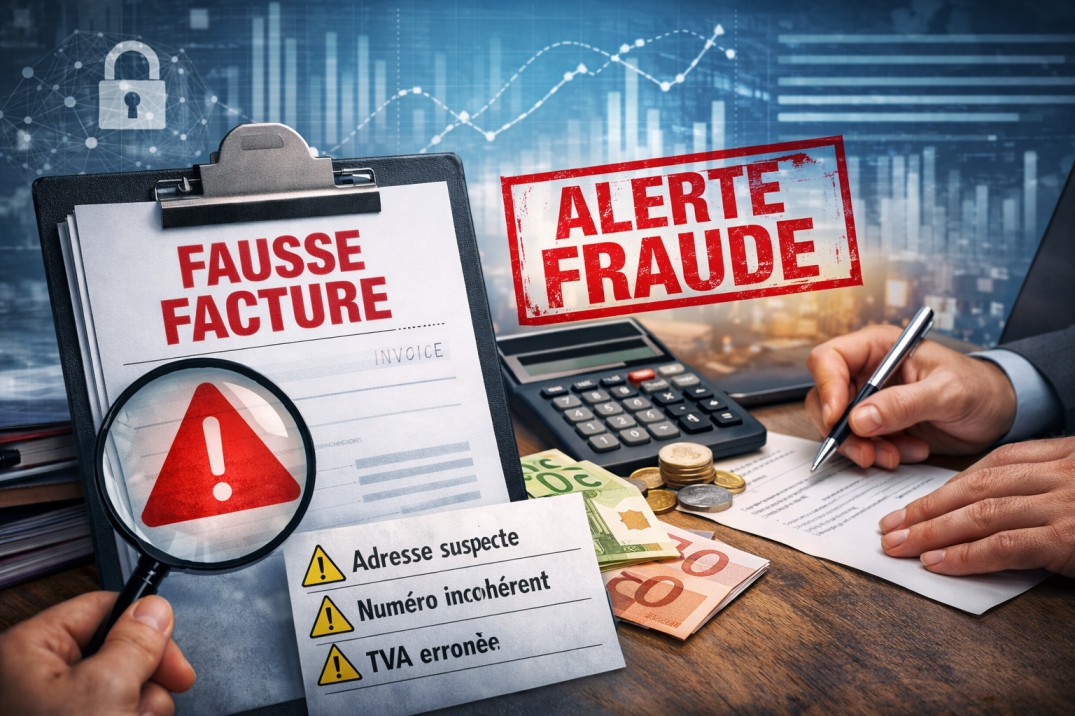
Finance Actu warns decision-makers and HR teams about a growing risk: fake invoices. Between internal fraud and external scams, a single control failure can cost tens of thousands of euros. Here are 10 essential checks to secure your invoicing processes and protect your cash flow.
Why fake invoices are a major risk for businesses
Invoice fraud is one of the leading causes of financial loss in companies, particularly in B2B. According to the PwC fraud survey, more than 40% of French companies report having faced at least one attempted financial fraud.
A financial, legal and HR issue
A fake invoice can lead to:
- an immediate cash loss,
- a tax risk if VAT is deducted improperly,
- potential liability for company directors,
- internal tensions caused by errors, suspicion or conflict.
HR and finance teams are on the front line, especially in companies where approval workflows are not clearly formalized.
10 key checks to identify a fake invoice
1. Inconsistent or recently changed supplier details
Always verify:
- the address,
- the company registration number,
- the trade register details,
- the bank account number (IBAN).
👉 A sudden change in bank details is a major warning sign.
2. An unusual or inconsistent invoice number
Fake invoices often contain:
- non-chronological numbering,
- duplicates,
- no unique invoice number.
📌 In France, Article 289 of the General Tax Code requires invoice numbering to be continuous and chronological.
3. A vague or generic description of services
Suspicious examples include:
- “Miscellaneous services”
- “Service fees”
- “General consulting”
A legitimate invoice should describe the service provided precisely.
4. Missing mandatory legal information
In France, an invoice must include:
- the issue date,
- the full identity of both parties,
- the intra-community VAT number,
- the net amount, VAT and total amount,
- the payment due date.
📚 Article L441-9 of the French Commercial Code.
5. Inconsistent or incorrect VAT
Be cautious if:
- VAT is missing without justification,
- the VAT rate is incorrect,
- the calculation is wrong.
⚠️ Deducting VAT from a fake invoice is unlawful, even when the company acted in good faith.
6. Unjustified urgency around payment
Fraudsters often rely on:
- urgency,
- hierarchical pressure,
- very short deadlines.
➡️ Any payment request that falls outside normal processes should be stopped and verified.
7. An unknown or unapproved supplier
Before making any payment, check that the supplier:
- is registered in your ERP,
- has gone through the required validation process,
- matches an existing contract or purchase order.
8. No purchase order or related contract
A legitimate invoice should be supported by:
- a contract,
- a signed quotation,
- or a purchase order.
Without supporting documentation, payment should be suspended.
9. Foreign bank details without a clear reason
A foreign IBAN may be legitimate, but it should:
- match the supplier's country or business context,
- be consistent with the transaction history.
Recently changed bank details require particular attention.
10. An invoice sent outside normal channels
Be cautious with invoices:
- received through a personal email address,
- sent by a new contact,
- attached to an unusual or unexpected message.
Best practices for reducing fake-invoice risk over time
Strengthen internal controls
- separate duties between ordering, approval and payment,
- require dual validation for changes to bank details,
- document procedures in writing.
Train HR and finance teams
HR teams play an important role in:
- raising employee awareness,
- sharing good practices,
- preventing internal fraud.
Invoice before or after payment: another key control point
The timing of invoice issuance can also affect risk. To explore this topic in more detail, read our full analysis on when an invoice should be issued before or after payment.
Official sources and references
- French Commercial Code - Article L441-9
- French General Tax Code - Article 289
- DGFiP - invoicing requirements
- PwC - Global Economic Crime and Fraud Survey
Note: Sponsored article






.svg)