
Olivier Audino
Webinar
Tail Spend: The Overlooked Lever to Free Up Your Buyers' Time
Tuesday March 31 at 2:00 PM

Tail Spend: The Overlooked Lever to Free Up Your Buyers' Time
Tuesday March 31 at 2:00 PM


Reports from firms like Gartner often track major trends in Procure-to-Pay. However, they frequently omit a brutal accounting reality regarding field operations: managing your one-off purchases internally costs you significantly more than the product itself.
You might think you are preserving your margins by refusing to delegate this flow to external experts.
Here is the reality: you destroy your EBITDA every time you force your teams to add a local craftsman to your information system. The only mathematically profitable solution to neutralize this financial loss is to adopt a Transactional Trusted Third Party.
Manually cleaning a supplier database is an illusion. As long as you allow account creation for your Class C purchases, you are continuously injecting entropy and weakening your Master Data.
Typos or inconsistent formats ("BME", "BuyMadeEasy") unnecessarily multiply records for a single entity.
A third party created for a one-off purchase sees its legal documents (Registry extract, tax info) expire, becoming a highly toxic asset.
An overloaded database slows down technical searches, which frustrates your buyers and structurally encourages Maverick Spend.
Large groups apply procedural engineering that is unsuited to the reality of their supplier base. Using heavy infrastructure, designed to frame international contracts of two million euros, to manage a simple 500-euro invoice is like using a jackhammer to drive in a nail.
Precise spend analysis reveals a fearsome inverse Pareto law. Tail spend management becomes a true operational abyss for your employees.
| Inefficiency indicator | Direct impact on Procurement |
|---|---|
| 5% of purchase volume | Generates 80% of mental and administrative burden. |
| 70% of supplier base | Composed of "disposable" third parties (craftsmen, occasional providers). |
| 150 euros per order | Internal management cost to process a one-off invoice. |
These providers serve you only once, but they permanently pollute your Master Data and require continuous legal vigilance dictated by the CSRD directive and the Sapin II law.
On the ground, your buyer is an overqualified expert. Their analytical role is to lead complex tenders and negotiate with your strategic partners to secure the value chain.
But there is a detail: faced with the urgency of a purchase for marketing or a spare part for the factory, they must interrupt their core work.
They become the clerk for your ERP. This friction generates several disastrous consequences for your organization.
To measure the impact of this malfunction on your legal exposure and resources, you can perform our compliance stress test.
Documentary evaluation of third parties is not just a simple formality. It is a burdensome process that consumes your human resources and capital. Hidden P2P costs silently destroy the benefits of your negotiations.
The accounting reality is relentless. Creating a "Spot" account requires approximately 3 hours of effective work, distributed between procurement, legal, and accounting. The cost of invoice processing averages 150 euros per one-off order—a figure consistently corroborated by Gartner analysts for large groups.
Let's do the exact calculation for a company attempting to integrate 5,000 occasional suppliers per year internally.
| Internal process step | Volume processed | Cost and time consumed |
|---|---|---|
| Data entry and validation (KYC) | 5,000 account creations | 15,000 hours of work (several FTEs) |
| Full administrative processing | 5,000 one-off invoices | 750,000 euros destroyed (150 euros per transaction) |
The result?
You sacrifice 750,000 euros of your net profitability on the altar of internal control. This staggering amount funds sterile administration instead of creating value. You can audit your own processes and precisely calculate this procurement transactional load using our transactional load calculator.
This procedural slowness has a direct psychological consequence on the behavior of your internal clients. Faced with operational urgency, the business requester refuses to wait the 15-day lead time imposed by a new supplier validation.
They bypass the Procurement department, perceived as a systemic blocker, and use their department's credit card. This is the rapid emergence of rogue spending (maverick spend).
Why?
Because field needs always take precedence over administrative burden. This bypass practice creates systemic risk for your company.
Internal management of Class C purchases is not just a financial drain; it is a major security breach in your internal control system. Anti-corruption agencies have hardened their requirements regarding third-party evaluation, and transaction flow traceability is now scrutinized with surgical rigor.
In a large group, 70% of the supplier base is composed of "disposable" third parties. These entities perform only one or two transactions per year. Yet, legally, they require the same level of due diligence as a strategic partner.
But there is a detail:
Manual control of thousands of small providers is an impossible mission. Procurement teams, drowned in volume, end up validating incomplete or obsolete files. An expired social security certificate or missing business registry extract on an 800-euro invoice is enough to characterize a serious breach of your duty of vigilance.
Why continue to assume this systemic risk for purchases that represent only 5% of your financial volume?
The solution to escape this permanent insecurity is to transfer legal responsibility to specialized infrastructure. You can measure your current exposure by performing our compliance stress test.
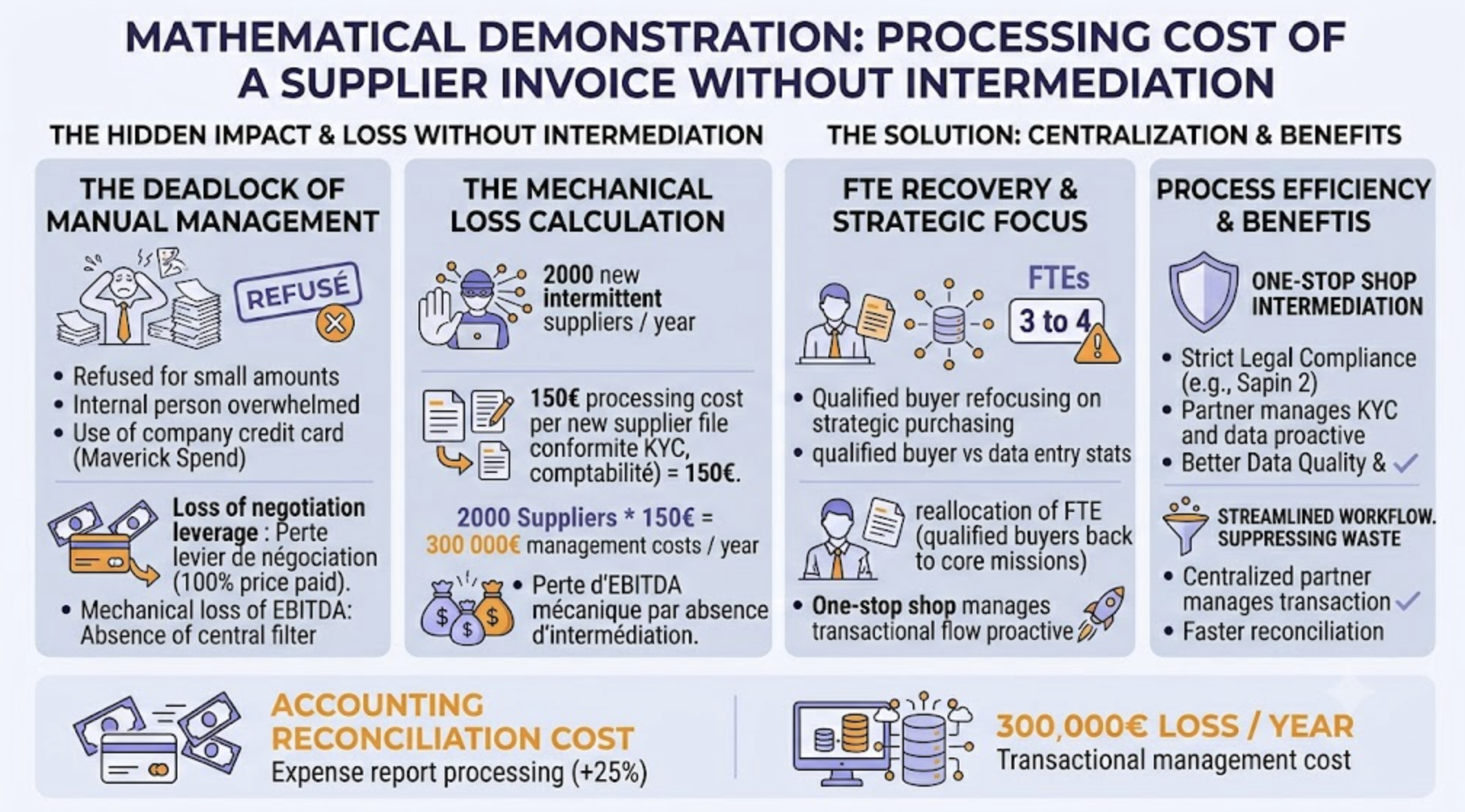
The solution is not to recruit more buyers. Nor is it to add costly new modules to your existing ERP.
To stop this value destruction, you must change the trajectory of the transactional flow. Buy Made Easy technically inserts itself between your information system and your thousands of local providers.
The exclusive concept of the Single Creditor allows you to instantly purge your infrastructure. The goal of optimizing your Master Data is not to sort your data, but to drastically reduce it.
Here is the technical reality.
Your thousands of small, occasional suppliers physically disappear from your production environment. Whether you use SAP, Ariba, or Coupa, the multitude is replaced by a single creditor line.
| Master Data state | Classic polluted ERP management | BME Trusted Third Party model |
|---|---|---|
| Number of active accounts | 40,000 suppliers (incl. 25,000 inactive) | 1 single referenced supplier (BME) |
| Time to create a third party | 3 hours of internal workload | Immediate (Zero data entry required) |
The buyer validates their order with one click. They no longer create any accounts. The bottleneck disappears, and the internal requester receives their product on time, without resorting to rogue spending.
We are not a simple marketplace or digital catalog. BME assumes the entirety of the financial and legal engineering inherent in every microtransaction.
The supplier KYC process falls entirely under our legal responsibility. We activate a true compliance shield between the craftsman and your executive committee.
Here is the execution principle.
The penal risk linked to the Sapin II law never reaches you. The French Anti-Corruption Agency (AFA) will find no fault in your process, because the Class C flow is outsourced, traced, and secured.
Cleaning a supplier database is not a one-time event; it is a battle lost in advance if you do not change the structure of your flows. Most companies launch costly "data cleansing" projects that become obsolete in less than six months.
Here is the reality:
As long as you authorize account creation for Class C purchases internally, you are injecting "noise" and entropy into your system. Master Data degrades as duplicates and inactive third parties accumulate.
Firms like McKinsey regularly highlight that data quality is the primary obstacle to the digitalization of procurement. In a standard environment, maintaining a supplier record costs approximately 50 euros per year in management fees and IT storage.
If you have 25,000 inactive suppliers, you are paying an invisible tax to maintain a toxic asset. This cost does not include the fraud risk associated with obsolete supplier records sleeping in your system.
Transitioning to one-stop shop procurement is not just outsourcing a service; it is a detoxification cure for your ERP (SAP, Oracle, or Ariba). By using BME as a Single Creditor, you move from reactive to preventive data management.
| Data characteristic | Classic internal ERP model | BME Trusted Third Party model |
|---|---|---|
| Tax ID / VAT integrity | Manual entry prone to errors. | Automatic API verification upon onboarding. |
| Document updates | Time-consuming manual reminders by buyers. | Real-time updates via our algorithms. |
| CSRD / Scope 3 Reporting | Fragmented and often untraceable data. | Consolidated and ready-to-use reporting. |
The result?
Your database becomes a strategic asset again. Your teams no longer waste time "cleaning" useless supplier records. You can audit the current quality of your database and the cost of its dispersion by using our transactional load calculator.
Transitioning to our Transactional Trusted Third Party model does not require a six-month IT project. The deployment is designed to simultaneously reassure your IT department (CIO) and your finance department (CFO).
The goal is to fit into your existing processes without creating new friction.
You retain your current technological infrastructure. Technical integration occurs in the background via PunchOut, API, or a dedicated portal.
The buyer navigates their usual e-procurement environment. When they need a Class C purchase, they validate their request with one click. The manual creation of occasional suppliers disappears entirely from their daily tasks.
The transactional burden collapses definitively during the accounting closing cycle. Processing hundreds of heterogeneous invoices from small artisans is a sinkhole in Full-Time Equivalents (FTE).
Here is the new accounting reality.
BME aggregates all your one-off transactions made during the past month. Instead of a multitude of complex payments, your CFO receives a single document.
| Accounting process | Classic internal management | With BME outsourcing |
|---|---|---|
| Invoice volume | 5,000 isolated invoices to reconcile | 1 single consolidated invoice per month |
| Disputes and errors | Time wasted on micro-amounts | Zero disputes (BME financial carrying) |
| Analytical accounting | Time-consuming manual entry | Clean, pre-allocated file |
The transition to our Transactional Trusted Third Party model does not require a six-month IT project. The deployment is designed to simultaneously reassure your IT department (CIO) and your finance department (CFO).
The goal is to insert ourselves into your existing processes, without creating new friction.
You retain your current technological infrastructure. Technical integration occurs in the background via PunchOut, API, or a dedicated portal.
The buyer navigates their usual e-procurement environment. When they need a Class C purchase, they validate their request with one click. Manual creation of occasional suppliers disappears entirely from their daily objectives.
The transactional burden collapses definitively during the accounting closing cycle. Processing hundreds of heterogeneous invoices from small artisans is a sinkhole in Full-Time Equivalents (FTE).
Here is the new accounting reality.
BME aggregates all your one-off transactions made during the past month. Instead of a multitude of complex payments, your CFO receives a single document.
| Accounting process | Classic internal management | With BME outsourcing |
|---|---|---|
| Invoice volume | 5,000 isolated invoices to reconcile | 1 single consolidated invoice per month |
| Disputes and errors | Time wasted on micro-amounts | Zero disputes (BME financial carrying) |
| Analytical accounting | Time-consuming manual entry | Clean, pre-allocated file |
Convincing your CFO to outsource the management of Class C purchases is not a matter of political persuasion, but of pure mathematical demonstration.
By replacing unsuitable internal machinery with dedicated infrastructure, you act directly on the three levers of value creation that matter to the finance department.
Do not let your low-value purchases destroy your department's profitability. Prove the urgency to act now by evaluating your exposure with our compliance stress test to prepare for your next executive committee meeting.
Processing a multitude of micro-orders in a heavy ERP environment mobilizes too many stakeholders (requester, buyer, legal team, accountant). The cumulative cost of these resources averages 150 euros per order. This amount often exceeds the face value of the goods purchased, creating a net and measurable loss on your balance sheet.
Rogue spending (payment by credit card outside of process) stems from internal clients' frustration with administrative slowness. By outsourcing via BME, the buyer validates the order immediately without creating the supplier. The product is delivered quickly, which mechanically cancels the need to bypass company procedures.
Absolutely. BME activates an impenetrable compliance shield. As a Trusted Third Party, we assume legal responsibility for screening (KYC). We guarantee the presence of up-to-date documents, such as a validated business registration and certificate of vigilance, before committing a single euro of financial carrying. The penal risk never reaches your executive committee.


Get in touch with our experts, who'll be glad to take you behind the scenes of our procurement outsourcing systems — proven for over 10 years.
.svg)