Olivier Audino
Webinar
Tail Spend: The Overlooked Lever to Free Up Your Buyers' Time
Tuesday March 31 at 2:00 PM



Tail spend outsourcing is not just about Procure to Pay software. It is, above all, a strict matter of risk transfer and legal liability when dealing with one-off suppliers.
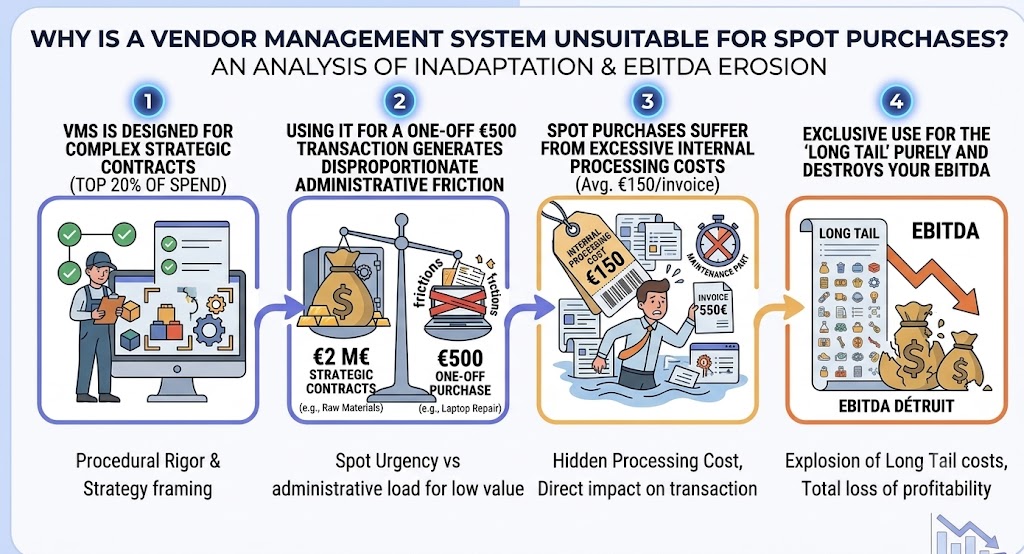
You are attempting to process €500 transactions using the same heavy machinery as your €2 million strategic contracts. Operational teams grow impatient and bypass the rules.
Maverick spend is multiplying uncontrollably, and your Master Data is clogging up with non-recurring third parties.
The traditional software optimization model reaches its technical and legal limits here. To protect EBITDA and guarantee compliance with the Sapin II law, a paradigm shift is required.
Measure your actual exposure to compliance risks
Take the BME Compliance Stress-TestPurchasing commission, operated by a Transactional Trusted Third Party, stands out as the only legal mechanism capable of absorbing this operational friction.
In a direct purchasing model, a simple omission (Kbis, URSSAF) exposes you to concealed work. As a purchasing commission agent, BME legally bears the duty of vigilance on your behalf.
The buyer signs up to be a strategist. On paper, they must analyze global markets and negotiate with critical partners to secure the supply chain.
The plant manager demands an urgent €800 spare part. To place this simple order, the buyer must face the rigidity of the internal system. Using an ERP designed to audit multi-million dollar contracts to handle an isolated invoice of a few hundred euros is a fundamental calibration error.
The internal customer refuses to wait 15 days for the onboarding process. They bypass the procedure and resort to maverick spend, causing you to lose all control over the expenditure.
Procurement departments bear the full brunt of what is known as the reverse Pareto law on Class C spend management.
According to industry analyses from firms like McKinsey, this structural inefficiency transforms information systems into obsolete storage spaces.
Let us look at the financial impact of this drift from a purely mathematical perspective. Validating a new profile requires an average of 3 hours of actual work (corporate records, bank details, compliance, software configuration). This heavy machinery generates an internal processing cost estimated at €150 per invoice for non-strategic purchases.
5,000 creations x €150 = €750,000 of EBITDA burned / year
This is no longer a simple question of productivity. It is a financial capital leak that requires a strict strategy for reducing the procurement administrative burden.
Measure your actual exposure to compliance risks
Access the Transactional Load CalculatorThe proliferation of uncontrolled purchases does not only destroy your operational profitability. It directly exposes your general management to a systemic legal risk. Each payment made in an emergency introduces an un-audited third party into your accounting ecosystem.
But there is a critical detail
The finance department finds itself forced to settle invoices without any legal guarantee regarding the payee's probity. This is an unacceptable breach in your governance and your supplier compliance strategy.
Procurement departments often deploy complex software suites in an attempt to lock down their transactions from end to end. However, recommendations from technology authorities like Gartner confirm that user adoption collapses when the administrative burden exceeds the value of the purchase.
Faced with an urgent business need, the internal requester will bypass the procedure. The technological tool alone does not resolve human friction and drives teams toward maverick spend.
The law makes no distinction regarding volume. Supplier KYC requirements apply with the same severity for a one-off service as they do for a strategic partnership.
During an audit by the French Anti-Corruption Agency (AFA), the absence of a rigorous process for the tail spend constitutes a major criminal vulnerability for the group. Manually collecting corporate registration records, verifying the validity of social security certificates, and analyzing ultimate beneficial owners for thousands of small actors drains your FTE resources.
Vigilance files remain incomplete. Furthermore, the European CSRD directive requiring strict reporting on your Scope 3 makes maintaining this compliance humanly impossible.
Identify your compliance gaps before the audit
Take our Sapin II & CSRD Stress TestTo protect the company, the CPO must rely on an infrastructure capable of absorbing the legal burden upstream of the ERP.
To neutralize legal risk and restore your EBITDA, adding yet another P2P software module is not enough. You must restructure the financial and administrative workflow at the source.
This is where the Transactional Trusted Third Party comes into play. It positions itself physically and legally between your ERP and your thousands of occasional suppliers.
You stop creating disposable vendor profiles in your Master Data. You delegate the entire onboarding, compliance, and payment burden to a single partner authorized for Class C spend management.
The Single Procurement Desk transforms systemic complexity into a simple accounting line item. You replace a multitude of creditors with an exclusive, secure point of contact.
If your corporate group utilizes 1,000 different Class C suppliers throughout the year, your team would normally have to perform 1,000 distinct configurations within the ERP. With our infrastructure, these 1,000 entities are absorbed. Your database requires only a single active billing line item.
| Performance Indicator | Traditional Internal P2P Process | Single Desk Model |
|---|---|---|
| Master Data Creations | 1,000 distinct supplier files | 1 single consolidated creditor file |
| Total Administrative Burden | 3,000 direct hours (3h per account) | Zero buyer data entry hours |
| Accounting Processing Volume | 1,000 isolated invoices to match | 12 global monthly invoices |
Thanks to seamless integration with your existing ecosystem (Coupa, Ariba, SAP), buyers approve the purchase request in a single click, without any data entry.
Operational outsourcing demands robust payment engineering. Local craftsmen and agencies do not have the cash flow to sustain your 60-day end-of-month payment terms.
The financial porting resolves this asymmetry. The Trusted Third Party secures the transaction with the supplier while preserving your company's cash flow cycle.
The process executes in three strict control stages
Your internal customer receives their service in less than 48 hours. They no longer have any friction to bypass, which completely eradicates the need to resort to maverick spend.
Delegate the complexity of your spot purchases to an expert
Discover our Single Procurement Desk solutionTail spend outsourcing must no longer be perceived as a mere administrative convenience. It is a lever for a profound transformation of your operational model.
By adopting a purchasing commission model, you take a heavy weight off the shoulders of your strategic buyers. You give them back the time needed to focus on innovation and securing critical supplies.
The modern CPO is no longer a database manager. They are the guarantor of their organization's financial resilience and ethical compliance.
Maintaining 25,000 inactive suppliers in a saturated ERP is not a technical inevitability. It is a management choice that you can reverse today. The result? Cleansed Master Data, streamlined processes, and a procurement team finally aligned with the Executive Committee's growth objectives.
The legal model of the commission agent is the only one capable of offering this total flexibility. It allows you to manage the unexpected without ever sacrificing the rigor of your compliance audit.
But there is a detail
This approach also makes it possible to anticipate the requirements of the CSRD directive. By centralizing your Class C spend, you gain perfect visibility into your Scope 3, data that has become vital for your extra-financial reporting.
To move from theory to action, it is necessary to understand how these flows concretely integrate into your current tools.
Deepen your operational knowledge
Register for the Webinar : Mastering Spot PurchasesOptimizing your EBITDA begins with eliminating low-value-added tasks.
Transform your supplier management now
Deploy the Single Procurement Desk InfrastructureManaging the long tail of spend raises complex questions regarding legal liability and technical integration. Here are the answers to the most critical points for procurement departments.
A broker simply connects two parties without ever getting involved in the financial flow. Within the framework of tail spend outsourcing, this does not solve any of your vendor creation issues in the ERP.
Conversely, a purchasing commission agent acts in their own name but on behalf of their principal. They purchase the service, pay for it, and reinvoice it to you.
The reality is simple
The purchasing commission model creates a protective legal shield. It is this model that enables a Single Desk and the elimination of thousands of third parties from your database.
In a direct purchasing model, if an operational team member orders a service from a supplier without verifying their social security certificate, your company is exposed to concealed work liabilities. The BME model transfers this responsibility.
As a commission agent, we bear the duty of vigilance. If a document is missing or expired, our system automatically and preventatively blocks the payment.
But there is a key detail
This risk transfer is total. In the event of an AFA audit, you prove that 100% of your Class C purchases pass through a certified trusted third party, which radically simplifies your supplier compliance file.
Technical integration is a prerequisite to guarantee user adoption. The purchasing commission model integrates via Punch-Out protocols or hosted catalogs directly within your Procure to Pay tool or ERP.
The buyer or requester selects the service via the BME interface connected to their usual tool. The purchase request is automatically generated toward a single supplier, avoiding any double administrative data entry.
Traditional tail spend outsourcing can sometimes strain relationships with small suppliers. BME leverages its financial strength to pay providers upfront or according to their specific requirements.
Financial porting allows you to maintain your usual payment terms while your suppliers are satisfied immediately. This mechanism reinforces your image as a responsible partner within the framework of the CSRD.
Secure your outsourcing strategy today
Book an appointment with a BME expert


.svg)