Market studies

The Different Types of Protective Packaging for Your Products

Published By
Olivier Audino
Tags
Sourcing

Protective packaging in logistics and supply chain management

Within logistics and supply chain operations, protective packaging plays a crucial role in ensuring products arrive at their destination in perfect condition. This article reviews the three primary categories of packaging (primary, secondary, and tertiary) alongside various protective materials—including plastic shipping films, corrugated cardboard boxes, protective foam, and paper cushioning. The goal is to help you select the most suitable protective packaging solution for your goods, whether fragile or bulky, to guarantee total security during transit and storage.

Core objectives of protective packaging selection

  • Categorize packaging layers across primary, secondary, and tertiary levels
  • Evaluate protective materials: shipping films, cardboard, foam, and paper cushioning
  • Optimize product safety for both delicate, fragile items and heavy, bulky shipments
  • Ensure comprehensive goods protection throughout transport and warehousing

What is protective packaging?

Protective packaging is a packaging solution designed primarily to safeguard products against shocks, vibrations, pressure, or harsh weather conditions during handling, transit, and warehousing. Unlike purely promotional or presentation packaging, protective packaging exists specifically to absorb impacts and prevent damage. It generally includes protective elements added around the product or inside the box—such as bubble wrap, air pillows, or foam cushioning. This type of packaging is most prevalent at the secondary and tertiary packaging levels during parcel shipping and freight consolidation. In short, any material or solution that enhances an item's safety within its package qualifies as protective packaging.

What are the 3 main types of packaging?

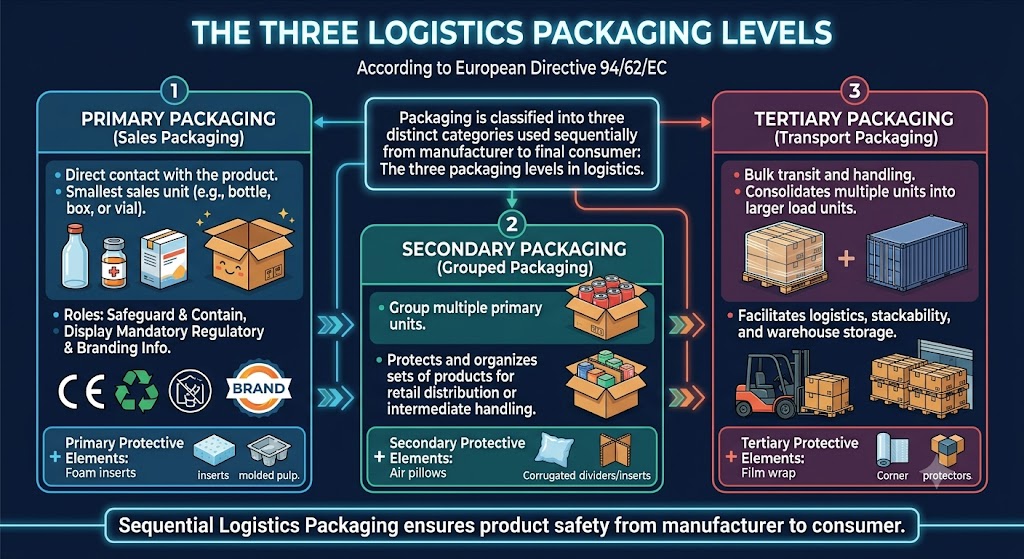
According to European Directive 94/62/EC, packaging is classified into three distinct categories used sequentially from manufacturer to final consumer:

The three packaging levels in logistics

  • Primary Packaging (Sales Packaging) – The layer in direct contact with the product. It represents the smallest sales unit (e.g., a bottle, box, or vial). Its role is to contain and safeguard the product while displaying mandatory regulatory and branding information.
  • Secondary Packaging (Grouped Packaging) – Designed to group multiple primary units together. For example, a corrugated box holding a pack of cans. It protects and organizes sets of products for retail distribution or intermediate handling.
  • Tertiary Packaging (Transport Packaging) – Used for bulk transit and handling. It consolidates multiple primary or secondary units into larger load units (e.g., film-wrapped pallets or heavy-duty shipping containers) to facilitate logistics, stackability, and warehouse storage.
Every level of packaging can integrate protective features. For instance, a glass bottle (primary) may use a protective sleeve; an outer shipping box (secondary) often contains void-fill materials like crumpled kraft paper or packing peanuts; and a pallet load (tertiary) is secured using industrial stretch film or heavy-duty strapping to prevent collapse during transport.

Plastic shipping films: A wide range of protective solutions

Plastic packaging films are omnipresent in logistics to protect and stabilize merchandise, particularly at secondary and tertiary packaging levels. They shield goods against dust and moisture while maintaining load stability during transport. Market options cater to diverse operational needs—ranging from pallet load stabilization to delicate surface protection.

Stretch film (Stretch wrap)

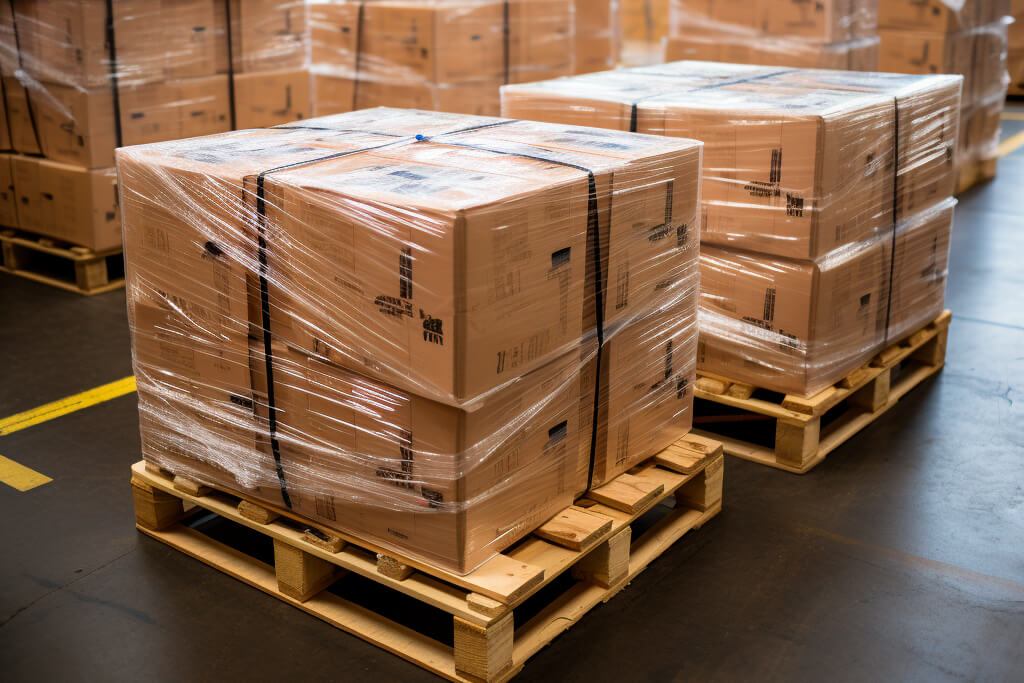
An extensible plastic film used primarily to secure cartons on pallets, preventing shifting, tipping, or dispersion during transit. Available in transparent or opaque options, stretch film offers high tear resistance and protects palletized goods from dust and weather. It comes in manual application rolls or machine-wrap rolls. Using pre-stretched film is highly recommended as it maximizes load containment without deforming products while significantly reducing plastic usage and material costs.

Bubble wrap

A flexible plastic material filled with air bubbles, bubble wrap is a staple for cushioning fragile items (glassware, electronics, delicate ceramics). It absorbs shock impacts, fills box voids, and acts as a dust barrier. Specialized variants include large-bubble rolls (18 mm+ bubbles) for heavy or bulky goods, opaque black bubble wrap for shipment privacy, and isothermal bubble wrap for temperature-sensitive cargo. Because bubble wrap is non-biodegradable and may not fully immobilize heavy items alone, combining it with void-fill materials ensures optimal protection.

Polyethylene foam film

Presented as a thin, flexible foam roll, this lightweight and scratch-resistant material wraps around sensitive items to prevent abrasions and minor shocks. It conforms easily to surface shapes—making it ideal for screens, lacquered finishes, and high-end industrial parts. Recyclable and recycled-content foam sheets are increasingly common, offering an eco-conscious alternative that improves unboxing presentation for premium products.

Shrink film (Heat-shrink wrap)

When exposed to heat (via a heat gun or shrink tunnel), heat-shrink film contracts tightly around products or palletized loads. It creates a rigid, hermetic protective layer that locks items in place while providing a complete seal against water and dust. Shrink film is ideal for bundling multi-pack items or long-distance/export shipping where compact, weather-proof containment is essential.

Pallet top sheets and protective covers

Pallet top sheets are plastic covers placed over the top of loaded pallets to protect cargo from rain, moisture, and dust during storage and transport. Heat-shrinkable pallet covers combine top coverage with shrink-wrap stability when heated. Additional specialized plastic films include tubular poly tubing (gaines) for long products and anti-corrosion (VCI) films for metal component preservation.

Summary of plastic shipping film applications

  • Stretch Wrap – Unitizes pallet loads and prevents carton shifting during transport
  • Bubble Wrap – Absorbs shock and protects fragile glass, ceramic, and electronic goods
  • PE Foam Film – Prevents surface scratches and abrasions on delicate or lacquered finishes
  • Shrink Film – Creates a tight, waterproof, hermetic seal for export freight and multi-packs
  • Pallet Covers – Shields pallet tops against outdoor rain, weather, and warehouse dust
While plastic shipping films offer unparalleled protection and ease of use, selecting the right film thickness and type prevents unnecessary plastic over-packaging and supports responsible logistics practices.

Alternative cushioning solutions and protective materials

Beyond plastic films, numerous complementary cushioning and protective packaging materials exist to secure the interior of shipping cartons. Made from paper, cardboard, foam, or air, many of these solutions offer eco-friendly alternatives. Here is an overview of the primary protective cushioning options available for modern logistics.

Corrugated cardboard and kraft paper

Corrugated cardboard rolls and kraft paper are timeless classics for interior protection. Multi-layered corrugated cardboard is thick and durable, making it ideal for wrapping heavy items with sharp edges or serving as protective dividers. Kraft paper rolls are exceptionally versatile for void-filling or wrapping goods. Natural, recyclable, and tear-resistant, kraft paper effectively absorbs shocks when crumpled or balled up. Automatic paper cushioning systems can also convert kraft paper into high-volume accordion padding for high-throughput packing lines.

Packing peanuts (Loose fill)

Packing peanuts fill interior box voids around lightweight or moderately heavy items. While traditional expanded polystyrene (EPS) peanuts generate static electricity and lack sustainability, biodegradable cornstarch peanuts offer a eco-friendly alternative. They decompose naturally without toxic residues and dissolve in water while providing the same shock absorption and shape-conforming protection as plastic peanuts.

Inflatable air pillows

Inflatable air pillows are a modern logistics favorite. Composed of 99% air, they add virtually no shipping weight while immobilizing products to prevent internal collisions. Available in recyclable polyethylene, recycled plastic, bio-based films, and 100% recyclable kraft paper, air pillows provide clean, fast void-filling for electronics, cosmetics, and consumer goods.

Protective foam boards, corner blocks, and profiles

Semi-rigid polyethylene foam boards (typically 1 to 3 cm thick) line interior box walls or separate delicate components inside a single carton. They absorb repetitive impacts without crumbling and can be custom-cut to fit sensitive instruments. Foam corner profiles (U-shape or L-shape) protect sharp edges on glass panels, frames, and monitors, while molded foam-in-place systems offer custom-contoured protection for high-value items.

Tissue paper and decorative paper shred

Tissue paper and paper shredding focus on presentation and surface protection. Ultra-thin tissue paper wraps luxury items, jewelry, and leather goods to prevent micro-scratches during handling. Shredded kraft paper fill provides decorative cushioning for gift boxes and gourmet baskets, elevating the customer unboxing experience while offering light product support.

Key alternative cushioning and void-fill materials

  • Corrugated Cardboard & Kraft Paper – Heavy-duty wrapping, void filling, and 100% recyclable paper padding
  • Biodegradable Packing Peanuts – Eco-friendly cornstarch void fill that dissolves safely in water
  • Inflatable Air Pillows – Ultra-lightweight (99% air) void fill for rapid, clean internal stabilization
  • PE Foam Boards & Profiles – Semi-rigid impact absorption and edge protection for fragile cargo
  • Tissue & Shredded Paper – Elegant scratch protection and decorative fill for luxury unboxing
The most effective protective approach often combines multiple materials: wrapping fragile items in bubble wrap or PE foam, filling remaining voids with crumpled kraft paper or air pillows, and securing the outer carton on a film-wrapped pallet.
What is the best protective packaging solution?

Faced with numerous options, determining the absolute best protective packaging for securing goods is a common challenge. In reality, there is no universal one-size-fits-all answer: the optimal choice depends entirely on product characteristics, level of fragility, weight, and specific transit or storage conditions. Nevertheless, key selection criteria define the ideal packaging strategy.

Tailoring cushioning without over-packaging

Protective packaging must prevent shocks and hold the product securely in place without adding unnecessary bulk or material. Superior cushioning conforms closely to the product's shape, filling empty spaces precisely where needed.

Minimizing weight and overall volumetric footprint

Protective materials should be lightweight to prevent driving up parcel weight. Air pillows and paper cushioning excel here compared to heavy high-density foams, helping reduce shipping costs—especially when carriers calculate rates based on dimensional weight.

Ensuring an exceptional customer unboxing experience

Packaging protection should never make unboxing frustrating or messy. Excessive dust or static-prone packing peanuts sticking to products can damage brand image. Conversely, a clean, securely protected, and easy-to-open parcel significantly enhances customer satisfaction.

Evaluating environmental impact and sustainability

Eco-friendly packaging is increasingly vital to consumers and businesses alike. The best protection fulfills its structural role while maximizing sustainability—utilizing recycled, recyclable, or bio-based materials, or simply minimizing material volume. Prioritizing recycled paper or recyclable films represents a clear environmental win.

Key criteria for choosing optimal protective packaging

  • Tailored Fit – Precise cushioning that prevents internal movement without over-packaging
  • Weight Optimization – Ultra-light materials reducing dimensional shipping charges
  • Unboxing Quality – Clean, hassle-free opening experience enhancing customer sentiment
  • Eco-Responsibility – Sustainable, recyclable, or recycled-content materials minimizing waste

Conclusion: Balancing protection, cost, and sustainability

Selecting the right protection for your cargo

The best protective packaging is the one perfectly tailored to your specific operational needs. High-value, delicate goods warrant multi-layered protection (PE foam, bubble wrap, and reinforced corrugated outer boxes). Standard, durable products need only simple recycled paper cushioning.

The core priority remains securing the product completely by eliminating internal movement while optimizing total shipping costs and environmental footprint.

Conclusion - Making the right choice for optimal protection

Ensuring end-to-end supply chain security

In summary, protective packaging comes in many forms—from essential plastic shipping films for palletization, to paper, cardboard, foam, or air cushioning materials for padding box interiors. Each solution offers unique advantages and operational limitations. Industrial and logistics professionals benefit significantly from analyzing product fragility and transit conditions to combine the right protective elements.

Remember that the ultimate goal of proper protective packaging is to deliver goods intact to the end customer while optimizing costs and respecting the environment. By following best practices and selecting wisely among these packaging options, achieving optimal product protection during transport and storage is fully attainable. Your shipments will travel safely, ensuring complete satisfaction across the supply chain—from supplier to final recipient.

Key takeaways for optimal protective packaging

  • Analyze Fragility & Transit Conditions – Combine complementary internal cushioning and external pallet films based on real risk
  • Optimize Total Costs – Prevent over-packaging while selecting lightweight materials that minimize dimensional freight costs
  • Prioritize Eco-Responsibility – Select recyclable or bio-based solutions to reduce overall environmental impact
  • Guarantee Customer Satisfaction – Ensure undamaged cargo arrival to build long-term trust across the entire supply chain
Line
Featured Post

Popular posts