Olivier Audino
Webinar
Tail Spend: The Overlooked Lever to Free Up Your Buyers' Time
Tuesday March 31 at 2:00 PM

Tail Spend: The Overlooked Lever to Free Up Your Buyers' Time
Tuesday March 31 at 2:00 PM


The French Anti-Corruption Agency (AFA) is not only interested in your strategic partners. During an audit, inspectors often target the most gaping flaw in your information system: Class C purchases.
You think you have mastered your panel of providers. Here is the reality: your ERP is saturated with thousands of small, ad hoc suppliers, created in an emergency to process a 500-euro invoice.
Using heavy infrastructure like SAP or Coupa, designed to manage 2-million-euro contracts, to handle a spot purchase, is like using a jackhammer to drive a nail. It is a financial absurdity and a legal time bomb.
The solution to sanitize your Master Data and neutralize penal risk relies on precise engineering. It involves delegating this flow to a Transactional Trusted Third Party.
Regulatory requirements impose rigorous monitoring of every business partner, regardless of the financial volume involved. Manually auditing the multitude of occasional subcontractors saturates your internal processes and slows down project execution.
Automated analysis of official business registrations, social security validations, and international restriction databases to secure every transaction.
Avoid exhausting your expert buyers with endless document follow-ups. Entrust administrative management to a dedicated infrastructure.
A preventive barrier filters anomalies upstream, preventing the blocking of your supply chains and streamlining settlements.
Regulations impose a strict and uncompromising duty of care. You are required to verify the integrity of every third party with whom you perform a financial transaction, regardless of the amount involved.
The Supplier KYC (Know Your Supplier) process is no longer a recommended option; it is a mandatory legal shield. It requires the systematic collection of up-to-date legal documents for every entity.
The result? Your highly qualified buyers turn into ERP clerks. They spend hours chasing local contractors for a missing document, which paralyzes your operations and blocks the payment of legitimate invoices.
Managing non-strategic Class C purchases follows a formidable reverse Pareto principle. Only 5% of your total spending generates 80% of your administrative burden and legal vulnerability.
Why? Because nearly 70% of your database consists of "disposable" third parties that will only be used once. Each new "spot" creation requires approximately 3 hours of actual work, spread across Purchasing, Accounting, and Legal teams.
Faced with urgent field requirements, internal clients refuse to wait for the 15 days imposed by the process. They bypass the procedure, leading to an increase in maverick spending via credit cards. This loss of control destroys your visibility, pollutes your CSRD reporting, and ruins any serious attempt at supplier risk management.
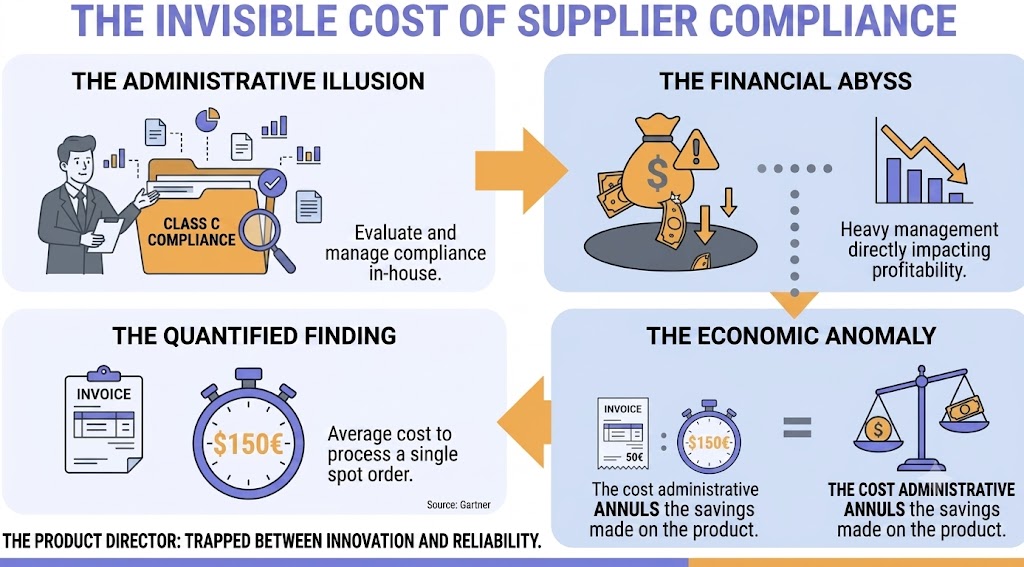
Third-party evaluation is not just an administrative formality. It is a silent financial drain. When you manage the compliance of your Class C purchases internally, you destroy your company's profitability.
Why?
The cost of processing an isolated invoice cancels out any savings made on the product. According to Gartner, the complete cycle of a spot order costs large groups an average of 150 euros.
The administrative burden linked to registering a new supplier weighs heavily on your teams. Creating a "Spot" account requires approximately 3 hours of actual work to validate legal documents and configure the ERP.
Let's apply these figures to a company that creates 5,000 occasional suppliers per year.
| Transactional element | Annual volume | Unit cost or time | Total impact on the company |
|---|---|---|---|
| Spot account creation | 5,000 suppliers | 3 hours per creation | 15,000 hours lost (Data entry and follow-ups) |
| P2P processing | 5,000 invoices | 150 euros per processing | 750,000 euros destroyed (Direct EBITDA loss) |
The result?
You are burning three-quarters of a million euros in pure waste. This budget funds clerical work instead of supporting your strategic negotiations. The ROI of your Procurement department collapses under the weight of this burden.
In the field, your Lead Buyers bear the brunt of this pressure. Faced with an urgent purchase request of 800 euros for a factory part, the buyer finds themselves in an operational impasse.
If they follow the compliance process, here is the reality of their daily routine.
If they yield to urgency and validate the purchase without verification, they put the company in danger. A single compliance failure with a non-certified artisan directly exposes the group during an AFA audit.
The direct consequence?
The requester refuses to wait and uses the service credit card. This leads to an explosion in maverick spending. This practice bypasses your Master Data and completely neutralizes your Supplier KYC process.
To precisely measure the extent of this financial and legal vulnerability, you can assess your P2P leakage rate by taking our compliance stress-test.
Faced with an inflating supplier base, the solution is not to hire new buyers. It is not to change your ERP either. The only financially viable answer is to divert the flow.
You must entrust your spot purchases and Class C purchases to an external infrastructure capable of inserting itself between your internal software and the multitude of small, local providers.
The concept of a single creditor is radical engineering designed to clean up your information system. Instead of registering each craftsman individually, you register a single entity.
Here is the principle.
Your 5,000 occasional suppliers disappear from Coupa or SAP. They are replaced by a single "Buy Made Easy" line. The buyer validates their order with one click, without any manual account creation.
| Operational KPI | Standard Internal Management | With the BME One-Stop Shop |
|---|---|---|
| Suppliers in the ERP | 5,000 lines created per year | 1 single creditor (BME) |
| Legal documents to verify | 15,000 (Trade register, tax certs) | Zero (Delegated to BME) |
| Invoices to process | 5,000 individual invoices | 1 consolidated monthly invoice |
This centralized approach instantly frees up your teams. You can structure this process by deploying a one-stop shop for your spot purchases.
Outsourcing does not mean turning a blind eye. BME acts as a true legal shield between AFA obligations and your company. We absorb the entire regulatory risk of the Sapin II Law.
Our team and our algorithms apply relentless filtering before any financial transaction. Supplier KYC becomes our exclusive responsibility.
The result?
Your company is never exposed to fraudulent or illegal payments. This constant vigilance is made possible thanks to the automatic control of supplier compliance integrated into our technical infrastructure.
Transitioning to a Trusted Third Party model does not require an overhaul of your IT infrastructure. The goal is to insert ourselves seamlessly between your current processes and the reality on the ground.
The deployment of the BME solution is based on a strict methodology, designed to satisfy your CIO, CFO, and legal department simultaneously.
Once the one-stop shop is activated, supplier risk management shifts from your side to ours. This transition is built around three operational pillars.
The result?
You eliminate all processing costs associated with Class C purchases. To visualize the direct impact on your department's profitability, you can audit your flows using our transactional burden calculator.
To better understand the risk distribution before and after BME integration, here is a factual summary of compliance delegation.
| Risk type | Standard Internal Management | BME Trusted Third Party Model |
|---|---|---|
| Criminal risk (AFA, Sapin II) | Assumed by the company (Direct exposure) | Transferred to BME (Legal shield activated) |
| Financial risk (Cash flow) | Complex payments and time-consuming disputes | Absorbed by BME (Immediate cash advance) |
| Operational risk (Bottlenecks) | The buyer becomes the bottleneck | Total fluidity (One-click validation) |
Supplier compliance regarding Sapin II Law requirements should no longer be perceived as an administrative cost center. Continuing to treat occasional purchases with the same procedural rigor as your strategic purchases is a major mathematical error.
By delegating this flow to a Transactional Trusted Third Party, you clean up your Master Data, protect your company against AFA sanctions, and return your buyers to their true mission. They can finally focus on negotiations that generate a positive impact on EBITDA.
It is time to stop the value destruction linked to your P2P processes. Plan an audit of your transactional flows and book an appointment with our experts to definitively secure your purchases.
Schedule an audit with an expertImplementing a Trusted Third Party adjusts perfectly to your current protocols without requiring complex technical projects. Our methodology frames your flows to meet the joint requirements of your Finance, Legal, and IT departments.
We handle the onboarding of occasional providers and the automated collection of their mandatory regulatory documents in record time.
Avoid bottlenecks related to down payment requests or immediate payment demands from small craftsmen. We advance the funds according to their required terms.
Replace the tedious processing of hundreds of heterogeneous micro-invoices with the receipt of a single, clean, analytically pre-coded monthly invoice flow.
These expenses often evade the control processes applied to strategic suppliers. They constitute the major flaw in your database. The French Anti-Corruption Agency (AFA) particularly targets this long tail because it concentrates the highest number of Supplier KYC anomalies and unverified maverick purchases.
Our model relies on full compliance delegation. BME acts as a single creditor in your ERP. We require and verify all legal documents (trade register, URSSAF compliance certificate) before engaging in financial outsourcing. If a contractor is not compliant, the transaction is preventively blocked. The penal risk never reaches you.
Manual integration of an ad hoc third party mobilizes approximately 3 hours of effective work. Combined with invoice accounting processing, the internal management cost reaches 150 euros per order. Outsourcing this flow directly preserves your profitability by eliminating this sterile administrative burden. You can precisely quantify this shortfall using our transactional burden calculator.


Get in touch with our experts, who'll be glad to take you behind the scenes of our procurement outsourcing systems — proven for over 10 years.
.svg)