Olivier Audino
Webinar
Tail Spend: The Overlooked Lever to Free Up Your Buyers' Time
Tuesday March 31 at 2:00 PM



You invest millions in a structuring ERP to obtain total control over your spending. Yet, the field tells a different story.
Deploying a tool designed for 2-million-euro contracts to manage a 500-euro invoice is an operational calibration error. It is like using a jackhammer to drive in a nail.
Deploying our Trusted Third Party ecosystem requires no heavy IT project. Our approach is designed to align immediately with the requirements of your IT department and the financial goals of your CFO, by integrating transparently with your current flows.
✓ Immediate adoption
✓ Instant cleanup of your Master Data
Classic transactional suites are formidable at structuring the Top 20% of your strategic suppliers. They provide visibility, traceability, and secure complex tenders.
Here is the reality
These systems turn into administrative bottlenecks when faced with Class C [purchases]. To understand this limitation, one must analyze the functionalities of a procure-to-pay solution regarding the volatility of small purchases.
The classic premise is to integrate 100% of suppliers into a single tool. This ambition collides head-on with the inverse Pareto law, characteristic of tail spend management.
Faced with an urgent request from a factory for a spare part, a buyer will always prioritize their multi-million euro strategic negotiation. The small request stagnates. Operational staff, blocked in their work, end up paying with the company's credit card.
This phenomenon of rogue spending (maverick spend) completely destroys your financial visibility and exposes the Procurement Department.
McKinsey regularly highlights the need to streamline procurement processes to protect operational profitability. The systematic creation of small, occasional suppliers in a Vendor Management System has a direct mathematical impact on your EBITDA.
| Load indicator | Value |
|---|---|
| Occasional supplier creations / year | 5,000 |
| Unit processing cost (Full P2P process) | 150 € |
| Total burned in administrative burden | 750,000 € / year |
This figure represents the real cost of a tool unsuited to the volume of micro-transactions. It is precisely to stop this financial leakage that Class C procurement outsourcing becomes an imperative for performance.
Measure the financial impact of your supplier dispersion
Calculate your potential savings with our tool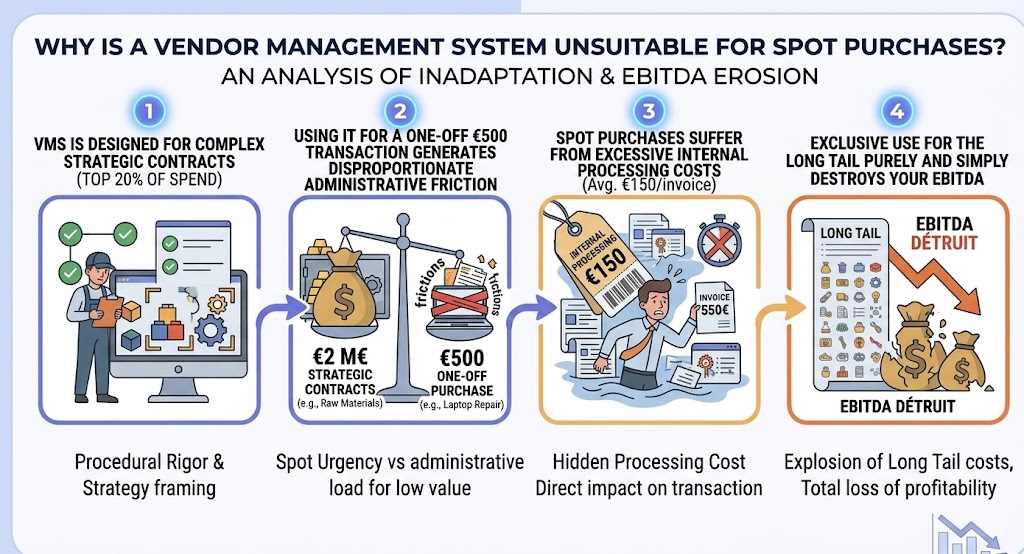
The role of the Procurement Director has evolved. The exclusive search for savings has given way to the overall management of supplier risk. Today, a legal flaw or a regulatory fine costs infinitely more than a bad negotiation on peripheral equipment.
You demand absolute rigor regarding your strategic suppliers. You audit their practices, analyze their financial health, and validate their certifications.
But there is a critical detail
The penal danger does not come from your Top 20%. It hides within the thousands of invisible micro-transactions that escape your centralized radars.
Integrating a new actor into a Vendor Management System is a process that is heavy by design, intended to secure large volumes. The buyer must create a complete file, input banking details, verify statuses, and validate the legal entity. This process requires constant back-and-forth.
For a simple one-off purchase of 800 euros, a qualified buyer loses up to three hours of effective work. The machine stalls when faced with the volume of Class C purchases.
Every inactive supplier in your system is a potential audit failure.
You can identify the extent of this hidden risk by measuring your exposure via
our AFA and Sapin II compliance stress testThe role of the Procurement Director has changed. The exclusive search for savings has given way to overall supplier risk management. Today, a legal flaw or regulatory fine costs infinitely more than a bad negotiation on peripheral equipment.
You demand absolute rigor regarding your strategic suppliers. You audit their practices, analyze their financial health, and validate their certifications.
But there is a critical detail
The penal danger does not come from your Top 20%. It hides within the thousands of invisible micro-transactions that escape your centralized radars.
Integrating a new actor into a Vendor Management System is a heavy procedure by design, intended to secure large volumes. The buyer must create a complete file, input banking details, verify statuses, and validate the legal entity. This process requires constant back-and-forth.
For a simple one-off purchase of 800 euros, a qualified buyer loses up to three hours of effective work. The machine stalls when faced with the volume of Class C purchases.
Every inactive supplier in your system is a potential audit failure.
You can identify the extent of this hidden risk by measuring your exposure via
our AFA and Sapin II compliance stress testThe illusion of total control collapses in the face of operational urgency on the ground.
Your Vendor Management System imposes a linear and rigid validation process. The reality your business teams face is made of unforeseen events and immediate needs.
This friction between the theoretical framework and practical urgency creates a major risk zone.
Let's take a classic situation experienced daily by your buyers.
Faced with this request, your Lead Buyer faces an operational dilemma.
But there is a critical detail
The buyer will logically prioritize their strategic file to achieve their own goals. The 1,200 euro request stagnates in the system.
The factory manager, pressed by their own production imperatives, refuses to wait. They bypass the official process and pay with the company's credit card.
This is the very essence of maverick spend.
This transaction completely escapes your financial visibility and compliance control. When this pattern repeats hundreds of times across all your sites, your centralization strategy falls apart.
Tail spend management transforms into a silent loss of EBITDA.
Your P2P tool, designed to structure spending, paradoxically becomes the trigger for off-contract spending.
To quantify the impact of these unsuitable processes on your teams, you can evaluate the precise time lost by your buyers via
our Transactional Load CalculatorGartner regularly emphasizes that optimizing transactional processes is a major driver of competitiveness. Faced with the obvious limits of your current architecture regarding small expenses, the answer is not to abandon your ERP.
You need to add an infrastructure capable of absorbing operational friction. This is exactly the role of outsourcing Class C purchases through a One-Stop Procurement Shop.
Your P2P tool is designed to centralize financial data. A Transactional Trusted Third Party acts as a protective filter between this strict centralization requirement and the unpredictable fragmentation of the field.
The single-creditor mechanism radically transforms your Master Data management.
This process instantly removes the mental burden associated with creating "Spot" accounts. Your teams reclaim their 3 hours of effective work per file to focus on their true strategic mission.
Outsourcing goes far beyond simple database cleaning. It establishes a true compliance shield and guarantees fully secured financial carrying.
The technical process is implacable
The impact on your profitability is mathematical. You purely and simply eliminate the internal processing cost of 150 euros per invoice on thousands of lines of occasional orders.
To understand how to deploy this mechanism within your own organization, participate in our
Webinar "Mastering spot purchases"A Vendor Management System is an essential foundation for structuring the top of your panel. But using it to pilot the long tail is a strategic error that exhausts your buyers and exposes your company to penal sanctions.
Coupling your ERP with a Transactional Trusted Third Party is the only viable response to align the strict requirements of your CFO with the operational reality of your sites.
Take action and structure your Master Data management
Book an appointment with our BME experts


.svg)