Olivier Audino
Webinar
Comment 3 leaders de l'Auto ont fait économiser +1000 heures à leurs équipes Achats
Jeudi 02 Octobre à 11h00



Cost control in business is no longer a year-end budget exercise. It directly determines margin resilience, investment capacity, and the ability to absorb price volatility across energy, freight, materials, and subcontracting. When costs rise without visibility, leadership shifts from deliberate decisions to reactive cuts.
The real issue is that many organizations measure “what was spent” without clearly understanding why it was spent, how often it repeats, and where leakage starts. This is why strengthening spend control becomes a practical first step: it helps spot recurring exceptions before they turn into a structural drift.
In most companies, a significant share of avoidable variance comes from frequent, low-value flows that are rarely standardized, especially C-class purchasing. Because these transactions are distributed across teams and often decided “on the fly,” they create hidden costs: extra supplier admin work, inconsistent pricing, invoice friction, and slower approvals. A useful baseline is to clarify the levers that actually move the needle, such as those covered in cost optimization in company.
Finally, macroeconomic uncertainty increases the need for fast, explainable decisions. Public indicators on inflation and price dynamics show how quickly a “stable” cost line can shift. For example, OECD inflation (CPI) data provides a useful reference point for understanding broader pressure on operating costs.
Cost reduction initiatives are often launched as emergency measures: budget freezes, across-the-board cuts, or last-minute renegotiations. While these actions can generate short-term relief, they quickly reach their limits when they are not grounded in a clear understanding of how costs are created.
In many organizations, decisions are made using aggregated financial data, without distinguishing between controllable spend, constrained costs, and structural expenses. This explains why the same cost-cutting plans resurface every 12 to 18 months, with diminishing returns. The most common pitfalls are well documented in purchasing management mistakes, where weak governance amplifies the negative effects of short-term decisions.
Cutting costs once is not the same as controlling them. A cost reduction strategy requires separating exceptional adjustments from recurring problems that must be addressed structurally. Without this distinction, teams face repeated trade-offs that gradually erode quality, supplier relationships, and execution speed.
A structured approach makes it possible to focus on the most sensitive cost drivers, define simple rules, and track results over time. This is the logic behind end-to-end procurement management, which turns cost reduction into a continuous process rather than a reactive cycle.
When operating costs are reduced without granular analysis, side effects often appear elsewhere: delays, rework, hidden surcharges, or an explosion of exceptions. These effects are especially visible in high-frequency flows, where even small constraints trigger workarounds.
C-class purchasing illustrates this dynamic clearly. Price pressure without a clear framework often leads to supplier proliferation, lower visibility, and higher administrative workload. Over time, these drifts cost more than they save, as highlighted in cost reduction initiatives that are not paired with proper structuring.
Cost optimization in business is not about finding one dramatic saving. It is about acting where spending repeats, accumulates, and escapes day-to-day governance. These areas rarely sit in strategic categories; they usually live in fragmented, high-frequency flows that remain under the radar.
This is precisely where value is lost over time. Without clear rules, each team arbitrates locally, making global visibility almost impossible. Strengthening spend control transforms thousands of micro-decisions into usable data for leadership.

Leakage does not begin with large contracts. It starts with exceptions: urgent requests, off-catalog purchases, and suppliers used outside any reference framework. Over time, these habits build structural inefficiencies.
C-class purchasing rarely involves high unit prices, but it concentrates a large number of suppliers, orders, and invoices. This multiplication generates hidden costs: administrative workload, reconciliation errors, and limited negotiating power.
When these flows remain unstructured, any cost reduction effort becomes unstable. In contrast, approaches such as tail spend management make it possible to regain control quickly while improving data quality for better decisions.
External indicators also confirm this pattern. Studies published by McKinsey Operations regularly show that organizations focusing on process discipline outperform those relying solely on price renegotiation.
Effective cost steering starts when spending is connected to operational causes: who initiates the request, for which need, through which validation path, with which supplier and level of urgency. Without this level of detail, costs are only “seen” after the invoice is booked, when corrective options are already limited.
Structuring the procurement-to-pay flow connects request, order, receipt, and payment into a single chain. This continuity reduces blind spots and makes deviations visible earlier, before they turn into permanent cost drift.
Hidden costs are rarely invisible by nature. They are simply dispersed, unattributed, and therefore unmanaged. They usually take the form of time loss, rework, supplier duplication, and weak contract enforcement.
Without reliable data, organizations debate instead of deciding. The goal is not to produce more reports, but to generate comparable, traceable, and actionable information. This is exactly the role of a purchasing dashboard designed for decision-makers.
For C-class purchasing, data reliability depends heavily on category standardization, supplier references, and approval rules. Applying purchasing standardization directly reduces variability and noise in the data.
Effective procurement cost control does not come from repeated budget cuts. It comes from a clear organization of decision rules, responsibilities, and execution. When cost initiatives focus only on limiting spend, they often create friction and push teams to work around the system.
The challenge is to redesign how purchasing decisions are made, especially for the most dispersed flows. This is where C-class purchasing becomes a decisive lever: its volume and frequency make it either a structural cost drain or a powerful source of sustainable savings.
Centralization does not mean rigidity. It means defining a shared framework that simplifies decisions while preserving operational flexibility. Approaches such as central buying for industries and purchasing standardization significantly reduce cost variability.
In some contexts, trying to manage everything internally becomes counterproductive. Targeted outsourcing allows procurement teams to focus on high-value decisions while securing execution.
This approach is particularly effective when volumes are high, unit values are low, and rules are difficult to enforce internally. Outsourcing spot purchases illustrates how organizations can reduce operational workload while improving visibility and compliance.
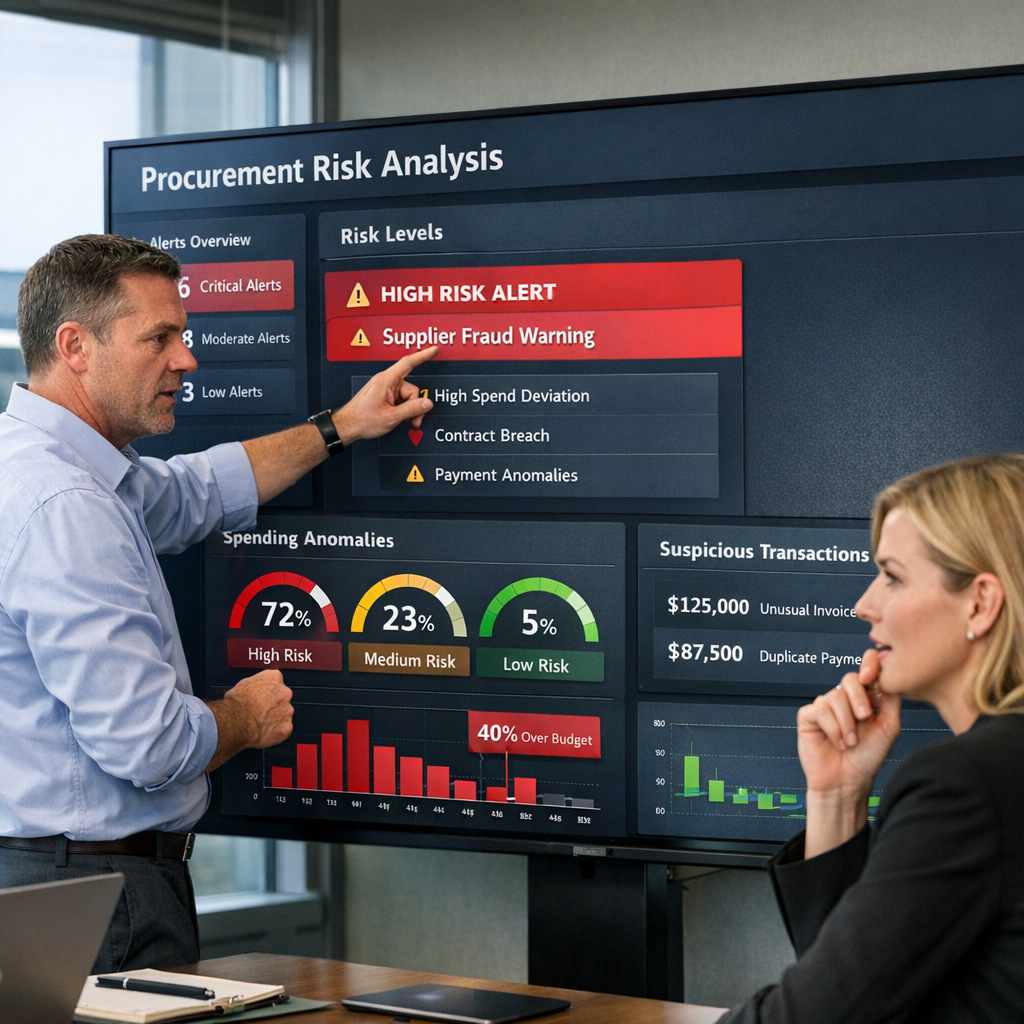
A sustainable cost control strategy in business is not built on isolated actions. It relies on a coherent framework that allows results to hold over time. The objective is not only to reduce costs, but to make decisions repeatable, understandable, and operationally enforceable.
Organizations that manage to stabilize their cost base share a common trait: they treat cost control as a governance topic rather than a series of corrective measures. This means clear rules, relevant indicators, and progressive accountability across operational teams.
Without governance, rules remain theoretical. Effective governance defines who decides, on which scope, with what level of autonomy and arbitration. It removes grey areas that are often at the root of recurring cost drift.
This approach naturally relies on structuring SME purchases, aligning day-to-day practices with financial objectives.
More indicators do not mean better control. A strong strategy is based on a limited number of KPIs that directly support decision-making. A high-performance purchasing dashboard plays a central role here.
Cost control cannot sit solely with finance or procurement. Operational teams must understand the impact of their decisions and have a framework that supports the right trade-offs.
For C-class purchasing, this empowerment is critical. It is where repeated decisions will either create structural drift or deliver long-term performance.
Regaining control over business costs requires more than a diagnostic. Organizations need an operational framework that delivers quick results while building long-term discipline. This is exactly where Buy Made Easy’s approach makes a difference.
The focus is deliberately placed where cost leakage is the most frequent and the hardest to manage: C-class purchasing. These flows are often perceived as secondary, yet they concentrate a large share of hidden costs, administrative workload, and lack of visibility.
By structuring rules, suppliers, and decision paths, Buy Made Easy enables companies to move quickly from reactive corrections to controlled cost steering. This pragmatic approach is grounded in real operational constraints and is reflected in procurement consulting engagements designed for measurable impact.
Beyond cost savings, this approach frees up internal teams’ time, secures supplier relationships, and strengthens management’s decision-making capacity. It also aligns naturally with initiatives such as tail spend outsourcing, when execution needs to be accelerated.
For organizations looking to start this journey, an initial discussion helps clarify priorities and identify the most actionable levers based on context. A direct conversation can be initiated via contacting Buy Made Easy to assess concrete opportunities for improvement.
Cost reduction usually focuses on short-term savings, often through one-off cuts. Business cost control is a long-term approach that aims to understand how costs are created, structure decisions, and keep results stable over time. It prevents costs from reappearing a few months later.
The most difficult costs to control are typically frequent, low-value, and highly fragmented. This is especially true for C-class purchasing, where many decentralized decisions generate hidden costs, administrative burden, and limited visibility.
They fail when they rely only on financial targets without addressing underlying processes. Without clear rules, governance, and operational tracking, teams bypass constraints and costs simply move elsewhere instead of disappearing.
Leakage often appears through exceptions: off-framework purchases, unapproved suppliers, recurring emergencies, or invoices that are hard to reconcile. Making these flows visible allows organizations to act early, rather than waiting for consolidated financial reports.
No. When designed properly, cost control simplifies decisions. Clear rules, reference suppliers, and streamlined approval paths help teams buy faster while staying aligned with financial objectives.
Centralization does not mean rigidity. The goal is to define a shared framework that supports consistent decisions while preserving operational flexibility. Exceptions can exist, as long as they are traceable and justified.
Effective control relies on a limited number of actionable KPIs: share of off-framework spend, number of active suppliers, request processing time, and compliance with purchasing rules. Too many indicators dilute decision-making.
On highly fragmented flows such as C-class purchasing, initial improvements are often visible within weeks: fewer exceptions, reduced administrative workload, and better spend visibility. Sustainable gains are then consolidated over time.
Cost control is a cross-functional responsibility. It involves leadership, procurement, finance, and operational teams. When only one department owns the topic, results tend to be limited and fragile.
The best starting point is to identify the most frequent and least structured spending flows. By addressing these first, organizations achieve fast, measurable results while laying the foundations for long-term control.



.svg)